The problem is usually not a lack of software
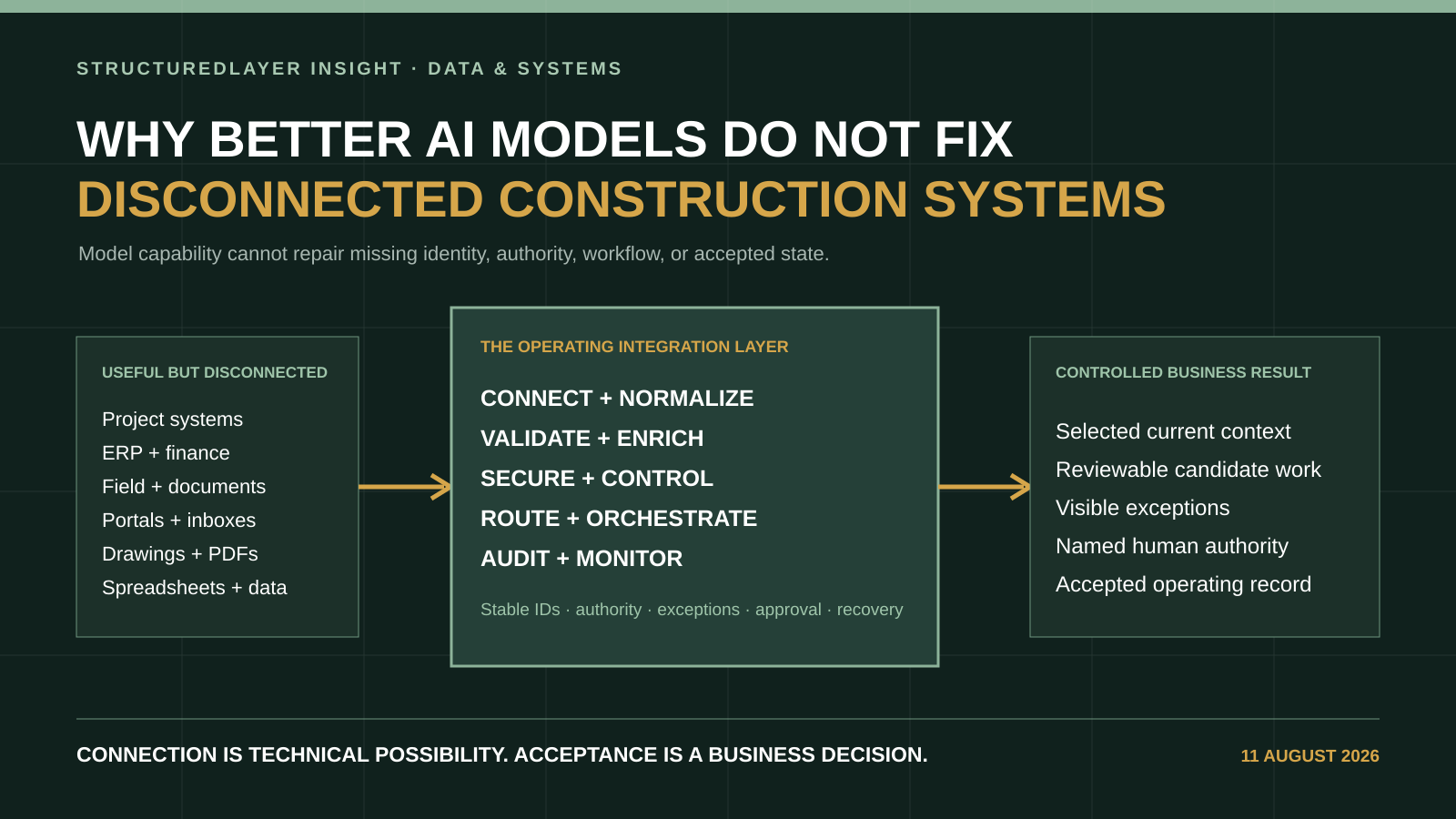
Construction and property teams often have capable tools for estimating, project delivery, accounting, document storage, email, and reporting. The difficulty appears between those tools. The same company, project, opportunity, document, deadline, and decision are represented differently in each place.
An operating layer addresses those relationships. It does not begin with a requirement to replace every existing platform. It begins by defining the records and workflow states that the business needs to recognise consistently.
What an operating layer contains
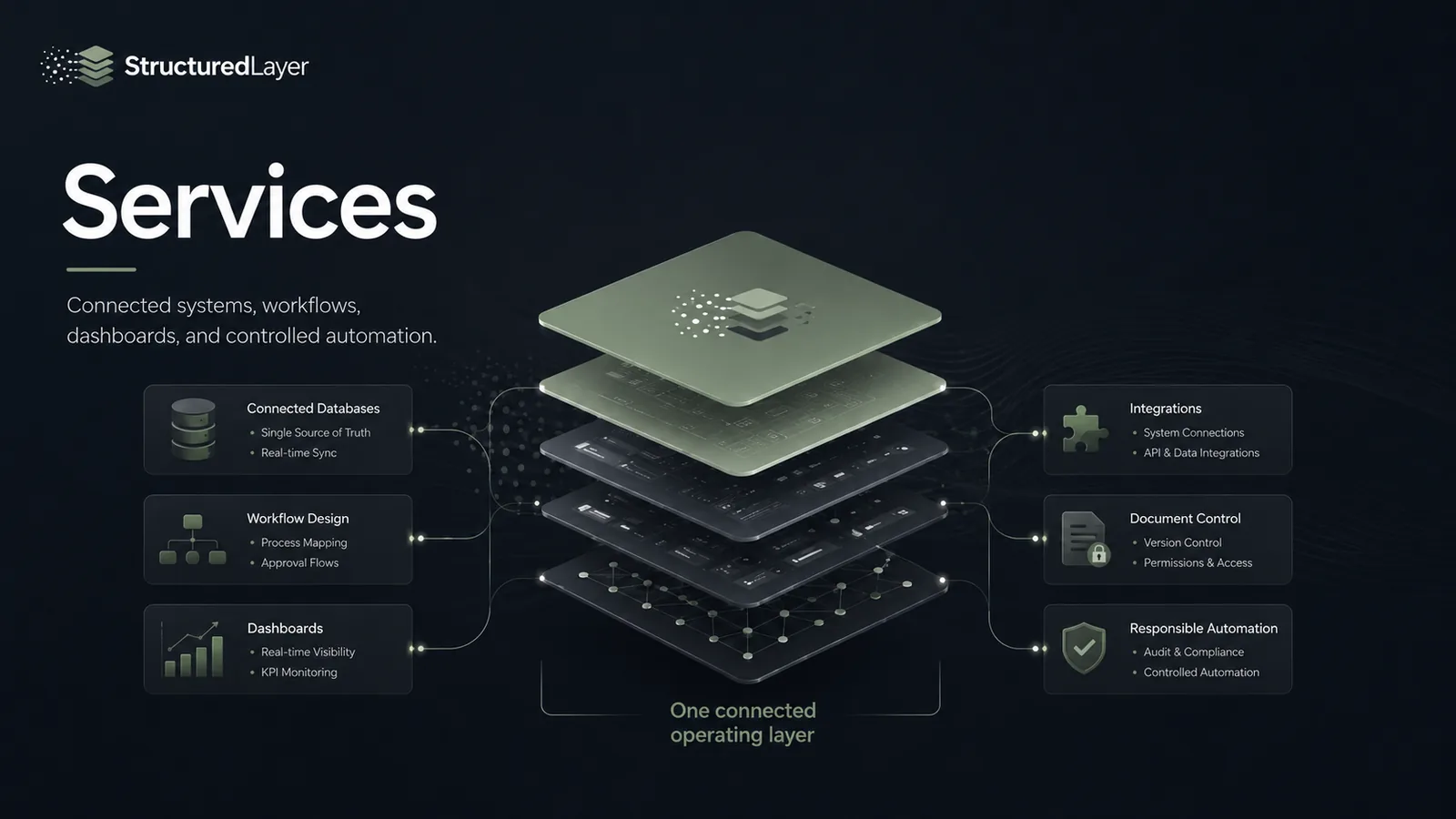
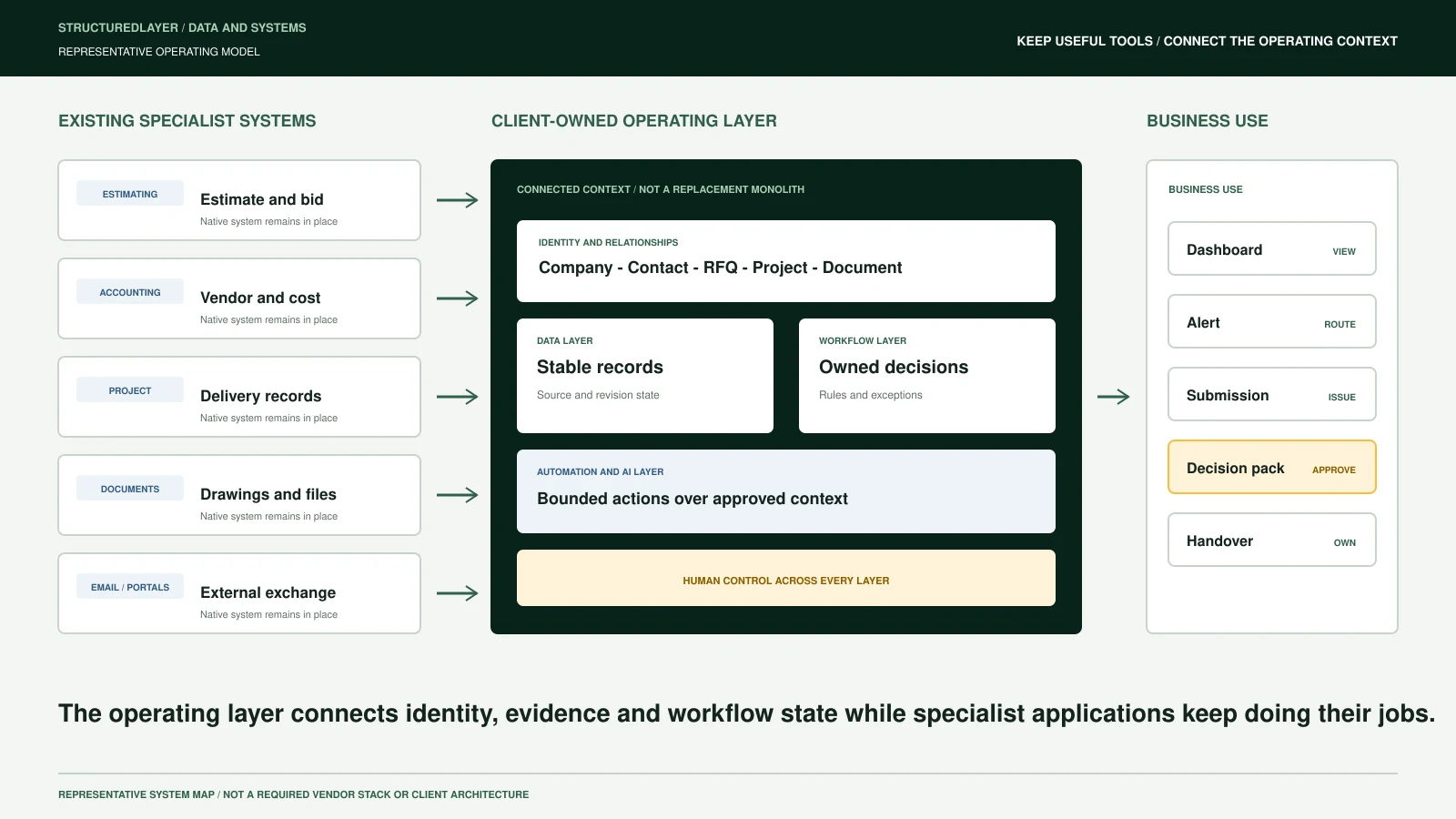
A dependable operating layer normally brings together five concerns:
- Connected records. Companies, contacts, opportunities, RFQs, projects, documents, estimates, activities, costs, and outcomes use durable identities and explicit relationships.
- Controlled workflows. Triggers, stages, owners, handoffs, deadlines, approvals, exceptions, and completion rules are represented as operating state.
- Supported connections. APIs, webhooks, databases, exports, inboxes, shared folders, and permitted browser workflows move information through defined boundaries.
- Inspectable reporting. Metrics follow approved definitions and can be traced to the records and events that produced them.
- Bounded assistance. Reminders, extraction, summaries, document preparation, and AI-supported retrieval operate inside permissions and human approval rules.
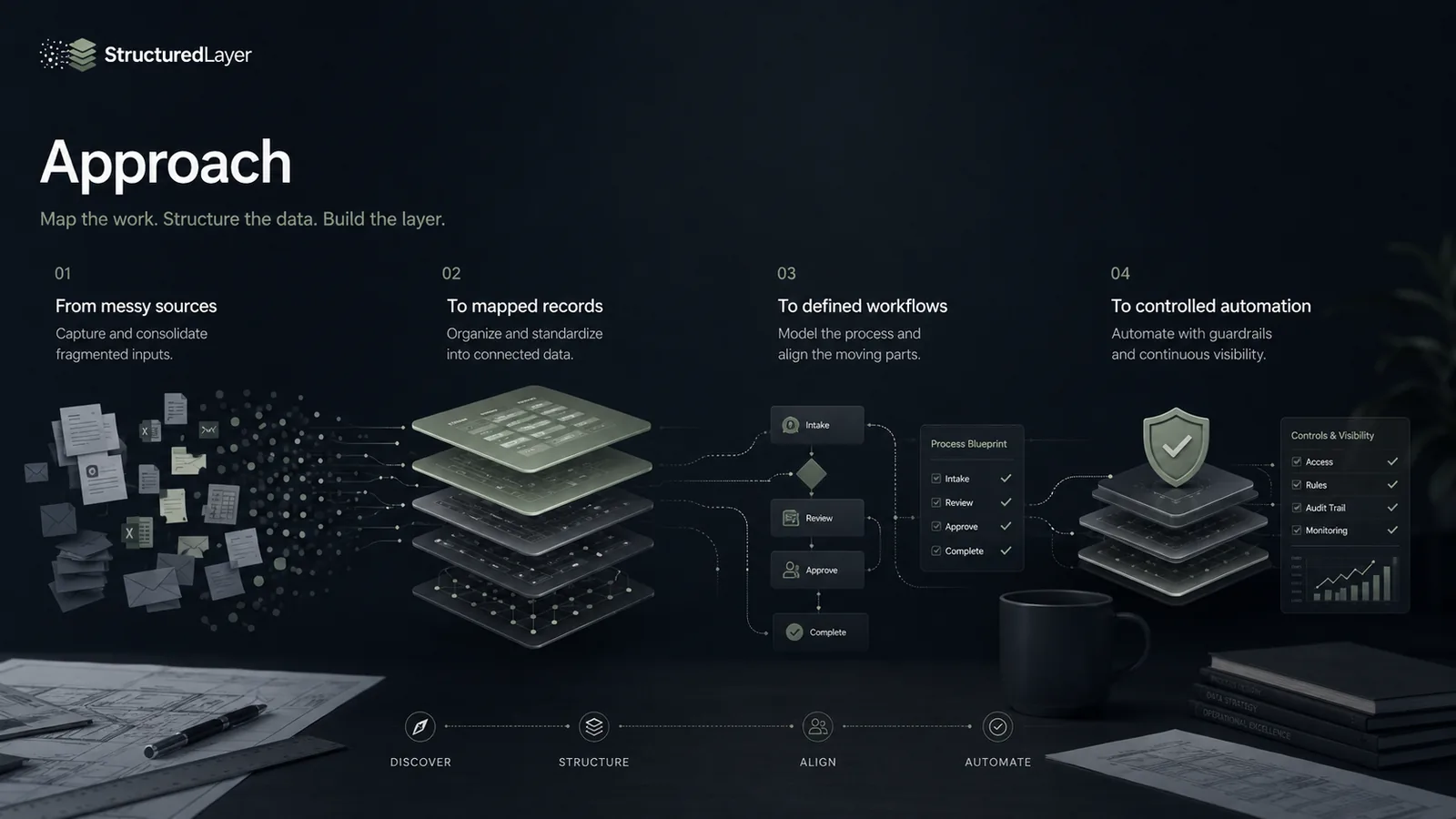
The order matters. Automation built before identity and ownership are clear usually creates faster inconsistency.
Start with one workflow
The first implementation should have a visible beginning, an accountable owner, a meaningful completion point, and enough repetition to justify structure. RFQ intake, estimating handoff, document control, subcontractor onboarding, and management reporting are common candidates.
Map the current path before selecting technology:
- Where does the work begin?
- Which records and documents are involved?
- Who owns each stage and exception?
- Which system controls each important value?
- What requires review or approval?
- How is completion demonstrated?
- Which measures should improve, and what is the current baseline?
This keeps the implementation focused on an operating result rather than a software catalogue.
Preserve useful specialist systems
Existing estimating, project, accounting, document, CRM, and communication tools can remain where they are useful and support the agreed controls. The operating layer can coordinate shared identity and workflow state without pretending one database should perform every specialist function.
A supported API or export is generally preferable to a fragile connection. When no supported interface exists, authorised inbox, folder, report, or browser-assisted methods may be considered with explicit monitoring and human review. Access controls, MFA, CAPTCHA, paywalls, and platform restrictions are not bypassed.
Airtable or Postgres is a requirements decision
Airtable can be appropriate for a bounded workflow that benefits from rapid configuration, collaborative interfaces, and client administration within its operating limits. Postgres can be appropriate for larger relational models, higher integration volume, stricter application boundaries, or custom software and reporting requirements.
The decision should follow scale, access, security, maintainability, ownership, integration, reporting, and cost requirements. Neither platform removes the need for a clear data model and operating owner.
Design the failure path
A reliable implementation makes uncertainty visible. Possible duplicates, conflicting dates, missing files, failed syncs, stale source records, and low-confidence extraction should enter a review queue instead of silently updating the source of truth.
The system also needs a disable procedure, monitoring ownership, recovery instructions, and a documented response when a vendor changes an API, export, authentication flow, or schema.
Handover is part of the architecture
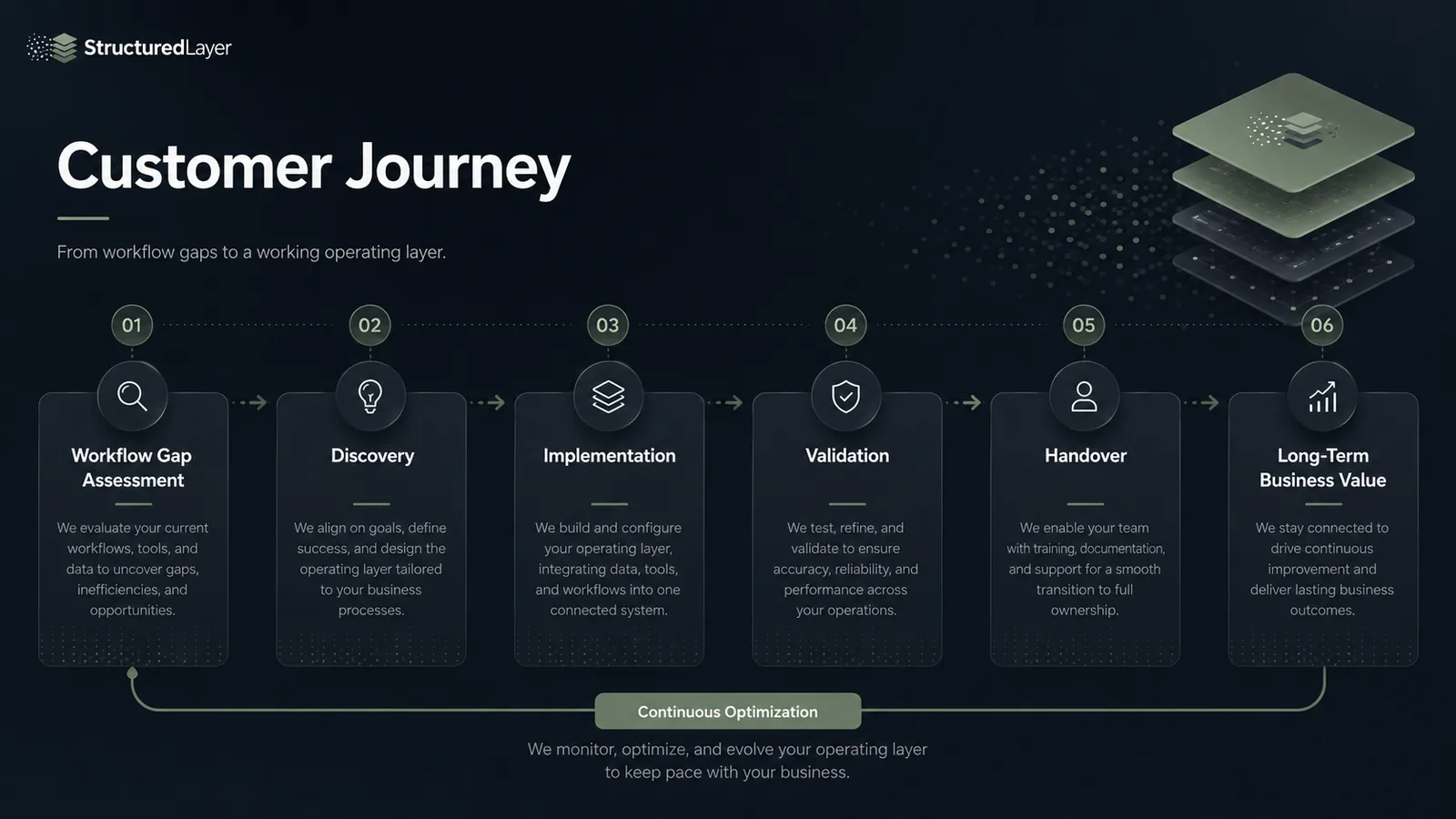
Client ownership is operational only when the client receives the accounts, data model, field definitions, workflow documentation, integration inventory, approval rules, known limitations, monitoring responsibilities, recovery procedures, and training required to run the system.
A successful handover should answer who maintains each source, mapping, automation, dashboard, permission, and exception queue after implementation access is removed.
A practical first step
Choose one workflow where disconnected information creates visible delay, rework, uncertainty, or reporting effort. Document the current records, sources, owners, approvals, exceptions, and baseline measures. That evidence will show whether the immediate requirement is a focused workflow implementation or a broader operating-layer implementation.