01
Conflicting bid deadlines
The portal, inbox, and spreadsheet show different dates.
For construction and project-based businesses
StructuredLayer is a construction workflow automation and implementation practice for general and specialty contractors. It connects disconnected records, documents, software, approvals, handoffs, and reporting into client-owned operating systems, then adds controlled automation and bounded AI where appropriate.
Free diagnostic. No passwords, credentials or system access required. You receive an initial readiness summary, and suitable submissions are reviewed by a person.
Prefer to talk? Book a Fit CallAlready need a ready-made workflow? Explore Aineed Data
Primary market and adjacent paths
General and specialty contractors are the first path.
Property development and field service remain available where the same project, document, evidence, handoff, and approval pressures apply. Every path begins with one controlled workflow, not a company-wide AI programme.
StructuredLayer introduction
StructuredLayer helps construction and property teams connect scattered records, documents, software and workflows into one reliable system.
Once the information is structured, your team can use dashboards, automation and controlled AI with clearer context, lower manual effort and human oversight.
Watch the introductionOperational consequences
The cost appears before it reaches a financial report.
It appears as missed deadlines, avoidable searching, incomplete decisions, weak handovers, delayed reporting, and work that has no visible owner.
The portal, inbox, and spreadsheet show different dates.
A revision arrives without a clear owner, acknowledgement, or downstream update.
Estimate assumptions and commercial decisions disappear when work becomes a project.
Teams manually reconcile spreadsheets, systems, and email because the numbers conflict.
People cannot identify which document version governs the current decision.
Important next actions remain open because no accountable owner is visible.
These are not simply software problems. They are operating-layer problems.
Start Free Workflow AssessmentStart by...
You do not need to follow every page or engagement stage. Use the entry point that matches what you already know, then move only as far as the next decision requires.
Choose how you want help with AI
Learn, decide, test, build, and improve are alternative routes inside the same construction and property operating model - not mandatory steps every buyer must purchase.
Three operating layers, one control principle, one result
First establish trusted business records. Then make ownership, decisions, and exceptions visible. Only then introduce controlled AI within approved boundaries.
Explore the complete approachTrusted foundation
Connected records, durable identities, source authority, revisions, history, and permissions.
Operating control
Defined stages, owners, handoffs, deadlines, approvals, exceptions, and operational measures.
Deterministic action + bounded assistance
APIs, authorized browser workflows, bounded agents, notifications, and reviewable assistance using approved context.
Control principle
Authority, approval, correction, pause, and accountability apply across the Data, Workflow, and Automation and AI layers.
Result
Dashboards, reports, alerts, submissions, decisions, and completed work remain traceable to the operating layers underneath.
Flagship workflow
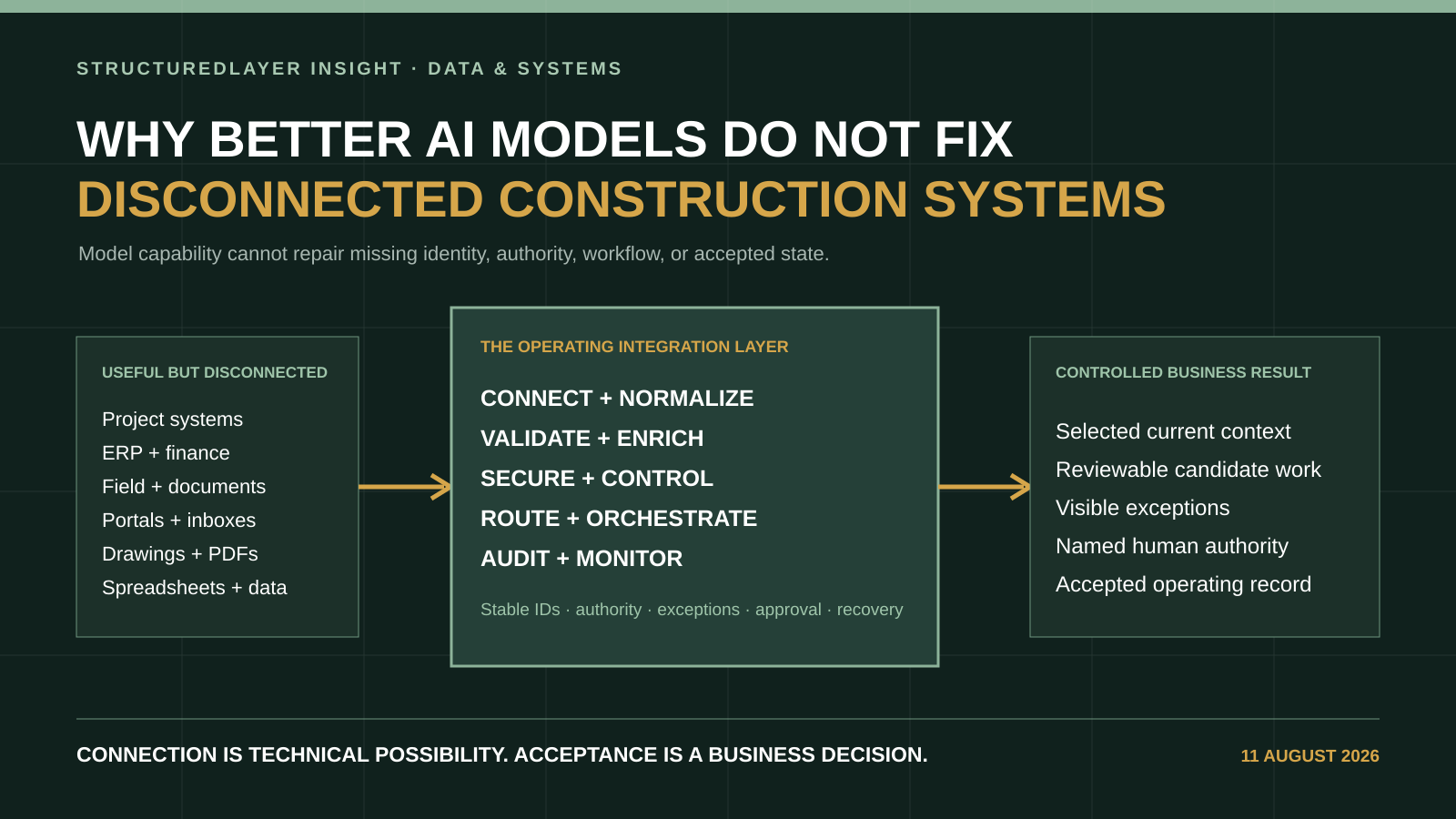
The issue is rarely a lack of software. It is the absence of a dependable layer between incoming information, the people doing the work, and the decisions that follow.
The same RFQ moves through a portal, inbox, tracker, drawing folder, and estimator memory. Each handoff can lose the current instruction, responsible owner, or next action.
Before
Every source can be individually correct while the business still lacks one current state.
After
RFQ-02418
Northbank Stage 2 · Concrete works
Source evidence stays connected while ownership, review state, and the next action become visible to the team.
Result
Qualitative design outcomes, not audited performance measures.
The operating layer does not replace the tender portal, inbox, tracker, or drawing environment. It gives them one shared business record and controlled decision path.
Explore the RFQ-to-bid workflowTwo more operating changes
Completed implementation evidence
Trust should follow an understandable operating transformation.
Review the safeguards, completed confidential engagement record, redacted processing evidence, validation boundaries, and client-owned handover path.
What the published scale represents
Processing and operating evidence, not audited financial outcomes or guaranteed future performance.
Choose the right starting point
The levels describe increasing implementation depth. They are not mandatory sequential purchases: begin where the task, systems, information, authority, and desired outcome can be bounded responsibly.
Free
A diagnostic entry point that identifies workflow gaps without requiring deep system credentials and provides an initial readiness summary.
Usually 15-20 minutes; detailed submissions may take up to 30 minutes
$3,500 fixed
Map the current state, target architecture, data inventory, workflow controls, implementation boundary, and fixed implementation quote. The completed Blueprint belongs to the client.
Approximately 10 business days · an agreed portion may be credited if StructuredLayer completes the implementation
$6,500–$12,500
Configure one bounded AI task with limited context to test viability, cost, failure rates, and human-review requirements.
Typical duration: 2-4 weeks
Review this level$9,500–$17,500
Deploy one fully controlled production workflow across approximately three core systems with dashboards, training, documentation, and client-owned handover.
Scoped via Blueprint
$30,000–$75,000+
Deliver a phased implementation connecting two to five workflows, shared records, reporting, and bounded AI across multiple business departments.
Scoped via Blueprint
Detailed scope, timing, price guidance, credit conditions, payment stages, and exclusions are presented once in the pricing section below.
Review detailed pricingHow engagement works
Assessment → Discovery → Blueprint → Build → Validate → Handover → Stabilize. Detail, access, and commitment increase only after the previous boundary is reviewed and agreed.
Identify the workflow and operating gaps worth investigating.
ExploreConfirm owners, records, systems, restrictions, and representative cases.
ExploreMap current state, target controls, systems, and implementation boundary.
ExploreConfigure the records, workflow, interfaces, integrations, and reporting.
ExploreProve normal work, exceptions, permissions, failure, and recovery with real cases.
ExploreTransfer access, documentation, training, ownership, and change control.
ExploreResolve open items, monitor operation, and transfer ongoing change control.
ExploreEngagement fit
StructuredLayer works best when there is a real workflow to improve, a person accountable for the result, representative evidence to test, and a team prepared to operate what is handed over.
A recurring operating path with visible delay, rework, uncertainty, or missed ownership.
A person who can explain the work, make decisions, approve access, and accept the result.
Representative records, documents, cases, and exceptions that reflect how work actually happens.
A team prepared to review, test, train, adopt, and own the completed capability.
Strong fit signals
06 checksPause and clarify first
06 checksInternational delivery
Locations describe team representation, not office claims. Engagements remain coordinated through StructuredLayer with agreed access and communication boundaries.
Inspect what a client receives
These representative RFQ-to-bid samples show deliverable structure without exposing confidential client systems, records, or results.
Detailed pricing
Start with a free diagnostic, use a paid Blueprint when the wider operating problem requires formal design, or use a Bounded AI Agent Pilot when one contained AI task can be evaluated independently. Production implementation begins only after scope, responsibilities, access, risks, acceptance measures, and commercial terms are agreed.
These are different commercial paths, not mandatory sequential purchases. The appropriate starting point depends on how clearly the task, systems, information, authority, and desired outcome can be bounded.
Usually 15-20 minutes; detailed submissions may take up to 30 minutes
A diagnostic entry point that identifies workflow gaps without requiring deep system credentials and provides an initial readiness summary.
Review the Workflow AssessmentApproximately 10 business days · an agreed portion may be credited if StructuredLayer completes the implementation
Map the current state, target architecture, data inventory, workflow controls, implementation boundary, and fixed implementation quote. The completed Blueprint belongs to the client.
Review the Operating-Layer BlueprintTypical duration: 2-4 weeks
Configure one bounded AI task with limited context to test viability, cost, failure rates, and human-review requirements.
The pilot is not a production deployment. It provides a working pilot, evaluation evidence, identified limitations, human-review requirements, and a recommendation to proceed, revise, or stop.
Review the AI Agent PilotScoped via Blueprint
Deploy one fully controlled production workflow across approximately three core systems with dashboards, training, documentation, and client-owned handover.
Review Single Workflow ImplementationScoped via Blueprint
Deliver a phased implementation connecting two to five workflows, shared records, reporting, and bounded AI across multiple business departments.
Review the Complete Operating Layer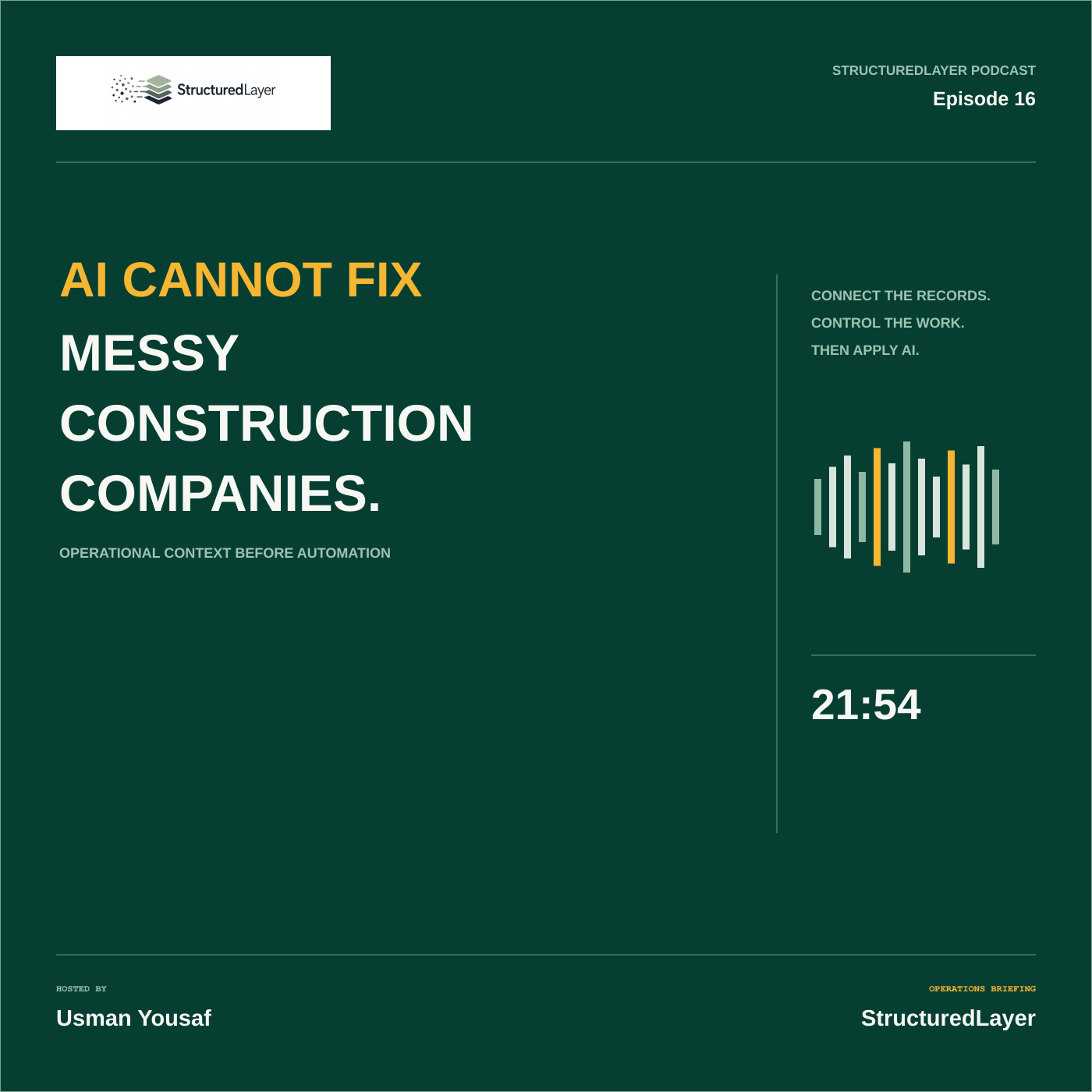
Continue your evaluation · Podcast episode 16
Ten August 2026 construction and property signals show why new AI tools cannot repair fragmented records, unclear workflow state, missing approvals, or weak operational ownership.
Listen to episode 16
AI Cannot Fix Messy Construction Companies
21:54
Continue your evaluation · AI Technology Briefs
Source-grounded reviews of what changed, what was verified, what implementation requires, and what must remain controlled.
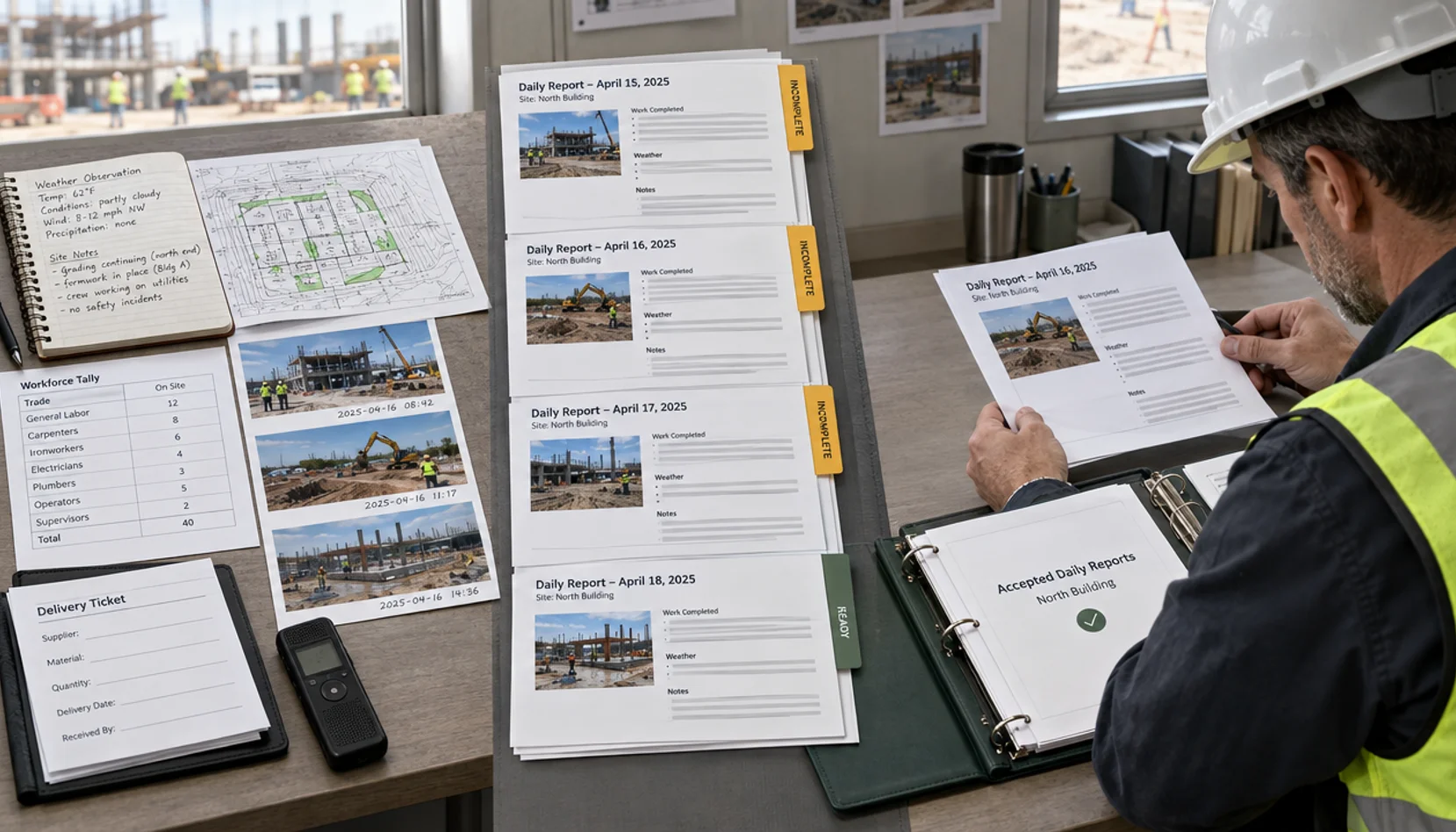
AI Technology Brief · 19 min read
Eight copyable prompts, a fictional worked example, field evidence, difficult-case tests and an accepted-record workflow for daily logs. AI prepares candidates; the superintendent verifies and accepts the site record.
Read the brief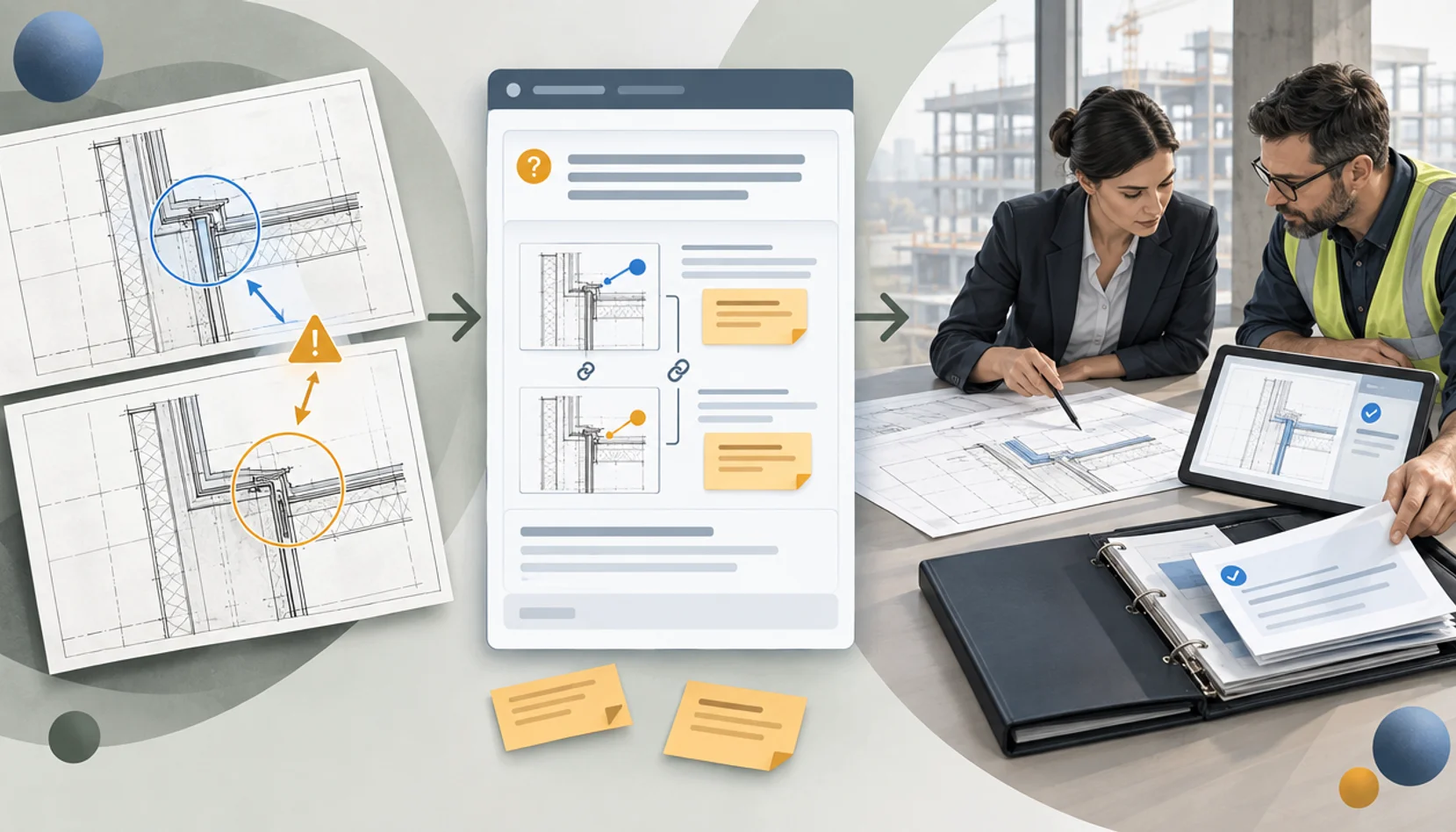
AI Technology Brief · 19 min read
Eight copyable prompts, a fictional drawing-conflict example, revision checks, official response controls and a governed RFI workflow. AI prepares questions; qualified parties decide, issue and respond.
Read the briefContinue your evaluation · Latest insights
Detailed guidance on construction workflows, connected records, systems, governance, reporting, and controlled AI readiness.
Common buyer questions
The complete FAQ covers services, assessments, AI, security, pricing, ownership, implementation, and handover.
Read the complete FAQAccess is defined after the workflow and architecture are understood. It may use client-owned accounts, least-privilege permissions, approved domains, dedicated implementation identities, credential vaults, access logs, and removal of temporary access during handover. Never submit passwords, API keys, MFA codes, or unrestricted access through a public form.
Commercial commitments, pricing, bid submission, contracts, payments, deletion, safety, employment, compliance, and external publication remain subject to defined validation and approval rules. Each implementation states what AI may read, draft, update, and never perform independently.
Potentially. StructuredLayer evaluates supported APIs, webhooks, exports, reports, inboxes, and file transfers first. Where those are insufficient and access is authorized, a bounded browser workflow may be considered with allowlisted actions, validation, checkpoints, exception handling, and human takeover.
Not automatically. Useful estimating, project, accounting, document, CRM, and communication systems can remain in place while a connected operating layer gives their records, documents, owners, approvals, and exceptions dependable relationships.
The engagement is designed for client ownership of core accounts, records, configurations, editable documentation, administration, and operating access wherever practical. Access can be revoked after delivery, and future providers can work from the documented architecture.
The agreed stabilization period addresses open items, monitors operation, completes training, confirms ownership, and transfers ongoing monitoring, recovery, administration, and change control to the named client owners.
Start with one inspectable problem
Show where the work starts, which systems and documents it crosses, who decides what happens next, and where delay, rework, or uncertainty appears. No passwords, credentials, or unrestricted confidential information are required.