
1. Data Layer
The records, identifiers, relationships, sources, permissions and update rules that preserve business context.
StructuredLayer Glossary
Plain-language definitions for construction, property, AEC and operational teams evaluating structured data, connected workflows, system integration and controlled AI.
You do not need to become a data engineer to improve your business. However, understanding a few important terms will help your team evaluate opportunities, ask better questions and avoid buying disconnected technology.
Why these terms matter
Businesses often begin with a tool: an AI assistant, automation platform, chatbot or reporting product.
The real work usually begins underneath that tool.
The system needs to understand what a company, contact, project, document, estimate, approval or status represents. It must know which record is current, who owns it, where it came from and what actions are permitted.
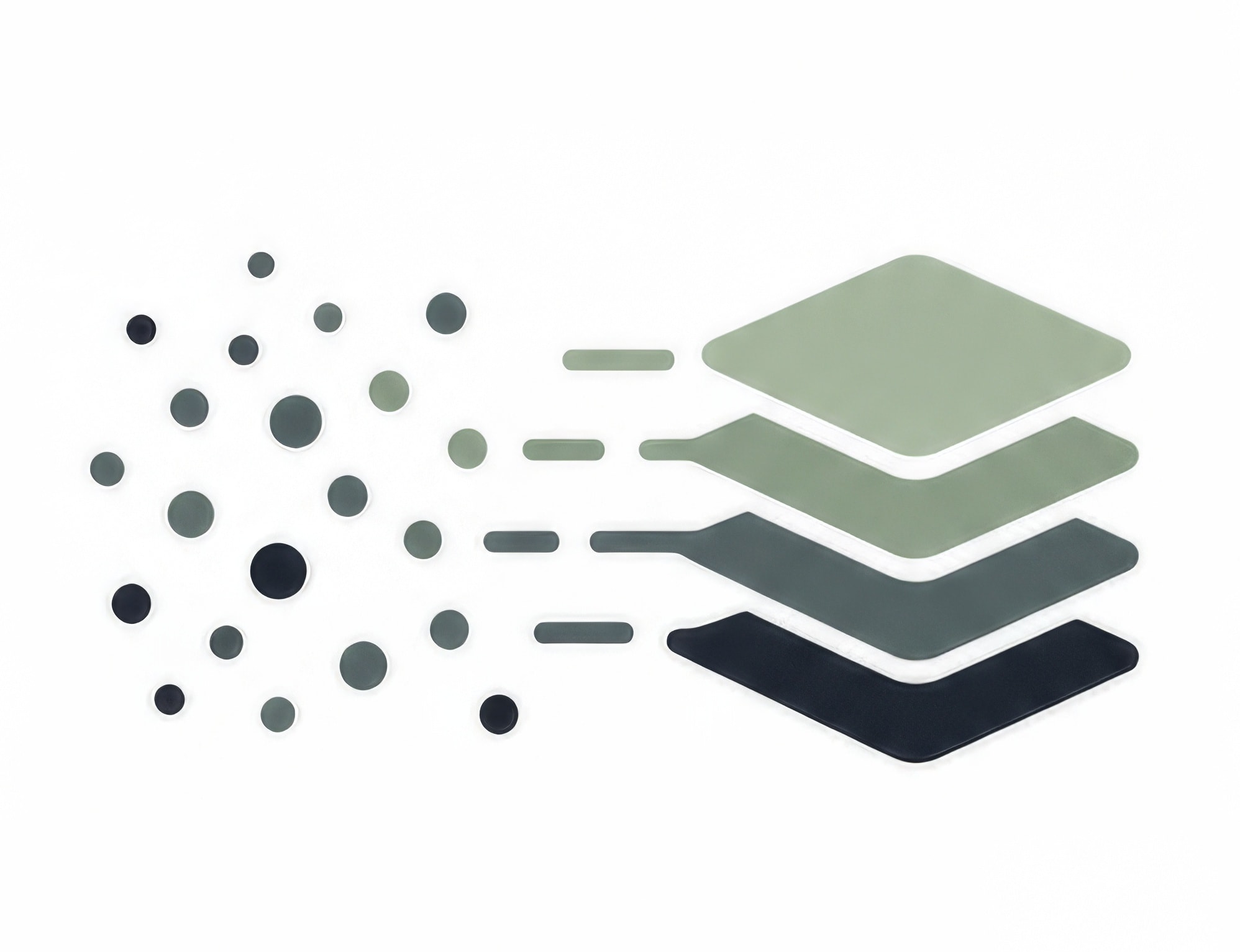
StructuredLayer describes this foundation through three connected layers:
The records, identifiers, relationships, sources, permissions and update rules that preserve business context.
The triggers, handoffs, approvals, responsibilities, exceptions and business rules that determine how work progresses.
The controlled tools that retrieve information, draft outputs, monitor conditions or perform approved actions using the first two layers.
Human oversight, access control and auditability apply across every layer.
Foundational terms
Definitions for the business environment, the StructuredLayer model and the recurring cost of fragmented operations.
Architecture, Engineering and Construction.
AEC describes the organizations involved in designing, engineering, constructing and operating the built environment. These projects frequently involve owners, consultants, contractors, subcontractors, suppliers and regulators using separate systems.
Example: An architect may store drawings in one platform while the contractor tracks RFIs elsewhere and the owner maintains commercial records in spreadsheets.
An implementation company that helps businesses create client-owned data layers, controlled workflows, integrations and AI-ready operating systems.
StructuredLayer does not require every client to replace its existing software. The objective is to make the important information, relationships and processes understandable across the systems the business already uses.
The connected structure between a company’s existing software and the people, reports, automations and AI systems that need to use its information.
An operating layer may use one database or several governed systems connected through stable identifiers and clear update rules.
A StructuredLayer framework consisting of:
The model reflects a practical principle: reliable automation requires controlled workflows, and controlled workflows require reliable business data.
The recurring cost created by fragmented information and unclear processes.
It can appear as duplicate data entry, missed follow-ups, delayed approvals, manual reporting, incorrect document versions or time spent searching for information.
The additional effort required to coordinate responsibilities, dependencies and information across people, departments and external partners.
As projects and teams grow, coordination overhead can increase faster than headcount unless records, ownership and handoffs are clearly defined.
The smallest appropriate way to begin an engagement based on how clearly the workflow, records, systems, authority and implementation boundary are already understood.
StructuredLayer's Assessment, Operating-Layer Blueprint, Bounded AI Agent Pilot, Workflow Implementation and Operating-Layer Implementation are alternative starting points, not mandatory sequential purchases.
The transfer of agreed records, configuration, documentation, permissions, validation rules, runbooks, training materials, open issues and operating responsibility to the client environment or another approved ownership structure.
The signed scope defines the exact boundary for hosting, licences, source code, accounts, third-party services and continuing maintenance.
A defined period after accepted implementation in which defects against the approved scope are corrected and operating responsibility is confirmed.
New features, additional systems, changed business rules, expanded data, vendor changes and ongoing administration are separate improvement work rather than stabilization defects.
Data terms
Definitions for identity, authority, relationships, provenance, structure and controlled collection.
The structured foundation that defines business records, relationships, identifiers, sources, ownership, permissions and update rules.
Example: A project record may connect to its client, contacts, RFQs, documents, estimates, bid status, responsible estimator and source portal.
A business record that is linked to the other records required to understand its context.
A document becomes more useful when it is connected to its project, version, owner, approval status and original source.
A stable ID used to distinguish and connect a record across systems.
Names and filenames can change. A durable project, company or document ID helps integrations recognize that two records refer to the same business entity.
The approved system responsible for maintaining a particular category of information.
A company may use its CRM as the system of record for contacts, its project platform for delivery information and its accounting system for financial transactions.
The approved location or rule used to determine which value should be trusted for a particular decision.
A business does not necessarily need one database for everything. It needs defined authority for each important field and a reliable way to reconcile conflicts.
A record of where information came from and how it changed.
Provenance may include a source URL, portal name, email message, uploaded document, extraction date, reviewer and transformation history.
Information that describes another record or file.
For a contract, metadata could include project ID, document type, version, effective date, counterparty, status, confidentiality level and source link.
The defined structure of a database or dataset.
A schema specifies record types, fields, relationships, accepted values and constraints. It helps people, integrations and AI systems interpret information consistently.
The process of determining whether multiple records refer to the same company, person, property, project or document.
Example: “ABC Construction,” “ABC Construction LLC” and “ABC Const.” may need to be matched to one governed company record.
The controlled process of collecting information from emails, files, APIs, portals, spreadsheets or other sources and placing it into a structured system.
Ingestion should include validation, duplicate detection, source tracking and exception handling.
A governed representation of people, organizations, projects, assets, documents, decisions and workflow events using stable identifiers and defined relationships.
The implementation may use relational databases, document databases, search indexes, vector stores, knowledge graphs, existing platforms or an approved combination. The record model and source authority come before the technology choice.
Workflow and integration terms
Definitions for triggers, deterministic processing, system connections, exceptions and operating evidence.
The layer that defines how work moves between records, people and systems.
It includes triggers, ownership, stages, due dates, approvals, handoffs, business rules and exception paths.
An event that starts or advances a workflow.
Examples include receiving an RFQ email, detecting a new portal listing, approving an estimate or uploading a revised drawing.
A fixed instruction that produces a predictable result when defined conditions are met.
Deterministic rules are often more appropriate than AI when the decision must remain consistent.
Example: If a bid deadline is fewer than three business days away, assign high priority and notify the estimating manager.
An application programming interface that allows approved software systems to exchange information through defined requests.
APIs are usually the preferred integration method when they provide the required data, permissions and reliability.
An automated notification sent by one system when a specific event occurs.
For example, a CRM may send a webhook when an opportunity changes stage, allowing another workflow to update a dashboard or create a review task.
A controlled workflow that interacts with an authorized website or portal through its user interface when a suitable API is unavailable.
Browser automation requires permission, monitoring, failure handling and careful treatment of credentials and platform rules.
A review area for records that could not be processed confidently or safely.
Examples include missing project IDs, conflicting dates, inaccessible documents, duplicate companies or unclear classifications.
A dated record of actions, changes and approvals within a system.
An audit trail can show who changed a status, which source was used, what automation ran and who approved the final action.
An inspectable record of one workflow or agent run, including its business purpose, trigger, responsible owner, input record IDs, sources, tools, instructions, timestamps, outputs, validation, corrections, approval, failures, retries, cost and final disposition.
An operating record allows the business to understand what happened and keeps accepted history outside a temporary model or automation provider.
The agreed conditions used to decide whether a deliverable, workflow, pilot or release is acceptable.
Criteria may cover expected outputs, difficult cases, permissions, failure behavior, review effort, timing, reconciliation, recovery, cost and critical failures that prevent release.
The approved limit for live systems, data, users, actions, monitoring, ownership and responsibility after testing.
A successful demonstration or pilot does not automatically authorize wider production use. Continuing operation requires a separately accepted scope when the live boundary differs from the test.
AI and governance terms
Definitions for bounded AI, retrieval, evidence, model choice, confidence, human authority and access control.
The layer that uses structured records and workflow rules to support retrieval, drafting, classification, monitoring and approved actions.
AI is treated as a reasoning capability within a controlled operating system, not as the system of record.
Often abbreviated to LLM.
A model trained on large collections of content to interpret and generate language and, in some cases, images or structured output.
An LLM can prepare a candidate answer, classification, summary, draft or extraction. It does not independently establish that a source is current, a fact is correct, a record is authoritative, or an action is permitted.
An AI-enabled process restricted by defined context, tools, permissions and action limits.
Bounding an agent does not eliminate errors. It reduces the information and actions available to the agent and limits the potential impact of an incorrect decision.
The evidence and business context required for a system to explain what it knows and why.
Grounding may include source documents, record relationships, approved definitions, dates, permissions and citations.
A method commonly called RAG that retrieves relevant information before asking an AI model to prepare an answer.
A reliable retrieval system should consider relevance, freshness, permissions, source authority and document version.
Often abbreviated to MCP.
A standard way for an AI application to discover and call defined tools or retrieve approved resources from an external system.
MCP can standardize a connection. It does not replace source-system permissions, server-side validation, workflow controls, or accountable approval for a business action.
Operating instructions supplied to a model before or alongside a task. They can describe role, scope, output format, limits, and how the model should respond to missing evidence.
A system prompt can guide model behaviour, but it is not access control. Permissions, tool limits, validation, approvals, and recovery must be enforced outside the model.
An attempt in a user message, email, document, website, tool response, or other untrusted content to redirect a model or provoke unsafe retrieval, disclosure, or tool use.
Treat external content as evidence, not instructions. Reduce exposure with bounded tools, external authorization, validation, testing, logging, and human approval for consequential actions.
A system used to store and search numerical representations of content based on meaning.
Vector search can help find related information when the wording differs, but it should usually be combined with metadata, business filters and access rules.
The process of selecting an appropriate AI model for a particular task.
A business may use different approved models for extraction, classification, research or complex reasoning while keeping its authoritative records outside the model provider.
A model benchmark measures performance on a defined test set under stated conditions. It can identify capabilities worth investigating, but it does not prove that a model will work reliably, safely, or economically in a specific business workflow.
A workflow evaluation tests representative records, sources, permissions, tools, exceptions, human review, critical failures, latency, and complete cost per accepted business outcome.
An indicator of how strongly a system supports a classification, extraction or recommendation.
A confidence score is not proof of correctness. It should be combined with validation rules, source evidence and human review thresholds.
A control in which a person reviews, corrects or approves an automated output.
Human review is especially important where an action affects money, contracts, safety, employment, compliance, external communication or access rights.
A specific point where a workflow cannot continue until an authorized person approves the proposed action.
Example: AI may draft a bid response, but an estimator or commercial manager must approve it before submission.
The practice of giving each person, integration or agent only the access required for its approved responsibility.
An extraction workflow may need permission to read portal listings but not permission to modify account settings or submit bids.
A controlled commercial test of one defined AI-assisted business task using a named owner, narrow approved context, limited tools or sources, representative cases, human review, visible cost and reliability evidence, and a documented next-step recommendation.
A pilot is not a general production commitment. The evidence may support a separately approved implementation, a narrower assistive role, additional preparation, or a decision not to proceed.
The retrieval of approved information with visible record, document, page, section or source references so a reviewer can inspect the basis of an answer.
A dependable implementation considers identity, revisions, freshness, permissions, source authority, conflicts, missing information and uncertainty before presenting retrieved context.
The coordination of approved models, APIs, browser tools, coding tools, deterministic rules, validation, storage and human approvals without making one provider the permanent source of truth.
Provider selection follows task suitability, evidence, data terms, region, security, latency, availability, format, review effort, cost and client approval.
Review by a person with the authority and appropriate professional competence for the consequential decision being considered.
AI may prepare, retrieve, compare, generate or flag information, but it does not replace required architectural, engineering, estimating, fabrication, safety, legal, planning or compliance judgement.
AEC and evidence terms
Definitions for controlled AEC assistance and the evidence classifications used across the public website.
The controlled identification and organization of information contained in approved PDF drawings, schedules, specifications and model exports.
Possible tasks include sheet classification, title and revision capture, selected symbol or tag detection, source coordinates, version comparison and review routing. Measurements and quantities remain subject to source quality, scale, validation and qualified judgement.
The controlled classification, extraction, identity, revision, metadata and permission-aware retrieval of information from approved documents.
Useful outputs preserve source references and expose missing, conflicting, superseded or low-confidence information instead of presenting unsupported answers.
A controlled path connecting an approved enquiry, requirements, drawings, product rules, design decisions, commercial records and manufacturing handoffs.
The workflow may prepare structured review packages, schedules, bills of materials or production information, but authorized technical reviewers retain responsibility before fabrication information is released.
The use of approved project requirements, parameters, models, scripts and constraints to prepare controlled design alternatives and reviewable outputs.
Generated options remain design-assistance outputs. Qualified professionals retain responsibility for final design, calculations, coordination, compliance and release.
The generation and comparison of preliminary spatial options using explicit boundaries, areas, adjacencies, access requirements, exclusion zones, constraints and project-defined comparison measures.
The output supports early review. It does not replace surveys, planning advice, architecture, engineering, accessibility, fire and life-safety analysis or regulatory approval.
Evidence from completed implementation work that may be described publicly only within an authorized confidentiality boundary.
Client identity, credentials, portal names, production configuration, volume, duration, financial results or other details remain undisclosed unless publication is explicitly authorized.
Approved portfolio evidence from completed work with sensitive identities, configurations and commercial information removed or generalized.
Broader portfolio figures must not be presented as the undisclosed production volume or outcome of a separate confidential engagement.
A recreated operating situation used to demonstrate how records, systems, workflows, exceptions, approvals and reporting could work together.
A representative scenario is not a completed client engagement and does not claim a client result, production deployment or guaranteed future performance.
A public demonstration of a possible interface, data structure, queue, dashboard, agent activity view or operating pattern.
It is capability evidence rather than completed client evidence unless it is individually and explicitly classified as authorized implementation work.
Workflow example
A connected operating path from opportunity intake through bid decision and submission outcome.
A controlled RFQ-to-bid workflow may include:
AI may assist with extraction, summaries, document comparison and drafting. The workflow rules, records and approval responsibilities remain controlled by the business.
Frequently asked questions
Structured business data organizes information into defined records and fields. Instead of leaving a project buried inside emails and folders, the business maintains a project record with an ID, client, location, status, owner, deadlines, documents and source links.
No. Some companies benefit from a central database, while others should retain several specialized systems. The important requirement is clear ownership, durable identifiers, governed relationships and defined synchronization rules.
StructuredLayer is an implementation company, not a single software product. The recommended architecture depends on the client’s existing systems, requirements, permissions and ownership preferences.
Traditional automation follows predefined conditions. An AI agent can interpret less predictable information and select from approved tools or actions. Many reliable systems combine deterministic automation with narrowly bounded AI assistance.
Sometimes. Authorized exports, inbox rules, scheduled files, database connections or controlled browser workflows may be considered. The method depends on platform terms, client authorization, security and operational reliability.
Not by default. Most implementations use approved models to process selected context without creating a custom trained model. Data handling requirements must be agreed before implementation.
Contractual submissions, financial commitments, external messages, access changes, safety decisions, personnel actions and destructive record changes should normally have explicit authorization controls.
The intended approach is client ownership. The implementation should be built in agreed client-controlled environments with documentation, training and defined handover responsibilities.
Begin with one workflow that creates repeated delay, manual work, missing information or unreliable reporting. Map its records, systems, owners, decisions and exceptions before selecting automation.
A pilot is a bounded test with limited context, tools, representative cases, human review and acceptance evidence. Production use has a separate live boundary covering systems, users, permissions, monitoring, recovery, ownership and continuing responsibility. A successful pilot does not authorize production automatically.
The website distinguishes completed confidential implementation evidence, selected redacted implementation work, representative scenarios and public interface examples. Each classification limits what can be inferred about client identity, production use, operating volume, outcomes and future performance.
Related resources
Understand what business information AI needs before it can produce reliable answers.
Separate generative AI, deterministic automation, governed workflows, bounded agents and accountable approval.
Test representative outcomes, critical failures, reviewer effort and complete cost before expanding an AI workflow.
Select models and coding agents by the task, operating boundary, evidence, cost and human release authority.
See how structured data, controlled workflows and human oversight support AI at scale.
Learn how companies, contacts, projects, documents and communications connect.
Explore APIs, webhooks, exports, browser workflows and integration controls.
Inspect representative operating workflows for construction, property and AEC teams.
Review controlled drawing, document, connected-knowledge, fabrication, parametric-design and layout-generation guidance.
Understand completed confidential, selected redacted, representative and public-example evidence boundaries.
See delivery models, shared responsibilities, ownership, handover and alternative commercial starting points.
Your next useful step
Describe one important workflow, the systems involved, where information is stored and what your team is currently doing manually.
StructuredLayer will use the information to identify the records, relationships, controls and implementation questions that should be examined next.
Do not submit passwords, API keys, authentication codes or unrestricted system access through the assessment.