The short answer
Improve WIP reporting across disconnected construction systems by aligning project and cost-code identities, defining each metric and reporting cutoff, preserving source authority, reconciling differences, assigning commentary to accountable owners, and issuing an approved version that can be reproduced later.
A dashboard does not resolve disagreement by itself. If budget, commitments, actuals, forecast, billing, progress, and approved changes come from different systems or dates, the report must show those differences as controlled exceptions rather than hiding them behind a single chart.
Accounting policy, contract treatment, revenue recognition, tax, audit, and jurisdiction-specific requirements remain under qualified financial and professional authority. The workflow described here concerns data control, reconciliation, review, and reporting operations.
Why disconnected reports disagree
Construction reporting brings together records created for different purposes. Accounting systems preserve posted transactions. Procurement systems track commitments and purchase orders. Project systems record progress, change events, and operational forecasts. Spreadsheets may hold management adjustments or commentary. Billing systems may use another period or project structure.
Two reports can both be internally consistent and still present different project health because they use different:
- Project and contract identities
- Cost-code structures and mapping rules
- Reporting periods and cutoff dates
- Budget and approved-change versions
- Commitment and accrual treatment
- Forecast and estimate-at-completion logic
- Billing and earned-progress sources
- Currency, tax, or consolidation rules
- Refresh times and missing-record behavior
The first requirement is not a new visualization. It is an explicit reporting contract for what each measure means.
Define the reporting grain
Decide the level at which records will reconcile. Depending on the organization, the grain may be project, contract, entity, cost code, work package, period, or a controlled combination.
Every source record should map to that grain without losing its native identifier. A project called "North Hub" in one system and "P-0241" in another needs an approved relationship, not a text match repeated inside every report.
Unmatched projects, duplicate mappings, retired codes, and one-to-many relationships should remain visible until resolved. Silent fallback to a similar name can place financial information against the wrong project.
Approve metric definitions
A governed metric needs more than a label. Record its formula, inclusions, exclusions, period basis, source authority, unit, currency, owner, approval, and version.
For example, "committed cost" may or may not include unapproved purchase orders, subcontracts in draft, taxes, expected changes, or manual accruals. "Forecast margin" depends on which budget, approved changes, actuals, commitments, and remaining-cost forecast are included.
The specific accounting treatment belongs to qualified financial owners. The operating layer should ensure the approved definition is applied consistently and can be inspected.
Control period and source freshness
Every issued report should identify:
- Reporting period and cutoff
- Source refresh time for each system
- Budget and forecast version
- Currency and consolidation basis where relevant
- Missing or late source state
- Person responsible for review
- Approval and issue timestamp
A late accounting refresh or incomplete project forecast should not disappear because the rest of the dashboard loaded successfully. Freshness is part of the report, not a technical footnote.
Reconcile before explaining
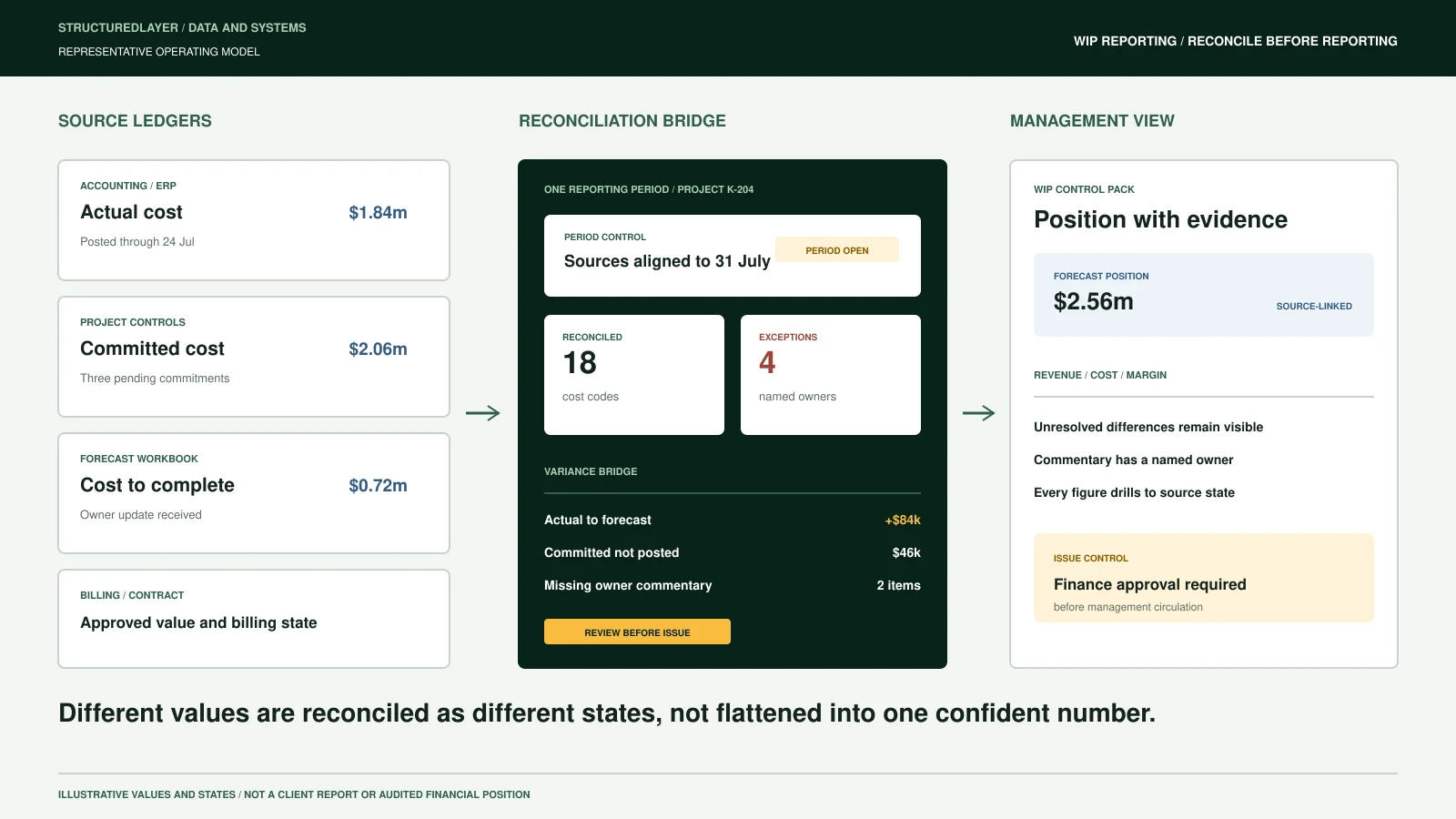
Reconciliation compares the governed records before management commentary is added. The workflow can check:
- Project and cost-code coverage across sources
- Opening and closing balances where applicable
- Budget plus approved changes
- Commitments against procurement records
- Actuals and accruals against accounting authority
- Forecast against the approved project submission
- Billing and cash against the relevant source
- Current report against the previously issued version
Differences should create exception records with the compared values, sources, period, materiality rule, owner, status, and resolution. Commentary should explain a difference or action; it should not change source financial values.
Make exceptions the centre of review
A useful WIP process directs attention to material financial, operational, and data-quality exceptions. Examples can include:
- Missing project or invalid cost-code mapping
- Unapproved budget or change included in a forecast
- Commitment without a matching project record
- Actual cost loaded after the reporting cutoff
- Forecast not refreshed by the accountable project owner
- Billing or progress inconsistent with the approved source
- Material margin movement without explanation
- Stale source, duplicate row, or partial import
Thresholds and materiality rules should be approved for the organization. A system can identify records that meet those rules; it does not determine accounting significance independently.
Structure commentary and action
Management commentary is more useful when it is connected to a specific governed metric or exception. Capture:
- The observation being explained
- Source values and reporting period
- Cause category where approved
- Corrective action or decision required
- Accountable owner and due date
- Reviewer and approval state
- Relationship to prior commentary
Free text can remain, but it should not be the only record of ownership or status. Overdue actions and repeated explanations should be visible across reporting cycles.
Preserve an issued version
A live dashboard changes as sources refresh. Management still needs to know what was reviewed and issued for a particular period.
An issued reporting version should preserve or reference:
- Approved metric definitions and calculation version
- Source versions and refresh timestamps
- Reconciliation results and unresolved exceptions
- Approved commentary and actions
- Reviewer, approver, and issue time
- Corrections or restatements made later
Later corrections should not silently rewrite the record used in a prior meeting or decision. Preserve the original issue and append the authorized correction according to policy.
A controlled WIP reporting sequence
A practical sequence is:
- Collect approved budget, commitments, actuals, forecast, billing, and progress data.
- Match project, contract, entity, and cost-code identities.
- Apply cutoff and source-version rules.
- Validate missing projects, invalid codes, duplicates, and incomplete periods.
- Reconcile governed values across sources and against the prior issue.
- Detect exceptions using approved thresholds and data-quality rules.
- Request commentary and corrective actions from accountable owners.
- Review and approve material exceptions, definitions, and commentary.
- Issue the approved dashboard or reporting pack with drill-through evidence.
- Follow actions and preserve the issued version for the next cycle.
Automation can collect, map approved identifiers, calculate documented metrics, compare versions, route exceptions, and prepare reporting views. Financial approval, accounting treatment, material judgement, and external reporting remain with authorized people.
Minimum acceptance tests
Representative tests should confirm that the reporting workflow can:
- Map the same project correctly across every required source
- Isolate unmatched or ambiguous project and cost-code records
- Apply the approved period and cutoff consistently
- Show source freshness and incomplete loads
- Reproduce each governed metric from its documented definition
- Keep posted accounting values under the designated source authority
- Expose reconciliation differences instead of netting them silently
- Connect commentary to the relevant metric or exception
- Require approval before a version is marked issued
- Reproduce a prior issued report after live sources change
- Record corrections without deleting the original issue
- Recover from a failed refresh, duplicate import, or partial write
Operational measures can include source coverage, unmatched records, exception age, commentary completion, approval timing, and reproducibility. Financial outcomes and savings require observed evidence and qualified interpretation.
Start with one reporting cycle
Take one recent WIP or management-reporting period and inventory every source, export, spreadsheet, mapping, formula, cutoff, exception, commentary request, and approval used to issue it. Identify where values were copied manually, where definitions differed, and which records could not be traced.
Use the detailed Job Cost and WIP Exception Reporting workflow, the management-reporting workflow, and the connected-records model to define the governed reporting path before rebuilding the dashboard.