The short answer
Estimate-to-project handoffs fail when the project team receives a job number, contract value, and folder, but not the accepted commercial and document context used to win the work.
The estimate is a versioned decision package. It contains scope interpretation, quantities, assumptions, exclusions, alternates, clarifications, quotes, cost-code logic, risk allowances, drawing issues, and approval history. If project setup copies only the headline value, delivery begins from an incomplete baseline.
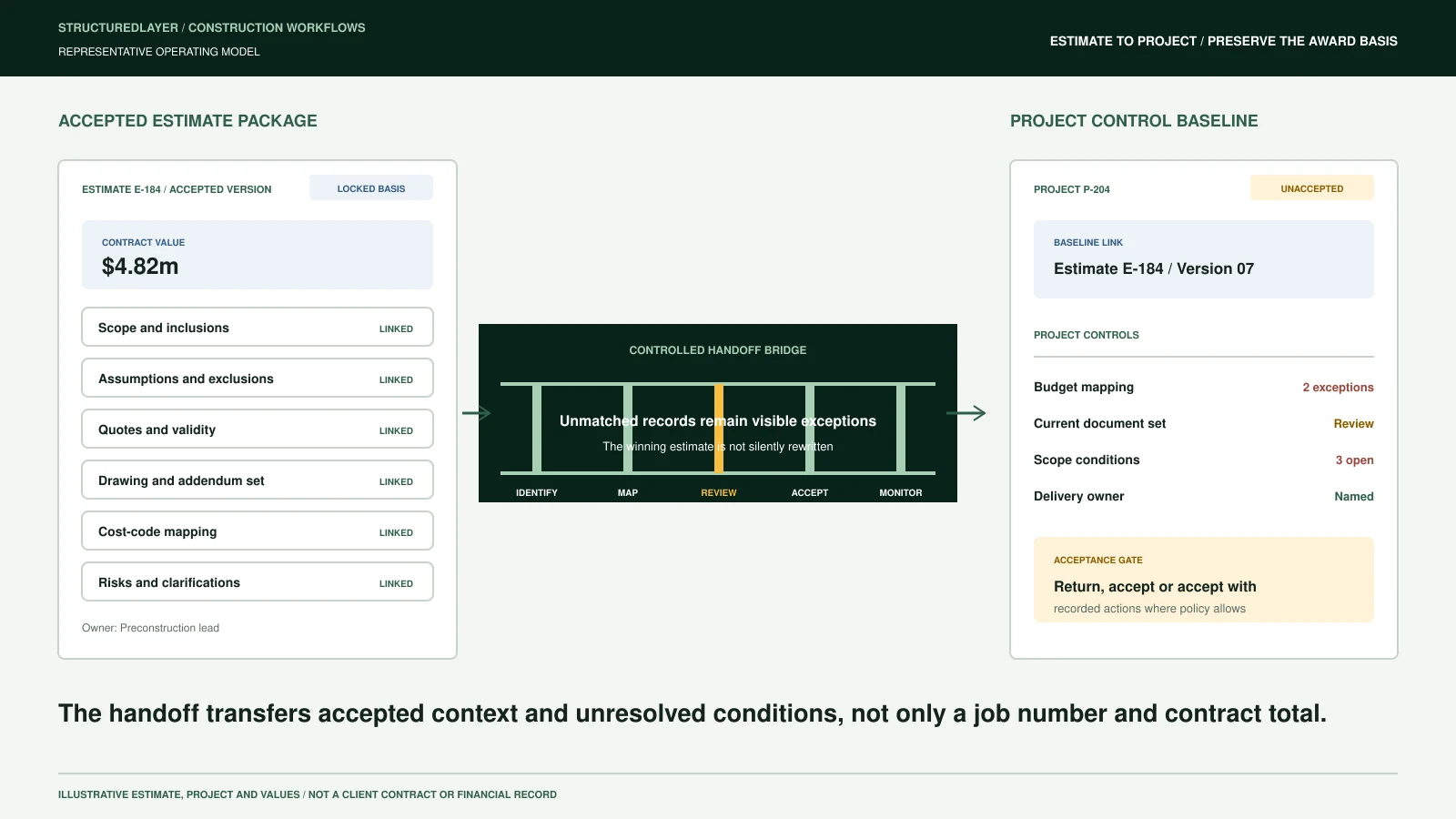
A reliable handoff connects the opportunity, accepted estimate, contract, and project records; preserves what was accepted; exposes unresolved conditions; maps the estimate into the approved project structure; and requires a named delivery owner to accept or return the package.
Why award creates a difficult boundary
Estimating and delivery answer different questions. Estimating asks what should be priced, under which assumptions, by what deadline, and with which commercial risk. Delivery asks what has been contracted, how the work will be controlled, who owns each obligation, and how actual performance will be compared with the approved baseline.
Those views overlap, but they are not interchangeable. A spreadsheet built to prepare a bid may not be the right project-control structure. A project-management platform may hold current delivery records without preserving the estimate logic behind them.
The handoff must translate between those purposes without rewriting history.
Seven common failure points
1. The accepted estimate is not identifiable
Teams may have working copies, alternates, value-engineering versions, post-bid adjustments, and a final proposal in different locations. If the project record cannot identify the accepted estimate version and approval evidence, later comparisons begin from an uncertain baseline.
The accepted version should be locked for reference. Corrections and post-award changes should append as controlled events rather than silently changing the winning estimate.
2. Scope context is reduced to a total
A contract value does not explain inclusions, exclusions, qualifications, alternates, allowances, or unresolved clarifications. These conditions affect procurement, planning, change control, and client communication.
The handoff should preserve each material condition as a connected record with its source, status, owner, and required action.
3. Estimate categories do not map to project controls
Estimating assemblies and bid categories may differ from the cost codes, work packages, commitments, schedule activities, or reporting groups used during delivery. A rushed import can create duplicate categories or force unlike values together.
Mapping should be explicit and reviewable. Unmatched or ambiguous categories remain exceptions until a responsible person resolves them.
4. Current documents are uncertain
The estimate may rely on a particular drawing issue, specification, addendum, clarification, supplier quote, or correspondence thread. A folder transfer does not prove which documents controlled the price.
Each material document should retain its identity, revision, source, received date, current or superseded state, and relationship to the estimate and project.
5. Commercial risks have no delivery owner
Long-lead items, provisional quantities, missing design information, quote expiries, access constraints, and unresolved scope can be visible during estimating but disappear when the project is created.
The handoff should convert each unresolved condition into a named risk, action, decision, or exception. Visibility without ownership is not control.
6. Project setup happens before review
Creating folders, contacts, budgets, and permissions can look like progress even when the source package is incomplete. The resulting project may then be treated as authoritative because it exists in the delivery system.
Project creation and handoff acceptance should be separate states. A project can be created for preparation while remaining visibly unaccepted.
7. Nobody records acceptance
A meeting or email does not necessarily show which package was reviewed, which exceptions remained open, or who accepted accountability. A controlled handoff needs a named decision: accept, accept with recorded actions where policy allows, or return for correction.
What the handoff record should preserve
A practical handoff model normally connects:
- Opportunity, estimate, contract, and project identifiers
- Accepted estimate version and approval evidence
- Scope, inclusions, exclusions, alternates, and assumptions
- Estimate categories, project cost codes, and mapping status
- Supplier and subcontractor quotes with validity and qualification
- Current drawings, specifications, addenda, and clarifications
- Customer, consultant, supplier, and project contacts
- Commercial, project, document, procurement, and finance owners
- Risks, decisions, actions, deadlines, and unresolved exceptions
- Handoff review, acceptance, and return history
- Post-award changes connected to the preserved baseline
Not every organization uses the same systems or terminology. The requirement is not one universal schema. It is a dependable relationship between the records that establish the award basis and the records used to control delivery.
Separate value states
Quoted, approved, contracted, budgeted, committed, forecast, billed, and actual values should not be presented as if they are the same number at different times. They represent different decisions and authorities.
The handoff should define:
- Which source controls each value state.
- Which date and version apply.
- Who may approve a change.
- How mappings and differences are recorded.
- Which reports use each value.
This prevents a later budget adjustment from rewriting what was originally estimated or contracted.
A controlled handoff sequence
A dependable sequence can follow these states:
- Confirm award authority. Record the authorized trigger, contract status, and accepted estimate candidate.
- Lock the award basis. Preserve the accepted estimate, proposal, clarifications, documents, and approvals.
- Map project controls. Translate categories into approved cost codes, packages, and reporting structures.
- Create connected project records. Establish identifiers, workspace, permissions, contacts, and owners.
- Expose unresolved conditions. Carry assumptions, exclusions, long-lead items, quote gaps, and document conflicts into visible queues.
- Review the package. Bring estimating, commercial, project, document, procurement, and finance responsibilities into the review required by the engagement.
- Record acceptance. Name the delivery owner and preserve the decision, open actions, and returned items.
- Monitor post-handoff exceptions. Compare delivered setup and later changes with the accepted baseline.
Automation can prepare records, copy approved fields, identify missing items, propose mappings, and route review. It should not decide that scope is complete, a commercial difference is acceptable, or a technical document is suitable without authorized human judgement.
Minimum acceptance tests
Before the workflow is accepted, representative cases should confirm that it can:
- Identify the accepted estimate version and prevent silent overwrite
- Distinguish quoted, approved, contracted, and budgeted values
- Preserve assumptions, exclusions, alternates, and clarifications
- Flag missing or uncertain document revisions
- Expose unmatched cost-code mappings
- Block or visibly withhold handoff acceptance when required records or owners are missing
- Record who reviewed and accepted the package
- Return incomplete items without losing prior decisions
- Append post-award changes while preserving the original basis
- Recover from a failed import, changed source, duplicate project, or partial setup
Measures should be based on observed operations. Useful candidates include complete packages at kickoff, accepted mappings, unresolved exception age, named acceptance, and post-award differences captured explicitly. They are not universal performance promises.
Start with the package, not the integration
Choose one recently awarded project and reconstruct the information the delivery team needed at acceptance. Identify where each item came from, which version controlled, who approved it, and what was missing. That exercise exposes the required records and decisions before software selection begins.
Review the detailed Estimate-to-Project Handoff workflow, the connected-records model, and the workflow implementation service when defining the first controlled handoff.