Business development and pursuits / Construction AI agent
Monitors authorized procurement portals, tender feeds, planning sources, inboxes, and industry sources for opportunities matching defined services, sectors, regions, values, delivery methods, and client criteria. See the database IDs, linked tables, source crosswalk, workflow stages, dashboard, and human approval needed to operate it.
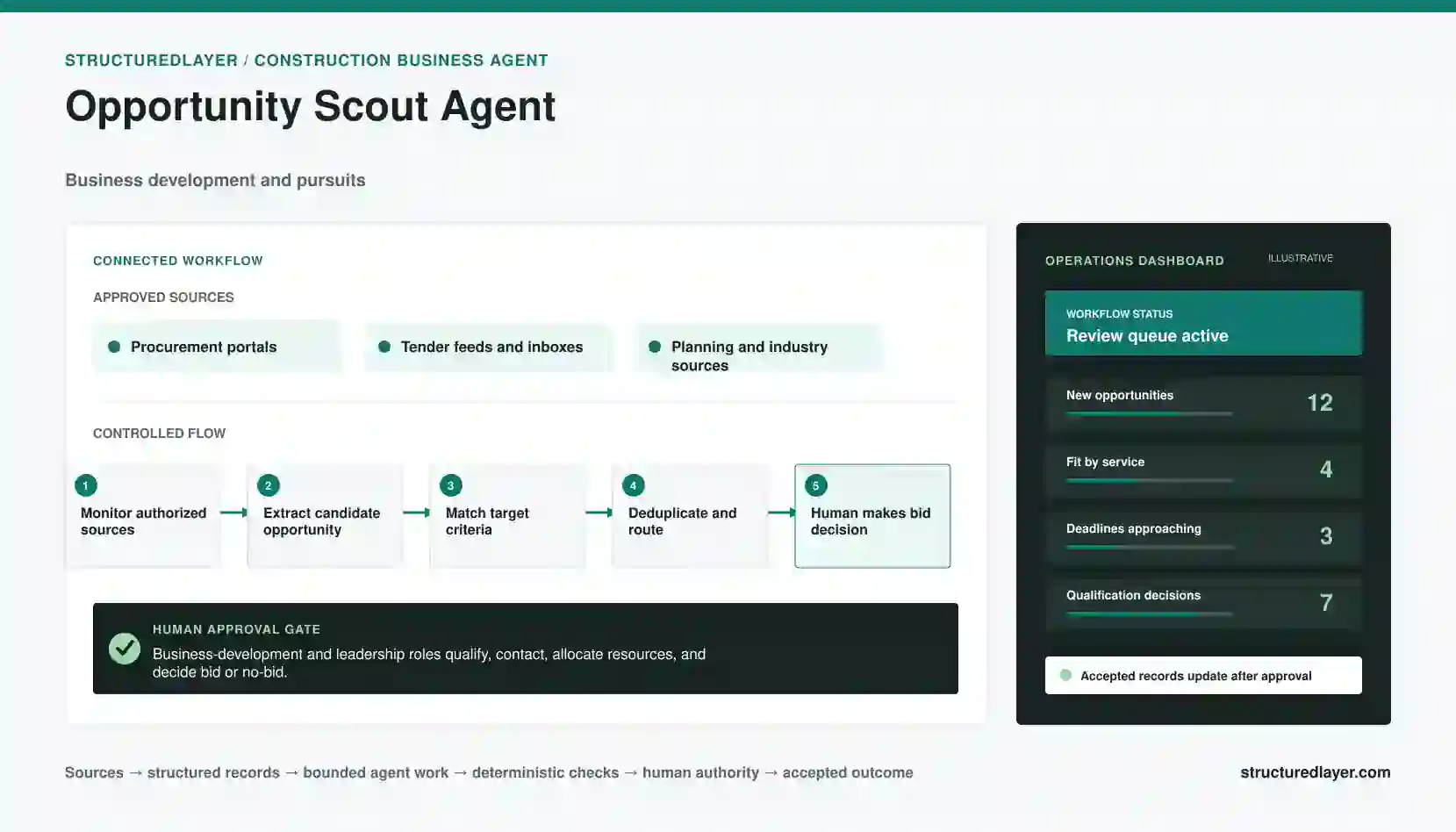
What happens
The agent performs a bounded part of the work. Deterministic controls preserve workflow state and evidence. A named person approves consequential use.
The run begins only from identified, permitted, current source records.
The workflow connects the task to stable business and project records.
The agent prepares structured work within approved tools and context.
Rules expose missing fields, conflicts, uncertainty, and exceptions before action.
An appointed person decides whether the prepared work can update an accepted record or be issued.
Required structure
The source material must connect to stable records, ownership, status, permissions, versions, and review. StructuredLayer defines this foundation before granting the agent consequential access.
Procurement portals
Tender feeds and inboxes
Planning and industry sources
Opportunity and source
Client and geography
Service-fit criteria
Deadline and owner
Database and record IDs
The database can be Airtable, Teable, SQL, or a controlled combination with existing systems. The agent depends on linked records and durable IDs, not on one database brand.
These values are examples. StructuredLayer agrees the naming format with the client. The key may be a readable code or a database UUID, but it should not be a row number, filename, email address, or editable display name. It remains stable when a project name, document title, company name, owner, status, or source system changes.
Why the ID matters
The agent should never rely on names such as “Tower Project,” “latest drawing,” or “John's quote.” Stable IDs connect the exact record, revision, source, run, reviewer, and accepted decision.
customer_idCUS-001048The client, contractor, consultant, supplier, or property organization that owns or participates in the work
target_profile_idTGT-REGION-SVC-04The approved service, sector, geography, value, and exclusion criteria
opportunity_idOPP-2026-0184The candidate procurement or development opportunity
source_listing_idLST-PORTAL-88412The exact portal, tender feed, email, or planning source listing
agent_run_idRUN-20260803-01842One traceable execution with its context, tools, versions, timestamps, cost, and result
review_idREV-20260803-00618The named reviewer, evidence presented, corrections, comments, and review status
decision_idDEC-20260803-00471The authorized approve, reject, return, escalate, or withdraw decision
qualification_decision_idQFD-2026-0718The human qualification and bid or no-bid routing decision
A small pilot can begin with these seven linked record groups. They may be separate Airtable or Teable tables, SQL tables, governed views over existing systems, or a mixture connected through APIs, exports, webhooks, and authorized browser workflows.
| Table or record group | Key fields | What it controls |
|---|---|---|
organizations | customer_id, name, role, status | Identifies who owns, supplies, reviews, or receives the work. |
scope_records | target_profile_id, customer_id, owner_id, status | Holds the approved service, sector, geography, value, and exclusion criteria and connects every downstream record to it. |
workflow_items | opportunity_id, target_profile_id, workflow_status, assigned_owner_id | Tracks the candidate procurement or development opportunity through the controlled process. |
source_registry | source_listing_id, source_system, external_id, revision, permission | Preserves where the evidence came from, which version was used, and whether the agent may access it. |
agent_runs | agent_run_id, workflow_item_id, context_version, tool_version, run_status | Records what the agent received, attempted, returned, cost, and why it stopped. |
reviews_decisions | review_id, reviewer_id, decision_id, decision_status, decided_at | Separates model output from accountable human acceptance, rejection, correction, or escalation. |
accepted_outputs | qualification_decision_id, decision_id, source_run_id, accepted_by, accepted_at | Holds the human qualification and bid or no-bid routing decision only after the required approval. |
Airtable or Teable: suitable for a bounded workflow, transparent linked records, operational ownership, forms, review views, and moderate volume.
SQL: suitable when the workflow needs greater volume, transaction control, integration depth, reporting performance, stricter environment separation, or several agents sharing the same operating layer.
Existing construction systems: Procore, Autodesk Construction Cloud, ERP, CRM, scheduling, estimating, document, and collaboration tools can remain authoritative. The operating layer connects their records and controlled actions.
Hybrid: a common implementation keeps source documents and transactions in current systems, uses SQL for durable relationships and event history, and provides Airtable, Teable, or a custom dashboard for operational review.
StructuredLayer does not need to rename every record in every system. A crosswalk stores the durable operating ID beside each source system and native external ID.
| Operating ID | Source | Native ID |
|---|---|---|
| TGT-REGION-SVC-04 | Current business system | EXT-238541 |
| LST-PORTAL-88412 | Document or source platform | REC-88419-R03 |
| RUN-20260803-01842 | Agent operations | Provider run reference |
The crosswalk supports deduplication, migration, audit, provider changes, and client-owned handover while preserving links back to the authoritative source.
Operations dashboard
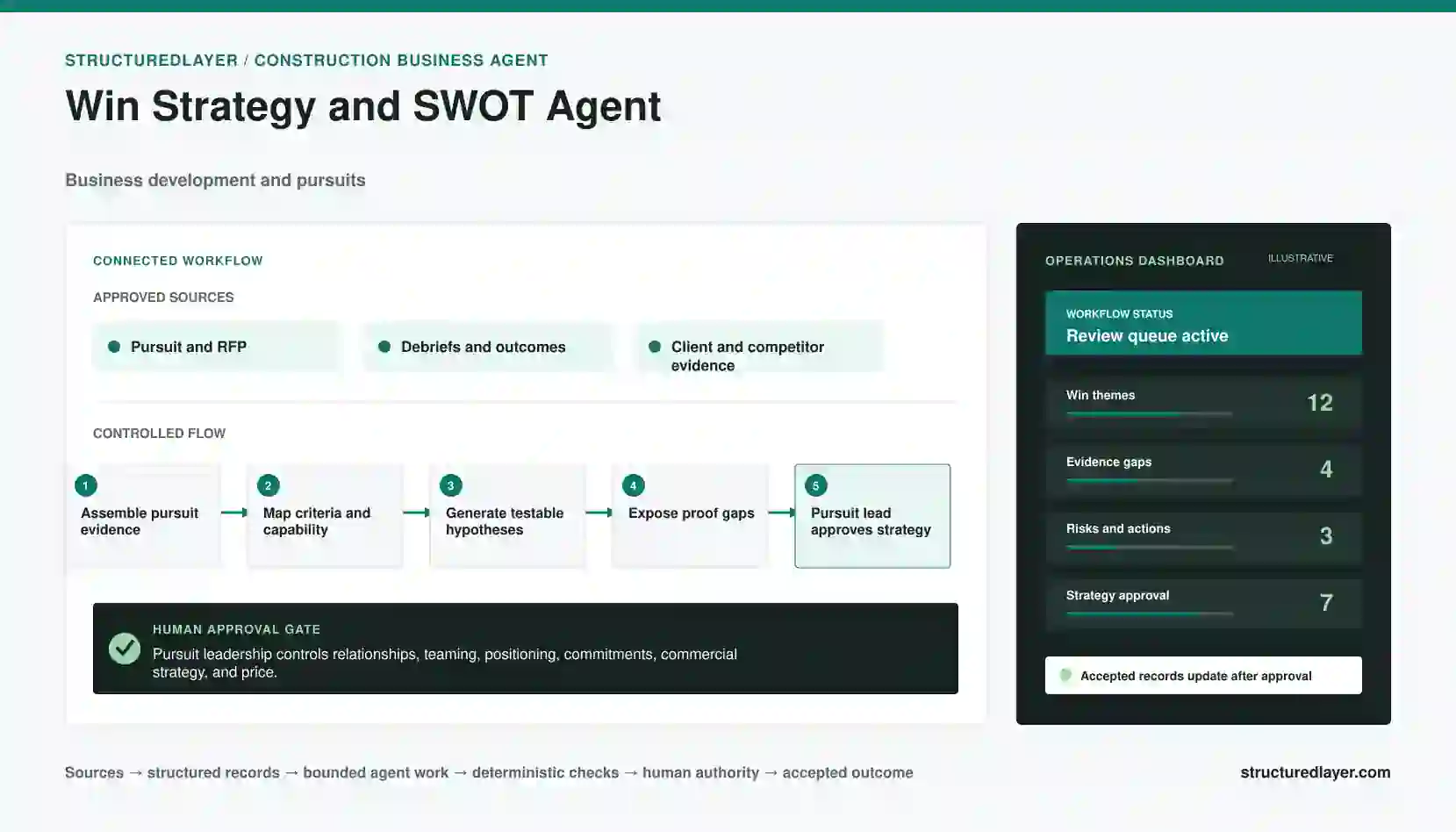
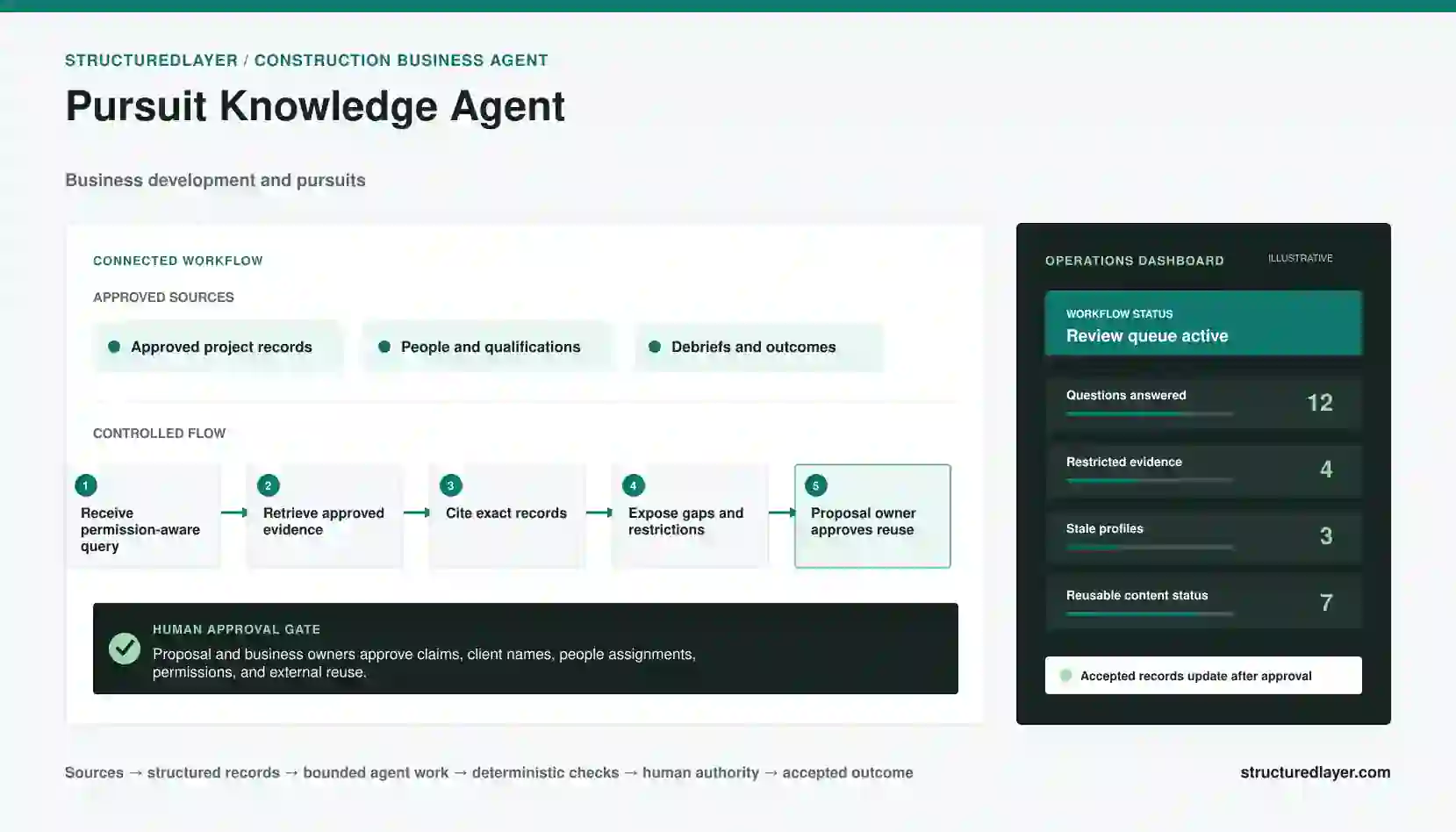
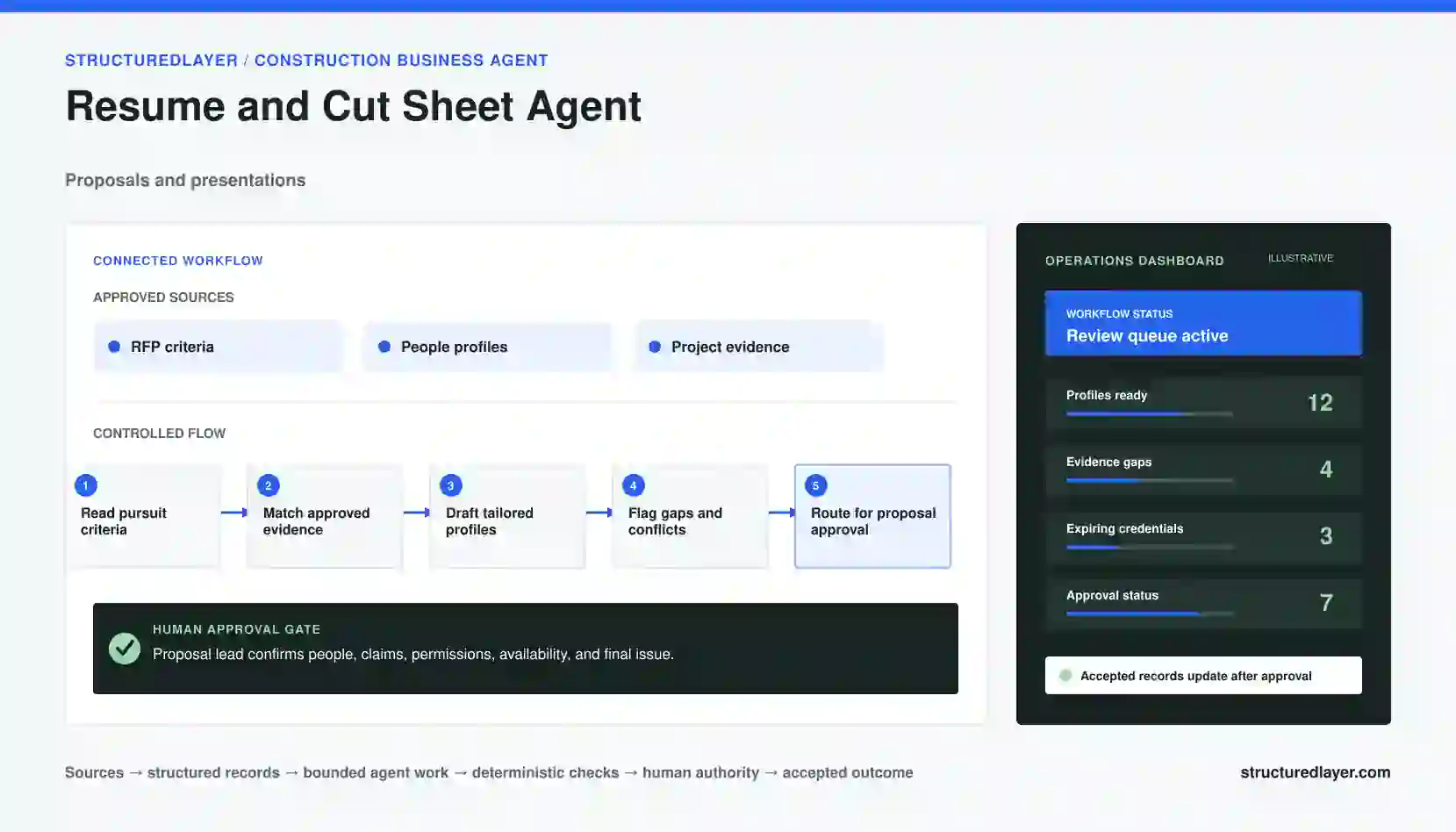
The dashboard is not a decorative AI chat screen. It helps owners see what entered the workflow, what the agent prepared, what failed validation, what needs a decision, and what became an accepted record.
Drill through to source, owner, status, evidence, exceptions, decision history, and downstream effect.
Drill through to source, owner, status, evidence, exceptions, decision history, and downstream effect.
Drill through to source, owner, status, evidence, exceptions, decision history, and downstream effect.
Drill through to source, owner, status, evidence, exceptions, decision history, and downstream effect.
StructuredLayer defines each status, count, timer, acceptance measure, critical failure, correction, reviewer action, cost, and alert against the client's operating process. The diagram shows the dashboard structure, not invented performance.
Human authority
Business-development and leadership roles qualify, contact, allocate resources, and decide bid or no-bid.
The interface must show the reviewer the source evidence, proposed change, uncertainty, exceptions, prior decisions, and downstream effect. A button without sufficient information is not meaningful human control.
It cannot guarantee complete market coverage, infer unstated fit, bypass portal conditions, decide bid or no-bid, contact the client, commit resources, or submit a response.
StructuredLayer engagement
Recommended starting route: Browser and source-monitoring pilot.
Current workflow
Target profile, exclusions, service and trade taxonomy, geography, value range, client and project records, approved sources and accounts, portal permissions, deduplication rules, owners, and review schedule.
Implementation outcome
Source-linked opportunity records, matched criteria, deadline and document state, duplicates, missing information, relevance explanation, owner routing, and a human qualification queue.
Production boundary
It cannot guarantee complete market coverage, infer unstated fit, bypass portal conditions, decide bid or no-bid, contact the client, commit resources, or submit a response.
Connected agent catalogue
Related agent roles can share controlled records, permissions, workflow events, dashboards, monitoring, and client-owned handover. Each new task still requires its own evaluation and authority boundary.
Buyer questions
Monitors authorized procurement portals, tender feeds, planning sources, inboxes, and industry sources for opportunities matching defined services, sectors, regions, values, delivery methods, and client criteria.
Target profile, exclusions, service and trade taxonomy, geography, value range, client and project records, approved sources and accounts, portal permissions, deduplication rules, owners, and review schedule.
It cannot guarantee complete market coverage, infer unstated fit, bypass portal conditions, decide bid or no-bid, contact the client, commit resources, or submit a response.
The record model can be implemented in Airtable, Teable, a SQL database, or a controlled combination with existing construction and business systems. The important requirement is not the brand of database. It is stable IDs, linked records, source authority, permissions, workflow states, review history, and client ownership.
No. StructuredLayer can preserve each source system's native ID in an ID crosswalk and connect it to one durable operating-layer ID. This prevents duplicate projects, people, documents, opportunities, and decisions while allowing the existing systems to remain authoritative.
The recommended starting route is Browser and source-monitoring pilot. The assessment should confirm source availability, workflow ownership, human review capacity, representative cases, system access, and accepted outcome before implementation.
Assess this workflow
Describe the current process, source systems, owner, common failures, human decisions, and accepted outcome. Do not submit credentials or unrestricted confidential information.
Plain-language route guide
Choose the smallest route that answers your next decision.
The formal service names remain useful for scope and contracts. The plain-language labels explain what each route actually does. These are alternatives, not four mandatory stages.
Operating-Layer Blueprint
Buyer question answered
What should we build, and where should the boundary be?
Typical input
One priority workflow, a named owner, current systems, representative records or files, and known failure points.
Output
A client-owned current-state map, target design, source inventory, implementation boundary, timeline, and fixed quote.
Bounded AI Agent Pilot
Buyer question answered
Can one specific AI-assisted task work reliably enough to justify more?
Typical input
One named task, approved sources and tools, representative cases, a human reviewer, and explicit stop conditions.
Output
A working pilot, evaluation evidence, cost and failure findings, review requirements, and a proceed, revise, or stop recommendation.
Single Workflow Implementation
Buyer question answered
How do we put one recurring workflow into controlled production?
Typical input
A defined trigger and completion point, accountable owners, approximately three core systems, rules, approvals, and test cases.
Output
Connected records, an operating view, integrations, a dashboard, acceptance testing, training, documentation, and handover.
Complete Operating Layer Implementation
Buyer question answered
How do we connect shared data and decisions across teams?
Typical input
Two to five related workflows, shared records, several departments or systems, an executive sponsor, and named operating owners.
Output
A phased operating layer with shared records, permissions, interfaces, integrations, reporting, controlled automation, training, and handover.
Still unsure which route fits?
Describe one broken workflow. The free assessment may recommend a Blueprint, pilot, implementation, a smaller discovery step, or no engagement.