
Who owns it?
Client-controlled accounts, records, configurations, documentation, and operating access wherever practical.
Trust tested in operation
StructuredLayer works with operational records, documents, workflows, integrations, and approved AI tools. That requires more than technical capability. It requires clear ownership, controlled access, documented decisions, human oversight, and evidence that the delivered workflow performs as agreed.
We do not ask you to trust a black box. We design the engagement so your team can inspect, test, approve, operate, and ultimately own what is built.
Client-controlled accounts, records, configurations, documentation, and operating access wherever practical.
Named identities, least-privilege permissions, approved sources, logged access, and removable delivery credentials.
Representative cases, expected results, actual results, exceptions, recovery checks, and named acceptance.
Visible exceptions, bounded retries, alerts, accountable owners, manual fallback, and recorded resolution.
Named people approve consequential commercial, contractual, safety, payment, employment, compliance, and external actions.
Documented architecture, client-owned handover, revocable access, and replaceable tools where the approved design permits.
Risk, evidence, and buying decisions
These direct answers consolidate due diligence, source traceability, permissions, validation, failure handling, handover, and separate production approval. The signed scope and client review remain controlling for a specific engagement.
Start by...
You do not need to follow every page or engagement stage. Use the entry point that matches what you already know, then move only as far as the next decision requires.
Client ownership
StructuredLayer does not require your business to surrender ownership of its operating knowledge.
Depending on the approved architecture:
The objective is a transferable operating layer, not dependency on StructuredLayer.
Access boundary
We do not request passwords, API keys, MFA codes, or unrestricted access through public assessment forms.
Before implementation, access requirements are documented and approved. Controls may include:
Controlled assistance
AI may assist with reading, classification, extraction, matching, comparison, drafting, and recommendations. It should not automatically control every decision.
Actions involving commercial commitments, pricing, bid submission, contracts, payments, deletion, safety, employment, compliance, or external publication remain subject to defined approval rules.
Every implementation defines:
Acceptance evidence
A workflow is not considered successful because it completed once.
Where appropriate, StructuredLayer tests implementations against approved historical examples before introducing them into live operations. Testing can cover:
The approved scenarios, expected results, actual results, exceptions, and sign-off conditions are recorded.
Operational recovery
Automation can fail because interfaces change, sessions expire, files are missing, source systems become unavailable, or information is uncertain.
Instead of hiding those failures, the operating design can include:
We describe browser workflows as capable of bounded recovery, not guaranteed self-healing.
Buyer due diligence
Use the available material to examine what was delivered, how a workflow behaves, what the client owns, which controls are visible, and what still needs to be confirmed for your scope.
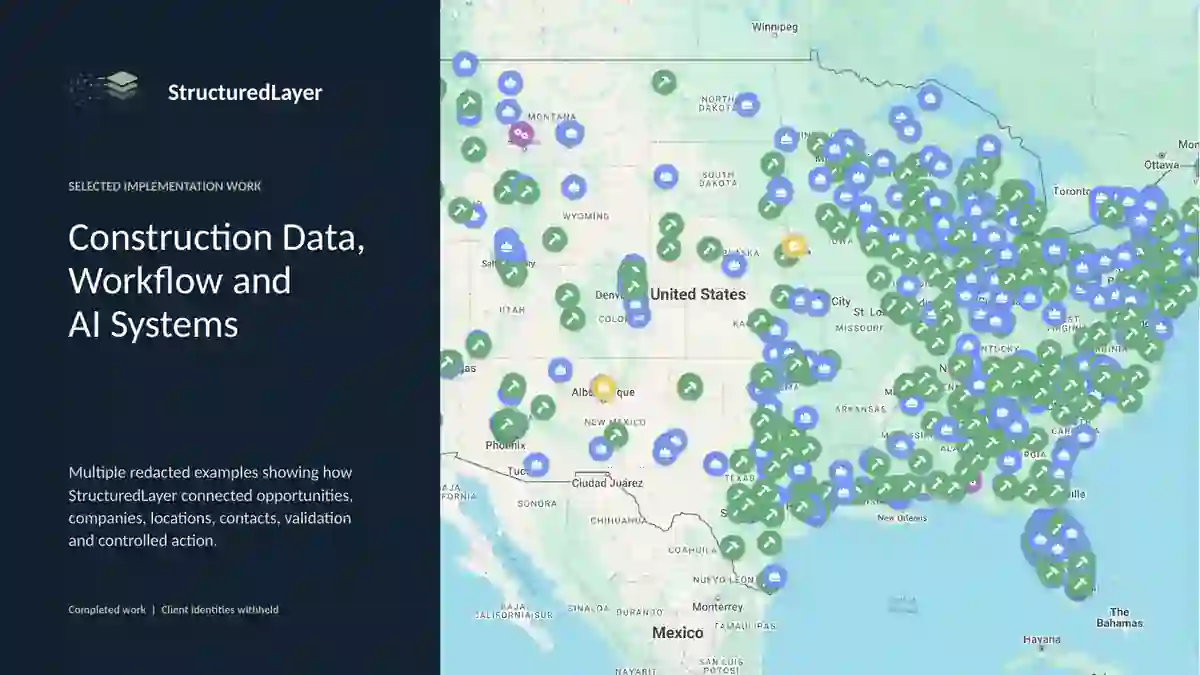
Client confidentiality limits public disclosure. Qualified buyers can request a controlled review of additional material when client permission, access restrictions, and confidentiality terms allow it.
Transferable delivery
Depending on the approved scope, the handover may include:
Delivery accountability
StructuredLayer coordinates specialists across workflow analysis, data design, integrations, document intelligence, automation, validation, governance, mobile systems, and digital construction.
Specialists are assigned according to the approved scope. Access is limited by role, responsibilities are documented, and client communication remains coordinated through an accountable engagement lead.
Meet the TeamWritten boundaries
The proposal, operating design, acceptance plan, and handover should state these boundaries directly.
A bounded first step
Trust does not need to begin with a large implementation. Start with one important workflow. Show us how it currently operates, where the information comes from, who makes decisions, and what repeatedly goes wrong.
StructuredLayer will determine whether the next useful step is an assessment, Blueprint, bounded pilot, single-workflow implementation, or no engagement at all.
Downloadable buyer checks
These public samples support buyer due diligence. They illustrate expected structures and review questions; they are not client records, security certifications, or a substitute for scope-specific technical and contractual review.
Review field authority, accountable ownership, and system boundaries.
Download PDFInspect the structure used to define records, fields, and operating meaning.
Download PDFReview how representative cases, expected outcomes, and approval are recorded.
Download PDFInspect how missing, conflicting, uncertain, or failed work reaches an owner.
Download PDFReview the expected operating, support, ownership, and recovery handover structure.
Download PDFPlain-language route guide
Choose the smallest route that answers your next decision.
The formal service names remain useful for scope and contracts. The plain-language labels explain what each route actually does. These are alternatives, not four mandatory stages.
Operating-Layer Blueprint
Buyer question answered
What should we build, and where should the boundary be?
Typical input
One priority workflow, a named owner, current systems, representative records or files, and known failure points.
Output
A client-owned current-state map, target design, source inventory, implementation boundary, timeline, and fixed quote.
Bounded AI Agent Pilot
Buyer question answered
Can one specific AI-assisted task work reliably enough to justify more?
Typical input
One named task, approved sources and tools, representative cases, a human reviewer, and explicit stop conditions.
Output
A working pilot, evaluation evidence, cost and failure findings, review requirements, and a proceed, revise, or stop recommendation.
Single Workflow Implementation
Buyer question answered
How do we put one recurring workflow into controlled production?
Typical input
A defined trigger and completion point, accountable owners, approximately three core systems, rules, approvals, and test cases.
Output
Connected records, an operating view, integrations, a dashboard, acceptance testing, training, documentation, and handover.
Complete Operating Layer Implementation
Buyer question answered
How do we connect shared data and decisions across teams?
Typical input
Two to five related workflows, shared records, several departments or systems, an executive sponsor, and named operating owners.
Output
A phased operating layer with shared records, permissions, interfaces, integrations, reporting, controlled automation, training, and handover.
Still unsure which route fits?
Describe one broken workflow. The free assessment may recommend a Blueprint, pilot, implementation, a smaller discovery step, or no engagement.