
Source support
Does each material statement, action, translation, or visual claim remain linked to the approved source, timestamp, term, brief, or review record?
AI Pilot Experience · Meeting Records
Prepare draft minutes, decisions, actions, owners, dates, unresolved questions, and source timestamps from an approved recording or correspondence set for named attendee review.
Pilot experience
Meeting recordings and correspondence contain decisions, actions, dates, qualifications, unresolved questions, and context distributed across speakers, threads, attachments, and timestamps.
Speech-to-text and language models can prepare draft minutes and structured decision or action candidates while deterministic formatting preserves IDs, timestamps, speakers, source messages, and issue state.
A named attendee reviews the source, corrects omissions and wording, confirms commitments, owners and dates, resolves open questions, and approves the final issue. No draft becomes the meeting record automatically.
Visual walkthrough
Each view shows how source records, system outputs, exceptions, corrections, and human decisions remain connected during the pilot.
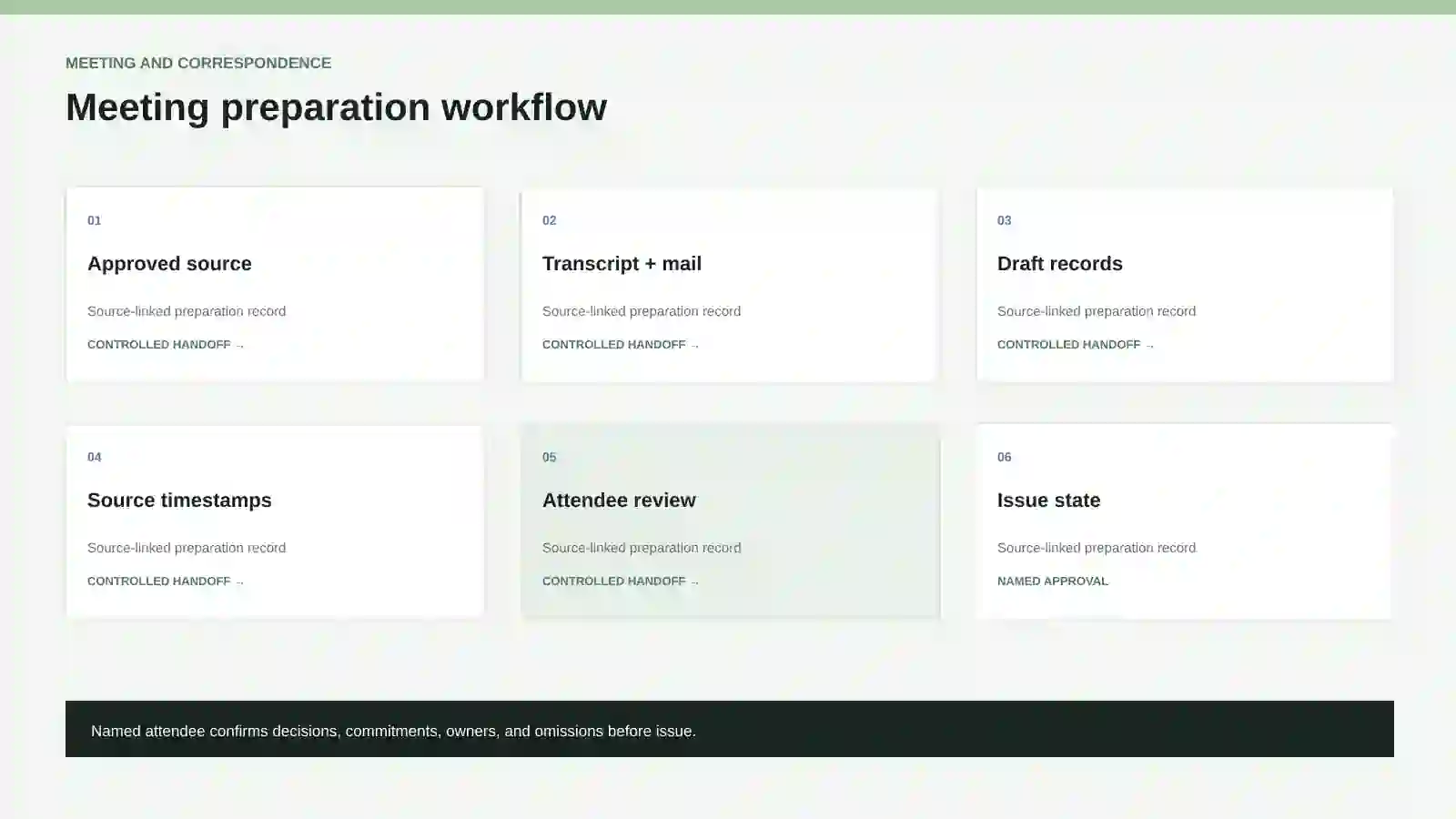
Approved sources remain connected to transcript, draft records, timestamps, attendee review, and issue state.
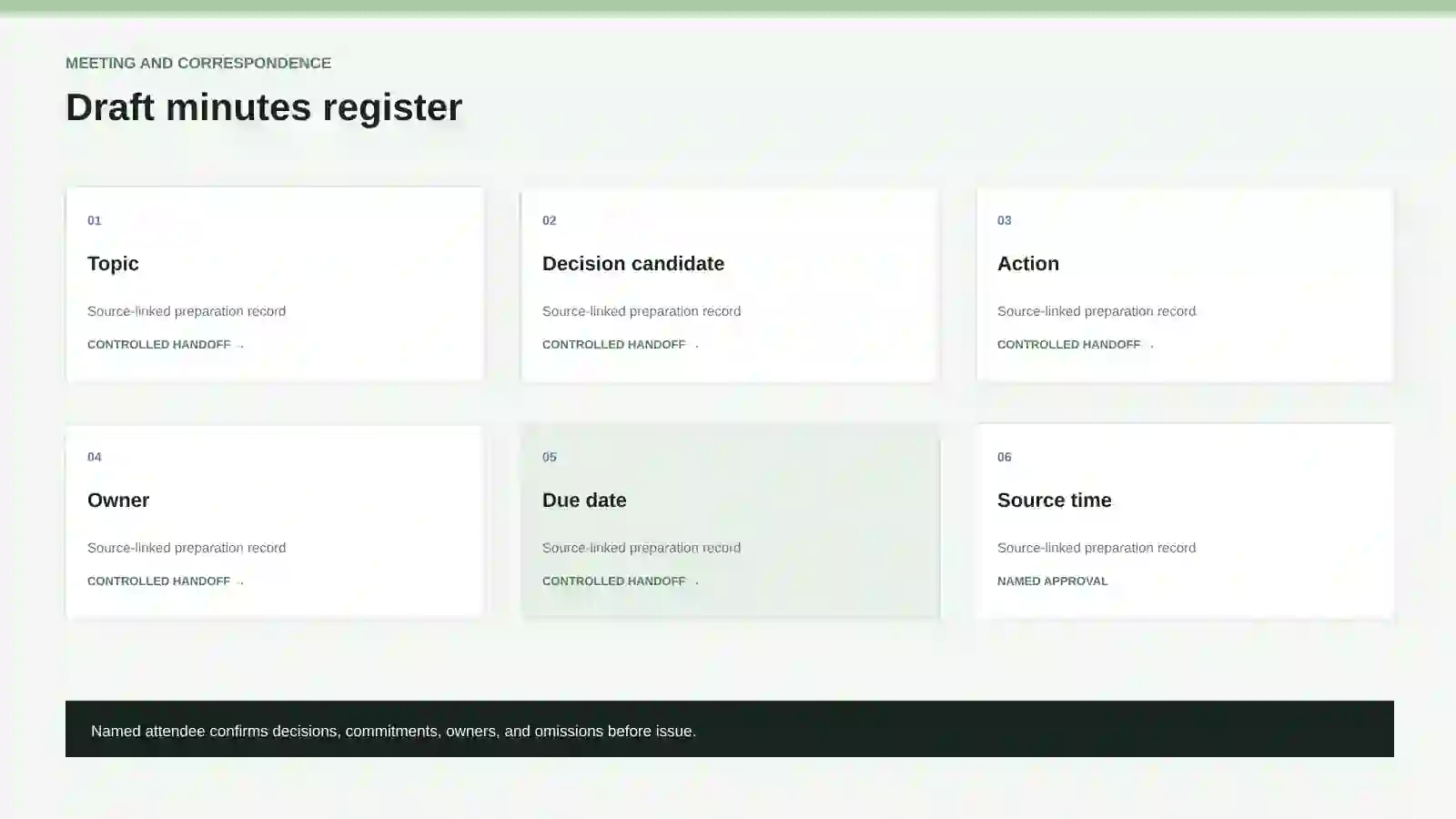
Topics, decision candidates, actions, owners, dates, questions, and source times remain separate reviewable fields.
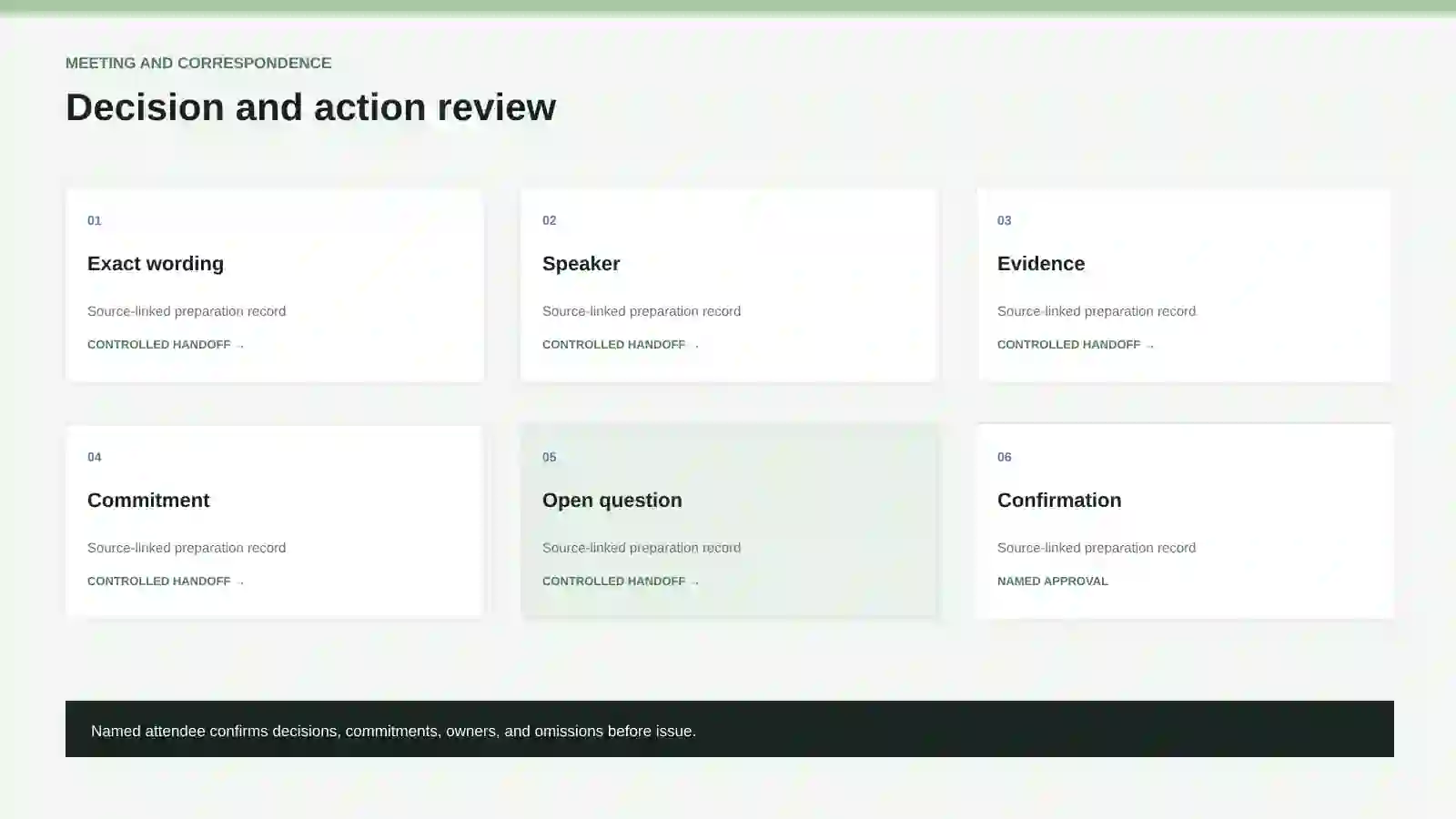
Exact wording, speaker, evidence, commitment, owner, and open questions remain visible before confirmation.
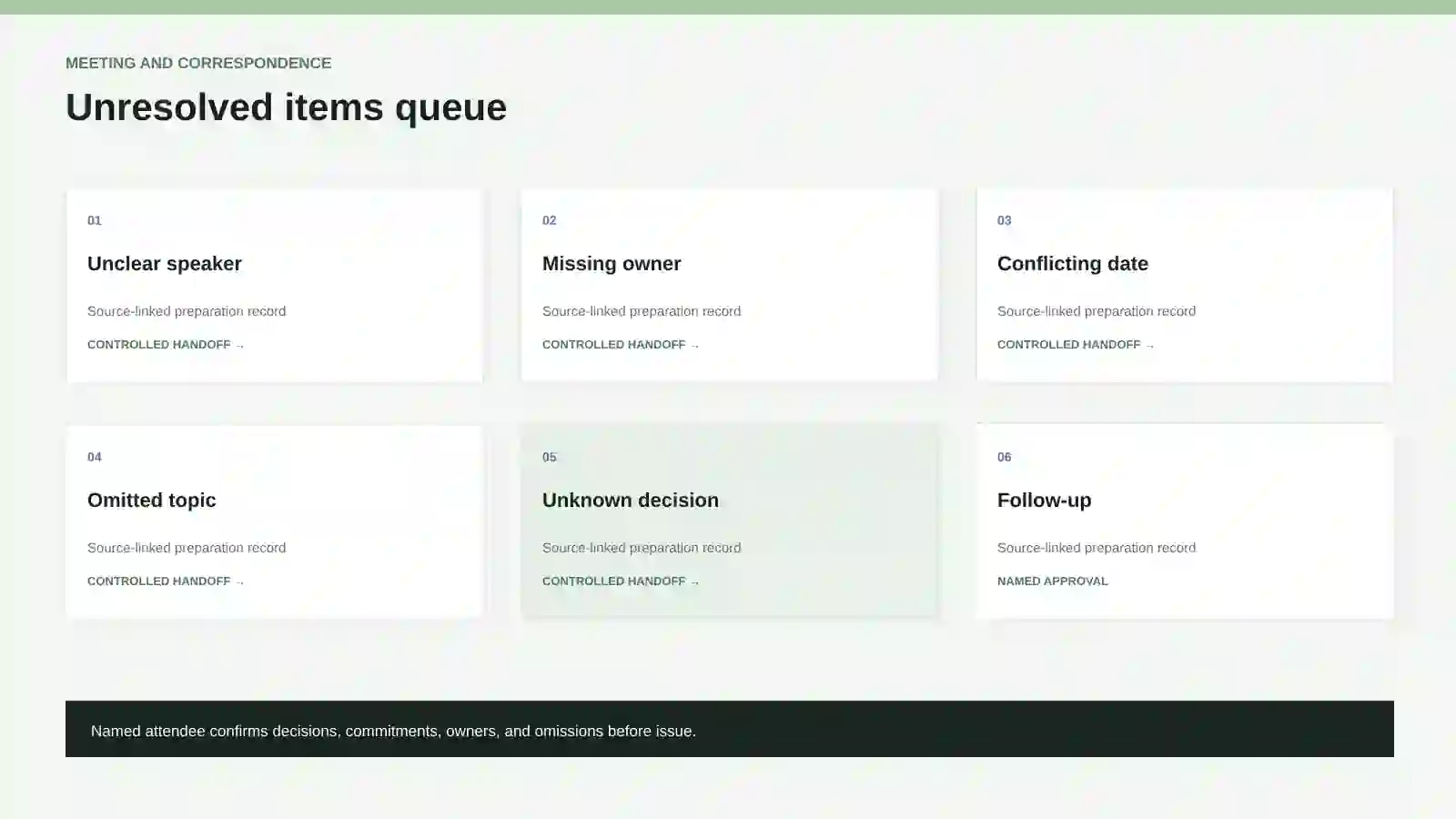
Unclear speakers, missing owners, conflicting dates, omissions, and unknown decisions receive owners and states.
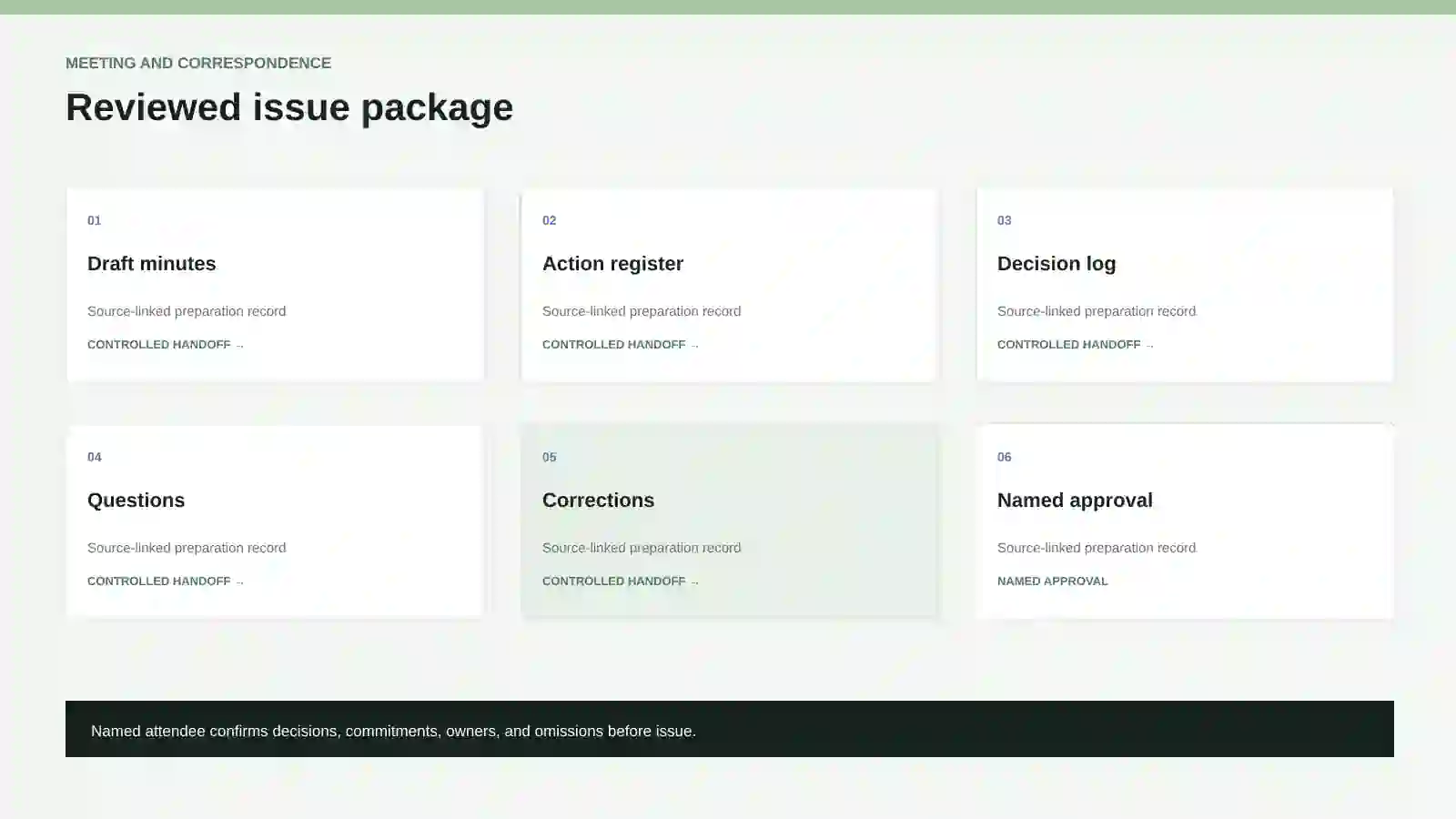
Only the attendee-confirmed minutes, actions, decisions, questions, corrections, and issue state move to release.
User journey
The interface can feel simple while the pilot preserves document identity, revision, permission, retrieval, uncertainty, and review evidence behind every result.
Register meeting, correspondence, participants, purpose, owner, consent, confidentiality, retention, and permitted audience.
Fingerprint audio, video, transcript, email, attachment, thread, message, and timestamp records without overwriting sources.
Apply approved speech-to-text, speaker labels, punctuation, message threading, attachment links, and quality warnings.
Draft topics, decisions, actions, owners, dates, commitments, unresolved questions, and source timestamps.
Expose unclear speakers, ambiguous commitments, missing owners, conflicting dates, omitted topics, and unsupported decisions.
A named attendee opens sources, corrects wording, confirms decisions and actions, assigns owners, and records omissions.
Freeze the reviewed version, issue owner, approval time, recipients, corrections, open items, and permitted use.
Carry accepted actions and unresolved questions into separate owned workflows without changing the meeting record.
Technology options
The final selection records exact versions, licences, data handling, cost, limitations, replacement options, and the evidence required before use.
| Component | Examples | Pilot role | Boundary |
|---|---|---|---|
| Speech to text | Approved transcription services with speaker and timestamp support | Prepare timestamped transcript candidates from approved recordings. | Speaker, wording, names, numbers, and omissions can be wrong; the recording remains controlling. |
| Claude, GPT, or Qwen | Exact approved model and version recorded | Prepare draft minutes, decisions, actions, owners, dates, and questions linked to sources. | The model cannot create a commitment, confirm an owner, or decide what the meeting agreed. |
| Correspondence processing | Approved email export, message parser, attachment register, and threading rules | Connect messages and attachments by thread, sender, recipient, time, source, and purpose. | Thread order and quoted text do not establish authority, receipt, intent, or contractual meaning. |
| Deterministic formatting | Punctuation, date normalization, IDs, schemas, templates, and validation | Create stable, consistent draft records and issue packages. | Valid formatting does not establish complete or accurate minutes. |
| Review interface | Source player, correspondence viewer, decision and action register, issue approval | Show each candidate beside its timestamp or source message and retain corrections. | Only named attendee approval creates the issued record for the agreed purpose. |
Client-owned pilot outputs
Evaluation evidence
A fluent answer is not the acceptance unit. The pilot tests whether a reviewer can reach the controlling evidence efficiently and detect important failure.
Does each material statement, action, translation, or visual claim remain linked to the approved source, timestamp, term, brief, or review record?
Did the workflow expose missing topics, owners, dates, terms, captions, permissions, references, or required release information?
Measure reviewer time to inspect, correct, reject, resolve exceptions, and approve the final output.
Record unsupported commitments, omitted decisions, mistranslated controlled terms, identity issues, false factual details, and unauthorized release.
Did only the approved version reach the named audience, destination, language, and permitted use?
Measure preparation, transcription, translation, generation, storage, review, correction, monitoring, support, and replacement per accepted output.
Cost drivers
Scaling factors
Use durable source, run, output, review, correction, release, expiry, and withdrawal IDs with queues, retries, and checkpoints.
Preserve project, user, source, speaker, language, image, purpose, audience, destination, retention, and reuse permissions.
Version controlled terms, speaker rules, prohibited claims, disclosure, review roles, and release conditions.
Keep sources, transcripts, translations, prompts, outputs, corrections, approvals, and manifests outside any provider.
Measure payload size, media duration, model calls, rendering, queue latency, timeouts, fallback, reviewer capacity, and cost.
Require separate security, integration, monitoring, recovery, service, training, ownership, rights, and cost approval.
Cross-industry reuse
The reusable capability is permission-aware multilingual retrieval across versioned documents with citations. Each industry keeps its own source authority, terminology, consequence, retention, and qualified review.
Meetings, correspondence, workflow explainers, proposals, site communication, and approved media.
Review: Project, commercial, design, safety, technical, legal, communications, or authorized owner.
Asset meetings, tenant correspondence, training, service explainers, proposals, and property communication.
Review: Property, facilities, compliance, legal, technical, communications, or asset owner.
Technical meetings, actions, training, explainers, proposals, diagrams, and concept communication.
Review: Qualified engineer, technical lead, quality, legal, training, or communications owner.
Design meetings, minutes, training, proposals, storyboards, concepts, and presentation media.
Review: Architect, design lead, technical, legal, brand, or communications owner.
Production meetings, actions, work explainers, multilingual training, proposals, and concept media.
Review: Production, quality, engineering, safety, training, legal, or communications owner.
Service meetings, correspondence, instructions, training, proposals, and customer communication.
Review: Service manager, technical, safety, commercial, training, legal, or communications owner.
Client meetings, correspondence, training, proposals, presentations, and approved knowledge media.
Review: Matter owner, subject specialist, legal, quality, privacy, or communications owner.
Team meetings, decisions, procedures, onboarding, workflow explainers, and change communication.
Review: Process owner, department lead, HR, legal, security, training, or communications owner.
Authority boundaries
Related paths
Continue into the operating, technical, security, and readiness guidance connected to this workflow.
Review scope, evaluation, duration, price range, and decisions.
Open pageConnect approved decisions, actions, exceptions, and outcomes to operating reporting.
Open pageControl source access, participants, providers, retention, issue, and withdrawal.
Open pagePrepare cases, acceptance criteria, critical failures, and monitoring.
Open pageStart with one approved collection
Use general workflow information during the assessment. Do not submit confidential documents, passwords, API keys, authentication codes, or unrestricted system access.
Plain-language route guide
Choose the smallest route that answers your next decision.
The formal service names remain useful for scope and contracts. The plain-language labels explain what each route actually does. These are alternatives, not four mandatory stages.
Operating-Layer Blueprint
Buyer question answered
What should we build, and where should the boundary be?
Typical input
One priority workflow, a named owner, current systems, representative records or files, and known failure points.
Output
A client-owned current-state map, target design, source inventory, implementation boundary, timeline, and fixed quote.
Bounded AI Agent Pilot
Buyer question answered
Can one specific AI-assisted task work reliably enough to justify more?
Typical input
One named task, approved sources and tools, representative cases, a human reviewer, and explicit stop conditions.
Output
A working pilot, evaluation evidence, cost and failure findings, review requirements, and a proceed, revise, or stop recommendation.
Single Workflow Implementation
Buyer question answered
How do we put one recurring workflow into controlled production?
Typical input
A defined trigger and completion point, accountable owners, approximately three core systems, rules, approvals, and test cases.
Output
Connected records, an operating view, integrations, a dashboard, acceptance testing, training, documentation, and handover.
Complete Operating Layer Implementation
Buyer question answered
How do we connect shared data and decisions across teams?
Typical input
Two to five related workflows, shared records, several departments or systems, an executive sponsor, and named operating owners.
Output
A phased operating layer with shared records, permissions, interfaces, integrations, reporting, controlled automation, training, and handover.
Still unsure which route fits?
Describe one broken workflow. The free assessment may recommend a Blueprint, pilot, implementation, a smaller discovery step, or no engagement.