Document completeness
Did the register identify every supplied file, type, revision, relationship, duplicate, superseded item, and missing expected document?
AI Pilot Experience · Tender Intake
Provide one identified tender package and prepare source-linked candidate project details, dates, scope categories, required documents, qualifications, and missing-information records for authorized review.
Pilot experience
Tender packages arrive as invitations, addenda, specifications, drawings, schedules, forms, and supporting files with different layouts and revision states. The intake workflow creates one identified package and preserves every source before extracting candidate fields.
OCR and layout processing identify pages, headings, tables, forms, dates, and document relationships. A selected language model can prepare project details, scope categories, required return documents, qualifications, deadlines, and missing-information candidates with page and section citations.
The reviewer opens the source, corrects fields, resolves date and revision conflicts, marks missing requirements, and approves the intake record. The workflow stops before Go/No-Go, pricing, technical response, correspondence, approval, or submission.
Visual walkthrough
Each view shows how source records, system outputs, exceptions, corrections, and human decisions remain connected during the pilot.
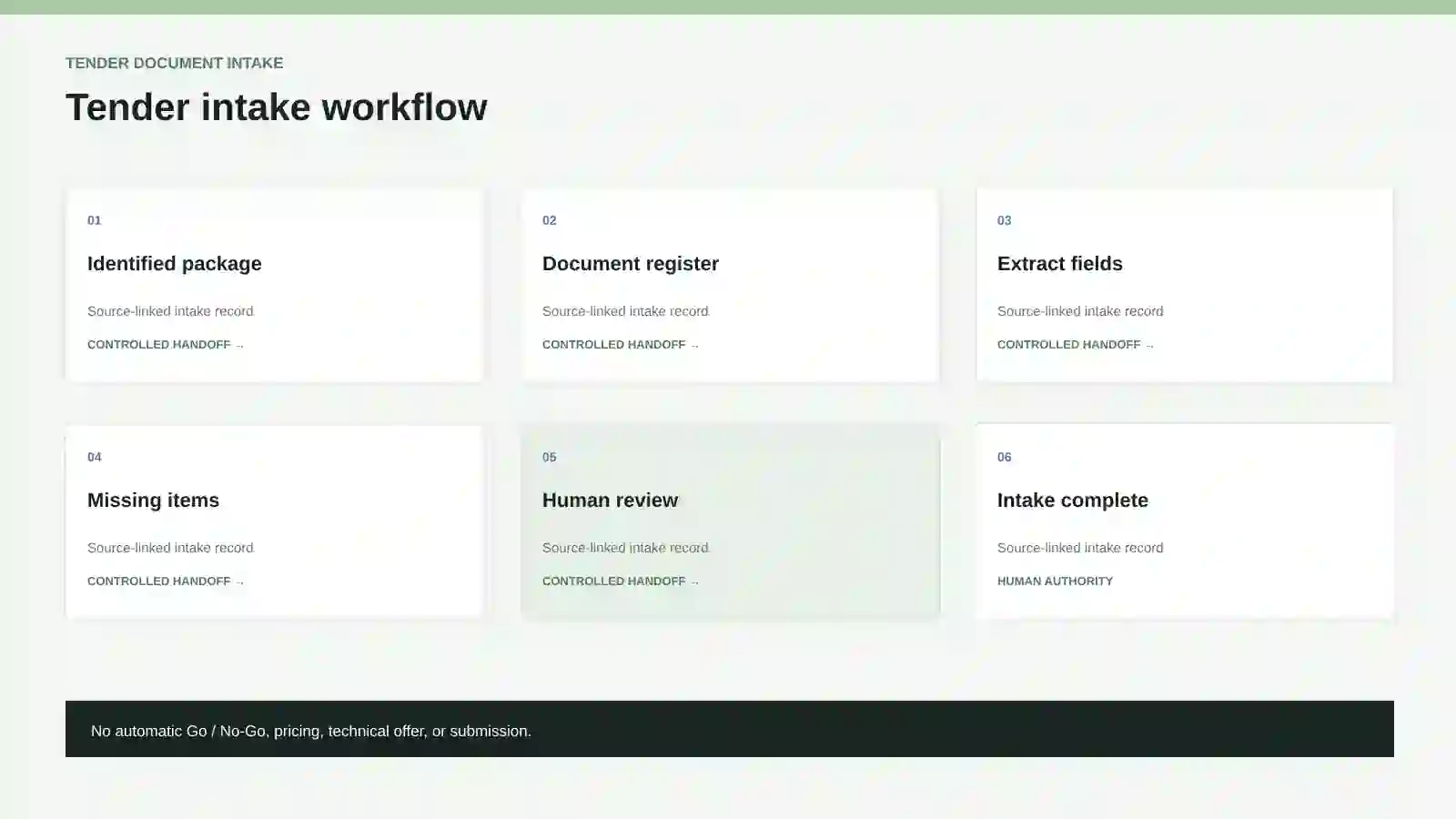
The package remains connected to its document register, extracted candidates, missing items, reviewer corrections, and completed intake state.
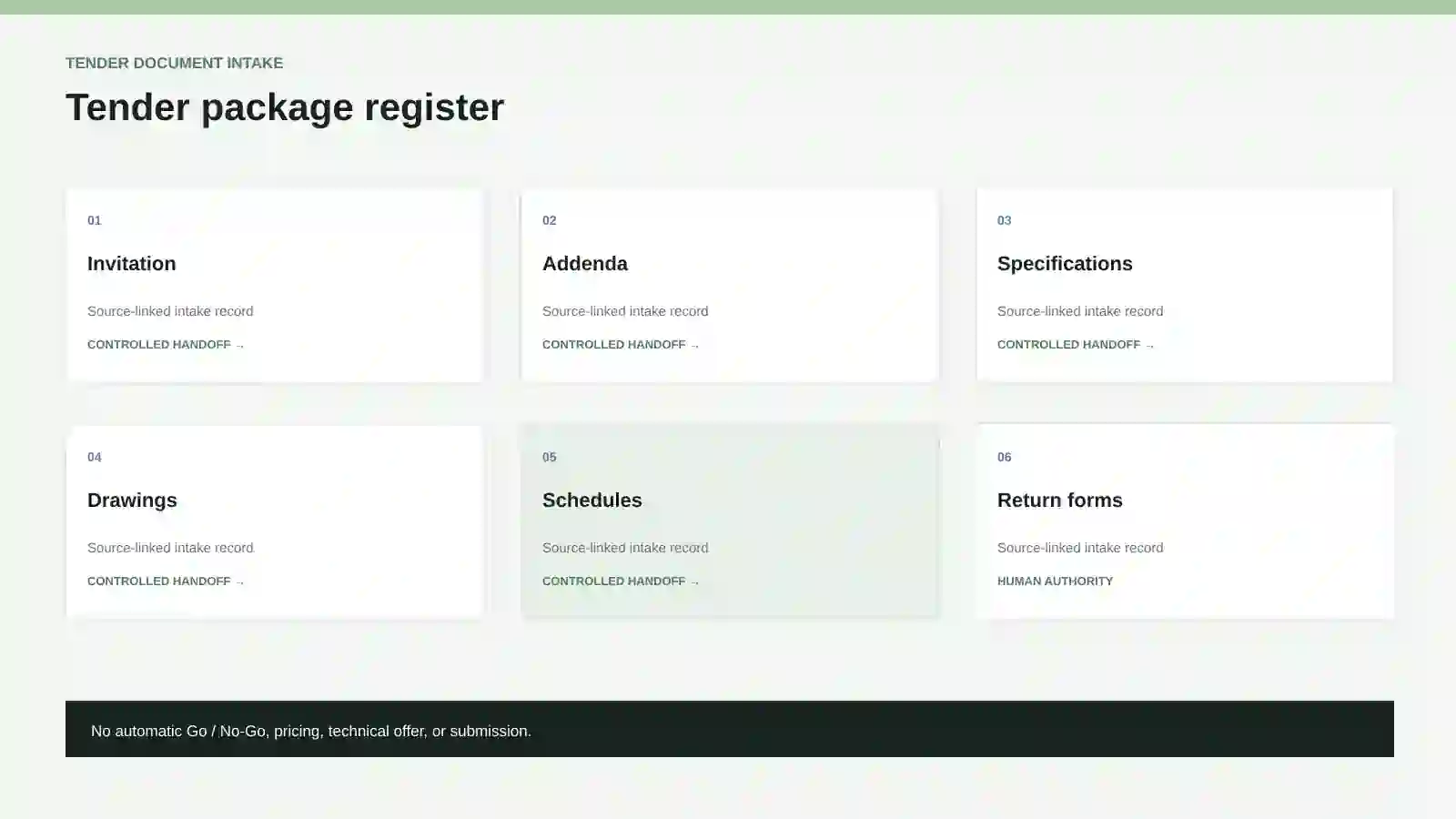
Document ID, type, issuer, revision, date, source, status, and relationship remain visible before field extraction.
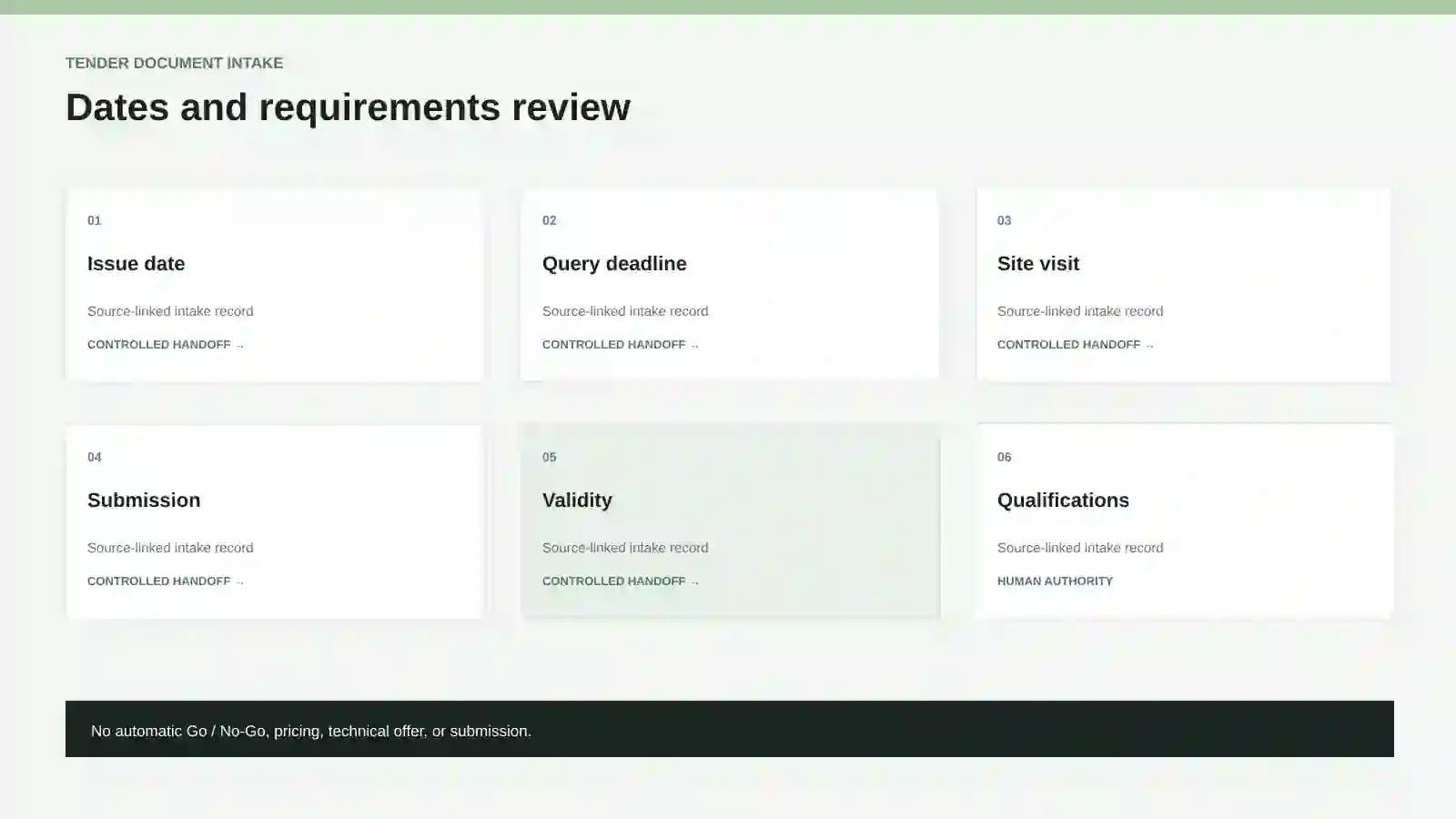
Issue, query, visit, submission, validity, and qualification dates retain source citations and conflict state.
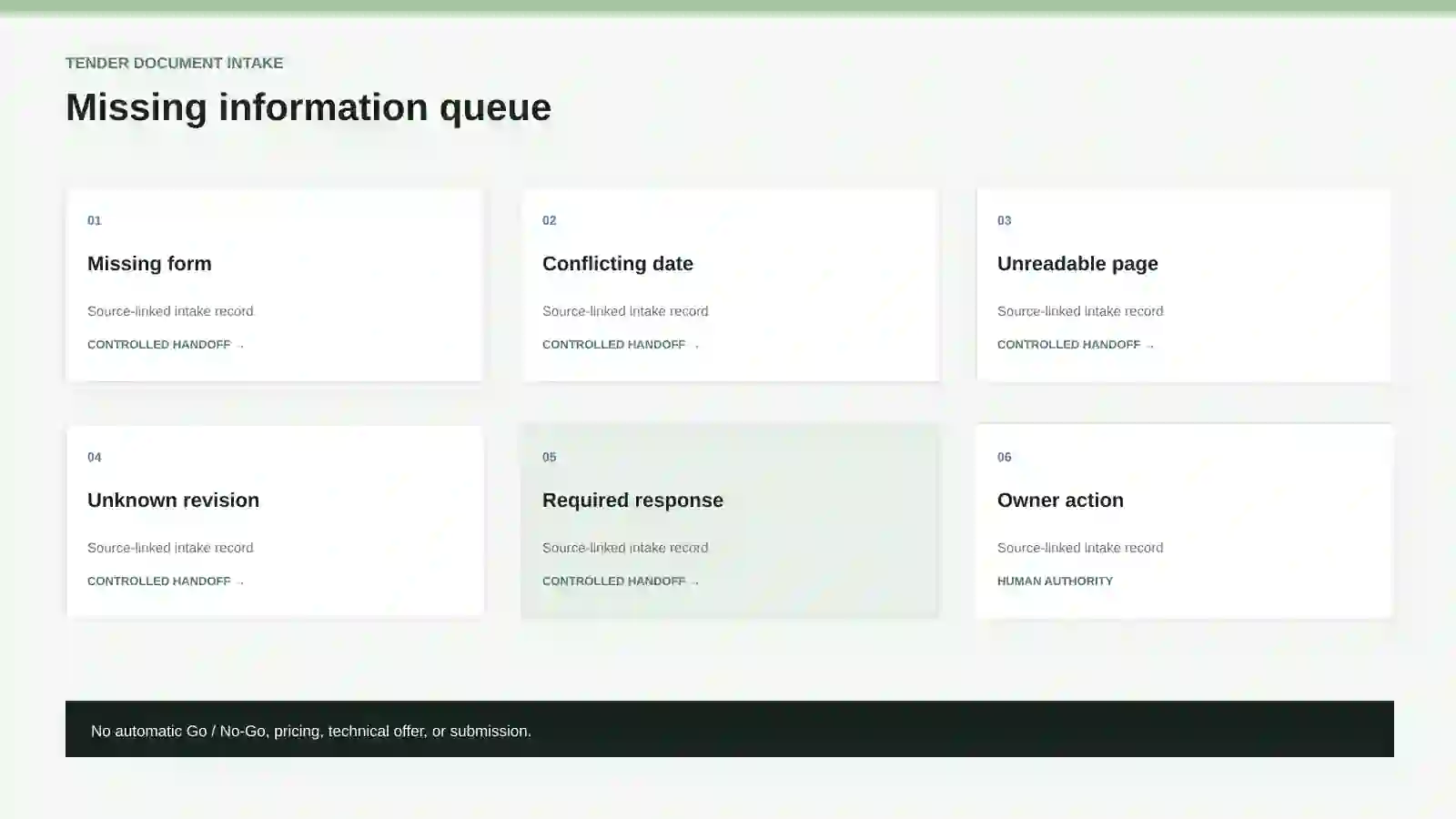
Missing forms, unreadable pages, conflicting dates, unknown revisions, and unresolved requirements receive owners and review states.
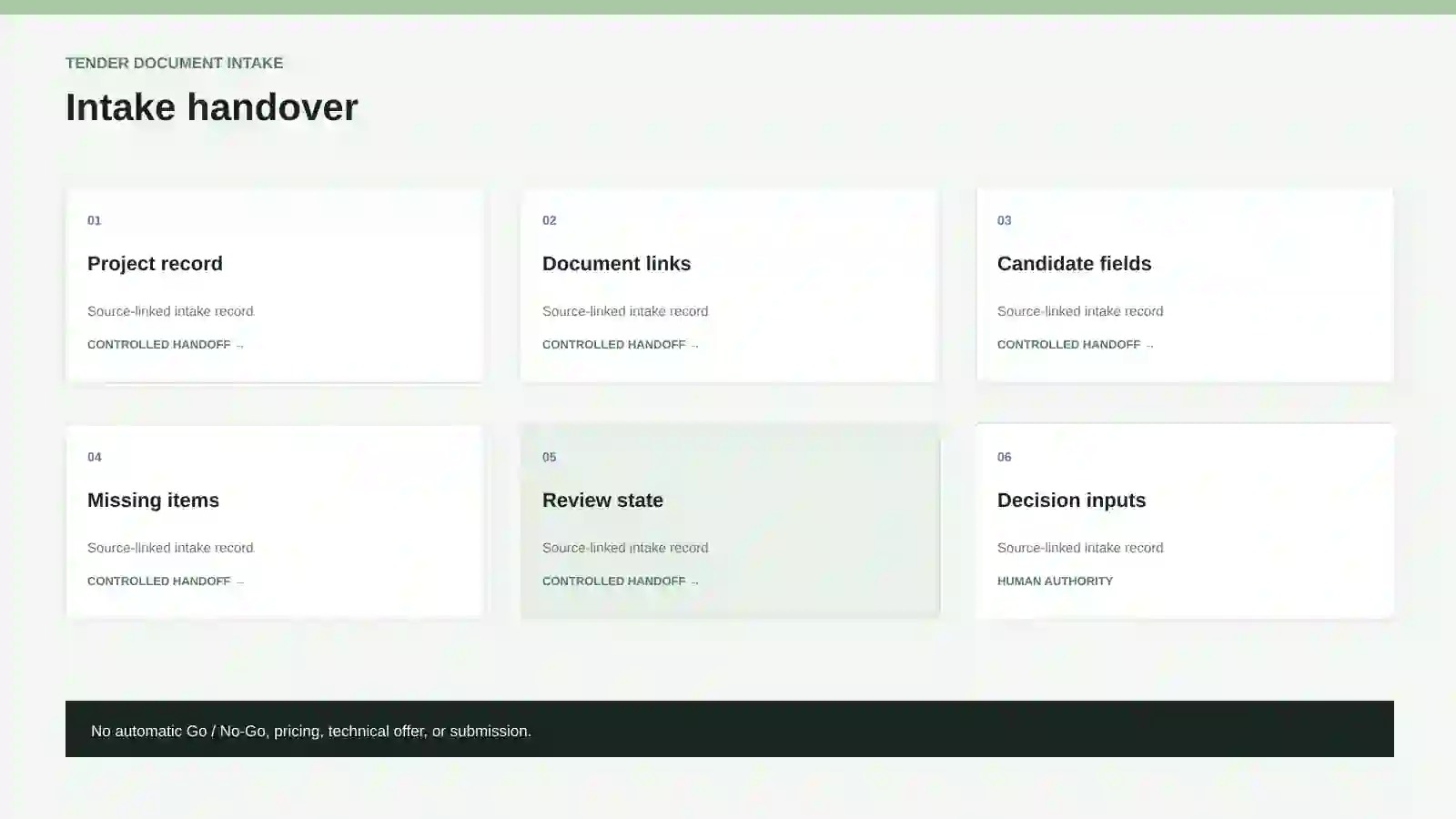
The completed intake record supports later human decisions without making them automatically.
User journey
The interface can feel simple while the pilot preserves document identity, revision, permission, retrieval, uncertainty, and review evidence behind every result.
Assign tender, opportunity, client, source, received-time, owner, purpose, permission, confidentiality, and retention records.
Fingerprint every file and record type, issuer, date, revision, status, source, relationship, quality, and supersession.
Apply OCR, page boundaries, reading order, headings, tables, forms, schedules, drawing references, and extraction-quality warnings.
Extract project details, dates, scope categories, qualifications, return documents, contacts, instructions, and source citations.
Compare addenda, schedules, forms, and instructions for missing files, conflicting dates, unknown revisions, and unresolved requirements.
An authorized reviewer opens cited pages, corrects fields, resolves document state, records missing information, and assigns follow-up.
Freeze the reviewed intake record with source versions, corrections, unresolved items, owner, timestamp, and permitted downstream use.
Provide structured inputs to separate Go/No-Go, estimating, technical, commercial, and submission workflows under human authority.
Technology options
The final selection records exact versions, licences, data handling, cost, limitations, replacement options, and the evidence required before use.
| Component | Examples | Pilot role | Boundary |
|---|---|---|---|
| OCR and layout | Docling, approved OCR, table and document-layout services | Recover text, tables, forms, headings, page coordinates, and document structure. | OCR, reading order, tables, and hierarchy can be wrong; the identified source file and revision remain controlling. |
| Claude Sonnet | Exact available Claude Sonnet model selected at pilot start | Prepare source-linked candidate details, requirements, qualifications, missing items, and review questions. | Model output does not interpret contractual obligations or authorize a tender decision, response, price, or submission. |
| GPT-5.6 tiers | Luna, Terra, or Sol with exact model ID and version recorded | Compare candidate extraction, long-context handling, structured output, and review effort for the bounded package. | Tier naming, availability, context, cost, and behavior can change; model selection requires current verification and evaluation. |
| Qwen3.7-Plus | Exact Qwen3.7-Plus endpoint and version recorded | Prepare structured candidate fields or compare multilingual and multimodal handling where approved. | Endpoint availability and capability do not establish tender accuracy, confidentiality, or accepted use. |
| Deterministic controls | Package registry, schema, date rules, required-field checks, source citations, permissions | Enforce identity, source, revision, field, citation, status, and output conditions outside the model. | Rules depend on correct source records, tested logic, exceptions, monitoring, and ownership. |
| Review interface | Client-owned intake form, document viewer, date conflict and missing-item queue | Show each candidate beside its source page, revision, confidence, correction, and accepted state. | Accepting intake confirms the record for its named purpose only and does not approve the tender. |
Client-owned pilot outputs
Evaluation evidence
A fluent answer is not the acceptance unit. The pilot tests whether a reviewer can reach the controlling evidence efficiently and detect important failure.
Did the register identify every supplied file, type, revision, relationship, duplicate, superseded item, and missing expected document?
Does each accepted project detail, date, scope, qualification, or requirement point to the controlling page and section?
Did the workflow expose conflicting dates, revisions, instructions, and requirements rather than silently choosing one?
Did it identify absent or unreadable information and avoid filling gaps with unsupported values?
Measure time to inspect, correct, reject, resolve conflicts, assign gaps, and accept the intake record.
Measure preparation, OCR, parsing, model use, storage, review, correction, monitoring, support, and reprocessing per accepted package.
Cost drivers
Scaling factors
Use durable package and document IDs, queues, fingerprints, deduplication, retries, checkpoints, and retention.
Reprocess only affected records while preserving prior source, accepted value, correction, and decision history.
Version field schemas, document expectations, terminology, dates, qualifications, forms, and review roles by client and tender type.
Preserve opportunity, client, project, user, document, purpose, retention, and export permissions across every route.
Keep documents, schemas, citations, corrections, tests, and accepted records independent of any provider.
Require separate security, integration, monitoring, recovery, service, training, ownership, and cost approval.
Cross-industry reuse
The reusable capability is permission-aware multilingual retrieval across versioned documents with citations. Each industry keeps its own source authority, terminology, consequence, retention, and qualified review.
Client tender packages, addenda, specifications, drawings, schedules, return forms, and subcontractor quotes.
Review: Preconstruction, estimating, commercial, design, legal, and authorized bid leadership.
Trade invitations, scopes, drawings, specifications, bills, schedules, supplier and subcontractor quotations.
Review: Estimator, commercial lead, operations, procurement, engineering, and authorized management.
Consultant appointments, contractor tenders, work packages, development requirements, and commercial submissions.
Review: Development, project, design, procurement, cost, legal, and commercial authority.
Technical invitations, scopes, schedules, qualifications, deliverables, consultant and supplier proposals.
Review: Technical lead, bid manager, commercial, legal, quality, and authorized signatory.
Design invitations, briefs, deliverable schedules, consultant scopes, forms, and fee submissions.
Review: Practice leadership, bid lead, design, commercial, legal, and quality owner.
RFQs, technical specifications, drawings, bills, supplier quotations, delivery schedules, and qualifications.
Review: Procurement, engineering, production, quality, commercial, and legal owner.
Service tenders, maintenance scopes, asset schedules, compliance requirements, and vendor quotations.
Review: Property, facilities, procurement, compliance, finance, legal, and technical owner.
Service requests, asset lists, response requirements, rate schedules, and subcontractor or supplier quotes.
Review: Service manager, operations, procurement, commercial, safety, and finance owner.
Authority boundaries
Related paths
Continue into the operating, technical, security, and readiness guidance connected to this workflow.
Review pilot scope, evaluation, price range, duration, and possible decisions.
Open pageConnect controlled intake to human Go/No-Go, preparation, review, submission, and learning.
Open pageReview document identity, OCR, revisions, extraction, comparison, citations, and control.
Open pagePrepare cases, expected outcomes, acceptance criteria, critical failures, and monitoring.
Open pageStart with one approved collection
Use general workflow information during the assessment. Do not submit confidential documents, passwords, API keys, authentication codes, or unrestricted system access.
Plain-language route guide
Choose the smallest route that answers your next decision.
The formal service names remain useful for scope and contracts. The plain-language labels explain what each route actually does. These are alternatives, not four mandatory stages.
Operating-Layer Blueprint
Buyer question answered
What should we build, and where should the boundary be?
Typical input
One priority workflow, a named owner, current systems, representative records or files, and known failure points.
Output
A client-owned current-state map, target design, source inventory, implementation boundary, timeline, and fixed quote.
Bounded AI Agent Pilot
Buyer question answered
Can one specific AI-assisted task work reliably enough to justify more?
Typical input
One named task, approved sources and tools, representative cases, a human reviewer, and explicit stop conditions.
Output
A working pilot, evaluation evidence, cost and failure findings, review requirements, and a proceed, revise, or stop recommendation.
Single Workflow Implementation
Buyer question answered
How do we put one recurring workflow into controlled production?
Typical input
A defined trigger and completion point, accountable owners, approximately three core systems, rules, approvals, and test cases.
Output
Connected records, an operating view, integrations, a dashboard, acceptance testing, training, documentation, and handover.
Complete Operating Layer Implementation
Buyer question answered
How do we connect shared data and decisions across teams?
Typical input
Two to five related workflows, shared records, several departments or systems, an executive sponsor, and named operating owners.
Output
A phased operating layer with shared records, permissions, interfaces, integrations, reporting, controlled automation, training, and handover.
Still unsure which route fits?
Describe one broken workflow. The free assessment may recommend a Blueprint, pilot, implementation, a smaller discovery step, or no engagement.