Included
Recurring collection and organization of approved construction opportunity and document information, source linking, change detection, record comparison, workflow state, review, exceptions, monitoring, and handover.
Completed engagement
A completed implementation for a confidential construction opportunity-intelligence and data-operations client. StructuredLayer connected approved browser-accessed sources, opportunity and document records, change controls, exception review, operating visibility, and client-owned handover.
Before
Construction opportunities and supporting documents appeared across multiple authenticated sources. The operating team repeatedly visited portals, downloaded documents, compared listings, checked deadlines, and maintained separate trackers.
Listings could be repeated, changed after publication, or accompanied by new documents. The team needed to determine whether an opportunity was new, whether an existing record had changed, which documents belonged to it, which revision was current, and which deadline required attention.
The starting process depended on manual comparison across source references, business identifiers, project identifiers, document history, and verification times. Baseline volume, labor time, cost, and error rates were not captured as accepted engagement measures.
Boundary
The implementation boundary defined what the system collected and prepared, what entered review, and what remained outside the delivered workflow.
Recurring collection and organization of approved construction opportunity and document information, source linking, change detection, record comparison, workflow state, review, exceptions, monitoring, and handover.
Authenticated browser-accessed opportunity sources, project-listing pages, supporting PDFs and documents, project metadata, source references, and a controlled operating database.
Client identity, portal names, credentials, access configuration, selectors, cookies, commercial records, proprietary documents, exact volumes, and production infrastructure remain confidential.
The workflow did not autonomously make consequential commercial decisions, determine bid strategy, authorize submissions, or accept uncertain and conflicting records as verified state.
What was built
Each part of the implementation retained source evidence, state, exception ownership, and the client’s ability to operate and change the system.
Opportunity, source, project, document, deadline, owner, review state, verification time, and exception information were organized into connected operating records.
Every collected record retained links to the approved source and supporting documents needed for comparison and review.
New values were compared with previously verified values so important changes could be reviewed without erasing prior state.
Repeated listings, possible duplicates, uncertain matches, incomplete fields, and conflicting values entered explicit review paths.
The team could inspect new opportunities, changed listings, document status, deadlines, assigned ownership, failed runs, and unresolved exceptions.
Workflow rules, operating responsibilities, failed retrieval, changed page behavior, access, and recovery were included in the delivered operating model.
What remained human
Operating views
Confidential values are excluded. The views preserve the delivered record and workflow structure without exposing client systems or data.
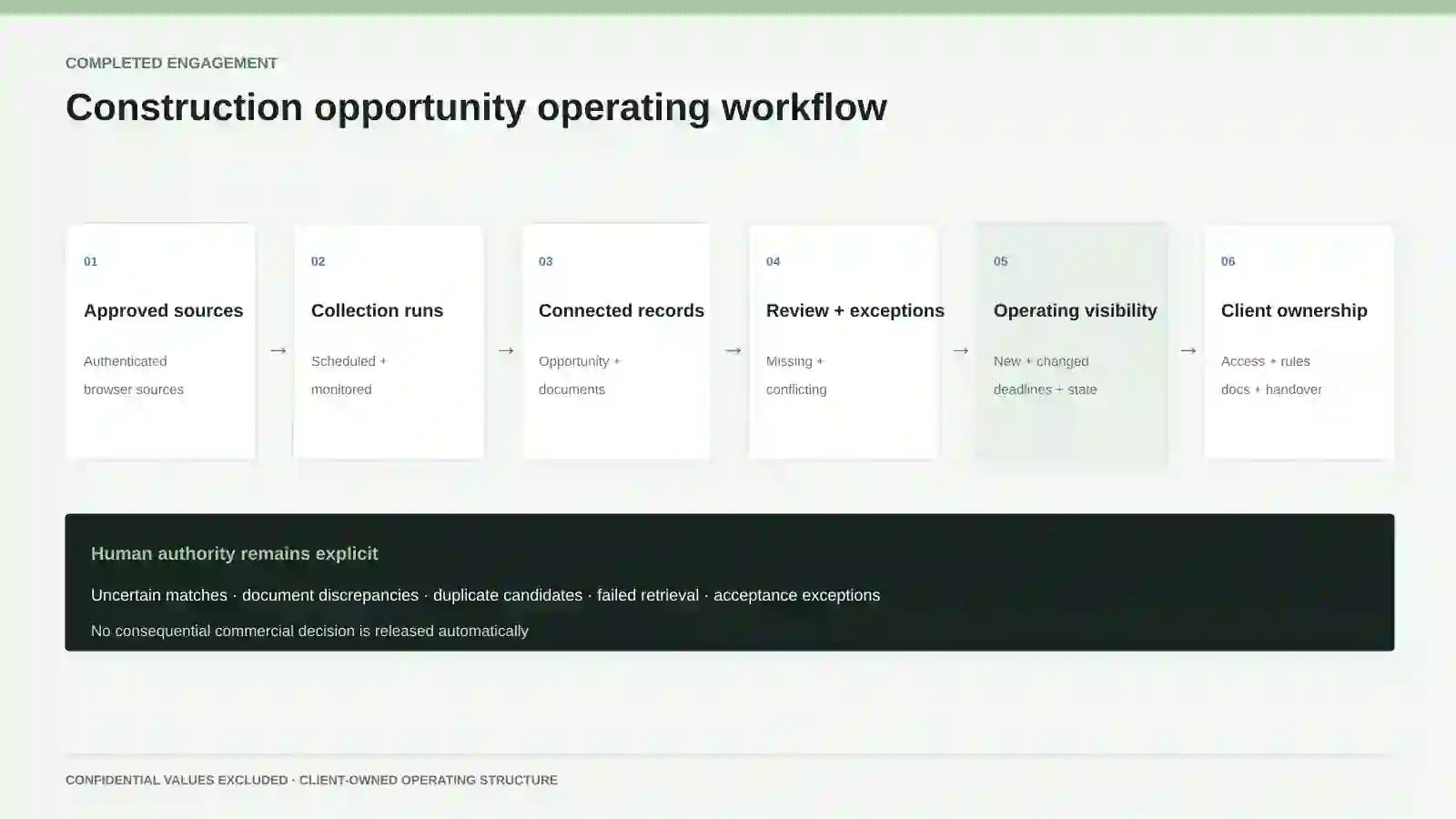
The delivered path connected approved sources to monitored collection, source-linked records, review and exceptions, operating visibility, and client ownership.
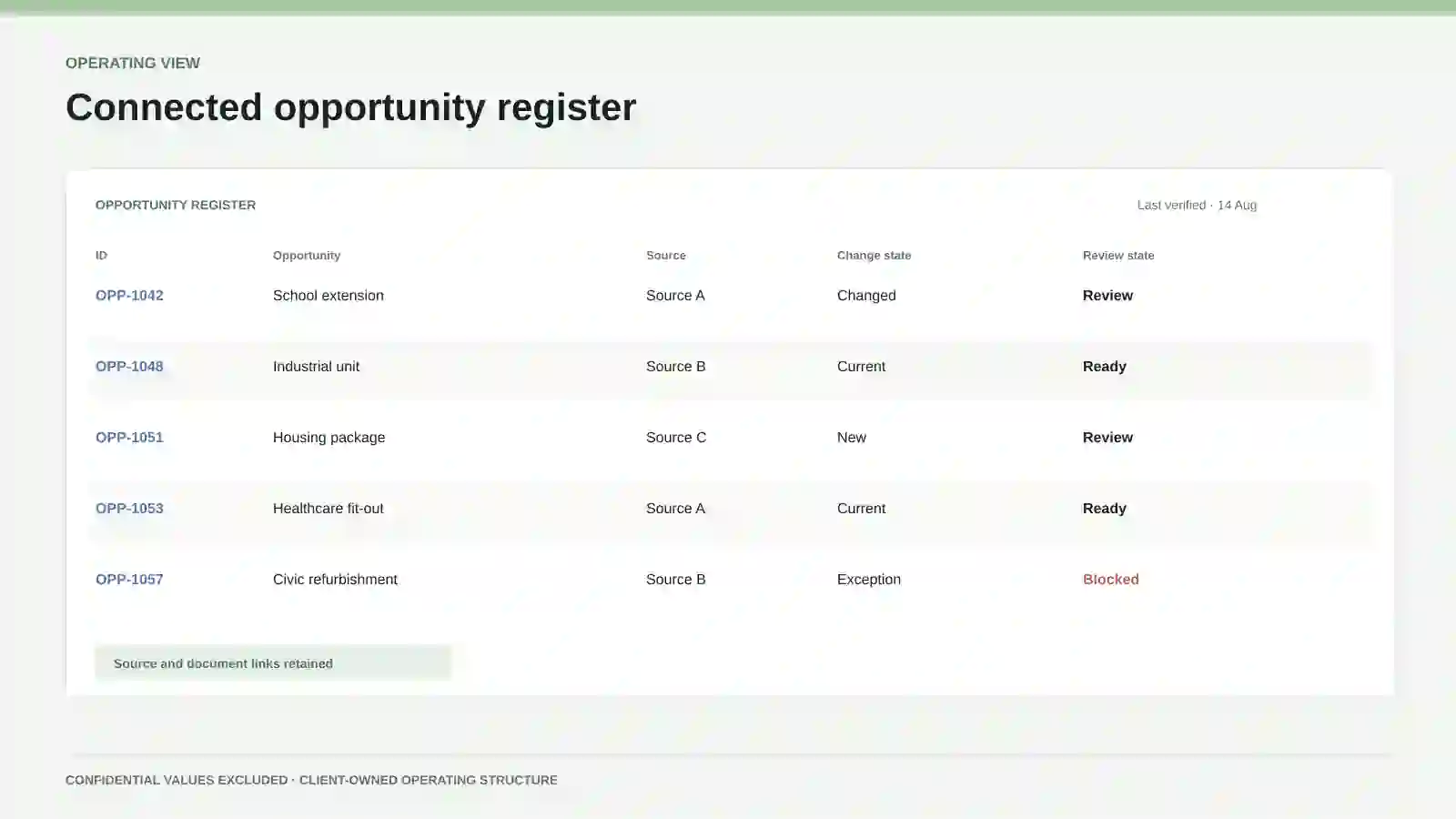
Opportunity, source, change, and review state remained visible together, with source and document links retained.
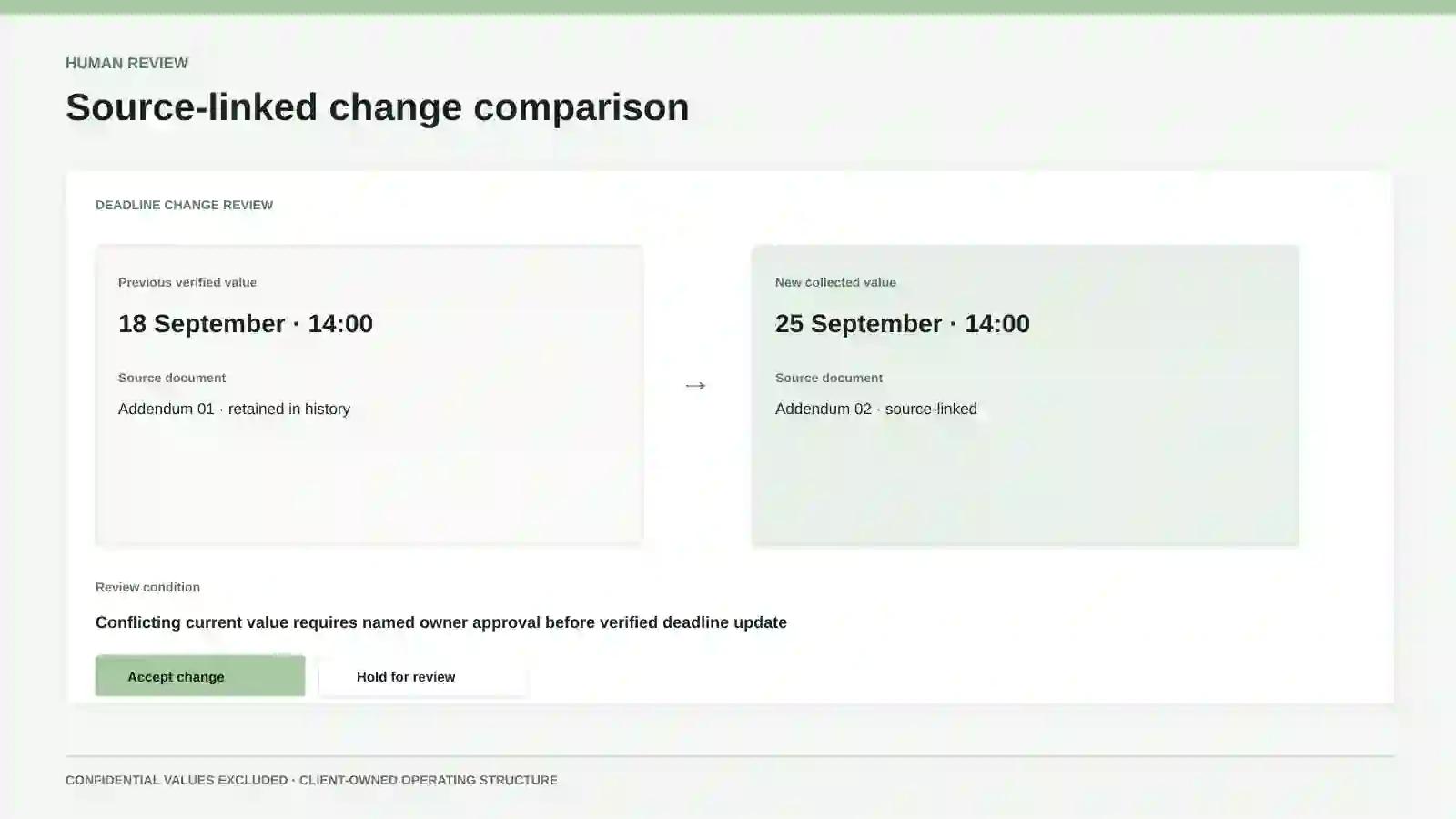
A new source value did not silently replace the verified record. The previous value remained in history until the named owner reviewed the change.
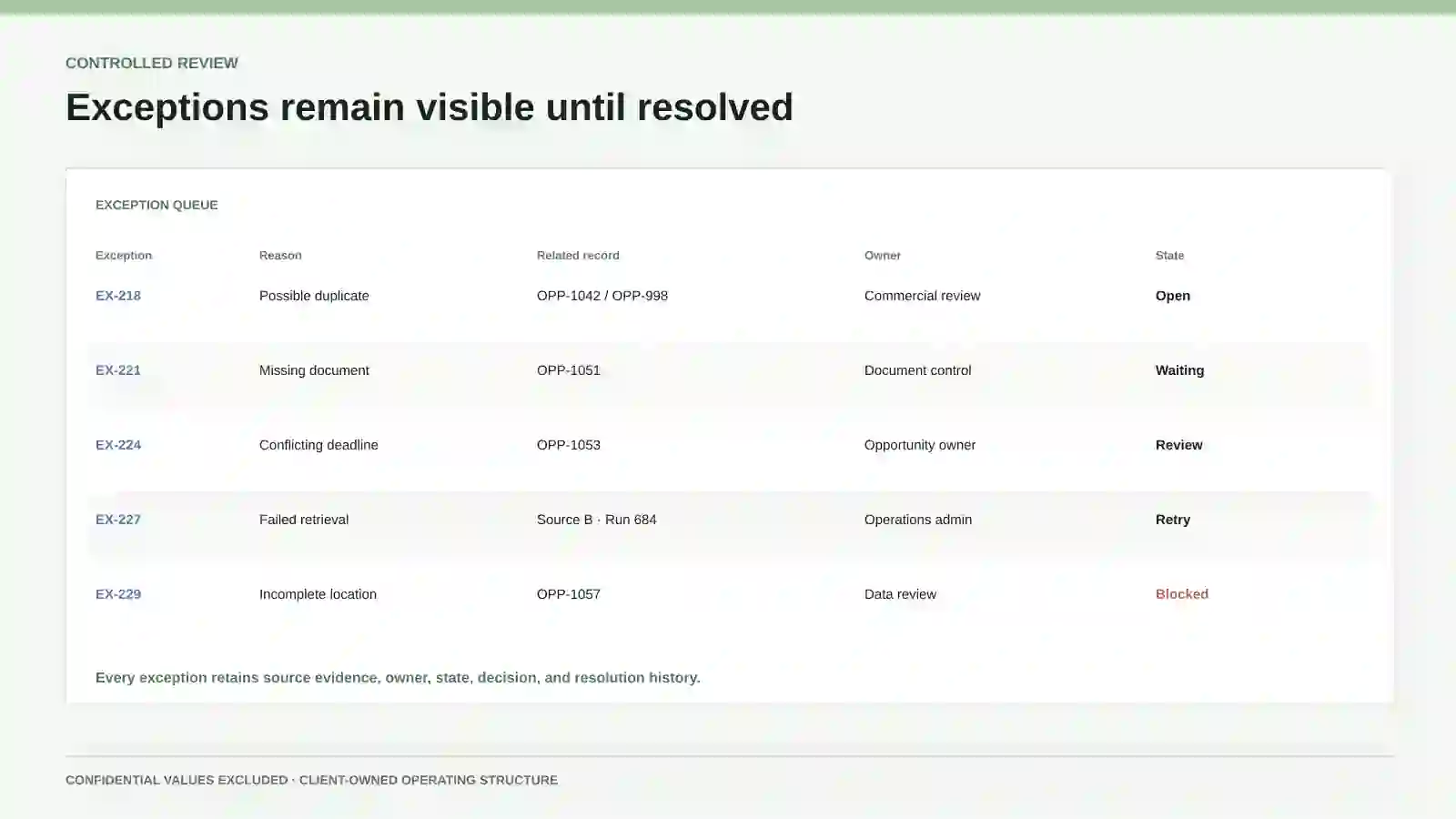
Missing, conflicting, duplicated, incomplete, or inaccessible records remained visible with an owner and resolution state.
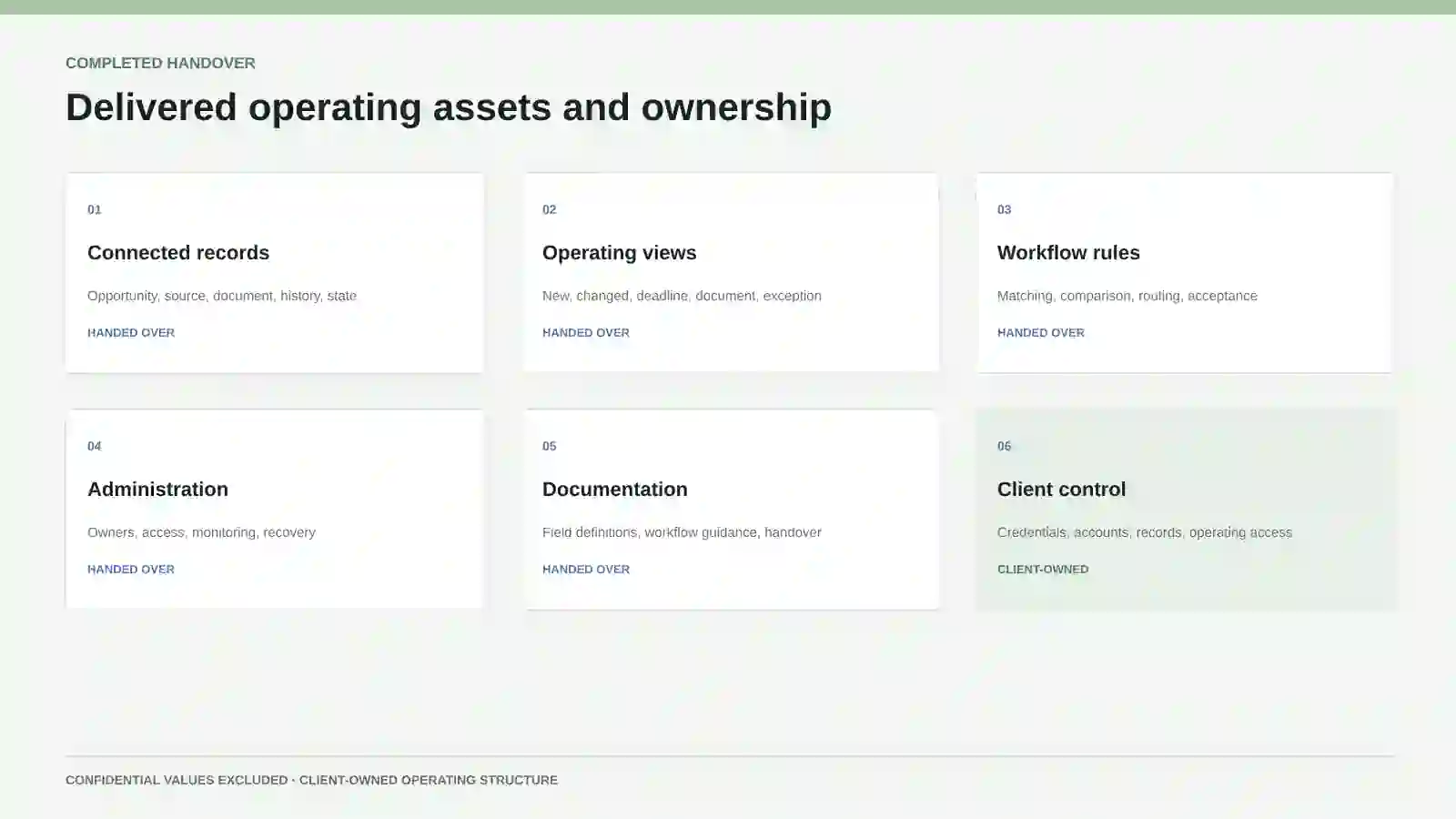
Connected records, views, rules, administration, guidance, credentials, accounts, and operating control remained with the client.
Validation method
The workflow kept failures and uncertainty visible instead of silently accepting incomplete, conflicting, duplicated, or inaccessible records.
New information was compared using source references, business identifiers, project identifiers, document history, and verification timestamps.
Repeated listings were not automatically treated as new opportunities. Uncertain matches entered review before acceptance.
Changed values retained previous verified state and source history until the applicable update met the review condition.
Missing documents, current-revision uncertainty, failed downloads, and document discrepancies remained visible for resolution.
Changed page behavior, failed retrieval, incomplete fields, and inaccessible sources entered monitored exception or recovery states.
Records outside the defined acceptance conditions remained in review. The completed implementation was accepted and handed over within the approved boundary.
Result
The completed implementation established a repeatable operating path for collecting, comparing, organizing, reviewing, and monitoring construction opportunities from approved sources.
It reduced dependence on separate manual trackers and gave the operating team clearer visibility into new records, changed listings, document status, deadlines, review ownership, and unresolved exceptions.
The result was accepted as an operating capability rather than a claim of autonomous decision-making. Human review remained part of uncertain, conflicting, incomplete, and commercially consequential work.
Client-owned handover
Credentials, production accounts, and operating access remained inside the approved client-controlled environment.
Connected opportunity, source, document, history, state, owner, verification, and exception records.
Views for new and changed opportunities, document state, deadlines, ownership, review, failures, and exceptions.
Collection, matching, comparison, change, duplicate, exception, review, and acceptance behavior.
Definitions for the delivered record fields and relationships used to operate and maintain the workflow.
Ownership for access, monitoring, failed collection, review queues, correction, and ongoing operation.
Credentials, production accounts, source access, operating data, and ongoing workflow decisions remained in the client-controlled environment.
Continue
Review the wider evidence record, inspect the implementation approach, or begin with one workflow assessment.
Inspect the wider completed-work record, deliverables, ownership, and due-diligence path.
Open pageFollow sources, triggers, connected records, controls, review, accepted state, monitoring, and handover.
Open pageDescribe one operating problem, the current systems, expected output, and person who must verify it.
Open pagePlain-language route guide
Choose the smallest route that answers your next decision.
The formal service names remain useful for scope and contracts. The plain-language labels explain what each route actually does. These are alternatives, not four mandatory stages.
Operating-Layer Blueprint
Buyer question answered
What should we build, and where should the boundary be?
Typical input
One priority workflow, a named owner, current systems, representative records or files, and known failure points.
Output
A client-owned current-state map, target design, source inventory, implementation boundary, timeline, and fixed quote.
Bounded AI Agent Pilot
Buyer question answered
Can one specific AI-assisted task work reliably enough to justify more?
Typical input
One named task, approved sources and tools, representative cases, a human reviewer, and explicit stop conditions.
Output
A working pilot, evaluation evidence, cost and failure findings, review requirements, and a proceed, revise, or stop recommendation.
Single Workflow Implementation
Buyer question answered
How do we put one recurring workflow into controlled production?
Typical input
A defined trigger and completion point, accountable owners, approximately three core systems, rules, approvals, and test cases.
Output
Connected records, an operating view, integrations, a dashboard, acceptance testing, training, documentation, and handover.
Complete Operating Layer Implementation
Buyer question answered
How do we connect shared data and decisions across teams?
Typical input
Two to five related workflows, shared records, several departments or systems, an executive sponsor, and named operating owners.
Output
A phased operating layer with shared records, permissions, interfaces, integrations, reporting, controlled automation, training, and handover.
Still unsure which route fits?
Describe one broken workflow. The free assessment may recommend a Blueprint, pilot, implementation, a smaller discovery step, or no engagement.