AI Technology Brief
Generative AI vs automation vs AI agents vs agentic AI: what is the difference?
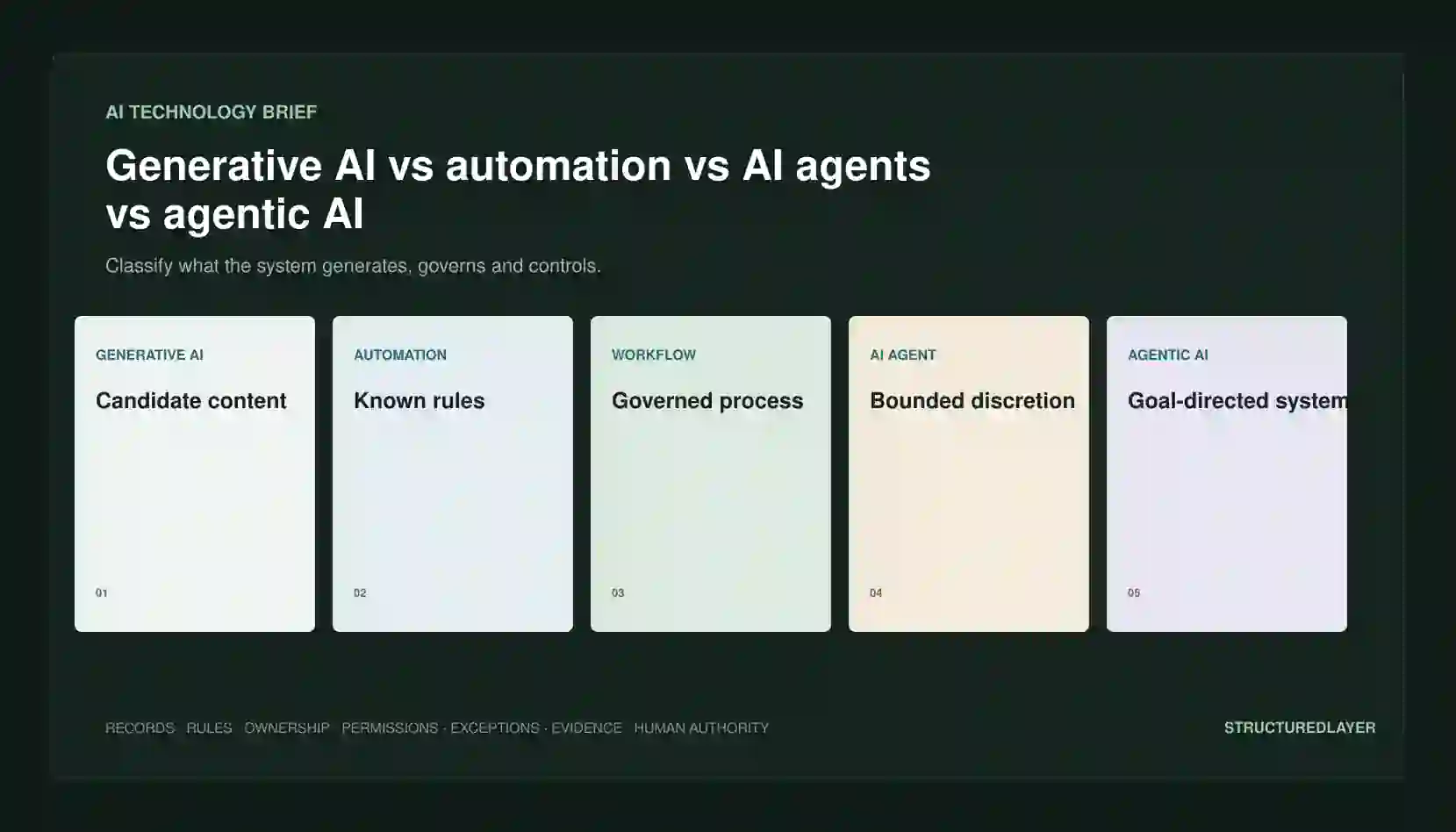
Generative AI creates candidate content. Automation executes known rules. A workflow governs state, ownership, exceptions, and approvals. An AI agent dynamically chooses permitted steps or tools. Agentic AI describes goal-directed discretion; it does not require multiple agents or unrestricted autonomy.
01 / Independently verifiable claims
Begin with what the technology and standards actually support.
- NIST defines generative AI as a class of models that generates derived synthetic content, including text, images, video, audio, and other digital content.
- NIST describes AI agents as software systems that use data and algorithms to autonomously perform tasks, while emphasizing identification, authorization, auditing, and appropriate access controls.
- Anthropic distinguishes workflows, where code controls predefined paths, from agents, where a model dynamically directs process and tool use.
- Microsoft documents workflows as explicit graphs controlling order, state, routing, checkpoints, and human approval while agents can handle selected reasoning-heavy steps.
- OpenAI documents agents using tools, handoffs, guardrails, and tracing; each control has an implementation scope and does not transfer business authority to the model.
- NIST describes agentic systems as planning multi-step tasks and taking actions with degrees of autonomy, tool access, identity, authority, and human oversight.
- OWASP identifies excessive functionality, permissions, and autonomy as separate causes of excessive agency.
02 / The practical distinction
Generative AI, automation, workflows, agents, and agentic systems differ by what they generate, govern, and control.
These categories can be combined inside one operating system. They are not a universal maturity ladder, and a product can use different modes for different tasks.
Candidate content
Generative AI
A model generates text, images, code, audio, video, or structured output. Generation alone does not establish tool authority, workflow state, memory, or independent execution.
Known action
Automation
Code or configuration executes predefined triggers, rules, branches, calculations, validations, transfers, notifications, retries, and updates.
Governed process
Workflow
A stateful process controls sequence, ownership, deadlines, routing, approvals, retries, exceptions, recovery, and completion evidence.
Bounded discretion
AI agent
A model interprets approved context and chooses from permitted steps or tools when the exact path cannot be fully predetermined.
System property
Agentic AI
Goal-directed architecture gives one or more agents meaningful discretion over intermediate planning or actions. Multiple agents are optional, and authority must remain bounded.
03 / Operating architecture
Let the workflow govern the agent, not the agent govern the business.
Records and permissions define context; deterministic rules enforce policy; agents handle bounded interpretation; people retain consequential authority.
Data layer
Projects, companies, documents, versions, owners, permissions, decisions, and evidence.
Workflow layer
States, transitions, deadlines, validation, approval, exceptions, retries, and audit history.
Agent layer
Retrieval, classification, drafting, comparison, recommendation, and permitted tool choice.
Human authority
Commercial, contractual, professional, safety, payment, permission, and external-issue decisions.
04 / Required records
Every execution needs business identity, state, evidence, and authority.
Workflow definition
Trigger, input contract, states, transitions, owners, deadlines, acceptance, and prohibited actions.
Automation run
Rule version, source event, inputs, outputs, idempotency key, validation, result, and retry.
Agent run
Objective, context, model, prompt, tools, budgets, choices, observations, citations, and stop reason.
Approval
Action, target, material parameters, evidence, approver, decision, timestamp, and effect.
Exception
Failure type, consequence, checkpoint, technical evidence, owner, due date, and resolution.
Outcome
Accepted business result, source links, reviewer corrections, latency, complete cost, and audit history.
05 / Construction example
RFQ intake shows where each layer belongs.
The agent does not need authority over the whole process to create value.
Automation
Capture
A mailbox event preserves the message and attachments, fingerprints files, and starts one idempotent run.
Workflow
Control
The process validates required fields, assigns an estimator, sets a deadline, and blocks progression on visible exceptions.
Agent
Prepare
AI classifies documents, extracts candidate details, summarizes requirements, and drafts a bid-decision brief.
Human
Decide
An authorized person decides bid or no-bid, resource commitment, price, clarification, approval, and submission.
06 / Deterministic controls
Use deterministic policy around every model-directed choice.
Least privilege
Expose only required tools, records, fields, accounts, domains, and action classes for the current task.
Action policy
Validate identity, target, parameters, permission, amount, state, and approval inside the application or tool.
Budgets
Limit model turns, tool calls, elapsed time, retries, tokens, spend, records changed, and external effects.
Checkpoints
Persist verified state and revalidate context after errors, handoffs, retries, or human takeover.
Approval gates
Bind approval to the exact operation and require it at the point of consequence.
Observability
Trace model choices, tool calls, rule results, approvals, exceptions, and final business outcomes.
07 / Failure analysis
Mislabeling architecture creates the wrong expectations and controls.
Calling a rule an agent
Simple deterministic work becomes harder to test, explain, and operate without gaining meaningful flexibility.
Calling an agent automation
Stakeholders expect identical paths and outcomes even though the model is choosing steps dynamically.
Agent controls workflow state
A model skips required validation, changes ownership, or advances work without the governed transition.
Workflow without exception ownership
The happy path is automated while missing, conflicting, and failed cases accumulate invisibly.
Tool permission equals authority
Technical access is mistaken for permission to make a business, commercial, or contractual decision.
Human review as a vague fallback
No named person, deadline, evidence, or stop state exists when the model becomes uncertain.
08 / Deployment and cost
Architecture determines infrastructure, operating cost, and risk.
Deterministic service
Rules and integrations run as code or workflow jobs. Lower model cost, but integration, monitoring, recovery, and change control remain.
Workflow platform
State, routing, approvals, retries, and audit history operate in a process engine. Licensing and platform constraints require review.
Agent worker
Model, tools, sandbox, queue, run state, tracing, and evaluation add flexible capability plus token, compute, latency, and review cost.
Hybrid operating layer
The workflow controls deterministic stages and invokes agents only where interpretation creates enough value to justify variability.
- Integration build and source-system access
- Workflow orchestration, state, queue, and audit storage
- Model tokens, tool calls, browser or sandbox compute
- Human approvals, exception handling, support, and training
- Evaluation cases, regression testing, monitoring, and incident response
- Complete cost per accepted outcome, including failed and rescued runs
09 / Evaluation
Evaluate the layer that actually controls each outcome.
- Automation: rule accuracy, duplicate prevention, latency, retries, and accepted updates
- Workflow: correct state, owner, deadline, approval, exception, recovery, and completion evidence
- Agent: task success, tool choice, groundedness, critical errors, abstention, and budget compliance
- Human boundary: consequential actions blocked until authorized approval
- System outcome: reviewer effort, operating reliability, complete cost, and business acceptance
- Change control: regression results after rule, workflow, prompt, model, tool, or permission changes
10 / Controlled pilot
Prove the operating boundary before expanding it.
Classify the work
Separate known rules, governed stages, uncertain interpretation, and consequential decisions.
Start deterministic
Implement identity, validation, routing, state, exception, and approval controls first.
Add one agent task
Give the model one bounded objective, approved context, limited tools, and explicit stop conditions.
Test failures
Use missing evidence, ambiguous inputs, tool errors, injection attempts, timeouts, and duplicate events.
Measure complete cost
Include model, infrastructure, workflow, review, exceptions, maintenance, and recovery.
Expand by authority
Add actions only after the prior permission and consequence boundary remains reliable.
Buyer classification test
Classify what the system controls before accepting the label.
- 01
Does the system only generate candidate content? It is using generative AI, but that alone does not make it an agent.
- 02
Are the steps, branches, and actions substantially predetermined in code or configuration? It is primarily automation or a workflow.
- 03
Does a model choose or revise intermediate steps and tools toward a task goal? It is plausibly operating as an AI agent.
- 04
Does the wider system give meaningful goal-directed discretion over planning or actions? It has agentic characteristics, even if only one agent is involved.
- 05
Does it combine predefined orchestration with one bounded model-directed step? Describe it as an AI-assisted or agentic workflow instead of overstating full autonomy.
- 06
Who controls permissions, stop conditions, approval, and the accepted business outcome? Those boundaries matter more than the marketing label.
Direct buyer answers
Common questions about AI agent labels.
Is ChatGPT an AI agent?
ChatGPT is a product with several operating modes. A normal conversational response is generative AI. Research, coding, computer-use, or agent modes may use tools and multi-step execution. Classify the actual mode and task by what the system controls rather than applying one label to the whole product.
Is Zapier, Make, n8n, Lindy, or Gumloop an AI agent?
These are platforms that can run deterministic automation, AI-assisted workflows, and in some cases model-directed agent tasks. The platform name does not determine the architecture; inspect who selects the path, tools, actions, and completion condition.
Are AI agents and agentic AI the same?
They overlap but are not identical labels. An AI agent is an implemented software system that performs tasks through models, tools, state, and an execution environment. Agentic AI describes goal-directed systems with meaningful model discretion over intermediate actions.
Does agentic AI require multiple agents?
No. One agent can operate agentically. Multiple agents are an orchestration choice that may help specialized work, but they also add handoffs, cost, coordination failures, permissions, and evaluation requirements.
When should a business avoid an AI agent?
Use deterministic automation when the rules, paths, calculations, validations, and expected exceptions can be defined reliably. Add an agent only where bounded interpretation or dynamic tool choice creates enough measurable value to justify variability, evaluation, review, and operating cost.
11 / StructuredLayer recommendation
Use automation for known rules, workflows for governed business processes, and AI agents only where bounded discretion creates measurable value.
Do not buy an agent and then search for autonomy to give it. Begin with the business record, process state, owner, exception, approval, and accepted outcome. Let the workflow invoke the agent for a narrow task, and keep authorization outside the model.
12 / Primary sources
Capability, governance, and implementation claims remain inspectable.
Anthropic
Building Effective AI Agents
Microsoft Agent Framework
Workflows
Microsoft Learn
Workflow-oriented multi-agent patterns
OpenAI Agents SDK
Agents
OpenAI Agents SDK
Tools
OpenAI Agents SDK
Guardrails
OpenAI Agents SDK
Tracing
NIST
Building Evaluation Probes into Agentic AI
NIST CSRC Glossary
Generative Artificial Intelligence
NIST
Identity and Authority of Software Agents
OWASP
AI Agent Security Cheat Sheet
NIST
Artificial Intelligence Risk Management Framework 1.0
Sources reviewed 21 July 2026. Technology capabilities, laws, guidance, terms, and pricing can change.
13 / Related StructuredLayer guidance
Continue from model selection into operating architecture.
AI Workflow Training
Build leadership and team capability to distinguish tools, workflows, agents, verification, governance, and human authority.
Bounded AI Agent Pilot
Test one model-directed business task with limited context, tools, representative cases, cost evidence, and human authority.
AI Agent Authorization
Separate authentication, tool access, permissions, and business approval using action-time external controls.