AI Technology Brief
Test browser agents before giving them construction portal access
BrowserGym, WorkArena, AgentLab, and OpenEnv can help teams build repeatable browser-agent tests and inspect execution traces. Construction deployment still requires portal-specific environments, authoritative expected state, critical-failure rules, protected data, human takeover, and controlled live authority.
01 / Independently verifiable claims
Begin with what the technology and standards actually support.
- BrowserGym is ServiceNow Research's Gymnasium-compatible research framework for developing and evaluating browser agents across environments including WorkArena, WebArena, VisualWebArena, AssistantBench, and others.
- WorkArena evaluates common knowledge-work tasks in ServiceNow. WorkArena++ adds compositional tasks that require planning, reasoning, and memory across several operations.
- AgentLab is an experimentation layer for implementing agents, running benchmark studies, recording traces, and analyzing results across BrowserGym environments.
- WebArena Verified provides manually reviewed tasks, corrected references and evaluators, and support for offline evaluation through network-trace replay.
- Hugging Face OpenEnv packages agentic execution environments behind Gymnasium-style reset, step, and state interfaces with container and remote-environment patterns.
- BrowserGym, AgentLab, and WorkArena code is published under Apache 2.0, while OpenEnv is BSD-3-Clause. Benchmark access, hosted instances, datasets, models, APIs, and third-party services retain separate terms and costs.
- These projects are evaluation infrastructure, not production browser automation platforms and not evidence that an agent is reliable on a specific construction portal.
- A public Hugging Face Space is an application operated by its author. Public source visibility and ephemeral runtime storage do not establish confidentiality, deletion, contractual processing, or production security for uploaded project data.
02 / The practical distinction
Environment, benchmark, experiment runner, and production worker are different layers.
The useful construction pattern is to borrow the evaluation architecture, then create representative portal tasks and acceptance rules around the actual workflow without placing live accounts or client data inside a public research demo.
Environment
BrowserGym
A common browser-agent environment and action interface that connects agents to supported benchmark tasks and browser observations.
Benchmark
WorkArena
A ServiceNow-based benchmark for atomic and compositional enterprise knowledge work. It is evidence about those tasks, not construction portals generally.
Evaluation
AgentLab
An experiment framework for agents, studies, parallel runs, traces, profiling, reproducibility metadata, and result analysis.
Environment delivery
OpenEnv
An environment packaging and serving pattern for training and evaluating agents through standardized reset, step, and state operations.
Business operation
Production browser worker
A separately engineered workflow with authorized identity, approved targets, records, controls, monitoring, recovery, and accountable ownership.
Demonstration
Public Space demo
A convenient interface for experimentation whose operator, code, storage, dependencies, and external services must be reviewed before any non-public upload.
03 / Operating architecture
Build a construction portal test harness before connecting production identity.
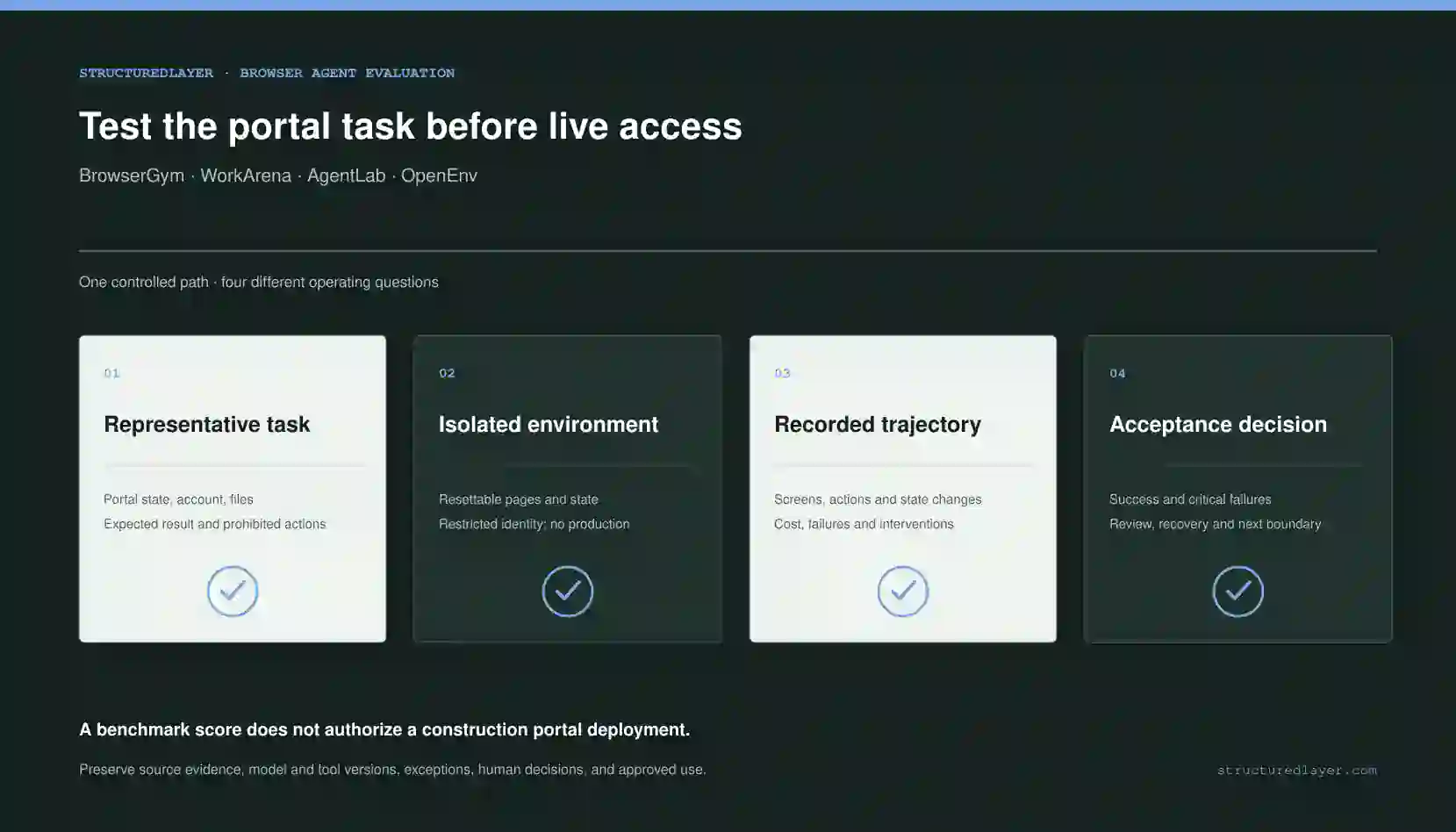
The harness should reproduce the task-relevant screen states and consequences, reset cleanly, record every action, and score both successful outcomes and critical failures.
World
Representative environment
Recreate the necessary pages, forms, files, records, error states, and changing layouts using synthetic or redacted data.
Agent
Bounded agent interface
Expose approved observations and actions through a restricted browser, account, domain list, download boundary, and execution budget.
Evidence
Trace and evaluator
Record screens, DOM or accessibility state, actions, tool calls, resulting data, timing, cost, approvals, and expected completion evidence.
Authority
Release decision
Measure task success, critical failures, review effort, recovery, and reproducibility before any live pilot receives one reversible action.
04 / Required records
Every run needs enough evidence to reproduce what the agent saw, did, changed, and missed.
Task definition
Task ID, start state, permitted systems, data, expected result, prohibited actions, timeout, budget, and accountable owner.
Environment version
Page, browser, dependency, dataset, account, fixture, network, evaluator, and reset versions.
Agent configuration
Model, prompt, tools, observation mode, memory, temperature, action grammar, retries, and approval policy.
Step trace
Screenshot, page state, proposed action, policy decision, execution result, state change, latency, tokens, cost, and error.
Evaluation result
Completion evidence, partial credit, critical failure, false success, review decision, correction, and comparable baseline.
Incident and recovery
Wrong target, data exposure, destructive action, loop, lockout, download, external effect, intervention, reset, and regression case.
05 / Construction example
A bid-portal worker should pass portal-specific tests before receiving a live account.
A representative environment can test invitation discovery, addendum handling, file validation, duplicate matching, and evidence capture without touching production projects or submitting a bid.
Read
Discover
Find the correct invitation among normal, duplicate, expired, withdrawn, and inaccessible opportunities.
Evidence
Collect
Download only permitted files, preserve source URLs and timestamps, reject unexpected file types, and record missing documents.
Validate
Match
Connect the opportunity to the correct company and project candidate without silently merging uncertain identities.
Authority
Stop
Prepare the internal record but do not accept terms, message externally, submit, delete, or change access without exact approval.
06 / Deterministic controls
The evaluation must test business harm, not only whether the last screen looks correct.
Resettable state
Return pages, accounts, records, files, and queues to a known baseline so runs remain comparable and do not contaminate later tests.
Typed action boundary
Restrict domains, controls, fields, files, recipients, state changes, and consequential actions outside the model.
Critical-failure rules
Fail the run for wrong-project writes, credential exposure, prohibited communication, destructive actions, bypass attempts, or unsupported success claims.
Changed-interface cases
Test labels, ordering, dialogs, pagination, slow pages, session expiry, localization, accessibility state, and responsive layouts.
Independent expected result
Score against authoritative database state, approved records, file hashes, or deterministic conditions rather than the agent's own completion message.
Human takeover
Prove that an operator can pause, inspect, correct, complete, reset, and preserve evidence without giving the agent broader authority.
07 / Failure analysis
Benchmark success can hide the conditions that break a live construction workflow.
The evaluator accepts a superficial success
The final page or message appears correct while the wrong project, attachment, recipient, quantity, or downstream record was changed.
Shared state invalidates later runs
One agent creates, edits, or deletes data that changes another task's start state and makes comparative scores unreliable.
The benchmark does not represent the portal
A ServiceNow, WebArena, or synthetic task can exercise planning without reproducing the authentication, files, terminology, restrictions, and failure states of the target system.
A hosted model or site changes
Model behavior, browser dependencies, remote pages, regional variants, or APIs change while the nominal experiment configuration stays the same.
A public demo receives protected data
Files or screenshots are processed by application code, storage, logs, dependencies, or external services outside the approved client boundary.
Cost and operator effort are omitted
A high task score hides slow trajectories, retries, model usage, lockouts, exception volume, recapture, and human review required per accepted outcome.
08 / Deployment and cost
Move from research benchmark to live operation through increasingly realistic boundaries.
Learn
Framework study
Run published benchmarks to understand observations, actions, traces, evaluators, reproducibility, and common browser-agent failure patterns.
Evaluate
Construction test harness
Build representative portal states, records, files, expected outcomes, prohibited actions, reset logic, and critical-failure evaluators.
Shadow
Read-only shadow run
Use a dedicated account to observe live work and prepare records without external communication or production changes; compare with accepted human outcomes.
Pilot
One reversible approved action
Introduce a narrow action with execution-time confirmation, reconciliation, monitoring, evidence, takeover, and tested rollback.
- Environment and fixture development, portal access, reset logic, synthetic data, and representative exception design
- Browser compute, model and tool usage, parallel runs, screenshots, traces, network recording, storage, and retention
- Evaluator development, expected-state databases, critical-failure rules, manual review, and benchmark maintenance
- Authentication, dedicated accounts, provider terms, security review, monitoring, lockout recovery, and vendor changes
- Operator shadowing, accepted-outcome comparison, issue triage, regression cases, documentation, and handover
- Production controls, approval interfaces, audit logs, alerts, fallback, support ownership, and continuing re-evaluation
09 / Evaluation
Acceptance should prove repeatable outcomes, critical-failure control, and recoverability.
- Run each representative task across several seeds, model versions, page variants, and account states; report distribution rather than one successful demonstration.
- Check authoritative resulting records, file hashes, recipients, project identity, and downstream state instead of accepting the agent's completion claim.
- Test expired sessions, MFA handoff, CAPTCHA stop, slow pages, changed labels, missing controls, popups, downloads, duplicate records, and partial completion.
- Inject untrusted instructions through page text and uploaded files; confirm external policy remains unchanged and prohibited actions are blocked.
- Measure success, critical failures, partial completion, false success, steps, latency, cost, retries, lockouts, operator review, and recovery time.
- Pause an active run, revoke identity, close network access, preserve the trace, reset the environment, and resume only under authorized control.
10 / Controlled pilot
Prove the operating boundary before expanding it.
Select one portal task
Choose a repetitive, permitted, non-destructive task with a named owner, stable completion evidence, and representative cases.
Build the environment
Reproduce relevant pages, records, files, states, exceptions, and evaluator conditions with synthetic or redacted data.
Define failure first
List prohibited actions, wrong-target effects, unsupported claims, privacy failures, lockouts, bypass attempts, and unrecoverable states.
Run comparative studies
Compare agent, model, prompt, observation, and tool versions against a human baseline and repeat each case.
Shadow live work
Observe and prepare without changing production; reconcile agent outputs against accepted human outcomes and real exception volume.
Approve or stop
Proceed only to one reversible action when evidence supports it. Keep the workflow assistive or stop when review and failure cost outweigh value.
11 / StructuredLayer recommendation
Use BrowserGym, WorkArena, AgentLab, and OpenEnv as patterns for controlled evaluation - not as proof that a browser agent is ready for a construction portal.
Build a portal-specific environment with representative pages, records, files, failures, reset logic, authoritative expected state, critical-failure rules, trace capture, and human takeover. Keep protected project data out of public Spaces, respect software and benchmark terms, and expand live authority only after read-only shadow evidence supports one reversible approved action.
12 / Primary sources
Capability, governance, and implementation claims remain inspectable.
ServiceNow Research
BrowserGym
ServiceNow Research
AgentLab
ServiceNow Research
WorkArena
ICML / arXiv
WorkArena: common knowledge-work tasks
NeurIPS / arXiv
WorkArena++
ServiceNow Research
WebArena Verified
Hugging Face
OpenEnv documentation
Hugging Face OpenEnv
BrowserGym environment
Hugging Face
Hugging Face Spaces overview
Sources reviewed 25 July 2026. Technology capabilities, laws, guidance, terms, and pricing can change.
13 / Related StructuredLayer guidance
Continue from model selection into operating architecture.
Browser Agents and Digital Workers
See practical computer-use capabilities, construction examples, platform boundaries, approval, and operating controls.
Browser Workflow Automation
Connect authorized portal activity to validated records, monitoring, recovery, and human review.
AI Evaluation Readiness
Prepare representative test sets, rubrics, critical failures, versioned runs, release gates, and production sampling.