
AI Technology Brief
When CMiC AI Prepares Construction Records, What Remains Under Contractor Control?
CMiC has announced NEXUS AI capabilities for budgets, job setup, cost transactions, potential change items, daily journals, and project-partner matching. Contractors still need connected records, deterministic validation, named review, exact approval, reconciliation, recovery, and separate authority for accepted project, commercial, and financial effects.
01 / Independently verifiable claims
Begin with what the technology and standards actually support.
- CMiC announced new NEXUS AI capabilities on 9 September 2026 for job budgets, job initiation, job-costing transactions and posting impact, potential change items, daily journals, and project-partner matching.
- CMiC describes its Job Budget Agent as supporting conversational job-budget creation or import with validation, and its Job Initiation Agent as a guided flow across job setup, budgeting, and billing contracts.
- CMiC says its Job Costing Transaction and Posting Impact Agent creates cost transactions while showing their stated impact on budgets, costs, and forecasts.
- CMiC says AI Daily Journals can convert a spoken end-of-day summary into a completed daily journal, while Project Partner Matching maps subcontractor and supplier names to existing project-partner records.
- CMiC documents a Review Before Submission step that allows captured daily-journal material to be reviewed and edited before it is added to the journal.
- The release does not state independent accuracy results, model provider, supported languages, pricing, data retention, customer-specific integration scope, autonomous approval authority, or a complete reconciliation and recovery design.
- CMiC publishes API documentation across supported modules, but a documented interface does not grant posting, payment, approval, or business authority.
- RICS 2026 research reports broader AI activity in construction and commercial property while distinguishing tool use from controlled production maturity. Product availability alone does not establish a contractor-ready workflow.
02 / The practical distinction
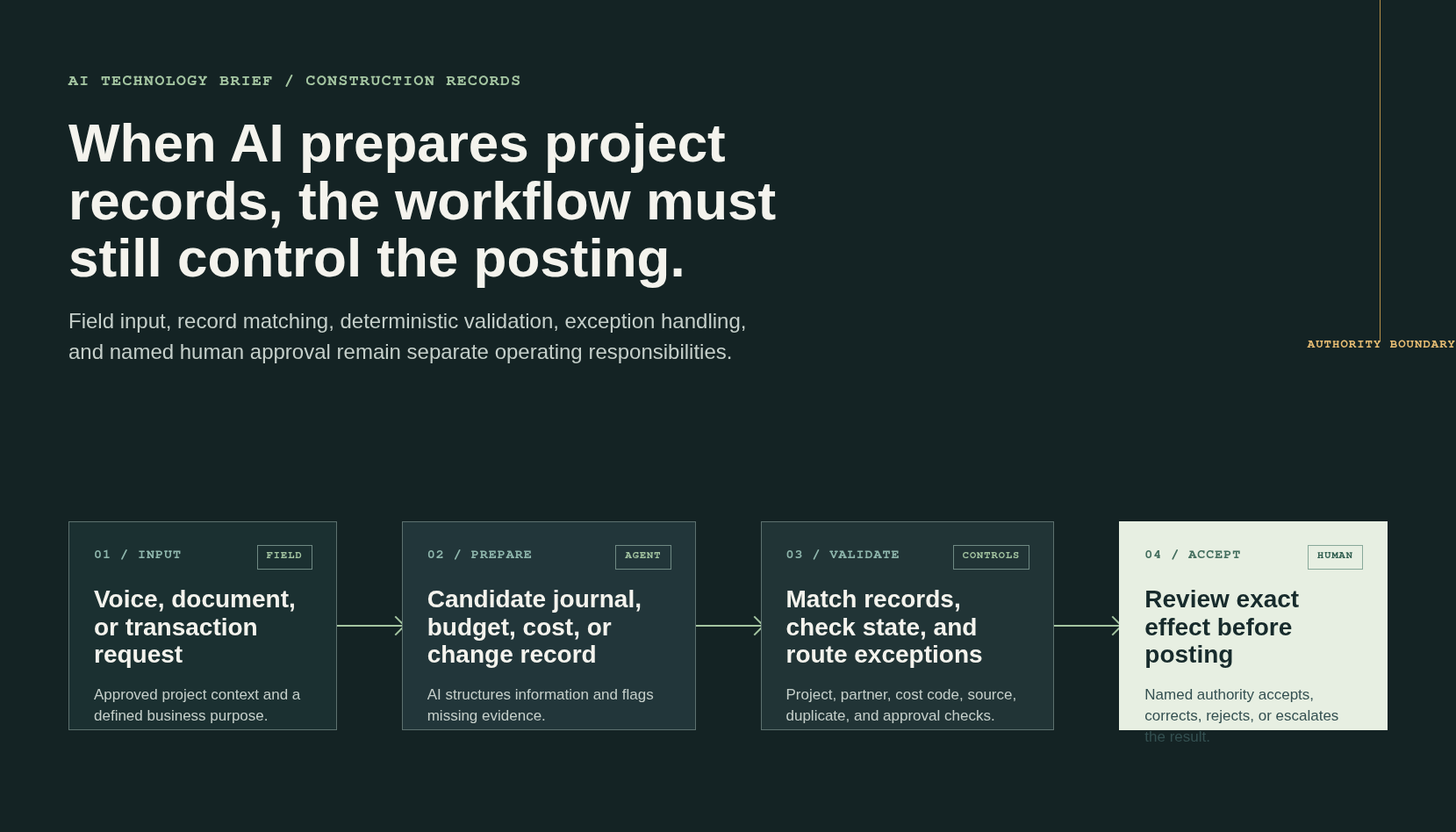
An AI-prepared construction record and an accepted ERP transaction are different states.
The value of an agent is often in reducing preparation work. The system of record, deterministic controls, and named authority should determine whether the candidate becomes business state.
Input
Field statement or source event
A spoken update, document, budget request, cost input, or change description starts a task with incomplete or variable context.
Candidate
AI-prepared record
The agent transcribes, classifies, matches, proposes fields, and identifies missing information or possible affected records.
Control
Validated transaction path
Rules check identity, source, date, cost code, contract, state, units, duplicates, permissions, and required approvals.
Accepted state
Authorized business record
A named person accepts, corrects, rejects, or escalates the exact effect before it posts to the relevant system of record.
03 / Operating architecture
Keep agent preparation inside a controlled construction record lifecycle.
AI can prepare a candidate journal, budget, transaction, or change item. External controls preserve source authority and prevent a plausible match from becoming an unreviewed financial or project effect.
Identified source
Project, contractor, user, source event, document, voice record, effective date, and approved purpose are established before processing.
Candidate preparation
The agent creates structured values, matching candidates, evidence references, uncertainty flags, and a proposed destination without silently accepting the result.
Record and policy checks
Independent services validate company, project, partner, cost code, contract, accounting period, field type, amount, state, duplicate risk, and permission.
Exception and review
Missing, ambiguous, conflicting, restricted, duplicate, or failed cases are visible to a named owner with evidence and a defined next action.
Exact approval
The reviewer sees the exact field values, affected records, evidence, consequence, and destination before approval or rejection.
Reconciliation and recovery
The workflow confirms resulting record IDs and state, detects partial effects, supports reversal or correction, and retains an operating record.
04 / Required records
Preserve the records that let a reviewer reconstruct the preparation and posting decision.
Source event
Origin, user, project context, source file or audio, timestamp, permission, transcription or extraction version, and fingerprint.
Candidate record
Proposed journal, budget, cost, change, or partner mapping values; uncertainty; citations; and each field's evidence location.
Entity match
Candidate company, subcontractor, supplier, project, cost code, contract, work package, confidence, match method, reviewer result, and reason.
Validation result
Required-field, controlled-value, arithmetic, unit, duplicate, status, date, source-authority, and permission checks with rule versions.
Approval decision
Reviewer, authority, exact payload, evidence inspected, correction, decision, rationale, expiry, and resulting permitted action.
Posting and recovery
Destination, resulting IDs, state, reconciliation result, partial effect, reversal or correction reference, exception owner, and closure.
05 / Construction example
A spoken field update can prepare a daily journal without becoming accepted project history by itself.
This is a representative operating pattern based on CMiC's announced Daily Journals and Project Partner Matching capability. It is not a completed StructuredLayer implementation or a claim about the configuration of any CMiC customer.
Capture
Supervisor provides the update
A superintendent describes work, partner activity, quantities, issues, weather, equipment, or progress in a permitted daily update.
Prepare
AI structures the candidate journal
The system transcribes the update, proposes fields, matches named partners, and links the result to identified project context.
Check
Rules and exceptions protect the record
The workflow checks date, project, partner, work package, missing evidence, duplicate entry, required fields, and any conflicting source or status.
Accept
The supervisor reviews before submission
The named field owner corrects or approves the exact journal content. Later commercial, safety, schedule, or contractual use remains separately governed.
06 / Deterministic controls
Apply deterministic controls wherever an agent can affect project, commercial, or financial records.
Purpose-bound access
Limit the workflow to the approved project, modules, records, fields, actions, source classes, and duration needed for one task.
Entity-resolution checks
Use stable IDs, current project assignments, controlled names, relationship checks, and reviewer confirmation rather than treating a name match as identity proof.
State-aware validation
Check current project, document, contract, budget, change, cost, or accounting state before allowing a candidate to advance.
Typed write controls
Validate target, fields, units, dates, amount, cost code, source, action class, idempotency, and approval at the point of consequence.
Visible exception ownership
Route ambiguity, missing evidence, policy denials, failed connections, duplicates, and partial results to a named queue owner with a deadline.
Independent reconciliation
Confirm the resulting source-system record and total, then detect mismatches, repeat events, partial updates, and corrective or reversal needs.
07 / Failure analysis
A fluent or correctly structured record can still have the wrong operational meaning.
Wrong partner match
A spoken or typed name is mapped to a similarly named subcontractor, supplier, company branch, contract, or project relationship.
Correct field, wrong state
A valid amount, date, or work statement is attached to a superseded document, closed period, wrong cost code, incorrect project, or unapproved change path.
Review becomes rubber-stamping
A user sees a complete-looking record but lacks source evidence, time, context, permission, or clarity about the financial or contractual effect.
Duplicate or partial posting
Retries, repeated voice updates, integration errors, or interruptions cause duplicate transactions or only some of the intended updates to occur.
Model or configuration change
A provider, agent, prompt, matching method, integration, permission, or source schema changes behavior without representative regression tests.
Capability becomes authority
A documented ERP feature is treated as permission for autonomous cost, change, billing, payment, contractual, professional, or external action.
08 / Deployment and cost
Choose a narrower record effect before expanding toward live ERP writes.
Read and prepare
Use AI to create a candidate journal, budget, change, or cost record in a draft or review state with cited evidence and no live posting.
Reviewed creation
Allow a named role to approve a typed, validated, exact record payload after source, policy, and state checks pass.
Narrow accepted update
Consider one limited live action only after identity, permissions, reconciliation, exception handling, monitoring, correction, and recovery are accepted for that action.
Cross-system workflow
Keep an operating layer when the record depends on sources or controls across ERP, project management, documents, email, field tools, approvals, or reporting.
- CMiC product, module, agent, integration, implementation, support, and contract terms
- Source preparation, stable identifiers, partner records, project and cost-code relationships, document state, and permissions
- AI and transcription usage, infrastructure, storage, identity, logs, monitoring, and data-path review
- Validation rules, exception queues, reviewer time, corrections, reconciliation, duplicate prevention, and recovery
- Regression tests after product, model, configuration, source, permission, or workflow changes
- Complete cost per accepted journal, budget, transaction, or change record, including rejected and rescued cases
09 / Evaluation
Measure accepted project and financial outcomes, not how quickly an agent fills a form.
- Correct project, company, subcontractor, supplier, contract, cost code, work package, date, unit, amount, and source mapping
- Current-state selection across documents, budgets, changes, cost periods, partner status, permissions, and workflow transitions
- Missing, ambiguous, conflicting, restricted, duplicate, stale, malformed, and adversarial source cases
- Field evidence, entity-match explanation, reviewer correction, approval, rejection, exception routing, and result traceability
- Idempotency, retry, timeout, partial effect, reconciliation, correction, reversal, manual takeover, and recovery behavior
- Critical errors, reviewer effort, accepted rate, cycle time, latency, usage, support demand, and complete cost per accepted outcome
10 / Controlled pilot
Prove the operating boundary before expanding it.
Choose one record outcome
Start with one daily journal, candidate change item, budget preparation, or cost-record draft that has a named owner and clear acceptance boundary.
Prepare accepted examples
Use representative historical and controlled source cases including alternate names, similar partners, wrong projects, incomplete information, changes, and valid exceptions.
Make the candidate state visible
Keep AI outputs distinguishable from accepted records and preserve inputs, evidence, matches, rule results, corrections, approvals, and resulting record IDs.
Keep writes narrow
Begin read-only or draft-first. Do not give the agent autonomy over financial posting, payment, contract position, safety, professional, or external communication decisions.
Test failure and recovery
Exercise failed matching, permission loss, retries, integration delay, repeated inputs, partial posting, reversal, correction, and accountable manual takeover.
Expand from evidence
Compare accepted quality, reviewer effort, critical failures, reconciliation, operating cost, and client ownership before adding another record type or write action.
Buyer classification test
Classify what the system controls before accepting the label.
- 01
Can the workflow prove the correct project, partner, contract, cost code, source, and current state before a record is accepted?
- 02
Does every candidate value retain evidence and a visible distinction from an accepted construction or ERP record?
- 03
Can an independent rule deny or route the action even if the agent, application, and user request it?
- 04
Does the reviewer have the right authority, evidence, context, and exact payload before approving the resulting effect?
- 05
Can the business detect, reconcile, correct, reverse, and explain duplicate, partial, or incorrect activity without depending on the agent?
- 06
Can a contractor repeat the test when CMiC configuration, agent behavior, integrations, permissions, sources, or business rules change?
Direct buyer answers
Common questions about AI agent labels.
Does CMiC's Review Before Submission make an AI Daily Journal correct?
It adds a documented opportunity for review and editing before material is added to the journal. It does not independently establish source completeness, correct matching, factual accuracy, later commercial interpretation, safety compliance, contractual use, or permission to take another action.
Should a contractor enable AI-created cost transactions immediately?
Treat the announcement as a reason to inspect the exact capability, role, permission, record state, validations, approval, reconciliation, recovery, commercial terms, and representative results. Start with a bounded read-or-draft path where the consequence is understood.
What does construction data readiness mean for ERP agents?
For one specific workflow, the needed project, company, partner, cost-code, contract, source, status, permission, approval, and outcome records must be identifiable, connected, current enough, traceable, and owned. It is not an organization-wide file-cleanup score.
11 / StructuredLayer recommendation
Use construction ERP agents to prepare bounded candidate records. Let connected data, deterministic controls, named review, and reconciliation govern every accepted effect.
CMiC's release is a meaningful signal that construction AI is moving from search and drafting toward operational record preparation. Begin with one workflow and define its source records, identities, matching rules, state, permission, exception owner, exact approval, accepted outcome, and recovery path. A useful agent reduces preparation work without becoming the authority for project, financial, commercial, contractual, safety, professional, or external decisions.
12 / Primary sources
Capability, governance, and implementation claims remain inspectable.
CMiC
CMiC expands NEXUS with new AI capabilities across job costing and project operations
CMiC
CMiC developer portal
RICS
Artificial Intelligence in Commercial Property and Construction 2026
Sources reviewed 11 September 2026. Technology capabilities, laws, guidance, terms, and pricing can change.
13 / Related StructuredLayer guidance
Continue from model selection into operating architecture.
Business Data Readiness
Prepare the connected project, company, document, source-authority, ownership, and permission records required for one AI use case.
AI System Readiness
Map integrations, workflow state, queues, idempotency, identities, monitoring, recovery, and handover before connecting AI to operations.
AI Agent Authorization
Separate technical tool access from user, resource, action, approval, and business authority.
CMiC in the AEC Systems Directory
Review CMiC's operating role, records, native IDs, documented access routes, and integration boundary.