
AI Technology Brief
How should EU AI Act transparency become operational evidence?
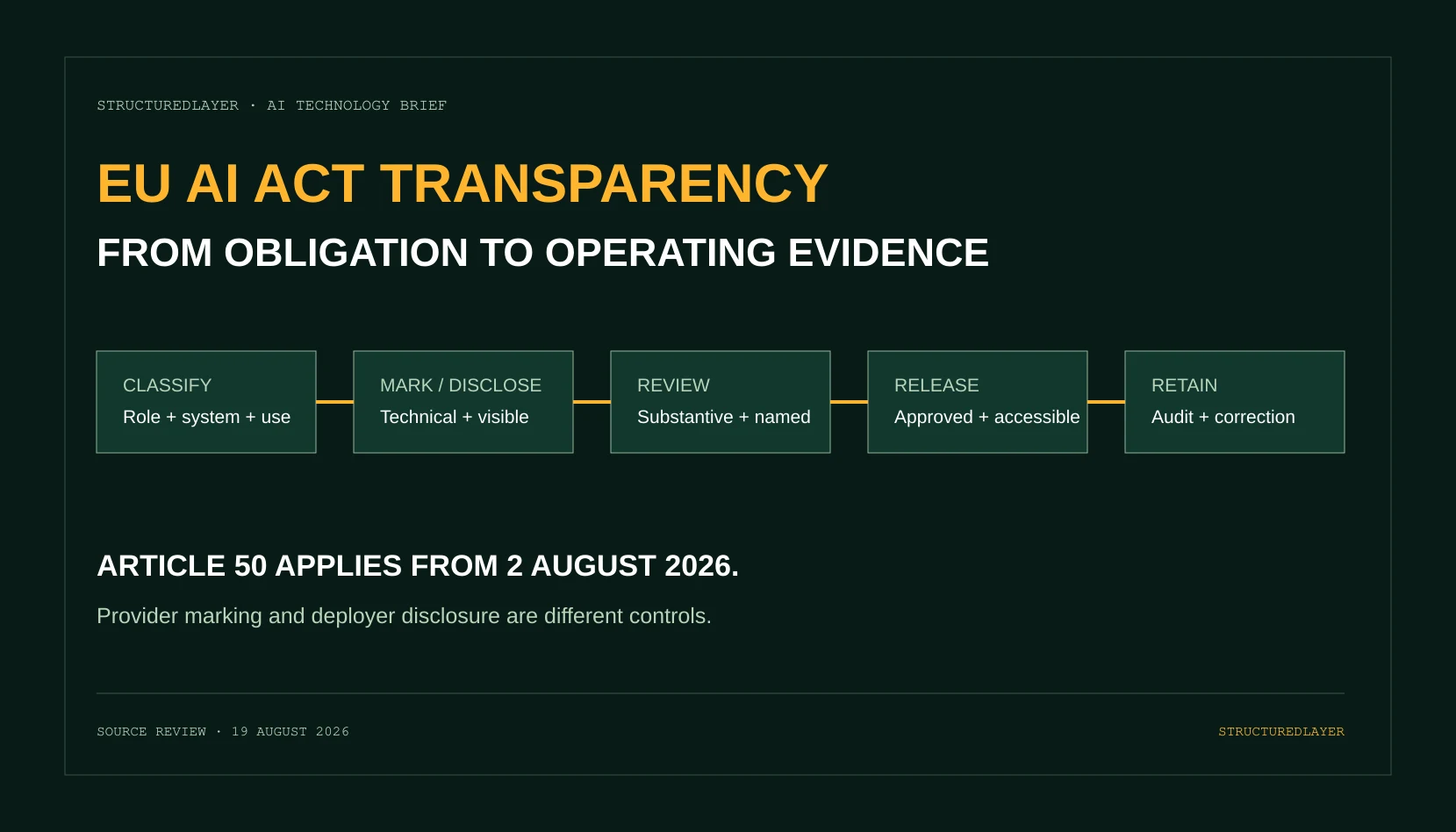
EU AI Act Article 50 transparency obligations apply from 2 August 2026, with distinct provider and deployer duties for interaction notices, machine-readable marking, emotion recognition, biometric categorisation, deepfakes, and public-interest text. Organizations need qualified applicability decisions, release controls, and retained evidence.
01 / Independently verifiable claims
Begin with what the technology and standards actually support.
- Article 50 transparency obligations apply from 2 August 2026. They contain distinct duties for providers and deployers rather than one universal AI label.
- Providers of directly interactive AI systems must generally design them so people are informed they are interacting with AI unless this is obvious to a reasonably informed, observant, and circumspect person.
- Providers of systems generating synthetic audio, image, video, or text content must generally support machine-readable marking and detectability, subject to scope and technical qualifications.
- Deployers must inform exposed people about emotion-recognition or biometric-categorisation systems and disclose qualifying deepfake audio, image, or video content.
- Deployers publishing qualifying AI-generated or manipulated text on matters of public interest must disclose it, subject to the substantive human-review and editorial-responsibility exception and other scope conditions.
- Provider-side machine-readable marking does not replace a deployer's required human-perceivable disclosure. Timing, placement, clarity, and accessibility matter.
- A limited transition to 2 December 2026 applies to Article 50(2) marking and detection for certain systems placed on the market before 2 August 2026; it is not a general postponement of Article 50.
- The Commission timeline moves Annex III high-risk requirements to 2 December 2027 and regulated-product high-risk requirements to 2 August 2028. Those delays should not be misrepresented as postponing current transparency duties.
02 / The practical distinction
Provider marking, deployer disclosure, and internal audit evidence solve different problems.
The correct control depends on the organization's legal role, system function, content type, audience, use, publication context, and applicable exception.
Provider
Design and technical marking
Build required interaction notice and machine-readable marking or detectability into the system where Article 50 applies.
Deployer
Human-facing disclosure
Notify exposed people or disclose qualifying deepfake or public-interest content at the required time and in an accessible form.
Operator
Workflow evidence
Retain classification, source, model, content, review, disclosure, publication, action, correction, and incident records.
Qualified adviser
Applicability decision
Determine legal role, territorial reach, exact obligation, exception, sector overlap, contract terms, and evidence requirements.
03 / Operating architecture
Translate a transparency decision into records, workflow gates, and release evidence.
A policy statement alone cannot show which system produced an output, whether disclosure was required, what a reviewer did, or what the public actually received.
Classify
Organization role, system, use, audience, geography, content type, direct interaction, publication purpose, and potentially applicable rule.
Prepare
Approved sources, prompt or instruction, model and version, generated or manipulated content, technical marking status, and candidate disclosure.
Review
Qualified applicability decision, substantive content review where relied upon, corrections, editorial responsibility, approval, and release conditions.
Publish and retain
Final content, visible or audible disclosure, machine-readable evidence, channel, time, audience, action, correction, withdrawal, and audit history.
04 / Required records
Retain enough evidence to explain the system, content, disclosure, review, and resulting action.
System inventory
Provider, system, version, purpose, owner, deployment role, users, affected people, geography, data, integrations, and change history.
Applicability assessment
Article or other rule considered, facts, actor role, content category, exception, qualified reviewer, decision, date, and review trigger.
Generation or interaction
Run ID, user, source set, instruction, model, tools, output, technical marking, timestamps, and identified limitations.
Human review
Reviewer identity, expertise, evidence inspected, substantive corrections, rejected claims, editorial responsibility, approval, and timestamp.
Disclosure and publication
Required wording or signal, accessibility, placement, channel, audience, first exposure, final asset fingerprint, publisher, and release record.
Change and incident
Changed system or use, missing label, broken marking, incorrect disclosure, complaint, correction, withdrawal, owner, response, and closure.
05 / Construction example
A public project update may require more than adding 'made with AI'.
The organization first determines whether the material is generated or manipulated, concerns a matter of public interest, has substantive human review and editorial responsibility, or includes a qualifying deepfake.
Classify
Identify content and audience
Record the system role, source materials, generated text, synthetic media, intended channel, target audience, geography, and public-interest context.
Review
Test claims and responsibility
A qualified editor checks sources and meaning, makes substantive corrections, rejects unsupported content, and accepts responsibility where applicable.
Disclose
Apply the required control
Use the approved visible, audible, interaction, or technical marking route based on the documented applicability decision.
Retain
Preserve release evidence
Store the final asset, fingerprint, disclosure, technical marking result, review record, publication URL, time, correction, and withdrawal path.
06 / Deterministic controls
Build disclosure into release control rather than relying on user memory.
System and role inventory
Identify provider, deployer, importer, distributor, employer, contractor, publisher, and editorial roles for each real use.
Content classification
Distinguish direct interaction, synthetic media, standard editing assistance, internal non-final material, deepfakes, and public-interest text.
Disclosure templates
Maintain approved wording, visual or audible treatment, timing, accessibility, language, placement, and channel variants.
Technical marking check
Test whether required machine-readable marking survives generation, editing, export, compression, upload, download, and redistribution.
Release gate
Block publication or exposure until required review, disclosure, technical evidence, editorial responsibility, and approval are present.
Monitoring and correction
Detect missing disclosures, changed systems, republished assets, complaints, marking failures, corrections, and required withdrawal.
07 / Failure analysis
A generic AI label can be both excessive and insufficient.
Every AI-assisted item gets the same label
The workflow ignores actor, interaction, content, publication, substantive review, exception, and channel distinctions.
Technical marking replaces visible disclosure
Embedded evidence exists, but exposed people do not receive a required clear and timely human-perceivable notice.
Grammar review is called substantive review
A person fixes wording without examining sources, meaning, claims, omissions, or professional implications.
Delayed high-risk rules are treated as a delay to Article 50
Current transparency controls are postponed because a different part of the regulatory timeline changed.
The label disappears downstream
Editing, screenshots, compression, export, syndication, or another platform removes visible or machine-readable evidence.
A compliance badge replaces applicability analysis
A product feature or vendor statement is treated as proof that the deployer's use, disclosure, records, and sector duties are satisfied.
08 / Deployment and cost
Deploy transparency controls according to the actual system and release route.
Interactive system
Design first-interaction notice, obviousness assessment, accessibility, language, identity, logging, and changed-interface testing.
Internal generation
Keep source, model, output, technical marking, review, and destination evidence even where content remains non-final or closed.
Public content release
Classify text and media, document substantive review and editorial responsibility, apply required disclosure, and preserve the final released asset.
Multi-provider workflow
Carry generation and marking evidence through models, editing tools, asset systems, CMS, social channels, agencies, translations, and archives.
- System inventory, legal-role mapping, use classification, and qualified advice
- Disclosure design, accessibility, translation, templates, and channel implementation
- Technical marking, detection, export, transformation, and persistence testing
- Source verification, substantive review, editorial responsibility, approval, and release control
- Monitoring, complaints, corrections, withdrawals, incidents, retraining, and changed-rule review
- Evidence storage, audit retrieval, vendor changes, cross-border operation, and sector-specific controls
09 / Evaluation
Test whether the right people receive the right transparency and whether evidence survives the workflow.
- Correct actor, system, content, audience, use, geography, obligation, exception, and review classification
- Notice timing, clarity, prominence, accessibility, language, channel, and first-exposure behavior
- Technical marking presence, detectability, accuracy, persistence, interoperability, and resistance to normal transformations
- Substantive human-review quality, source support, correction depth, editorial responsibility, and approval evidence
- Publication fingerprint, disclosure match, downstream republication, correction, withdrawal, complaint, and incident response
- Behavior after model, provider, prompt, editor, export, CMS, channel, law, guidance, or organizational-role changes
10 / Controlled pilot
Prove the operating boundary before expanding it.
Inventory one release path
Choose one chatbot, generated report, public article, image, video, voice, or multilingual publication workflow.
Obtain applicability review
Document the organization role, system function, content, audience, geography, relevant rule, exception, and qualified decision owner.
Build evidence records
Connect source, run, generated asset, technical marking, human review, disclosure, approval, publication, and correction records.
Test normal transformations
Check editing, conversion, compression, screenshots, uploads, downloads, embeds, syndication, translation, and archive retrieval.
Exercise failures
Remove a label, break marking, change a model, publish the wrong version, misclassify content, and test stop, correction, and withdrawal.
Release only after acceptance
Require legal, operational, accessibility, security, editorial, and technical owners to accept their defined evidence and controls.
Buyer classification test
Classify what the system controls before accepting the label.
- 01
What is the organization's role for this exact system and use?
- 02
Is a natural person directly interacting with AI, and if so when and how are they informed?
- 03
Is the output synthetic or manipulated audio, image, video, or text, and which provider marking duty may apply?
- 04
Is the deployer exposing people to emotion recognition, biometric categorisation, a deepfake, or qualifying public-interest text?
- 05
Is any relied-upon human review genuinely substantive, documented, and attached to named editorial responsibility?
- 06
Can the organization prove what was disclosed, technically marked, reviewed, published, changed, corrected, or withdrawn?
11 / StructuredLayer recommendation
Treat EU AI transparency as a classified release workflow with retained evidence, not as one generic label.
Inventory systems and real uses, establish the organization's role, obtain qualified applicability advice, and map each duty to technical marking, human-facing disclosure, substantive review, release approval, and retained evidence. Recheck current Commission guidance and applicable sector rules before deployment or material change.
12 / Primary sources
Capability, governance, and implementation claims remain inspectable.
EUR-Lex
Regulation (EU) 2024/1689
European Commission AI Act Service Desk
When does enforcement start?
European Commission
Transparency obligations under Article 50
European Commission
Guidelines on transparency obligations
European Commission
AI-generated content transparency
Sources reviewed 19 August 2026. Technology capabilities, laws, guidance, terms, and pricing can change.
13 / Related StructuredLayer guidance
Continue from model selection into operating architecture.
Construction Data and Workflow Governance
Design source, permission, approval, action, audit, and recovery evidence into the operating workflow.
Privacy and Security Readiness
Assess information classification, lawful purpose, access, providers, locations, retention, and incident ownership.
AI Agents for Business Operations
Place bounded agents inside approved context, validation, human authority, monitoring, and recovery.