
AI Technology Brief
StructuredLayer adds face matching to the data layer - but a match is not identity proof
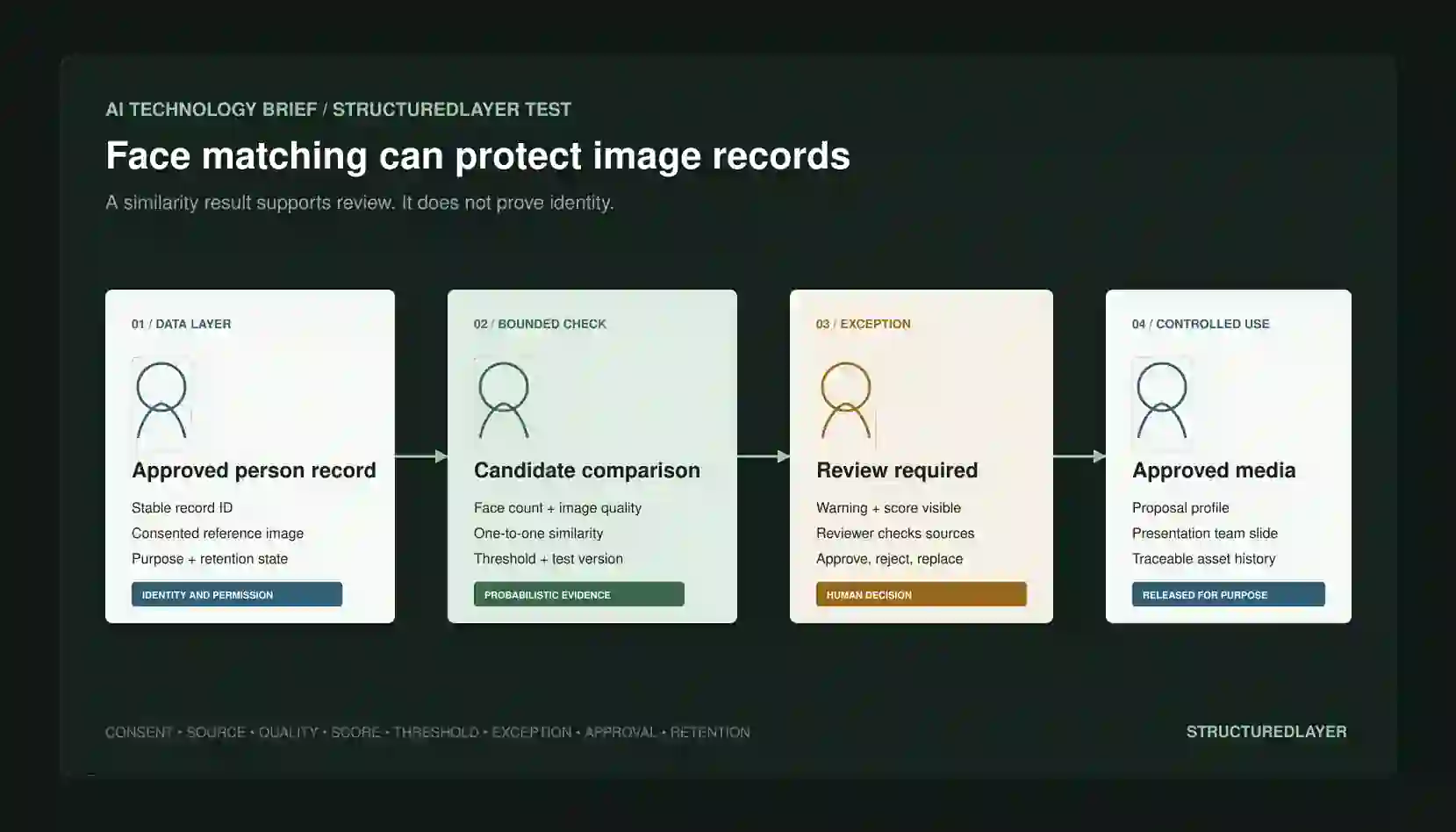
StructuredLayer created and tested a controlled one-to-one face-matching workflow for a narrow data-layer purpose: checking whether a candidate employee or client image is sufficiently similar to an approved reference before the image can be released for a proposal, presentation, profile, or other agreed business use. The result is supporting evidence, not identity proof, and StructuredLayer's test demonstrates why a warning and human decision must remain in the path.
01 / Independently verifiable claims
Begin with what the technology and standards actually support.
- The StructuredLayer test compared two images in a one-to-one workflow, detected one frontal face in each, assessed image and face quality, calculated similarity, applied a configured threshold, and returned an explicit issue record.
- The test returned a similarity score of 0.691 against a threshold of 0.63 and classified the pair as a match, while also flagging a medium-severity potential false positive because the similarity was low for an accepted match.
- The first image received excellent face quality, good overall image quality, and medium detection confidence; the second received excellent face quality, fair overall quality, and high detection confidence.
- The recorded processing time for this single comparison was 6.267 seconds. One comparison does not establish production accuracy, fairness, capacity, latency, or an acceptable threshold.
- NIST evaluates one-to-one verification using false match and false non-match measures at decision thresholds; changing a threshold changes the balance between those errors.
- NIST separately evaluates face-image quality because pose, blur, illumination, occlusion, framing, and other defects can influence recognition outcomes.
- The ICO describes biometric recognition outcomes as statistically informed judgments rather than facts and requires organizations to consider error impact, challenge, correction, deletion, and fit-for-purpose thresholds.
- The EU AI Act distinguishes one-to-one biometric verification from one-to-many biometric identification. That distinction does not remove applicable privacy and data-protection obligations.
02 / The practical distinction
A useful match, an approved image, and identity proof are not the same thing.
The workflow should preserve these distinctions in its records and user interface. A threshold outcome can help prioritize review, but it cannot establish legal identity or permission to publish an image.
Statistical output
Similarity result
A score describes how similar two processed face representations appear under one configured comparison. It is probabilistic evidence and depends on image conditions, implementation, and threshold.
Workflow decision
Approved image record
A reviewer confirms the person record, source, consent, purpose, image suitability, score, warning state, and intended use before releasing the asset.
Not established
Identity proof
The comparison does not by itself prove legal identity, authority, employment status, client status, consent, current role, or permission to publish.
03 / Operating architecture
Place face comparison inside the data layer, permission system, and media approval workflow.
The matching service prepares evidence. Stable person records, lawful purpose, consent or other applicable basis, access control, review, release, retention, and deletion remain governed outside it.
Approved person record
Employee or client ID, relationship status, approved name and role, lawful purpose, consent or other applicable basis, reference-image source, capture date, expiry, and access policy.
Candidate media
Original image, source, uploader, checksum, capture or receipt date, intended proposal or presentation, and temporary processing state.
Bounded comparison
Face count, quality checks, one-to-one similarity, configured threshold, version, warning codes, timing, and no authority to publish or overwrite records.
Human-controlled release
Reviewer sees the source images and evidence, resolves warnings, confirms consent and purpose, then approves, rejects, replaces, or requests a new image.
04 / Required records
Image verification needs more than a file attachment and a boolean match field.
Person and relationship
Stable person ID, employee or client status, approved display name, role, organization, owner, effective dates, and source system.
Permission and purpose
Lawful basis, consent where relied upon, allowed channels, specific proposal or presentation purpose, restrictions, withdrawal, and expiry.
Reference asset
Original source, file fingerprint, capture date, current status, quality state, approved uses, access scope, superseded relationship, and retention date.
Candidate asset
Uploader, source, fingerprint, intended person, intended document, received date, face count, quality results, and quarantine state.
Comparison run
Reference and candidate IDs, configuration version, similarity score, threshold, threshold outcome, quality evidence, warnings, duration, and timestamp.
Review and release
Reviewer, evidence inspected, correction, decision, purpose, approved document, publication state, timestamp, challenge history, and deletion state.
05 / Construction example
Verify the person-media relationship before generating a proposal or presentation.
The purpose is not surveillance or finding a person in a database. It is a narrow one-to-one check between a candidate image and the reference attached to the intended employee or client record.
01 / Select
Choose the intended person
The proposal workflow selects an existing employee or client record with an approved role, current relationship state, and permitted media purpose.
02 / Compare
Check the candidate image
The system confirms one usable face, measures quality, compares only against that person's approved reference, and records score, threshold, and warnings.
03 / Review
Resolve uncertainty
A reviewer checks the two source images, role, consent, intended use, and any low-similarity or quality warning. Ambiguous cases are rejected or replaced.
04 / Release
Generate controlled output
Only the approved asset ID is made available to the proposal or presentation template, preserving who approved it and for which purpose.
06 / Deterministic controls
Keep deterministic release controls around the probabilistic comparison.
One-to-one only
Compare the candidate only with the intended person's approved reference. Do not search a wider employee, client, visitor, or public-image gallery.
Purpose and permission gate
Verify relationship status, lawful purpose, consent or other applicable basis, intended channel, expiry, and restrictions before processing and again before release.
Quality gate
Require one face and agreed limits for pose, blur, brightness, occlusion, size, and overall quality. Route failures to recapture rather than lowering controls silently.
Calibrated thresholds
Select thresholds from representative validation data and the harm of false acceptance and false rejection. Do not treat a default threshold as a business standard.
Trusted review interface
Show the original reference and candidate, score, threshold, quality, warnings, purpose, and exact proposed use. Never show only a green match badge.
Controlled document generation
Proposal and presentation tooling may read only approved asset IDs. Draft generation cannot approve media, change person identity, or bypass an active restriction.
07 / Failure analysis
StructuredLayer's test demonstrates the most important failure: an accepted threshold can still require rejection.
Potential false positive
The test classified a 0.691 score as a match above the 0.63 threshold but raised a medium-severity warning. Automatic release would ignore material evidence against acceptance.
Wrong reference record
A technically correct comparison against the wrong employee or client record can still release the wrong person's image unless stable identity and record selection are controlled.
Poor or changing image conditions
Age of the reference, pose, blur, lighting, cropping, occlusion, compression, camera differences, and editing can change quality and comparison behavior.
Threshold transfer
A threshold that worked on one pair or dataset may produce unacceptable false matches or false non-matches for the organization's actual population and image sources.
Demographic performance
Aggregate accuracy can hide subgroup differences. Representative evaluation must inspect false acceptance and rejection behavior and provide a challenge path.
Permission without identity error
Even a strong similarity result does not prove the organization may use the image in a proposal, presentation, website, marketing document, or client deliverable.
Sensitive attribute overcollection
Estimated age or gender is not required for this one-to-one media check. Unnecessary inferred attributes should not be used to approve, rank, or describe people.
Biometric data exposure
Reference images, candidate images, derived representations, crops, scores, logs, and backups can create sensitive-data exposure if access, encryption, retention, and deletion are weak.
08 / Deployment and cost
Prefer a client-controlled, purpose-limited service with replaceable processing.
Client-controlled records
Keep person identity, relationship status, consent or lawful basis, original assets, approval state, document use, challenge, and deletion history in the client's governed data layer.
Isolated comparison service
Expose only the two approved image IDs and task configuration. Use encryption, restricted service identities, no broad gallery access, short-lived processing, and no autonomous publication.
Private processing option
Where risk, contracts, jurisdiction, or policy requires it, evaluate a private environment with controlled storage, logging, updates, access, deletion, and incident response.
Replaceable component
Persist provider-neutral run records and acceptance evidence so the comparison component can be changed without losing person records, permissions, approvals, or document history.
- Image ingestion, storage, transfer, encryption, backup, retention, and verified deletion
- Comparison processing, retries, quality failures, recapture, and exception handling
- Consent, lawful-basis review, privacy notices, contracts, DPIA, and jurisdiction-specific advice
- Ground-truth preparation, threshold calibration, demographic evaluation, regression testing, and monitoring
- Reviewer time, challenge and correction handling, audit review, and incident response
- Proposal and presentation integration, approved-asset controls, maintenance, replacement, and exit
09 / Evaluation
Measure whether the workflow prevents wrong-person media without creating disproportionate rejection or privacy harm.
- False match rate and false non-match rate at each candidate threshold using representative, authorized test pairs
- Performance by image source, age of reference, pose, lighting, blur, crop, compression, occlusion, and document channel
- Subgroup false acceptance and false rejection behavior where lawful, necessary, proportionate, and ethically supportable
- Warning recall: whether borderline accepted scores, quality problems, multiple faces, and wrong-record selections reach review
- Reviewer agreement, correction time, recapture rate, challenge outcomes, and wrong-person images reaching generated documents
- Permission enforcement, withdrawn-consent behavior, purpose limitation, retention expiry, deletion, access logs, and incident recovery
- Latency and complete cost per approved image, rejected image, corrected record, proposal, and presentation
- Regression results after any comparison, threshold, preprocessing, camera, workflow, or data-source change
10 / Controlled pilot
Prove the operating boundary before expanding it.
Define one purpose
Use one document type, such as controlled employee profiles in proposal team pages, and explicitly exclude surveillance, attendance, access control, and broad identification.
Complete privacy review
Confirm necessity, proportionality, lawful basis, notices, rights, DPIA requirements, contracts, jurisdictions, retention, deletion, and an alternative path.
Build authorized ground truth
Use consented or otherwise lawfully approved matched and non-matched pairs across realistic image conditions. Keep identities and sensitive media access restricted.
Calibrate and challenge
Test multiple thresholds, document false acceptance and rejection, preserve warnings, and provide correction, recapture, human override, and appeal paths.
Keep release manual
Require a named reviewer to approve every image and intended document use. Do not allow the similarity outcome to publish, send, or overwrite automatically.
Set stop conditions
Stop for wrong-person release, unauthorized processing, missing consent or basis, unhandled subgroup disparity, invisible warnings, deletion failure, or unacceptable reviewer burden.
11 / StructuredLayer recommendation
Use face matching as a second verification signal inside a governed media workflow, never as proof of identity or automatic permission to publish.
StructuredLayer's test shows both the value and the limitation: a candidate pair can exceed the configured threshold while the system correctly warns that acceptance may be a false positive. The safe design preserves that warning, checks image quality and the intended person record, confirms purpose and permission, and requires a human to approve the exact proposal or presentation use. Begin with one narrow document workflow, representative authorized ground truth, calibrated thresholds, explicit privacy controls, and a non-biometric alternative.
12 / Primary sources
Capability, governance, and implementation claims remain inspectable.
NIST
Face Recognition Technology Evaluation: 1:1 Verification
NIST
Face Analysis Technology Evaluation: Quality
NIST
Demographic Effects in Face Recognition
Information Commissioner's Office
Biometric recognition
Information Commissioner's Office
How do we process biometric data lawfully?
Information Commissioner's Office
How does the accuracy principle apply to biometric data?
Information Commissioner's Office
How do we process biometric data fairly?
Information Commissioner's Office
How do we demonstrate compliance with data protection obligations?
EUR-Lex
Regulation (EU) 2024/1689: Artificial Intelligence Act
NIST
Artificial Intelligence Risk Management Framework 1.0
Sources reviewed 22 July 2026. Technology capabilities, laws, guidance, terms, and pricing can change.