AI Technology Brief
Does forward-deployed AI engineering matter for construction buyers?
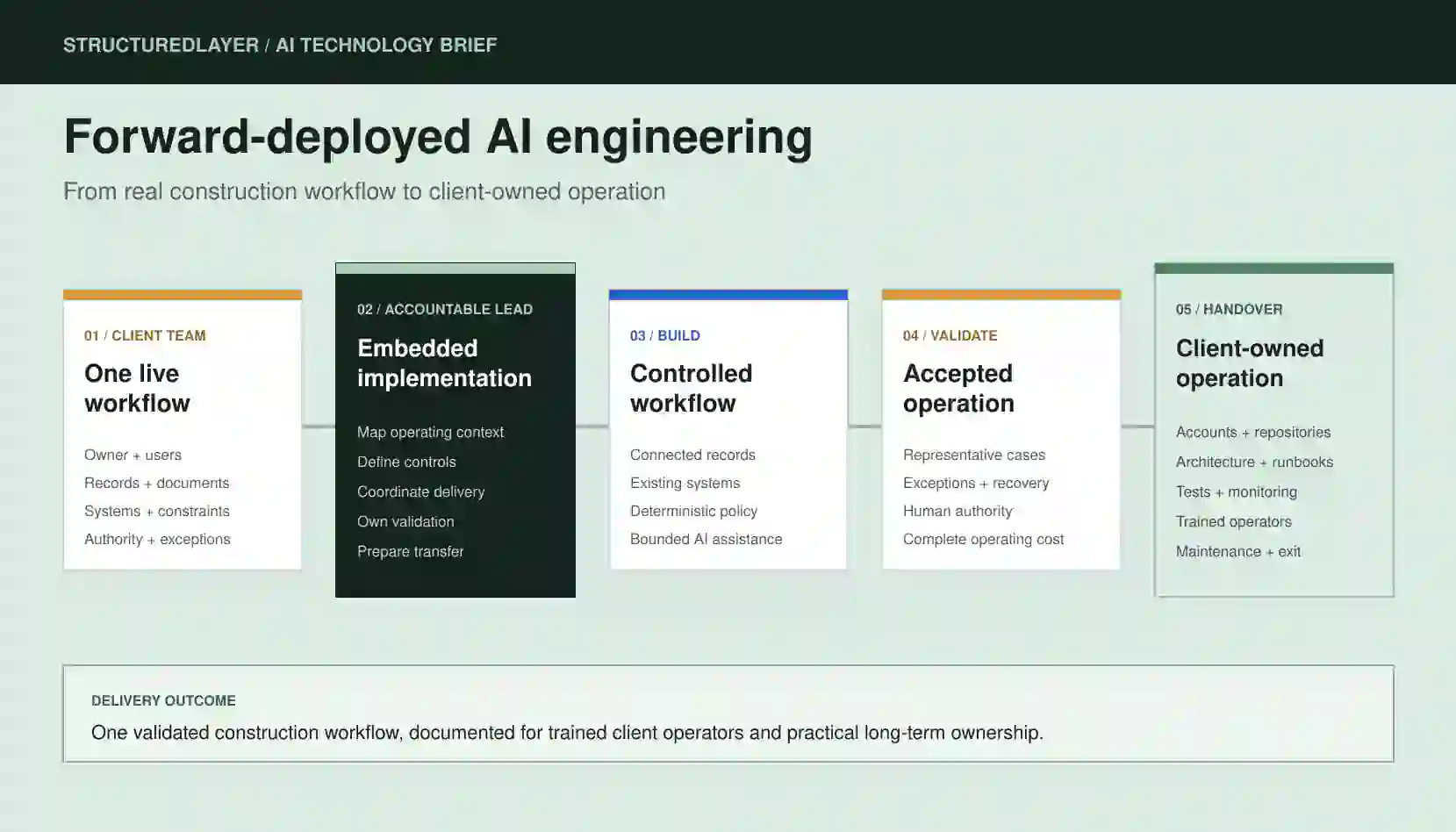
Forward-deployed AI engineering puts accountable technical delivery inside the customer's real operating environment. For construction and property teams, it provides a practical route from fragmented workflows and existing systems to one validated, documented, client-owned operating capability.
01 / Independently verifiable claims
Begin with what the technology and standards actually support.
- AWS announced a dedicated Forward Deployed Engineering organization backed by a stated $1 billion investment on 30 June 2026.
- AWS says its forward-deployed engineers work directly with customer business, engineering, and security teams using the customer's data, governance, processes, and operating constraints.
- AWS says engagements are intended to produce deployed systems, knowledge graphs, runbooks, architecture documentation, reusable workflows, and trained internal champions so customers can operate more independently.
- AWS's partner announcement describes AWS-led, partner-led, and combined delivery paths, with selected partners developing ring-fenced forward-deployed engineering capability.
- Accenture and Google Cloud announced a global Gemini Enterprise Business Group on 8 September 2026, combining Accenture-certified Gemini Enterprise personnel, forward-deployed engineers, Google Cloud engineering specialists, and Accenture industry and functional expertise.
- Accenture says the group plans a 1,000-person forward-deployed-engineer workforce and expanded Gemini Enterprise education and certifications. These are future plans, not a completed workforce or a performance guarantee.
- The announcement identifies deployment accelerators, industry solutions, capability centers, and employee and customer adoption as priorities. It does not establish construction-specific outcomes, delivery timelines, or results for another buyer.
- Buyers should confirm delivery timelines, production acceptance, complete costs, support, ownership, and contract terms for their own engagement; the AWS and Accenture announcements do not provide representative construction benchmarks or success rates.
- Capgemini reported Q2 2026 bookings of EUR 6.547 billion, up 9.2% year over year, and raised its 2026 constant-currency revenue-growth target to approximately 8.5%-9.0%.
- Capgemini says clients are accelerating agentic AI adoption while modernizing legacy systems because a resilient modern digital core is needed to deploy AI at scale.
- Capgemini's investor materials identify data silos, legacy systems, and integration debt as modernization problems. These are Capgemini's market observations, not a construction-specific demand benchmark.
02 / The practical distinction
Software access, advice, forward-deployed implementation, and client operation are different services.
A buyer should know who enters the operating environment, who builds, who authorizes, what is transferred, and who can run the system after handover.
Product
Software or model access
A platform supplies capability, interfaces, infrastructure, and product support. The buyer still owns workflow design, integration, operating controls, adoption, and accepted outcomes unless separately contracted.
Advice
Advisory engagement
A consultant assesses, recommends, or designs. The output may stop at a report, roadmap, architecture, or procurement decision without a production workflow.
Embedded delivery
Forward-deployed engineering
An accountable technical team works with operational users in the real environment to build, validate, document, and transfer a bounded production system.
Ownership
Client-operated capability
Named client owners hold the records, access, runbooks, training, decision authority, maintenance path, and ability to operate or appoint another provider.
03 / Operating architecture
Embed implementation around one controlled construction workflow, not an open-ended AI mandate.
The engagement should narrow the operating problem, connect authoritative context, build inside approved boundaries, validate normal and failed paths, and leave the client able to operate the result.
Workflow assessment
Identify one material operating problem, accountable owner, current systems, records, users, exceptions, consequence, baseline, and suitable next step.
Operating-Layer Blueprint
Define identities, source authority, relationships, workflow states, permissions, integrations, deterministic controls, AI boundary, acceptance, handover, and complete cost.
Bounded pilot or implementation
Build one controlled process against representative cases with restricted access, visible exceptions, recovery, human authority, and no silent expansion into adjacent work.
Client-owned operation
Transfer accounts, code or configuration as agreed, records, schemas, runbooks, tests, monitoring, training, known limits, maintenance decisions, and operating responsibility.
04 / Required records
A forward-deployed engagement needs business context, engineering state, and handover evidence.
Operating problem
Business owner, users, current path, systems, records, delays, failure modes, consequence, baseline, expected result, and exclusions.
Authority model
Source owners, identities, roles, permissions, approvals, prohibited actions, contractual authority, professional authority, and escalation.
Delivery environment
Client systems, test environment, accounts, credentials, data classes, residency, retention, network, integrations, vendors, and access history.
Implementation record
Requirements, architecture, versions, code, configuration, prompts, tools, migrations, tests, defects, decisions, changes, releases, and rollback.
Operating evidence
Accepted cases, exceptions, reviewer corrections, latency, complete cost, monitoring, incidents, recovery, user adoption, and business acceptance.
Handover package
Ownership, repositories, schemas, runbooks, permissions, training, support route, maintenance backlog, dependencies, exit path, and signed acceptance.
05 / Construction example
Construction buyers need deployment work between the demonstration and daily operation.
Use a bounded entry pattern where one owner can define the operating problem, accepted outcome, required authority, and practical handover.
Preconstruction
RFQ intake to bid decision
Connect inboxes, documents, opportunity records, deadlines, qualification, estimator ownership, exceptions, and commercial approval without giving AI authority to bid or submit.
Projects
Site evidence to controls review
Turn diaries, voice notes, quantities, photos, schedule state, cost records, and possible changes into validated candidate evidence before accepted progress or forecast decisions.
Commercial
Quote comparison and change
Structure package scope, supplier qualifications, rates, exclusions, commitments, notices, and impacts while retaining estimator, quantity-surveyor, and commercial authority.
Property
Service request to controlled closure
Connect property, asset, tenant, contractor, instruction, visit, evidence, approval, cost, communication, and closure across existing systems.
06 / Deterministic controls
Embedded access increases the need for explicit engineering and business controls.
One accountable lead
Name who owns scope, architecture, communication, specialist coordination, access decisions, validation, handover, and unresolved delivery issues.
Least-privilege environment
Use task-specific identities, approved workspaces, representative data, limited records, restricted tools, logged access, and time-bounded credentials.
Deterministic policy
Enforce identity, required fields, calculations, workflow transitions, permissions, duplicate prevention, approvals, and external actions outside the model.
Representative validation
Test normal, missing, conflicting, stale, adversarial, duplicate, unauthorized, timeout, integration-failure, and recovery cases before release.
Bound business authority
Keep price, contract, payment, safety, design, engineering, privacy, employment, permission, and external-issue decisions with appointed people.
Transfer from the start
Build in client-controlled accounts and repositories where practical, document decisions continuously, train named champions, and test operation without the delivery team.
07 / Failure analysis
Forward-deployed language can hide weak delivery if scope, evidence, and ownership are vague.
Renamed staff augmentation
Engineers are embedded, but no bounded workflow, acceptance measure, reusable system, accountable outcome, or handover obligation is defined.
Demonstration mistaken for deployment
A polished interface works on selected cases while source authority, permissions, exceptions, recovery, monitoring, and daily ownership remain unresolved.
Provider investment overgeneralized
One provider investment is treated as evidence that every buyer, sector, workflow, or construction company needs the same delivery model.
Modernization becomes transformation theatre
A large platform replacement begins before one operating decision, record relationship, workflow state, or measurable acceptance boundary is understood.
Provider dependency survives handover
The client receives a running system but not the accounts, architecture, code, schemas, tests, runbooks, skills, monitoring, rights, or replacement path needed to operate it.
Embedded access exceeds authority
A delivery team can reach sensitive systems or records without a clear business purpose, least privilege, approval, logging, expiry, and offboarding.
08 / Deployment and cost
Choose the delivery boundary from the client's environment, consequence, and ownership requirements.
Client-cloud deployment
Build in a client-controlled cloud account with agreed services, regions, identities, networking, logging, billing, support, retention, portability, and exit.
Existing-software operating layer
Keep useful project, document, finance, CRM, email, spreadsheet, and portal systems while connecting stable records, state, permissions, and reviewed actions.
Partner-supported implementation
Coordinate vendor, integrator, internal IT, specialist, and StructuredLayer responsibilities through one architecture, decision log, access plan, test plan, and handover boundary.
Restricted pilot environment
Use representative records and bounded integrations where production access, data sensitivity, legal review, system readiness, or operating ownership is not yet sufficient.
- Workflow discovery, operational observation, process reconstruction, stakeholder time, and accountable ownership
- Data preparation, document control, record identity, source reconciliation, permissions, and migration
- Engineering, integration, cloud, model, tool, storage, network, observability, security, and vendor charges
- Representative testing, exception adjudication, correction, regression, recovery, acceptance, and release
- Documentation, runbooks, training, internal champions, support, stabilization, maintenance, and replacement
- Complete cost per accepted operating outcome, including failed runs, rescued cases, reviewer effort, and dependency
09 / Evaluation
Measure accepted client operation, not embedded hours or deployment rhetoric.
- One frozen workflow baseline: time, handoffs, reconstruction, errors, exceptions, delay, and current operating cost
- Correct identity, source authority, workflow state, permission, deterministic calculation, approval, and accepted update
- Critical failure rate across missing, conflicting, stale, unauthorized, duplicate, adversarial, integration-failure, and recovery cases
- Reviewer effort, correction type, exception age, escalation, adoption, support load, and complete cost per accepted outcome
- Client ability to operate, diagnose, recover, change, monitor, and train another user without the delivery team
- Handover completeness across accounts, repositories, documentation, runbooks, rights, dependencies, maintenance, and exit
10 / Controlled pilot
Prove the operating boundary before expanding it.
Choose one live decision path
Start where one owner can define the records, systems, consequence, current baseline, accepted outcome, and authority boundary.
Freeze the implementation boundary
Name systems, records, users, data classes, permissions, actions, vendors, environments, exclusions, acceptance, and handover before building.
Build with representative cases
Use normal and difficult historical or controlled cases with known expected states, visible source evidence, and qualified reviewers.
Release one controlled capability
Add the minimum production access and authority needed, preserve rollback and manual operation, and monitor every material exception.
Test client independence
Have trained client operators run, review, recover, and explain the workflow using the transferred documentation and controls.
Expand only from accepted evidence
Add workflows, records, integrations, automation, or agent authority only after the first operating boundary remains reliable and owned.
11 / StructuredLayer recommendation
Use forward-deployed AI engineering as a delivery descriptor, not a promise, a new service tier, or a replacement for StructuredLayer's construction operating-system position.
AWS and Capgemini strengthen the commercial case for working inside real operating constraints, modernizing the foundations beneath AI, deploying one bounded workflow, and transferring ownership. StructuredLayer provides that path through the Workflow Assessment, Operating-Layer Blueprint, Bounded Pilot, Implementation, and AI Operations routes. Evaluate the accountable lead, records, access, controls, accepted outcome, complete cost, and client independence rather than the label alone.
12 / Primary sources
Capability, governance, and implementation claims remain inspectable.
Amazon
AWS invests $1 billion in forward deployed AI engineers
AWS
Introducing Forward Deployed Engineering for Partners
Accenture
Accenture and Google Cloud deepen partnership with Gemini Enterprise Business Group
Capgemini
2026 H1 Results
Capgemini
2026 H1 Results presentation
Sources reviewed 11 September 2026. Technology capabilities, laws, guidance, terms, and pricing can change.
13 / Related StructuredLayer guidance
Continue from model selection into operating architecture.
How StructuredLayer Serves Clients
Review founder-led accountability, specialist collaboration, existing-system connectivity, shared responsibilities, and client-owned handover.
Construction Project Controls Operating System
Connect approved scope, estimate, budget, schedule, field evidence, forecast, change, and authorized decisions.
Why ChatGPT or Claude Is Not a Source of Truth
Separate AI synthesis from governed records, ownership, versions, permissions, lineage, and approval.