Cloud task execution
Google describes Spark as a personal AI agent for complex workflows and ongoing tasks using connected apps, skills, chats, websites, and other available context. Tasks can continue in the cloud and may use a remote browser.
AI Technology Brief · 10 August 2026
Gemini Spark combines cloud tasks, schedules, reusable skills, connected apps, and custom MCP apps. Construction use requires current eligibility checks, controlled sources, monitoring, visible exceptions, human review, and separate business authority.
Verified product state
These points come from current Google documentation. Product availability, limits, and behavior can change.
Google describes Spark as a personal AI agent for complex workflows and ongoing tasks using connected apps, skills, chats, websites, and other available context. Tasks can continue in the cloud and may use a remote browser.
Google documents time-based schedules, Gmail-triggered monitors, and topic or event monitors. Its current help page lists up to 50 active schedules and 15 concurrently running tasks.
Google describes skills as reusable instructions, context, templates, and preferences. Several skills can be combined in a workflow.
Google documents standards-compliant remote MCP server connections for eligible users in the United States. Availability, account eligibility, server security, and tool behavior require current verification.
Google currently documents Spark for eligible users aged 18 or over with a personal Google Account, Keep Activity, and Google AI Pro or Ultra in the United States. Workspace accounts are not currently supported.
Google's changelog records launch and later additions including custom MCP apps, topic monitoring, a Mac app, and wider plan availability. Buyers should treat capability and limits as dated product state.
Choose the execution pattern
Spark is useful for bounded cloud tasks. It should not be stretched into the system of record, workflow authority, or acceptance layer when the business process requires durable state and control.
Use source-grounded retrieval when a person needs a specific fact, clause, requirement, status, or comparison from identified material. Preserve the source link and revision instead of treating the answer as a new project record.
Use an on-demand Spark task when the work needs interpretation, a reusable skill, visible intermediate output, and back-and-forth review, such as preparing a candidate exception pack from approved records.
Use a Spark schedule only when timing or the monitored event is clear, the permitted sources and destination are bounded, and skipped, delayed, duplicate, partial, or failed work has an owner and recovery path.
Use a separate operating layer when the process needs durable identity, workflow state, cross-system permissions, deterministic validation, exception ownership, approval, accepted records, audit history, or provider portability.
Bounded construction example
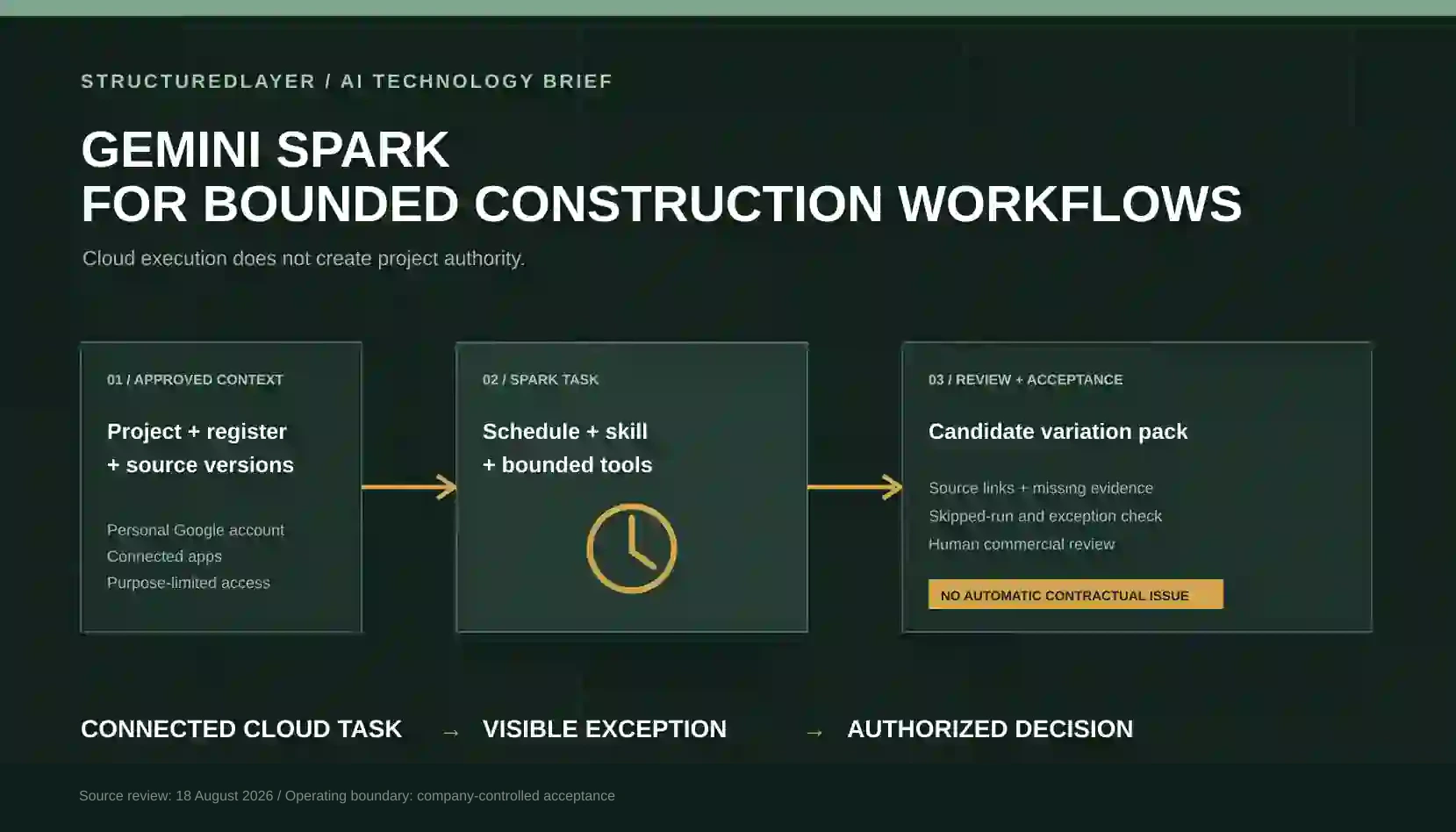
Spark prepares candidate information from approved records. An authorized commercial owner determines entitlement, valuation, programme effect, compliance, the accepted project position, and whether any communication may be issued.
Review a controlled variation register and approved correspondence to prepare a weekly candidate exception pack. Do not ask Spark to determine entitlement, value, programme effect, or contractual issue.
Use identified project, contract, register, correspondence, and source-version records. Exclude unrelated projects, personal data, privileged material, and unapproved folders.
Define required fields, source links, missing-evidence flags, prohibited conclusions, output format, escalation rules, and the named reviewer.
Run at a time aligned to project reporting, retain timezone and schedule ownership, and monitor skipped, delayed, duplicate, or failed work instead of assuming execution.
Write a candidate pack or controlled draft location with Run ID, source IDs, retrieval time, limitations, and status. Do not silently change the accepted variation register.
A commercial owner verifies source evidence, dates, notice requirements, valuation, schedule consequence, recipients, and authority before any record change or communication.
Deployment controls
Buyer boundaries
Evaluate source quality, account structure, regional availability, permissions, monitoring, recovery, and the separate person authorized to accept or issue each consequential outcome.
A completed Spark task can still use stale, incomplete, conflicting, or unauthorized context. Processing completion is not reviewer acceptance or business authority.
A connected app or MCP server establishes a possible route. It does not prove secure deployment, correct schemas, stable behavior, lawful use, or suitable write controls.
Capacity limits, skipped runs, source access, tool failures, product changes, and partial side effects require monitoring and recovery.
Current personal-account and regional limits can conflict with enterprise identity, retention, administration, data-location, support, and procurement requirements.
A draft variation notice or commercial summary does not establish contractual compliance, entitlement, quantum, delay, recipient, timing, privilege, or authorization to issue.
Compare Spark with other routes using the same construction task, approved sources, acceptance criteria, reviewer effort, failures, recovery, and complete cost per accepted outcome.
Official sources
Recommendation
Do not begin with automatic notices, payment actions, accepted registers, safety decisions, design conclusions, or broad folder access. Measure source completeness, skipped work, corrections, reviewer effort, accepted outcomes, and recovery.
Next best page
Move from evaluating the operating conditions to choosing a bounded response and assessing one real workflow.