AI Technology Brief
Can Gemma 4 provide locally controlled multimodal AI for construction evidence?
Gemma 4 provides open-weight text-and-image models plus audio-capable E2B, E4B, and 12B Unified variants across mobile, local, workstation, and server routes. Construction buyers still need exact model, licence, hardware, source evidence, permissions, evaluation, monitoring, and qualified review.
01 / Independently verifiable claims
Begin with what the technology and standards actually support.
- Google documents Gemma 4 E2B, E4B, 12B Unified, 26B A4B, and 31B variants.
- All variants accept text and images and produce text. Native audio input is documented for E2B, E4B, and 12B Unified; video is represented through image frames and supported audio.
- E2B and E4B have 128K context; 12B, 26B A4B, and 31B have 256K context according to Google's documentation.
- Google describes 12B Unified as an encoder-free multimodal decoder architecture that projects image patches and audio frames into the model embedding space.
- Published memory estimates cover model weights and exclude software overhead and the growing KV cache. They do not guarantee a particular laptop, speed, cost, privacy outcome, or quality result.
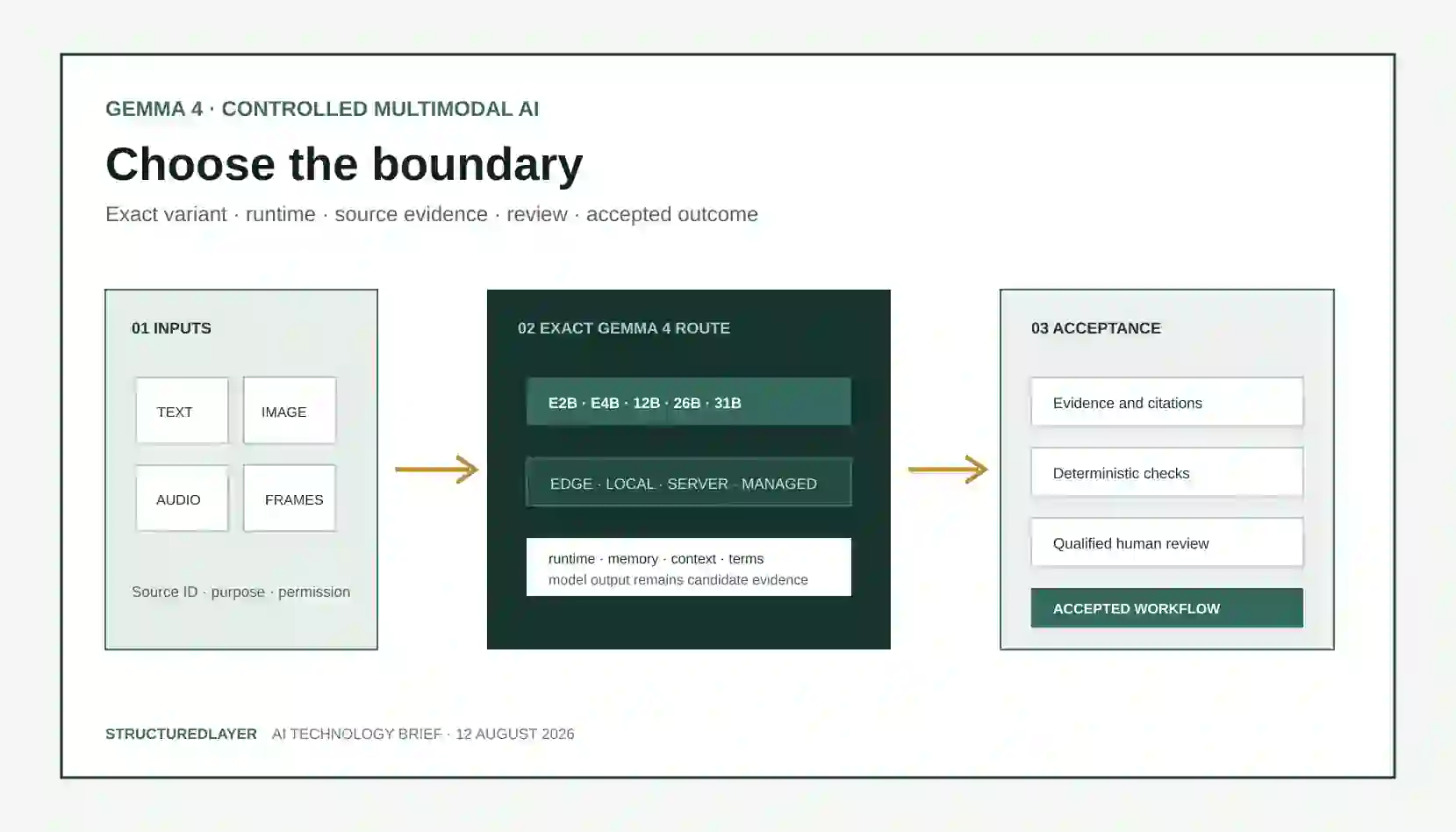
- Google documents mobile, edge, local, workstation, server, and managed routes through Google AI Edge, LiteRT-LM, llama.cpp, MLX, Transformers, vLLM, SGLang, Kaggle, and Hugging Face. Exact checkpoints and runtimes require testing.
- The model card warns that outputs can be incorrect or outdated and that developers remain responsible for safety controls, privacy, monitoring, and human review.
- Gemma 4 has exact current licence and terms documents. Distribution, hosted services, derivatives, notices, and prohibited use require reviewing those documents rather than assuming generic open-source rights.
02 / The practical distinction
Choose a deployment boundary by evidence, consequence, control, and complete cost.
Local inference may improve one data boundary; it does not automatically establish security, correctness, lower cost, availability, support, or authority.
Edge
Mobile or device
Bounded offline or field interaction, subject to device memory, capture permissions, synchronization, updates, and correction.
Local
Workstation
Controlled experiments and preparation with managed model files, runtime, dependencies, access, logs, and source cleanup.
Private
Company server
Centralized serving and monitoring with buyer responsibility for GPU capacity, patching, identity, security, and recovery.
Managed
Hosted open-weight
A provider operates selected weights and infrastructure; licence, region, retention, access, updates, support, and exit all require review.
Alternative
Hosted proprietary
A separate provider route with different capabilities, terms, quality, support, cost, and dependency that must be evaluated on the same task.
03 / Operating architecture
Keep the model below the construction evidence and approval layer.
Gemma can produce candidate text or multimodal observations; source systems, deterministic checks, qualified reviewers, and approved workflows retain authority.
Source and capture
Project, document, drawing, image, audio, video, revision, purpose, permission, and native IDs.
Variant and runtime
Checkpoint, tokenizer, quantization, runtime, hardware, context, visual tokens, audio limits, tools, and configuration.
Candidate observation
Extraction, transcription, classification, comparison, or summary linked to precise page, frame, timestamp, region, or record.
Acceptance
Deterministic validation, conflict handling, qualified review, correction, approval, accepted record, expiry, and withdrawal.
04 / Required records
A local model still needs a complete model, source, run, review, and replacement record.
Model and terms
Variant, checkpoint, release, model card, licence, prohibited-use policy, notices, derivative status, and distribution route.
Runtime
Runtime, version, hardware, precision, context, batch, visual tokens, audio duration, tools, and network boundary.
Source package
Source ID, revision, permissions, hash, page, frame, timestamp, region, and transformation history.
Inference run
Run ID, user, task, prompt, output, tool calls, latency, errors, resources, and cost.
Review
Claim, evidence, uncertainty, reviewer, correction, acceptance, critical failure, and downstream use.
05 / Construction example
Use Gemma 4 to prepare bounded multimodal evidence, not certify the condition.
Candidate patterns only; the model does not inherit inspection, engineering, safety, commercial, or contractual authority.
Document triage
Classify approved pages, locate candidate revision fields, and route uncertain or conflicting material.
Field media preparation
Transcribe a permitted short audio note and link it to the unchanged source record.
Visual candidate observation
Identify a possible object or condition while preserving frame, uncertainty, and capture context.
Offline assistant
Test a bounded local interaction with explicit synchronization, correction, and revocation rules.
06 / Deterministic controls
Local inference changes the processing route, not the evidence and authority rules.
Verify terms
Review exact licence, terms, prohibited use, hosted-service, derivative, notice, and distribution conditions.
Preserve originals
Store model-derived observations separately from original documents, frames, recordings, and records.
Restrict context
Apply user, project, purpose, record, device, and provider permissions before multimodal assembly.
Measure resources
Test memory, KV cache, latency, throughput, thermal behavior, power, concurrency, and recovery.
Test modality limits
Include tables, handwriting, diagrams, accents, noise, small text, ambiguity, long material, and missing evidence.
Require qualified review
Do not accept observations as safety, quality, engineering, design, contractual, payment, or professional conclusions.
07 / Failure analysis
A model that fits in memory can still fail the construction workflow.
Variant mismatch
Audio, context, visual, or video capability is assumed from another checkpoint.
Memory estimate error
Weight-loading figures omit KV cache, runtime overhead, batch, prompt length, and concurrency.
Visual confidence
A plausible observation is mistaken for verification despite occlusion, lighting, dust, angle, or resolution.
Source contamination
Sensitive or unrelated media enters a local or managed context outside the approved purpose.
Licence gap
Weights or an API are distributed without satisfying current terms, notices, downstream restrictions, or prohibited-use rules.
Authority confusion
A candidate observation becomes an inspection, estimate, design, safety, payment, or contractual record without acceptance.
08 / Deployment and cost
Operational ownership grows from managed service to self-managed inference.
Mobile and edge
Own device compatibility, offline state, synchronization, update, loss, deletion, and field support.
Local workstation
Own model files, runtime, environment, dependencies, updates, logs, hardware, and support.
Private server
Own capacity, serving, scaling, identity, network, monitoring, patching, backup, and incident response.
Managed deployment
Share infrastructure responsibility while retaining contract review, data controls, evaluation, records, and exit testing.
- Weights, licence, notices, and terms review
- Hardware, capacity, power, storage, network, and replacement
- Runtime, serving, batching, KV cache, monitoring, patching, and support
- Source preparation, permissions, synchronization, and deletion
- Inference, retries, evaluation, human review, correction, and accepted outcome
- Security, recovery, model change, regression, training, and handover
09 / Evaluation
Evaluate the accepted construction task, not model reputation.
- Exact variant, runtime, hardware, precision, context, visual tokens, audio, and prompt
- Source identity, permission, page, region, frame, timestamp, and citation preservation
- Text, image, audio, and video-frame accuracy on representative construction material
- Critical omissions, false observations, unsupported claims, unsafe suggestions, and confidence
- Refusal, uncertainty, escalation, and correction for missing, conflicting, stale, or restricted evidence
- Memory, latency, throughput, thermal, power, concurrency, storage, and recovery
- Complete cost per accepted record, observation, draft, or workflow
- Licence, security, monitoring, updates, portability, deletion, and exit
10 / Controlled pilot
Prove the operating boundary before expanding it.
Choose one low-consequence task
Start with document triage, source-linked transcription, or bounded visual classification.
Select exact variant
Record checkpoint, hardware, precision, context, input limits, software, and licence.
Freeze representative cases
Include normal, poor-quality, incomplete, conflicting, restricted, multilingual, and unanswerable material.
Compare one alternative
Use a hosted or deterministic method on the same sources and acceptance criteria.
Keep action separate
Block automatic professional, commercial, safety, contractual, or payment action.
Set stop conditions
Stop for lost identity, permission leakage, unsupported certainty, critical omission, resource failure, or licence uncertainty.
11 / StructuredLayer recommendation
Evaluate Gemma 4 as a bounded multimodal component, not a shortcut to private, cheap, accurate, or autonomous construction AI.
Start with one exact variant, one representative task, controlled source media, documented terms, deterministic checks, qualified review, and complete cost measurement.
12 / Primary sources
Capability, governance, and implementation claims remain inspectable.
Google AI
Gemma 4 overview
Google AI
Gemma 4 model card
Google Developers
Gemma 4 12B developer guide
Google AI
Gemma terms
Google AI
Gemma Apache 2 license
Google Developers
Google AI Edge Gallery
NIST
AI Risk Management Framework
Sources reviewed 12 August 2026. Technology capabilities, laws, guidance, terms, and pricing can change.