AI Technology Brief
Generated 3D assets can accelerate construction communication - but they are not BIM or as-built evidence
StructuredLayer evaluated an operating architecture for using text-to-3D, image-to-3D, multiview generation, and texturing systems in controlled construction and property communication workflows. This is architecture evaluation, not a claim of completed deployment. Generated meshes can accelerate concepts, training, logistics communication, and presentation assets, but they are not measured geometry, coordinated BIM, fabrication models, survey records, or as-built evidence.
01 / Independently verifiable claims
Begin with what the technology and standards actually support.
- Tencent officially documents Hunyuan3D 3.1 as a hosted service for text-to-3D, image-to-3D, multiview-to-3D, geometry, sketch, and topology workflows. The latest public open repository reviewed is Hunyuan3D 2.1, so hosted 3.1 and open 2.1 must not be conflated.
- TRELLIS.2 has an official Microsoft repository and research release for structured-latent 3D generation. TRELLIS is an earlier related project and should be versioned separately.
- Rodin Gen-2 is documented as a proprietary service rather than a public Gen-2 model repository. Public output and quality options require current service and contract verification.
- Hunyuan3D-2 and Hunyuan3D-2mv are earlier model families; the multiview variant uses controlled views. Optimized packaging does not create a separate authoritative geometry standard.
- Wonder3D, ImageDream, MVDream, Zero123++, and Shap-E are research or open model families for single-image, multiview, text, or image-conditioned 3D generation with different pipelines and output limitations.
- Text2Tex and generic texture pipelines modify or generate surface appearance rather than proving geometry. Text2Tex is published with noncommercial restrictions.
- Zero123++ code and weights have different licence terms, including noncommercial weight restrictions. MVDream's official repository is archived. Licence and maintenance status must be checked per artifact.
- Deep3D is described as 2D-to-3D video conversion, not an editable construction mesh generator. HappyHorse 1.1 is a video-generation family, not a 3D-asset model, even when its video has a 3D visual style.
- WorldClaw is official Tencent Hunyuan research describing an agentic pipeline that plans an open world, establishes global terrain, generates regional objects and textured meshes, places them, and uses BlenderMCP-supported refinement for geometry, materials, scale, orientation, collisions, and surface contact.
- The WorldClaw repository reviewed on 14 August 2026 contains research and presentation material but no released implementation code, model weights, installation path, or licence. It must not be described as open-source, downloadable, production-ready, commercially licensed, or directly integrated with Unreal Engine.
- WorldClaw demonstrates a useful plan-first and terrain-first architecture signal. It does not establish project-coordinate accuracy, BIM semantics, engineering validity, code compliance, validated simulation, construction logistics suitability, safety authority, reproducibility, operating cost, security, or maintainability.
- GLB, USDZ, FBX, OBJ, or STL export indicates file compatibility, not dimensional accuracy, topology quality, material correctness, buildability, or BIM semantics.
- Catalogue run counts and labels such as best, fastest, detailed, realistic, or production-ready are not independent construction validation.
02 / The practical distinction
A generated mesh, a BIM object, and measured reality are different records.
Construction teams must preserve this distinction in file names, metadata, user interfaces, approvals, and downstream permissions.
Generated candidate
Conceptual 3D asset
A probabilistic mesh, texture, material, or multiview result inferred from text or images. Hidden surfaces, dimensions, topology, and materials may be invented.
Coordinated information
BIM or design model
Structured geometry and information developed under project standards, coordinates, responsibilities, reviews, exchanges, and professional design authority.
Observed condition
Survey or as-built evidence
Measured or verified information tied to methods, tolerances, dates, coordinates, responsible parties, and acceptance. Generation cannot create missing evidence.
03 / Operating architecture
Keep generation in a conceptual asset lane outside authoritative project models.
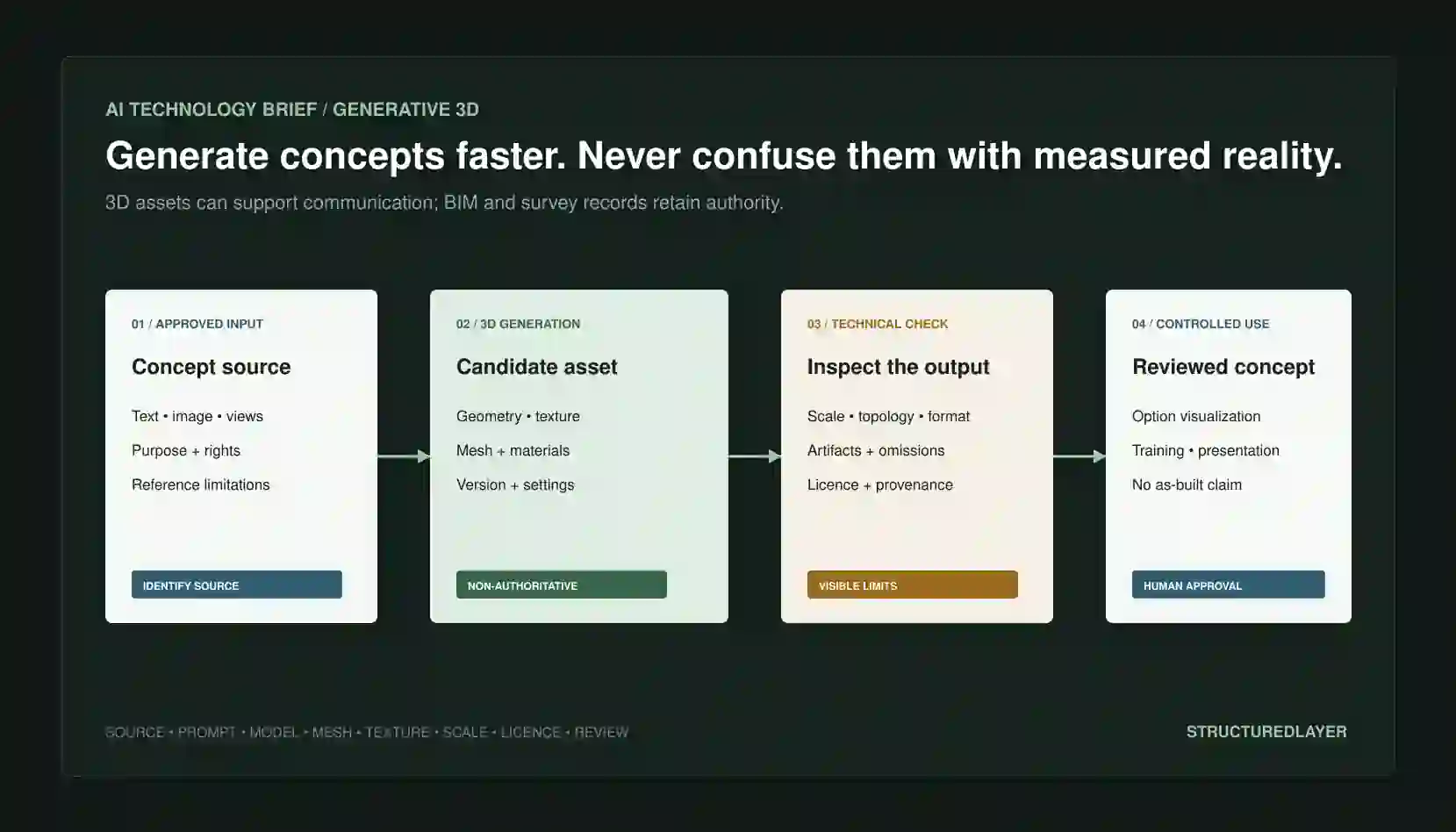
StructuredLayer's evaluated architecture treats every generated object as a versioned derivative of approved references with visible limits and a controlled release purpose.
Approved references
Text brief, image, sketch, or multiview set with source, rights, project, purpose, scale information where known, exclusions, sensitivity, and fingerprint.
Bounded generator
Verified model and version, input mode, seed, quality, polygon or resolution settings, texture mode, output formats, licence, retention, and cost.
Candidate asset
Mesh, topology, UVs, textures, materials, previews, dimensions reported by the file, warnings, provenance, and non-authoritative status.
Controlled use
Technical inspection, reviewer correction, approved purpose, document or scene, visible conceptual label, expiry, and separation from BIM and as-built systems.
04 / Required records
A useful 3D asset needs provenance, technical state, rights, and an approved purpose.
Source package
Prompt, reference images, multiview labels, sketch, source rights, project, object intent, known dimensions, exclusions, and fingerprints.
Generation run
Model family, exact version, deployment, seed, settings, polygon target, texture mode, duration, cost, output IDs, and logs.
Asset record
Format, mesh count, faces, vertices, topology, UVs, textures, materials, units, bounding dimensions, previews, checksum, and storage.
Technical review
Scale, orientation, watertightness, manifold state, normals, intersections, holes, artifacts, texture seams, hidden geometry, and compatibility.
Rights and status
Model licence, weight licence, input rights, output terms, attribution, commercial restriction, sensitivity, retention, and approved channels.
Release decision
Reviewer, allowed conceptual purpose, required label, downstream file or scene, prohibited uses, approval, timestamp, expiry, and audit history.
05 / Construction example
Use generated 3D where speed of communication matters more than measured authority.
These are representative architecture patterns, not completed StructuredLayer deployments or proof that every model supports every output.
Preconstruction
Option visualization
Prepare rough equipment, furnishing, temporary works, site setup, or product concepts for discussion before a designer creates coordinated information.
Logistics
Method and sequence communication
Create non-authoritative scene assets for explaining access, laydown, lifting, routing, or staging concepts, with dimensions and constraints verified separately.
Training
Scenario and safety communication
Generate generic objects for reviewed training scenes without depicting a real incident or replacing qualified safety content and approval.
Business development
Proposal and presentation assets
Prepare reviewed conceptual visuals, product stand-ins, property option illustrations, or interactive web assets with clear generated-content labels.
06 / Deterministic controls
Prevent conceptual assets from entering authoritative construction records by accident.
Separate storage and naming
Use a conceptual asset repository, generated status, visible watermark or label, and filenames that cannot be mistaken for design, fabrication, survey, or as-built models.
Rights gate
Verify input ownership, people and property permissions, model and weight licences, output terms, commercial rights, attribution, and restrictions before processing or release.
Technical validation
Check units, scale, orientation, topology, manifold state, normals, artifacts, material files, format compatibility, and security before import.
No silent BIM conversion
Do not map a generated mesh into an authoritative BIM family, quantity, specification, procurement item, clash result, or asset register without independent reconstruction and approval.
Purpose-limited export
Allow only approved formats, destinations, viewers, scenes, documents, and audiences. Preserve the conceptual label and provenance with derivatives.
Human authority
Require design, engineering, surveying, commercial, safety, brand, intellectual-property, and client approval according to the intended use.
07 / Failure analysis
Plausible geometry can conceal invented surfaces, scale, and construction meaning.
Single-view invention
One image does not reveal the back, underside, internal structure, dimensions, or true material. The model fills missing information probabilistically.
Scale and proportion error
A visually convincing object may have arbitrary units, dimensions, wall thickness, clearances, tolerances, or connection geometry.
Topology failure
Meshes may contain holes, non-manifold edges, self-intersections, inverted normals, excessive faces, disconnected pieces, or unusable UVs.
Material hallucination
PBR appearance can suggest a product, finish, reflectance, weathering, or performance that was never specified or observed.
Format overconfidence
Export to STL, OBJ, FBX, GLB, or USDZ does not make an asset printable, game-ready, fabrication-ready, BIM-ready, or dimensionally correct.
Licence conflict
Noncommercial weights, archived projects, proprietary services, reference-image rights, and output restrictions can block a planned business use.
Security and privacy
Reference images can expose people, property, products, security features, designs, locations, or client-confidential information.
Downstream contamination
An unlabeled generated asset can be copied into a model, presentation, tender, training package, digital twin, or client record and later mistaken for verified information.
08 / Deployment and cost
Hosted services and open pipelines trade convenience against control and maintenance.
Hosted generation
Hunyuan3D 3.1 and Rodin Gen-2 can accelerate evaluation. Confirm region, retention, training use, rights, formats, limits, cost, availability, version changes, and exit.
Private open pipeline
Hunyuan3D 2.1, TRELLIS.2, Wonder3D, ImageDream, MVDream, Zero123++, Shap-E, and related projects require licence, hardware, dependency, security, maintenance, and quality review.
Texture and multiview tools
Text2Tex, texture tools, Hunyuan multiview, Wonder3D, ImageDream, MVDream, and Zero123++ may supply stages rather than a complete accepted asset pipeline.
Client-controlled registry
Preserve sources, prompts, model versions, licences, assets, checks, approvals, purposes, and replacements independently of the generator.
- Reference preparation, image cleanup, multiview capture, prompts, rights review, storage, transfer, and retention
- Hosted requests or GPU hardware, model weights, serving, dependencies, generation time, retries, and previews
- Mesh cleanup, retopology, UV correction, texture repair, scale, format conversion, optimization, and compatibility testing
- Ground-truth comparisons, technical review, design or engineering review, brand approval, and client approval
- Licensing, commercial terms, attribution, privacy, contracts, security, incident response, and legal review
- Integration with Blender, viewers, web, AR, game engines, presentation tooling, asset registries, maintenance, and replacement
09 / Evaluation
Measure whether the reviewed asset serves its conceptual purpose without creating authoritative-data confusion.
- Prompt and reference adherence, multiview consistency, geometry completeness, visible artifacts, and hidden-surface assumptions
- Units, scale, proportions, dimensions, topology, watertightness, manifold state, normals, UVs, materials, and target-format compatibility
- Human correction time, rejected generations, retries, technical cleanup, and complete cost per accepted conceptual asset
- Performance by object type, material, reflection, transparency, symmetry, complexity, source quality, view count, and background
- Rights, licence, attribution, commercial-use, retention, deletion, confidentiality, and output-provenance evidence
- User comprehension: whether reviewers consistently distinguish generated concept, design/BIM, fabrication, survey, and as-built status
- Failure, timeout, version change, reproducibility, seed, portability, archived dependency, backup, recovery, and exit behavior
- Errors or unlabeled assets reaching quantities, coordination, procurement, fabrication, safety, client approvals, or authoritative records
10 / Controlled pilot
Prove the operating boundary before expanding it.
Choose one conceptual use
Use a low-consequence purpose such as a proposal illustration, generic training object, web viewer demo, or early option discussion.
Verify the model class
Confirm that the selected system outputs an editable 3D asset rather than only images or video. HappyHorse 1.1, for example, generates video rather than meshes.
Clear rights and licences
Review every input, code licence, model-weight licence, hosted term, output right, attribution, commercial restriction, and client permission.
Build technical acceptance
Define target format, units, scale tolerance for the conceptual purpose, polygon budget, topology, materials, compatibility, labeling, and prohibited use.
Keep it outside BIM authority
Store separately and block import into quantities, coordination, fabrication, asset registers, survey, or as-built records without independent approved reconstruction.
Set stop conditions
Stop for rights uncertainty, confidential-data exposure, misleading realism, unacceptable geometry, excessive cleanup, licence conflict, or authoritative-data contamination.
11 / StructuredLayer recommendation
Use generative 3D for clearly labeled conceptual communication, never as a shortcut to BIM, measured geometry, fabrication, survey, or as-built truth.
Start with one low-consequence visual purpose and approved references. Verify whether the system generates an actual editable mesh, inspect licensing and lifecycle, preserve prompts and source rights, test geometry and formats, label every derivative, and keep generated assets in a separate repository. Promote information into BIM or project records only through independent reconstruction, validation, and accountable approval.
12 / Primary sources
Capability, governance, and implementation claims remain inspectable.
Tencent Cloud
Hunyuan3D 3.1 service documentation
Tencent Hunyuan
Hunyuan3D 2.1 repository
Tencent Hunyuan
WorldClaw project
Tencent Hunyuan
WorldClaw repository
WorldClaw authors
WorldClaw paper
Microsoft
TRELLIS.2 repository
Hyper3D
Rodin Gen-2 generation documentation
Wonder3D
Wonder3D repository
ByteDance
ImageDream repository
ByteDance
MVDream repository
SUDO-AI-3D
Zero123++ repository
OpenAI
Shap-E repository
Text2Tex
Text2Tex repository
Alibaba Cloud
HappyHorse 1.1 release
buildingSMART International
Industry Foundation Classes specification
NIST
Artificial Intelligence Risk Management Framework 1.0
Sources reviewed 14 August 2026. Technology capabilities, laws, guidance, terms, and pricing can change.