
AI Technology Brief
Synthetic video can accelerate construction communication - but it must never become project evidence
StructuredLayer evaluated an architecture for using generative video in controlled construction and property communication. This is not a completed deployment. Synthetic scenes can explain options, methods, training scenarios, property concepts, and proposal narratives, but they cannot document site conditions, prove progress, recreate an incident, certify a method, or replace recorded evidence.
01 / Independently verifiable claims
Begin with what the technology and standards actually support.
- Runway Gen-4.5, Google Veo 3.1, Kling AI 3.0, Seedance 2.0 and 2.5, Sora 2, Wan 2.2, and HappyHorse 1.1 have official or primary documentation for video generation with differing text, image, reference, editing, audio, duration, and deployment capabilities.
- Dreamina's official Seedance 2.5 page describes up to 30-second standard generation, a 180-second beta long-video mode, up to 50 multimodal inputs, local region editing, and 4K output. It also says the product is coming soon while using present-tense trial language, so current availability, limits, model identity, and release status require direct verification.
- Seedance 2.5 documentation describes green-screen or white-model video references for movement, spatial control, and interaction. It does not establish native support for Blender scenes, meshes, rigs, depth maps, point clouds, camera files, or editable 3D output.
- HappyHorse 1.1 is video generation, not editable 3D mesh generation. Veo 3.1 and Sora 2 have versioned API model identifiers; Wan 2.2 has an official open repository.
- StructuredLayer's evaluated model inventory also includes Grok Imagine Video, Luma Ray, PixVerse, Hailuo, Vidu, Fabric, p-video, DreamActor, and multiple fast, lite, pro, omni, and preview variants. Every exact ID requires official lifecycle and terms verification.
- Native or synchronized audio does not prove dialogue accuracy, speaker consent, pronunciation, safety-message correctness, or rights to a voice or likeness.
- Spotify's published approach favors contribution-level AI credits, such as generated vocals, lyrics, instrumentation, or production, rather than treating every work as a single binary AI or non-AI category. Platform credits remain separate from source rights, identity consent, factual review, and publication approval.
- Twitch documents a channel-level choice controlling future Amazon generative-model training on channel-governed streams, chat, VODs, clips, highlights, text, and images. The setting does not establish removal from completed training, control chat posted under another channel's setting, or opt out of every machine-learning use.
- Leaderboard position, generation speed, catalogue runs, realism, and prompt adherence do not establish factual accuracy or suitability for construction communication.
02 / The practical distinction
Choose real footage, conventional VFX, generative AI, or a hybrid according to the required control.
Use the least expensive production method that provides the required factual accuracy, creative control, consistency, editability, rights, and release assurance. Generation speed alone does not determine total production value.
Observed
Real footage
Use for actual places, people, products, progress, demonstrations, and evidence. It requires access, planning, consent, permissions, suitable conditions, authenticated capture, and purpose-specific review.
Controlled
Conventional VFX or 3D
Use when the buyer needs precise art direction, repeatable characters and assets, controlled camera movement, editable geometry, and shot continuity. It adds specialist production, rendering, compositing, and revision effort.
Exploratory
Generative video
Use for rapid concepts, alternatives, storyboards, internal explainers, and visibly synthetic communication. Expect lower control over identity, continuity, physical behavior, exact revisions, and reproducibility.
Combined
Hybrid production
Use AI for bounded ideation, backgrounds, cleanup, or selected shots alongside controlled footage, 3D assets, editing, and human direction. Provenance, rights, integration, review, correction, and final mastering still apply.
03 / Operating architecture
Keep synthetic media in a labeled communication lane.
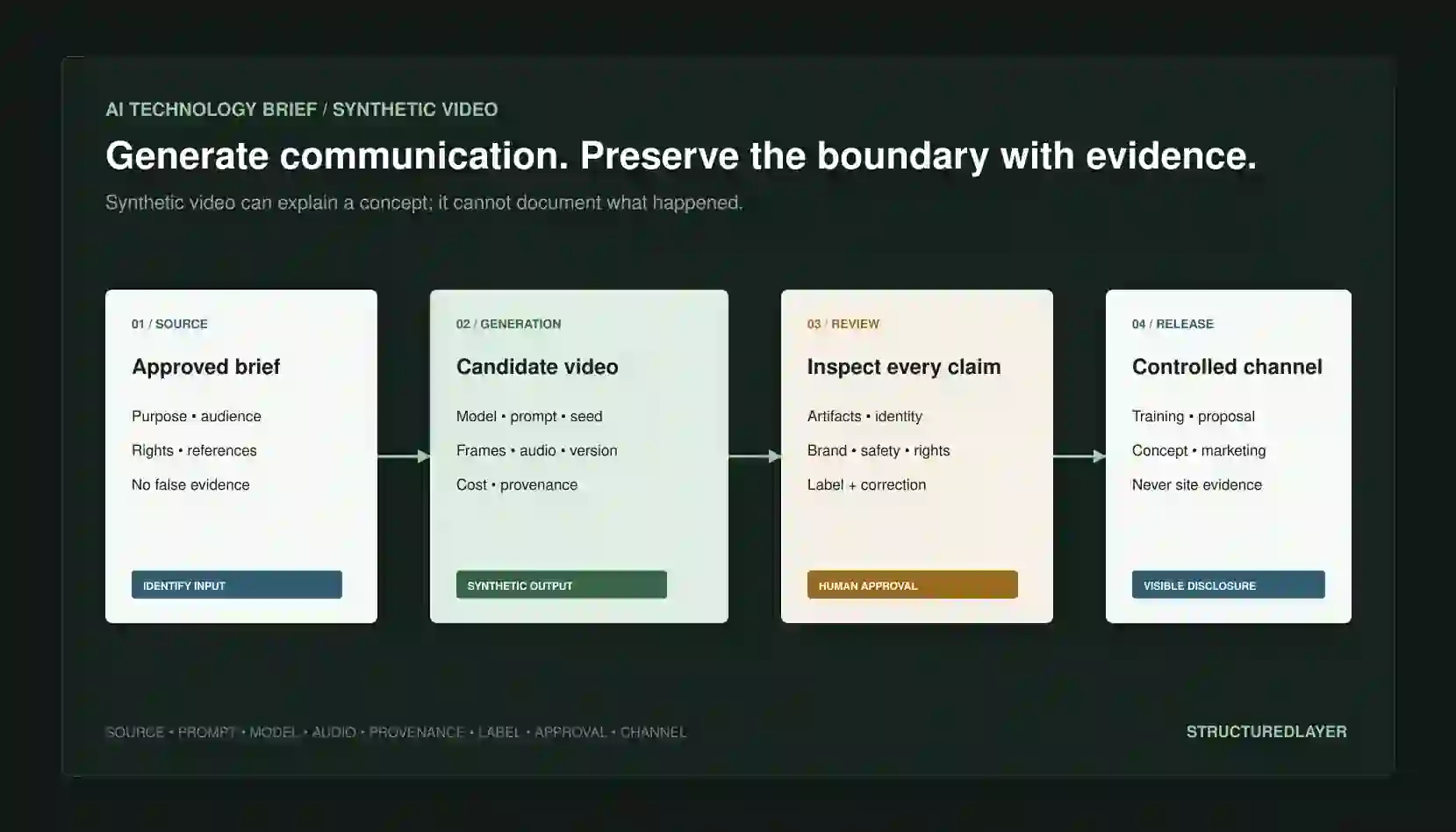
The generator creates a candidate asset; client-owned records control references, rights, review, disclosure, channels, and retention.
Approved brief
Purpose, audience, claims, script, references, rights, people, brand, prohibited content, and disclosure.
Versioned generation
Exact model, prompt, seed, frames, audio, duration, aspect ratio, settings, cost, and source assets.
Review package
Candidate video, script, transcript, frame review, factual claims, identity, voice, safety, brand, rights, and artifacts.
Controlled release
Approved channel, visible synthetic label, final file hash, owner, expiry, withdrawal, and no entry into evidence systems.
04 / Required records
Every generated clip needs provenance, rights, claims, and release state.
Brief
Business purpose, audience, narrative, factual claims, disclaimer, owner, reviewer, and approval conditions.
References
Source images, video, audio, scripts, people, property, brand, licences, consent, fingerprints, and restrictions.
Generation
Model and version, prompt, seed, settings, duration, aspect, audio mode, timestamps, usage, and cost.
Review
Frame and audio issues, false claims, unsafe depiction, identity, voice, text, logos, artifacts, and corrections.
Disclosure
Synthetic-media label, caption, watermark, metadata, channel requirements, audience, and accessibility.
Release
Approved file, hash, destination, publication, owner, expiry, withdrawal, archive, and incident history.
05 / Construction example
Use synthetic video where a reviewed concept is valuable and no one could mistake it for evidence.
Representative uses only; feasibility and rights depend on the project and model.
Proposal narrative
Create a visibly synthetic animation of an operating concept, service route, or client experience using approved claims and brand assets.
Training scenario
Illustrate a generic reviewed scenario without portraying a real event, person, site condition, or approved safety method inaccurately.
Property listing avatar
Use a consented, verified presenter avatar with an identified listing record, approved listing-media rights, source-mapped script, current price and availability, factual review, synthetic disclosure, publication approval, and withdrawal when the listing changes or expires.
Listing spotlight
Turn authorized property photographs into a reviewed short video while preserving listing ID, media rights, approved facts, captions, voice permission, publication version, and separation from valuation, survey, inspection, or property evidence.
Option communication
Show early property, logistics, or staging concepts while labeling dimensions, sequence, and conditions as illustrative.
Internal explanation
Prepare short walkthroughs of a proposed workflow or system for review before producing final controlled training material.
06 / Deterministic controls
Use deterministic disclosure and release gates around probabilistic generation.
Rights before generation
Verify references, people, voices, locations, products, brands, music, scripts, and model output terms.
Separate editing control from factual control
Object removal, appearance changes, camera paths, local edits, multi-shot generation, and fast previews can improve production control. They do not establish scene truth, continuity, physical accuracy, identity, rights, or construction authority.
No evidence ingestion
Store synthetic output separately and block upload into daily reports, progress records, inspection evidence, claims, or incident files.
Claim-by-claim review
Map every factual statement to an approved source; remove invented quantities, dates, performance, sequence, or compliance claims.
Identity and voice control
Require documented permission, product-required consent or verification, approved use, revocation, and publication review for recognizable people, avatars, or voices; prohibit deceptive impersonation and unsupported endorsements.
Property listing control
Verify listing ID, current status, price, address, dimensions, rooms, amenities, agent authority, source media, school or neighborhood claims, market statements, redistribution rights, channel rules, correction, expiry, and withdrawal before release.
Contribution-level disclosure
Record whether AI affected script, image, footage, voice, likeness, music, lyrics, instrumentation, sound, editing, translation, captions, or production. Apply the channel's required credits or labels without assuming one binary AI label describes the complete work.
Platform training choices
Record which account or channel controls training permission, the setting and effective time, content scope, future-versus-historical coverage, other machine-learning uses, downstream copies, and evidence of the choice. A platform opt-out does not replace input rights, consent, contracts, or deletion controls.
Visible disclosure
Apply persistent labels, captions, metadata, contribution credits, and context suitable for the audience and channel.
Human approval
Require brand, technical, safety, legal, client, and publication approval according to content and consequence.
07 / Failure analysis
Realism can increase persuasion faster than accuracy.
False physical behavior
Motion, gravity, equipment, water, materials, access, sequencing, and interactions may look plausible but be wrong.
Identity drift
People, uniforms, logos, objects, and locations can change between frames or shots.
Audio fabrication
Dialogue, lip sync, ambient sound, alarms, machinery, and narration can create unsupported meaning.
Reference leakage
Client sites, designs, people, products, or confidential information can be exposed through uploaded references. A higher reference limit increases the material that needs identity, rights, permission, retention, and deletion control.
Availability and terms gap
A product page may describe capabilities before general release while omitting exact pricing, API access, commercial rights, retention, training use, deletion, data location, and service limits. Do not design production operation from feature copy alone.
Evidence confusion
A downloaded clip may lose its label, contribution credits, or platform metadata and later be treated as a site record, wholly human-made work, or real event.
Platform-setting overconfidence
A verification badge, AI credit, content label, or training opt-out may cover only defined content, accounts, channels, dates, uses, or future processing. It does not establish ownership, consent, factual accuracy, complete provenance, deletion, or accepted business use.
Model lifecycle
Preview, fast, lite, omni, pro, and hosted aliases can change behavior, price, availability, and terms.
Demo-speed confusion
A fast preview or generation rate can exclude upload, queue, retry, review, correction, mastering, disclosure, and release time. Measure complete time and cost per approved asset.
08 / Deployment and cost
Hosted and open video systems require different controls.
Hosted API
Confirm model ID, region, retention, training use, rights, moderation, limits, price, availability, provenance, and exit.
Private or open
Wan and other open pipelines add GPU, dependencies, weights, licence, monitoring, patching, and security responsibility.
Editing pipeline
Keep scripts, captions, watermarks, metadata, hashes, and final exports in client-controlled deterministic tooling.
Asset registry
Preserve source rights, model version, prompts, reviews, disclosures, releases, withdrawals, and replacements.
- Reference preparation, scripting, storyboarding, rights, consent, and brand review
- Generation, retries, variants, extensions, audio, upscaling, storage, and transfer
- Frame review, factual verification, editing, captions, disclosure, accessibility, and approval
- Security, privacy, contracts, licences, moderation, incident response, and withdrawal
- Deterministic mastering, codecs, formats, quality control, hashes, archive, and distribution
- Regression testing, model change, vendor replacement, and complete cost per accepted clip
09 / Evaluation
Evaluate accepted communication, not cinematic appeal alone.
- Factual-claim accuracy and unsupported additions
- Character, object, text, logo, location, and audio consistency across frames, longer sequences, reference sets, and local edits
- Physical plausibility, artifacts, unsafe depiction, and misleading sequence
- Rights, consent, disclosure, provenance, retention, and withdrawal completeness
- Reviewer correction time, rejection rate, retries, and complete cost per approved clip
- Audience comprehension of synthetic status and intended conceptual boundary
- Failure, moderation, timeout, version change, reproducibility, backup, and exit
- Any synthetic media reaching evidence, safety, progress, contractual, or incident records
10 / Controlled pilot
Prove the operating boundary before expanding it.
Choose one low-risk purpose
Use an internal workflow explainer or visibly synthetic proposal concept.
Clear references and rights
Approve every image, video, voice, script, person, property, logo, and output term.
Freeze claims
Create an approved script and source map before generation.
Review frame and audio
Inspect every shot, transition, caption, voice, sound, and implied action.
Disclose visibly
Keep persistent synthetic labels and client-controlled metadata.
Set stop conditions
Stop for identity misuse, unsafe depiction, false claims, rights uncertainty, disclosure loss, or evidence contamination.
11 / StructuredLayer recommendation
Use generative video for visibly synthetic, reviewed communication - never to manufacture construction evidence or professional authority.
Start with one low-risk purpose, approved references, a source-mapped script, exact model version, frame-and-audio review, persistent disclosure, and separate storage. Release only after accountable approval and keep every synthetic asset out of site evidence, progress, inspection, safety, claims, and incident systems.
12 / Primary sources
Capability, governance, and implementation claims remain inspectable.
Runway
Creating with Gen-4.5
Google DeepMind
Veo
Kuaishou
Kling AI 3.0 announcement
ByteDance Seed
Seedance 2.0
Dreamina by CapCut
Seedance 2.5
OpenAI
Sora 2 model
Wan
Wan 2.2 repository
Alibaba Cloud
HappyHorse video documentation
HeyGen
Creating videos with avatars
HeyGen
Replace Avatar in Template
Spotify
Spotify AI protections and credits
Spotify
Verified by Spotify
Twitch
Twitch account settings and generative AI training choice
NIST
AI Risk Management Framework
Sources reviewed 16 August 2026. Technology capabilities, laws, guidance, terms, and pricing can change.