AI Technology Brief
Can large database models bring semantic AI to governed business records?
IBM SQL Data Insights Pro can run semantic similarity, dissimilarity, clustering, analogy, and commonality queries over selected Db2 for z/OS data. It remains a specialist mainframe capability: source selection, native IDs, permissions, model versions, deterministic filters, evaluation, and human business authority still govern use.
01 / Independently verifiable claims
Begin with what the technology and standards actually support.
- IBM SQL Data Insights Pro is documented for Db2 for z/OS on IBM Z and LinuxONE. IBM does not establish it as a general feature of PostgreSQL, Snowflake, Databricks, Airtable, Teable, or ordinary SQL installations.
- An administrator creates an AI object from selected columns in a Db2 table or view and classifies included columns as categorical, numeric, text, or key for the documented model workflow.
- IBM documents database embedding and self-supervised learning that represent selected relational values and their inter-column and intra-column relationships as vectors.
- IBM documents semantic similarity, dissimilarity, clustering, analogy, and commonality through built-in Db2 AI functions, including AI_SIMILARITY, AI_SEMANTIC_CLUSTER, AI_ANALOGY, and AI_COMMONALITY.
- SQL Data Insights Pro can include selected structured categorical and numeric columns together with selected unstructured text columns. This does not establish support for arbitrary files, drawings, images, audio, or external document stores.
- Model training requires a documented training engine such as z/OS Spark or Db2 Analytics Accelerator for z/OS, plus the applicable Db2 and SQL Data Insights Pro environment, maintenance, configuration, and operational ownership.
- IBM documents full retraining and eligible incremental retraining. Retrained models are staged as new models for later deployment rather than silently replacing the production model.
- IBM states that semantic processing can occur with source data in Db2 rather than exporting the source dataset to a general-purpose AI platform. This product architecture does not by itself prove complete security, privacy, compliance, correctness, or business acceptance.
02 / The practical distinction
Exact SQL, semantic SQL, language-model retrieval, and business authority answer different questions.
A useful architecture can combine these methods without treating any one of them as the complete operating system.
Deterministic
Exact SQL
Filters, joins, constraints, aggregations, calculations, and known business rules return inspectable results from explicitly stated logic.
Similarity
SQL Data Insights
A trained AI object can rank similarity, dissimilarity, cluster membership, analogies, or commonality across selected Db2 values and rows.
Synthesis
Language-model assistance
A separate approved model may explain or summarize source-linked results, but introduces another identity, retention, evidence, and evaluation boundary.
Authority
Human business decision
Named roles decide whether a historical comparison, anomaly, estimate, commercial conclusion, or operational action is accepted.
03 / Operating architecture
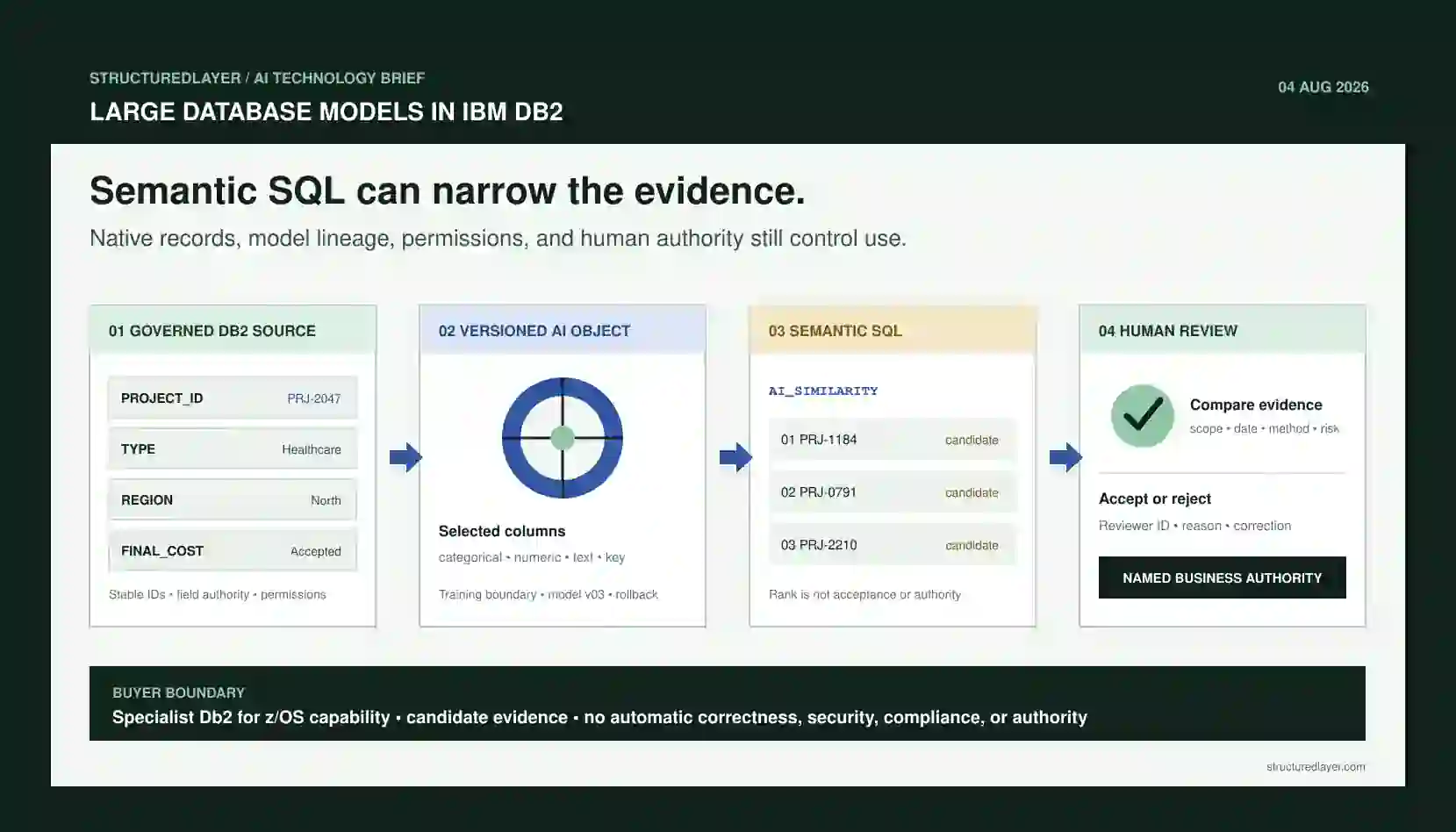
Keep the semantic model close to governed records without collapsing source, model, query, review, and decision into one state.
The Db2 record remains the source. The AI object is a derived model over selected fields. The query result is a candidate signal. A responsible person accepts or rejects its business use.
Governed Db2 source
Approved table or view, stable keys, selected rows and columns, field authority, permissions, data definitions, history, and correction procedures.
Versioned AI object
Column roles, preprocessing, model configuration, training engine, training data boundary, model version, deployment state, and retraining evidence.
Semantic SQL result
Query purpose, function, reference entity, deterministic filters, result rank or score, model version, execution time, and exact native record IDs.
Reviewed business use
Reviewer, comparison evidence, accepted interpretation, rejected matches, correction, decision, consequence, and any authorized downstream action.
04 / Required records
Semantic SQL remains dependable only when native identity and model lineage stay attached.
Source environment
Db2 subsystem, table or view, schema, environment, region, owner, permission boundary, data period, and source authority.
Business entity
Stable customer, supplier, project, contract, transaction, asset, estimate, or work-item ID plus source-system crosswalks.
AI object definition
Included and excluded columns, key field, categorical, numeric and text roles, null handling, numeric clustering, text processing, and owner.
Model lifecycle
Training engine, training boundary, model version, enablement, deployment, full or incremental retraining, delta predicate, checks, and rollback state.
Semantic query
Function, reference values, exact SQL filters, requested population, result limit, user, purpose, model version, and execution time.
Review and decision
Candidate record, score or rank, source comparison, reviewer, correction, acceptance, rejection, decision authority, and accepted output ID.
05 / Construction example
Historical project similarity can narrow review without choosing the benchmark for the estimator or project team.
This is a candidate construction test design, not an IBM construction performance claim or a promise that a buyer's current database supports SQL Data Insights Pro.
Select
Govern the project population
Include only reconciled completed projects with stable IDs, approved cost outcomes, defined scope, location, delivery route, project type, size, dates, and permitted reuse.
Train
Create a bounded AI object
Choose the relevant fields, preserve the project key, record exclusions, train a versioned model, and validate deployment without changing accepted project records.
Query
Retrieve candidate comparisons
Use semantic similarity with deterministic filters such as region, currency, date range, or project class and retain ranked native project IDs.
Decide
Review the real evidence
An estimator or project-controls owner compares scope, quantities, methods, market dates, risks, anomalies, and final outcomes before accepting any benchmark.
06 / Deterministic controls
Treat in-database semantic analysis as a governed retrieval and anomaly layer.
Define the decision first
State whether the query supports retrieval, anomaly review, segmentation, investigation, or another bounded decision. Do not train a general model without a named use.
Control the population
Reconcile duplicates, status, date, permissions, corrections, historical promotion, and exclusions before records enter the AI object.
Preserve exact filters
Use deterministic SQL restrictions where geography, business unit, project class, period, authorization, or another hard boundary must hold.
Version the model
Record training data, column roles, preprocessing, configuration, maintenance level, model version, deployment time, retraining method, and rollback state.
Test consequential subgroups
Evaluate missing values, rare categories, numerical ranges, new record types, changing market periods, business units, and sensitive attributes separately.
Separate score from acceptance
A similarity score or rank is a model result, not a verified match, forecast, fraud conclusion, estimate class, or instruction to act.
07 / Failure analysis
A model can stay inside the database and still produce the wrong business signal.
Wrong population
Cancelled, duplicated, unreconciled, incomparable, restricted, or historically biased records shape the learned representation.
Wrong columns
Included fields correlate with the past but omit current scope, location, contract, market, delivery, permission, or outcome conditions.
Numeric information loss
Clustering or binning can make close values equivalent for modelling even when exact quantities, costs, dates, or tolerances matter commercially.
Historical bias becomes proximity
Similarity can reproduce past selection, pricing, supplier, geographic, or operational patterns without establishing that they remain appropriate.
Model staleness
New records, changed categories, corrections, market movement, or operating changes make an old model less representative.
Score becomes conclusion
A ranked record is treated as a forecast, anomaly confirmation, benchmark, fraud finding, or commercial instruction without reviewing the underlying evidence.
Permission flattening
A model or query population includes fields or records the requesting person should not use for that purpose.
Platform assumption
A buyer assumes that IBM's documented Db2 for z/OS capability exists in a different database, Db2 edition, hardware, region, or licensed environment.
08 / Deployment and cost
This is specialist mainframe capability, not a default construction AI stack.
Existing Db2 for z/OS estate
Evaluate when important governed business data already resides in the supported Db2 and IBM Z environment and the required product, maintenance, skills, and training engine are available.
Read-only evaluation boundary
Begin with selected historical tables or views, no operational write-back, named reviewers, retained query evidence, and comparison with deterministic baselines.
Connected operating workflow
If accepted, pass native record IDs and reviewed candidate results into a separate workflow, decision register, or reporting layer through documented interfaces.
Alternative architecture
For businesses without the supported IBM environment, evaluate governed SQL, analytical platforms, vector services, or application-layer methods separately rather than relabelling them as SQL Data Insights Pro.
- Db2 for z/OS, IBM Z or LinuxONE, SQL Data Insights Pro, entitlement, maintenance, and environment requirements
- z/OS Spark or Db2 Analytics Accelerator training-engine capacity and administration
- Source reconciliation, column selection, null handling, numeric clustering, text preparation, and permission review
- Model training, storage, enablement, deployment, incremental or full retraining, rollback, and monitoring
- Query design, deterministic baselines, subgroup evaluation, reviewer time, corrections, and accepted-decision records
- Integration, reporting, runbooks, support skills, incident response, change control, and handover
09 / Evaluation
Compare semantic SQL with deterministic and current human baselines.
- Coverage and correctness of eligible source records, native IDs, permissions, and historical acceptance state
- Retrieval precision, recall, ranking quality, and reviewer acceptance for known similar and dissimilar cases
- Anomaly detection false-positive, false-negative, investigation effort, and missed-consequence measures
- Performance by business unit, project type, geography, date range, numeric range, missingness, rare category, and sensitive subgroup
- Stability across model retraining, incremental updates, source corrections, new categories, and operating changes
- Agreement and disagreement with deterministic SQL filters, established analytical methods, and qualified reviewer conclusions
- Query latency, training and retraining time, infrastructure usage, operational support effort, and cost per accepted result
- Permission leakage, prohibited-field influence, unsupported inference, model-version mismatch, and unauthorized downstream action
10 / Controlled pilot
Prove the operating boundary before expanding it.
Choose one reviewed decision
Start with historical project retrieval, contract comparison, transaction anomaly review, or another bounded use with an accountable owner.
Freeze an evidence set
Use reconciled records with stable keys, known outcomes, allowed fields, permissions, expected comparisons, difficult cases, and explicit exclusions.
Build deterministic baselines
Compare the semantic query with current SQL filters, established analysis, and qualified human review rather than evaluating presentation alone.
Run read-only
Return ranked native IDs and source evidence without changing project, contract, cost, supplier, payment, or operational records.
Record reviewer correction
Capture accepted and rejected matches, reasons, missing conditions, investigation time, consequence, and reusable evaluation cases.
Expand by one boundary
Add another population, column family, query type, refresh method, or workflow connection only after the previous boundary remains accepted.
11 / StructuredLayer recommendation
Use IBM SQL Data Insights Pro as a bounded semantic query layer when the buyer already has the supported Db2 for z/OS environment and a decision that similarity or anomaly evidence can improve.
Do not adopt it from the LDM label alone. Verify the exact Db2 environment, select and govern the source population, preserve native IDs and permissions, version every AI object and model, compare results with deterministic baselines, and keep project, commercial, financial, contractual, compliance, and professional authority with named people.
12 / Primary sources
Capability, governance, and implementation claims remain inspectable.
IBM Documentation
SQL Data Insights Pro overview
IBM
Bringing AI to mainframe data
IBM Research
Bringing the power of semantic AI to IBM Db2
IBM Documentation
Running AI queries with SQL Data Insights
IBM Documentation
Db2 built-in functions for SQL Data Insights
IBM Documentation
Enabling AI queries and training a model
IBM Documentation
AI_SIMILARITY scalar function
Sources reviewed 4 August 2026. Technology capabilities, laws, guidance, terms, and pricing can change.
13 / Related StructuredLayer guidance
Continue from model selection into operating architecture.
Connected Records
Preserve stable business identities, field-level source authority, relationships, workflow state, and accepted decisions across systems.
AEC Systems and Integration Directory
Compare databases, data platforms, project systems, reporting tools, orchestration, and AI platforms through documented interfaces and buyer-specific boundaries.
Why ChatGPT or Claude is not the source of truth
Keep AI synthesis separate from authoritative records, permissions, versions, lineage, conflicts, and approval.
Construction Project Controls
Connect accepted historical and current scope, cost, schedule, field, forecast, change, and decision records without making a derived model authoritative.