AI Technology Brief
Pipecat opens the real-time voice AI stack
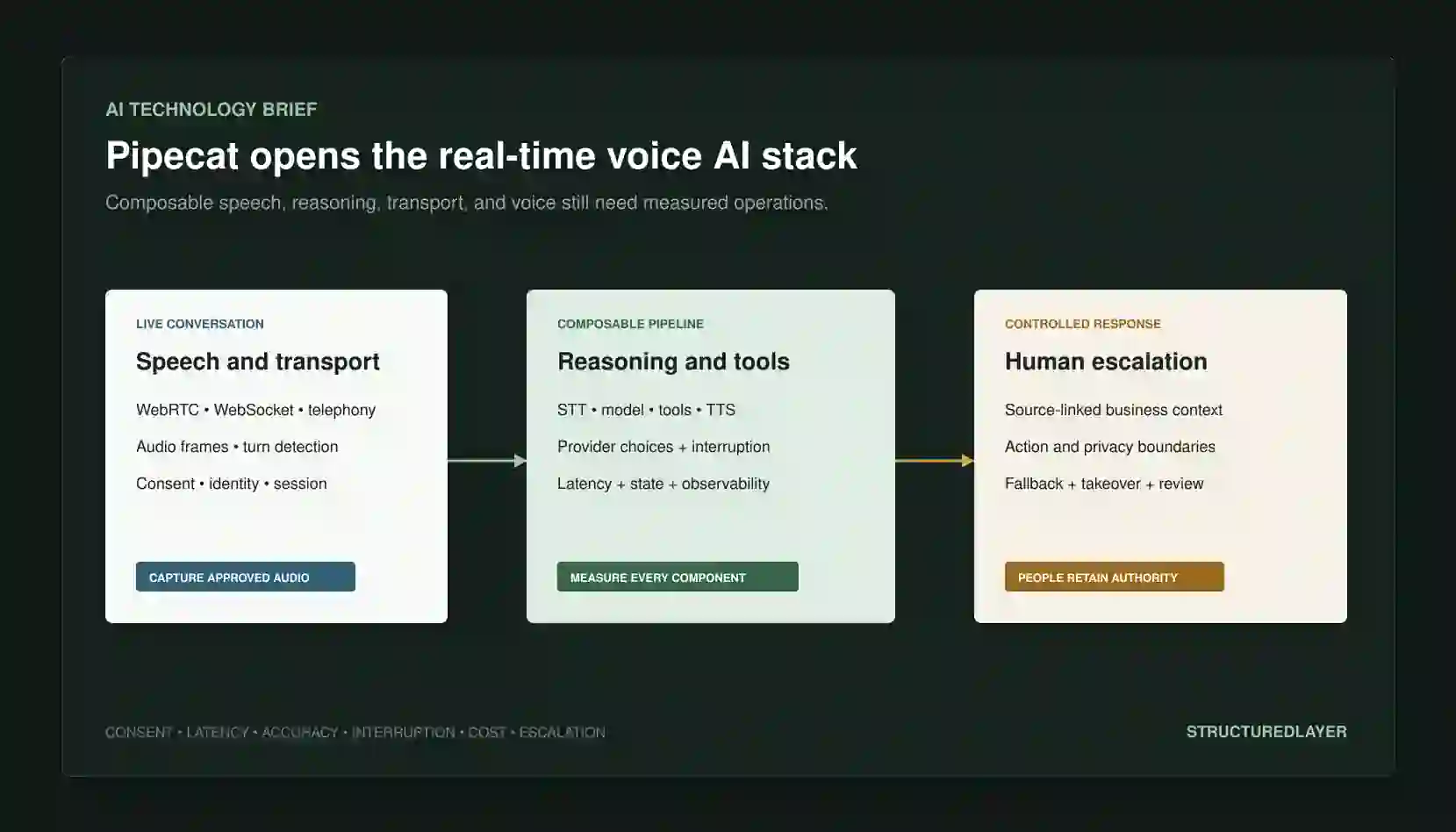
Pipecat makes speech, reasoning, voice, transport, turn detection, and monitoring components easier to combine, but production voice agents still require measured latency, consent, security, reliability, and human escalation.
01 — What happened
Pipecat makes real-time voice and multimodal pipelines composable.
Pipecat is a BSD-2-Clause, open-source Python framework for voice and multimodal conversational AI. It provides pipeline components for media transport, speech recognition, language or realtime models, speech generation, turn detection, context, tools, monitoring, and output.
That can reduce the orchestration code required to connect a voice experience. It does not turn voice operations into a finished product or remove responsibility for infrastructure, telephony, providers, permissions, quality, security, and support.
02 — What has been verified
The official repository and documentation support a broad integration surface.
Pipecat documents WebRTC transports through Daily, LiveKit, Vonage, and direct SmallWebRTC, plus FastAPI and general WebSocket transports for telephony, server-to-server connections, and prototypes.
Its supported-services catalog includes Deepgram, Whisper, AssemblyAI, OpenAI, Anthropic, Gemini, Grok, Ollama, ElevenLabs, Cartesia, Azure, OpenAI Realtime, Gemini Live, AWS Nova Sonic, Grok Voice Agent, Inworld Realtime, and Ultravox.
- BSD 2-Clause licence
- STT, LLM, TTS, and realtime-model adapters
- WebRTC, WebSocket, local, telephony, and specialized media transports
- Turn detection, VAD, audio filtering, vision, memory, and monitoring integrations
- Connection events, error frames, completion-timeout events, and tool-call events
- Automatic exponential-backoff reconnection with three retries for documented WebSocket speech services
Pipecat uses qualitative ultra-low-latency language, but the official sources do not publish one universal end-to-end latency result. They tell teams to benchmark actual deployments and tune measured P99 speech-to-text timing.
03 — Why businesses should care
A common pipeline can make voice experiments easier to compare and replace.
A modular framework can help a team test different speech, reasoning, voice, transport, and realtime providers without rebuilding every surrounding workflow. It creates a clearer place to apply common records, events, tools, monitoring, and controls.
This is not complete vendor independence. Provider contracts, APIs, events, model behavior, voices, regions, data terms, and costs still differ, and the application adopts Pipecat's own interfaces and lifecycle.
04 — Possible construction, property and business use cases
Voice can become another controlled interface to approved workflows.
Possible applications include controlled enquiry intake, appointment handling, maintenance triage, field information capture, status retrieval, internal knowledge access, guided inspection prompts, support triage, and escalation to an authorized person.
- AI phone and intake agents
- Customer-support triage
- Voice copilots for field or desk teams
- Interview and qualification agents
- Appointment and follow-up workflows
- Interactive training and simulations
- Multimodal assistants
- Controlled voice interfaces for existing systems
Suitability depends on consent, identity, environment, language, noise, urgency, and decision authority. High-volume calling does not automatically create qualified customers or compliant communication.
05 — What the framework still cannot safely do
Composable infrastructure does not remove operating responsibility.
- Pipecat is not a finished call-center, support, compliance, identity, billing, or workforce-management product.
- Provider adapters reduce switching work but do not eliminate provider dependency or behavioral differences.
- No official source supports one universal millisecond-level end-to-end latency figure.
- Interruption quality depends on VAD, interim transcripts, turn strategies, timestamps, provider timing, and output cancellation.
- A highly similar generated voice does not establish speaker identity, consent, translation accuracy, permitted use, or authority to represent that person.
- Speech, environmental audio, music, and sound-effect generation require separate source, rights, identity, disclosure, review, and release decisions.
- Open source does not remove hosting, telephony, speech, model, monitoring, engineering, security, support, or maintenance costs.
- The agent cannot safely make binding commercial, safety, employment, payment, access, or compliance decisions without approved authority and review.
06 — Data and workflow requirements
A voice session needs identity, state, authority, and an operating record.
Before an agent listens, speaks, retrieves information, or calls a tool, the operating boundary should define:
- Caller, user, agent, speaker, and generated-voice identity
- Consent, disclosure, recording, voice-use, withdrawal, and retention rules
- Approved knowledge sources and retrieval permissions
- Tool allowlists and least-privilege credentials
- Turn, interruption, timeout, retry, and fallback policies
- Human escalation and transfer conditions
- Session transcript, events, costs, and final disposition
- Representative P50, P90, and P99 latency testing
- Quality, safety, and acceptance criteria
- Recovery procedures for transport and provider failure
07 — Deployment choices
Transport and provider choices should follow the actual channel.
Pipecat recommends WebRTC for browser and mobile media where packet-loss handling, echo cancellation, quality statistics, timestamps, and reconnection matter. Direct WebRTC generally requires HTTPS and appropriate STUN/TURN planning.
WebSockets and provider-specific serializers are documented for telephony edges such as Twilio, Telnyx, Plivo, Exotel, Genesys, and Vonage. TCP blocking, jitter, timestamps, reconnection, and observability need explicit handling.
Separate STT, LLM, and TTS components provide more choice. Realtime speech-to-speech services can simplify the path but may change observability, transcript control, tool behavior, interruption handling, regional availability, and provider dependency.
08 — Security and human-review considerations
The agent hears sensitive information and may act before a screen can be inspected.
Confirm calling, recording, transcription, disclosure, retention, deletion, and jurisdiction requirements before sessions begin. Authenticate the caller where required, preserve retrieval permissions, isolate credentials, and constrain tools to approved records and actions.
Monitor transport quality, speech timing, model and voice latency, retries, errors, interruptions, tool calls, escalation, cost, and final disposition without logging unnecessary sensitive content. Provide visible transfer, stop, correction, complaint, emergency, and escalation paths.
Documented automatic retries are useful behavior, not a complete recovery guarantee. The product still needs retry-exhaustion, fallback, transfer, and incident procedures. Binding decisions remain with authorized people.
09 — StructuredLayer's practical view
The framework reduces assembly effort; the operating layer creates dependable value.
Pipecat can reduce the effort required to assemble a real-time voice pipeline. The durable value still comes from approved records, identity, permissions, tool boundaries, measured latency, exception handling, human escalation, monitoring, and ownership.
A controlled pilot should test one bounded conversation with representative accents, noise, interruptions, difficult requests, provider failures, sensitive-data rules, tool permissions, transfer behavior, latency distributions, review effort, and operating cost.
10 — Primary sources
Architecture and operating claims remain linked to official documentation.
GitHub
Pipecat open-source repository
Pipecat documentation
Pipecat transports: WebRTC and WebSockets
Pipecat documentation
Supported services and provider integrations
Pipecat documentation
Speech-to-text and interruption guidance
Pipecat documentation
STT latency tuning
Pipecat documentation
Production service events
Sources reviewed 20 July 2026