
AI Technology Brief
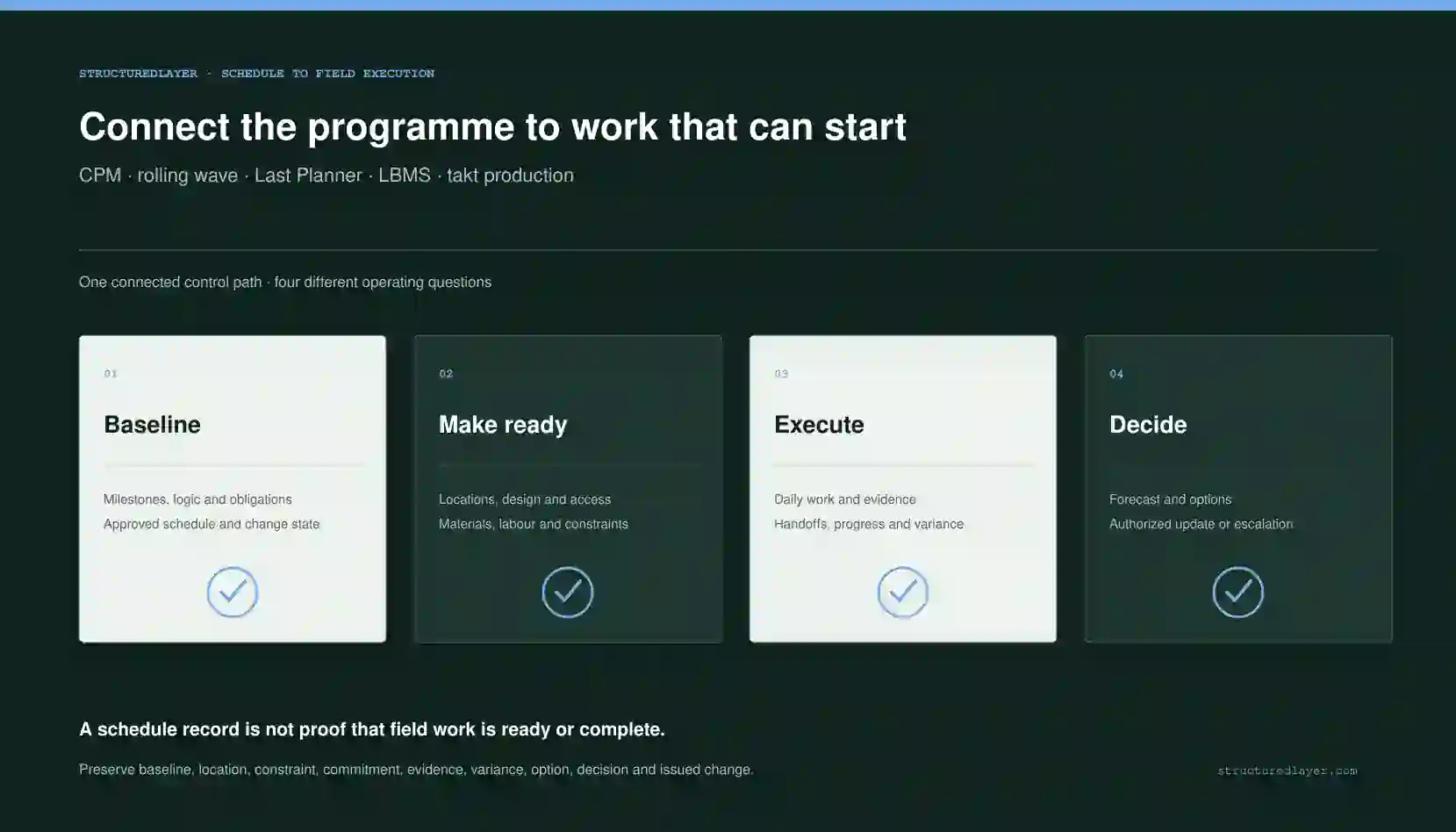
Connect the construction programme to work that can actually start
A contractual programme, look-ahead plan, location flow, daily record, and accepted schedule change answer different questions. Connect them through stable records, evidence-based readiness, variance learning, and human-authorized decisions before introducing AI assistance.
01 / Independently verifiable claims
Begin with what the technology and standards actually support.
- PMI's scheduling standard includes critical path, rolling-wave planning, schedule-model analysis, and adaptive approaches. CPM remains valid; the operating problem is not solved by declaring it obsolete.
- Rolling-wave planning develops near-term work in greater detail while later work remains higher-level until sufficient information is available.
- The Last Planner System connects milestone and phase planning with look-ahead make-ready work, reliable commitments, daily coordination, completion measurement, and learning from variance.
- Look-ahead planning identifies and removes constraints so activities move from work that should happen to work that can be executed.
- Location-Based Management Systems connect activities, quantities, resources, production rates, continuity, progress, and forecast by physical location.
- Takt planning divides work into zones and sequences trade flow around a shared production rhythm; takt control still requires active response when work deviates.
- A contractual schedule, look-ahead plan, location flow, daily record, progress claim, and accepted schedule change are different records with different authority.
- AI may reconcile, classify, forecast candidates, explain variance, and prepare options. It cannot establish progress, entitlement, delay liability, safety, constructability, or an approved update without required evidence and authority.
02 / The practical distinction
The master schedule, production plan, field record, and contractual update answer different questions.
A connected system preserves each purpose instead of flattening every planning conversation into one large activity list.
Baseline
CPM or contractual programme
Approved milestones, logic, calendars, float, obligations, forecast, and formal change under project controls.
Progressive planning
Rolling-wave detail
Adds near-term detail as information becomes more reliable without implying distant field-task certainty.
Readiness
Last Planner and make ready
Tests design, information, materials, labour, access, plant, preceding work, safety, and approvals before commitment.
Production flow
LBMS and takt
Organizes quantities, crews, sequence, continuity, handoffs, and rhythm by location to expose flow and spatial conflict.
Actual work
Daily execution evidence
Records what occurred, where, when, with which resources, evidence, interruption, quality state, and issue.
Governance
Authorized decision
Accepts, rejects, resequences, changes scope, revises forecast, issues notice, or changes the schedule through proper authority.
03 / Operating architecture
Connect planning horizons through stable activity, location, package, constraint, and decision identities.
Reconcile the records while each contractual and production-control method retains its definitions and approved state.
Should
Baseline and milestones
Import the approved programme, calendars, coding, logic, milestones, status date, requirements, and issued changes.
Can
Make-ready control
Connect near-term work to locations, drawings, approvals, quantities, crews, materials, access, plant, quality, safety, and predecessors.
Will and did
Commitment and execution
Record weekly and daily work, responsible teams, evidence, actual dates, quantities, interruptions, handoffs, and variance reasons.
Learn and decide
Forecast and authority
Reconcile actual state, calculate candidate effects, prepare options, preserve assumptions, and route formal updates to authorized people.
04 / Required records
The system needs more than activity names and percentage complete.
Schedule identity
Project, baseline, update, status date, calendar, WBS, activity, milestone, logic, constraint, float, source, owner, and approval.
Production identity
Location, package, trade, crew, quantity, production rate, sequence, zone, takt period, handoff, planned start, and readiness.
Constraint record
Type, affected work, evidence, owner, due date, promised and actual resolution, blocker, escalation, and recurrence.
Field evidence
Date, shift, location, activity, installed quantity, labour, plant, delivery, inspection, photograph, interruption, weather, issue, and reviewer.
Variance and forecast
Planned versus actual, reason, remaining duration, candidate effect, uncertainty, assumption, calculation version, and review.
Option and decision
Issue, alternatives, cost, time, scope, quality, risk and outcome effects, authority, decision, rationale, issued change, and follow-up.
05 / Construction example
A six-week look-ahead should expose why a planned area cannot start before the crew arrives.
The objective is not to let AI create a new programme; it is to connect the approved schedule with exact readiness and field evidence.
Look ahead
Select upcoming work
Relate approved activities and milestones to exact zones, packages, quantities, crews, and required finish conditions.
Make ready
Test readiness
Check drawings, submittals, access, predecessor acceptance, materials, labour, plant, inspections, and safety requirements.
Control
Record execution
Capture commitments, actual work, quantity, handoff, evidence, interruption, variance reason, and unresolved conditions by location.
Approve
Prepare the decision
Show candidate recovery options and effects; authorized teams decide and issue any formal changes.
06 / Deterministic controls
Keep calculations deterministic and schedule authority outside the model.
Immutable issued versions
Preserve every approved baseline, update, data date, calendar, logic revision, notice, and accepted change.
Stable crosswalk
Map master activities, look-ahead tasks, packages, locations, quantities, cost codes, evidence, and commitments through reviewed IDs.
Readiness rules
Define evidence and stop states for design, access, materials, labour, equipment, preceding work, inspections, safety, and quality.
Measured progress boundary
Separate reported, observed, measured, reviewed, certified, paid, and contractually accepted progress.
Calculation before narrative
Use approved schedule engines and formulas for dates, logic, float, quantities, rates, and reconciliation before AI explanation.
Authorized issue
Require named authority for commitments, resequencing, acceleration, scope change, notice, delay position, forecast, and update.
07 / Failure analysis
A connected dashboard can still conceal poor planning and unsupported progress.
False precision in distant work
Detailed future activities imply certainty that design, procurement, access, sequence, and resources do not support.
Look-ahead detached from baseline
Crews manage a separate plan while milestones, logic, forecast, cost, notice, and client reporting remain unreconciled.
Constraint closed without evidence
Work appears ready while a current drawing, predecessor acceptance, released material, access, permit, inspection, or crew is absent.
Progress copied from narrative
A note, model answer, photograph, invoice, or subjective percentage becomes actual progress without location, quantity, time, and review.
Optimization shifts harm downstream
A local sequence creates congestion, incomplete handoffs, excess work, storage, safety, quality, or milestone problems elsewhere.
AI rewrites contractual meaning
A model changes logic, interprets delay responsibility, or issues a forecast without the contract, records, calculation, and review.
08 / Deployment and cost
Begin with reconciliation and visibility before automated recommendation.
Foundation
Record and crosswalk
Connect one approved update with locations, packages, constraints, look-ahead tasks, field evidence, and owners.
Assist
Make-ready queue
Expose upcoming work and missing evidence while people continue the existing planning process.
Evaluate
Variance preparation
Calculate differences and use bounded AI to classify evidence and draft source-linked explanations for review.
Operate
Decision support
Prepare recovery options under version control; retain human approval and formal change procedures.
- Schedule exports, APIs, licenses, coding dictionaries, calendars, history, and contract requirements
- Location breakdown, packages, quantities, production rates, crew records, and reviewed activity crosswalks
- Design, procurement, material, access, plant, labour, inspection, safety, quality, and predecessor integrations
- Mobile field capture, daily evidence, photographs, installed quantities, review, offline operation, and correction
- Schedule engine, calculations, AI extraction and narrative usage, storage, monitoring, and version retention
- Planner, field, trade, commercial, client, and specialist review plus training, maintenance, disputes, and provider changes
09 / Evaluation
Measure readiness, forecast quality, and decision latency - not dashboard activity.
- Test activity, location, package, quantity, constraint, and evidence mapping against approved records and exceptions.
- Measure upcoming tasks with complete readiness evidence, overdue constraints, reliable commitments, variance reasons, and recurrence.
- Compare forecast dates and remaining work with later accepted outcomes while preserving the exact versions used.
- Measure false-ready work, unsupported progress, wrong-location matches, missed dependencies, and unauthorized change attempts.
- Track planning effort, field-entry effort, reconciliation time, reviewer correction, decision time, and cost per accepted update.
- Exercise missing integrations, stale evidence, changed calendars, offline work, model failure, manual fallback, and audit export.
10 / Controlled pilot
Prove the operating boundary before expanding it.
Choose one horizon
Use one active project, approved update, defined locations, one four-to-six-week horizon, named planners, and a clear decision.
Map the records
Connect activities, milestones, zones, packages, constraints, drawings, materials, crews, commitments, evidence, and status.
Define readiness
Agree exact evidence, owner, due date, stop state, override authority, and escalation for each constraint family.
Run in parallel
Keep current planning authority while comparing the connected queue with accepted human records.
Measure failures
Review false-ready work, missing constraints, mapping errors, unsupported progress, forecast difference, and review effort.
Approve the boundary
Proceed only where visibility improves without weakening contractual control, field judgment, safety, quality, or commercial authority.
11 / StructuredLayer recommendation
Connect the contractual programme to make-ready planning, location flow, daily evidence, variance learning, and authorized decisions - do not replace one planning method with an AI-generated schedule.
Start with one project and horizon. Preserve issued versions, map activity and location identities, define evidence-based readiness, separate observed from accepted progress, calculate before generating narrative, and keep authorized people responsible for commitments and formal change.
12 / Primary sources
Capability, governance, and implementation claims remain inspectable.
Project Management Institute
Practice Standard for Scheduling - Third Edition
Project Management Institute
Scheduling 101: The Basics of Best Practices
Lean Construction Institute
Last Planner System
Lean Construction Institute
Last Planner System Workbook
Lean Construction Institute
Takt Time
Lean Construction Journal
Location-Based Planning report
Aalto University
Location-Based Management System now and in the future
Aalto University
Integrated Forecasting Approach for Takt and Location-Based Scheduling
Routledge
Location-Based Management for Construction
Sources reviewed 25 July 2026. Technology capabilities, laws, guidance, terms, and pricing can change.
13 / Related StructuredLayer guidance
Continue from model selection into operating architecture.
Management Reporting
Connect schedule, cost, risk, option, decision, and follow-through records into reviewed reporting.
Workflow Library
Review schedule reconciliation, location production, material readiness, and wider construction workflows.
AI Evaluation Readiness
Prepare cases, critical failures, acceptance measures, release gates, and monitoring.