Construction and property operations report
Construction and Property Operations: 4 Signals for September 2026
Four source-grounded developments changing how construction and property leaders connect demand, capacity, records, rules, exceptions, and accountable decisions.
Executive view
The operating question is moving from what AI can produce to what the business can safely decide.
Across construction, insurance, and property operations, the September signals point in the same direction: demand, workforce capability, business records, rules, and exceptions need to be connected before AI can become dependable operating capacity.
AI does not remove capacity constraints. Connected operational records help management decide which work to pursue, what needs attention, and where accountable judgment belongs.
The evidence is mixed by design. Some facts are official statistics or public authority announcements. Some are vendor-reported capabilities or company disclosures. Each is useful as a direction signal, but none should be treated as proof that a buyer is ready, a workflow is accurate, or an outcome will transfer without local evaluation.
Four consequential signals
Separate the reported development from the operating conclusion.
Each signal states what the source establishes, what it does not establish, and which records or controls become more important.
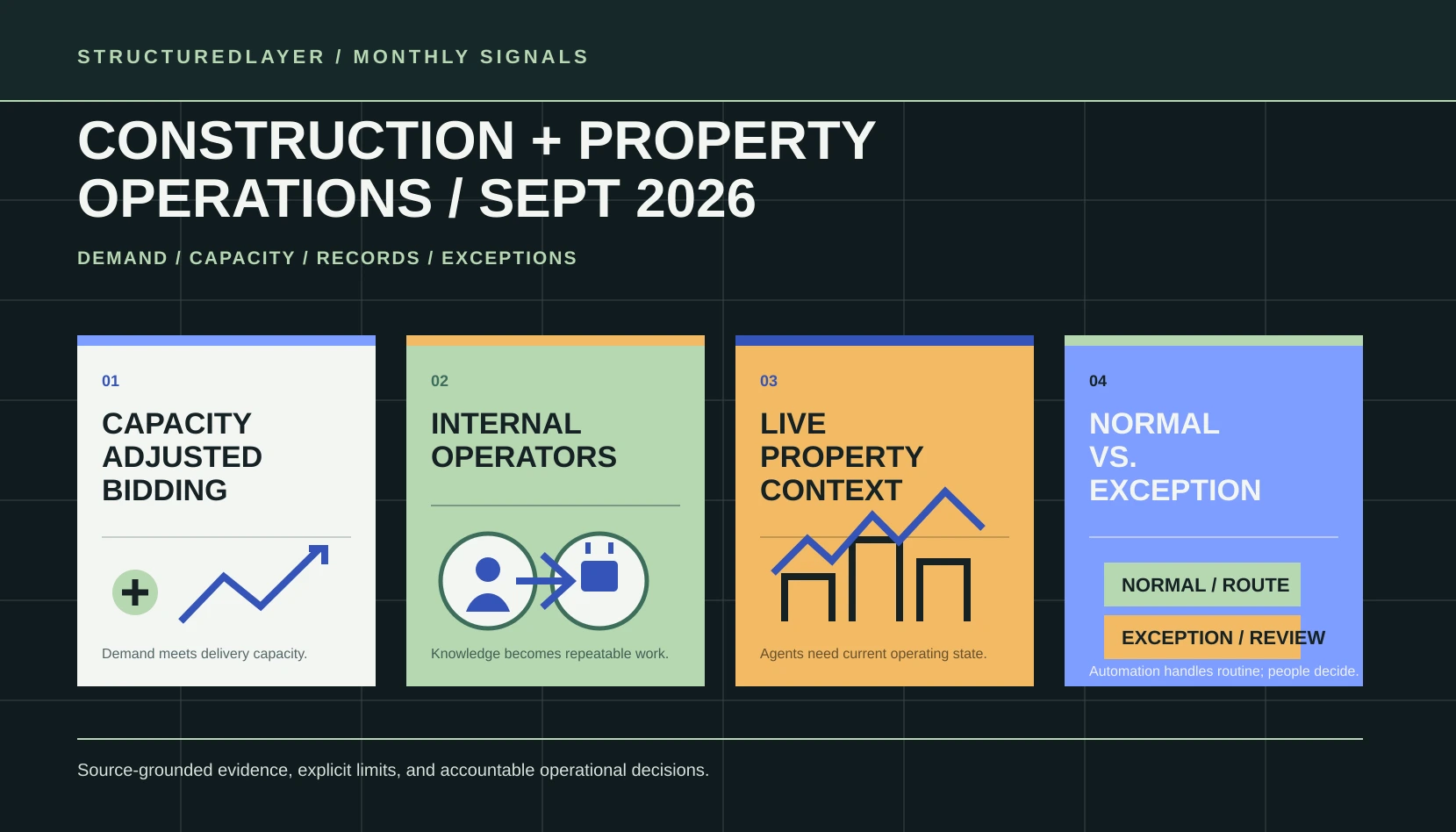
United States · Capacity-adjusted demand
Skilled-trade scarcity turns bid selection into a delivery-capacity decision.
Review bid go/no-go controlReported evidence
Lowe's Foundation announced a coalition of more than 75 organizations with a goal of helping prepare 1 million people for skilled-trades careers by 2035. Lowe's also cites a Department of Education estimate of 2.1 million unfilled skilled-trade positions by 2030. Separately, ABC estimates that construction needs 349,000 net new workers in 2026 to keep labor supply and demand in equilibrium.
Evidence boundary
The 2.1 million figure is reported by Lowe's as a Department of Education estimate and should not be treated as an independently verified project-level forecast. ABC's number is a national estimate, not a contractor-specific labor plan, available-trade count, or bid recommendation.
Operational implication
A useful pipeline view should connect opportunity, probability, expected award, schedule, trade demand, workforce availability, subcontractor coverage, recruitment lead time, and project overlap. The decision may be bid, do not bid, recruit, subcontract, reprice, or reschedule.
Enterprise operations · Internal capability
AI adoption is increasingly organized through internal operators who know the work.
Explore AI workflow trainingReported evidence
iTnews reported that Insurance Australia Group had more than 600 internal AI activators, more than 90 published AI agents, and regular AI use by more than 60% of its workforce. QBE separately describes AI moving into bounded underwriting and claims workflows, including a lead algorithmic underwriting capability that it says can reduce a defined quote-to-bind process from days to under 10 minutes.
Evidence boundary
The IAG workforce, activator, and agent figures are attributed to reported company disclosures rather than independently audited adoption evidence. QBE's timing is a company-reported result for a defined workflow, not proof that every underwriting or claims decision is automated or transferable to construction.
Operational implication
For a contractor, the durable pattern is a champion linked to a workflow: person, process, systems, records, rules, exceptions, approval, and accepted measure. That turns local expertise into a maintained capability without moving commercial, safety, contractual, or professional authority to AI.
Property operations · Live operating context
Property platforms are positioning AI as a live-data operating layer, not only a chat assistant.
Explore property operationsReported evidence
Yardi's September announcement positions Virtuoso Enterprise and Chat IQ around live Voyager data, multichannel conversations, specialized agents, urgency and intent signals, recommended next steps, and workflows spanning leasing, resident service, maintenance, invoice handling, and accounting. Yardi also describes a central environment for testing, deploying, and orchestrating agents.
Evidence boundary
These are vendor-described capabilities and product direction. They do not independently establish accuracy, adoption, savings, cross-system completeness, or a property operator's readiness. Live grounding inside one platform does not automatically resolve data authority across spreadsheets, email, vendors, finance systems, or other property software.
Operational implication
The operating question is whether property, unit, lease, tenant, asset, work order, vendor, invoice, approval, inspection, and payment records are identifiable and current enough for reviewable action. The platform can remain; the connected record and authority design still need to be explicit.
Dubai, United Arab Emirates · Exception-led processing
Structured developer records allow routine transactions to be separated from exceptions.
Review submission readinessReported evidence
Dubai Land Department's Initial Registration platform and Project 360 materials describe structured developer and project records, document extraction for items such as identity documents and sales contracts, role-based access, escrow and financial information, and rule-based handling for compliant transactions. The announced design sends incomplete or unusual cases into correction or review while connecting project status and early-warning indicators.
Evidence boundary
The official announcement supports the platform capabilities and operating model, but it does not establish the draft's claimed 80% reduction or five-minute transaction time. The existence of a platform also does not prove that every developer, transaction type, or exception path is already migrated or fully automated.
Operational implication
Construction and property teams can apply the same distinction locally: normal cases follow validated rules, missing information creates a request, discrepancies create an exception, and consequential decisions remain with an accountable person. This makes review effort visible instead of asking managers to inspect every transaction equally.
The common pattern
Connect the context, route the normal work, and reserve human attention for consequential exceptions.
A durable operating path
Make the decision traceable before making it faster.
The provider can change. The business still needs identifiable sources, connected records, explicit state, named authority, accepted outcomes, and recovery.
- 01
Source
Approved system, document, native ID, revision, owner, permission, and retrieval time.
- 02
Record
Stable opportunity, project, property, asset, person, document, cost, action, and decision relationships.
- 03
State
Trigger, current stage, required evidence, owner, due date, tolerance, and exception.
- 04
Rule
Deterministic completeness, comparison, validation, reconciliation, and conflict handling.
- 05
Authority
Qualified review, correction, approval, release, and accountable decision.
- 06
Action
Bounded preparation or approved action with logs, monitoring, and recovery.
Reader questions
Questions raised by the September signals.
- What is the main construction signal for September 2026?
- Skilled-trade capacity is becoming a bid-selection variable. A contractor needs to compare likely demand with trade availability, subcontractor coverage, schedule overlap, recruitment lead time, and delivery risk before treating pipeline value as desirable work.
- What is an internal AI activator?
- It is an employee who helps identify, shape, or deploy AI-enabled work around a real business process. The useful operating pattern is not prompt training alone; it is connecting that person's workflow knowledge to approved records, rules, exceptions, review, and a measure of accepted work.
- Does a property AI platform automatically create a complete operating layer?
- No. A vendor platform may provide live context, agents, actions, and management controls within its boundary. The operator still needs to define authoritative records, cross-system identities, permissions, exception ownership, human approval, history, and recovery.
- What does exception-led processing mean for a contractor or property team?
- Routine, complete, within-tolerance cases can follow validated rules. Missing, conflicting, unusual, high-value, or consequential cases are routed to named people with the supporting evidence. The goal is to focus judgment where it adds value, not to remove judgment.