
Construction operations guide
Construction Risk Registers: From Uncertain Event to Owned Action
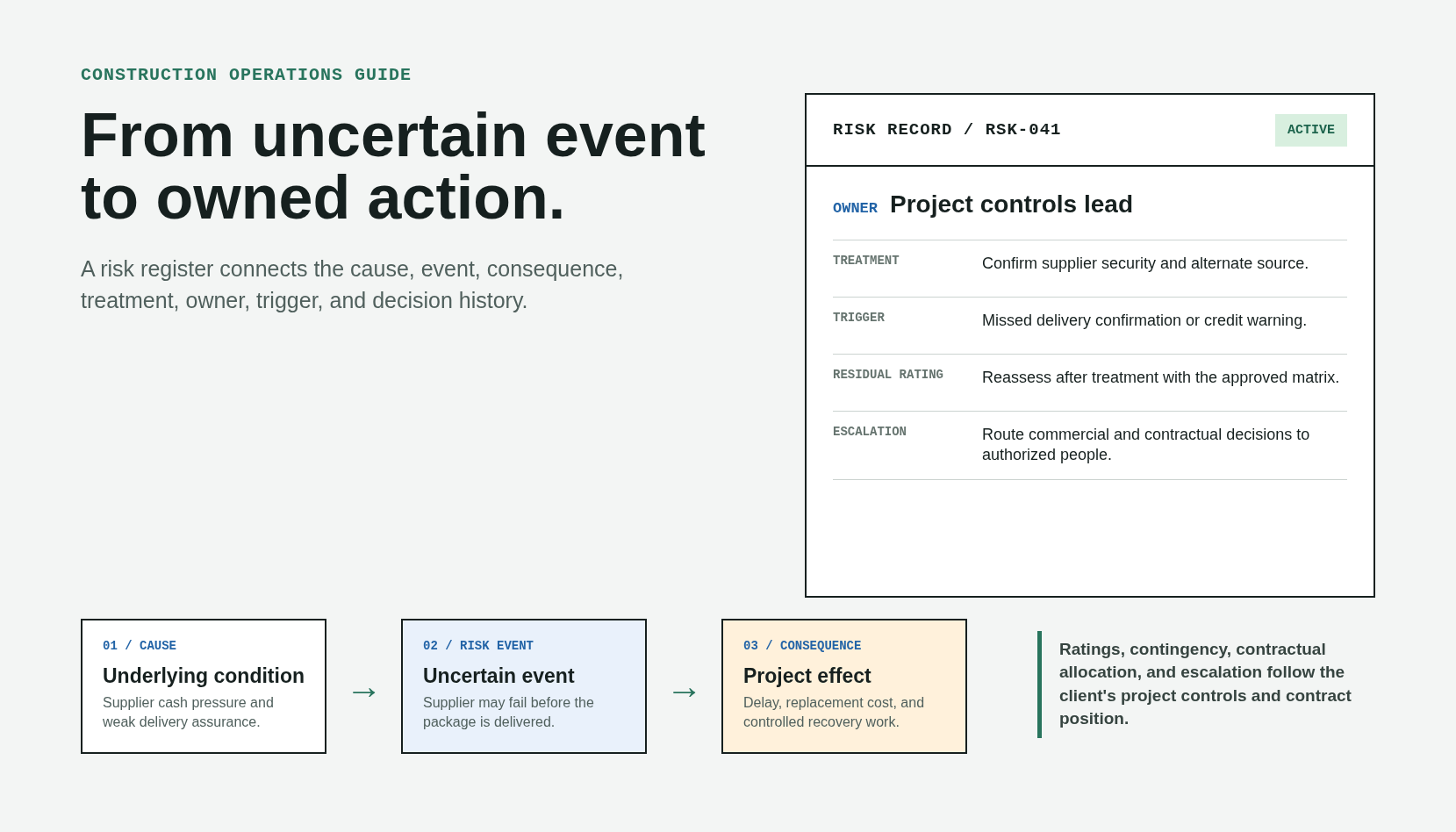
A useful register does more than list hazards. It connects a present cause, a future uncertain event, a potential project consequence, an owner, a proportionate treatment, a review trigger, and the decision history required to act.
Control boundary
This guide describes a vendor-neutral record and workflow pattern. The client's approved project controls, contract position, governance, commercial authority, professional responsibilities, and escalation route determine how a risk is assessed, funded, allocated, accepted, or acted upon.
Start with uncertainty
A risk is future-facing. An issue is present.
ISO 31000 frames risk as the effect of uncertainty on objectives. In project controls, that distinction prevents a register from becoming an undifferentiated list of concerns, completed events, actions, and outcomes.
A subcontractor that may become insolvent during delivery is a risk. Once the subcontractor has entered insolvency, the uncertainty has become a current issue requiring an appropriate response path. The historical risk record remains useful because it shows what was known, how it was assessed, which treatment was chosen, and whether a trigger was missed.
Do not ask a register to do every project-control job. Use it to make material future uncertainty visible, owned, reviewable, and connected to action.
Write the event clearly
Use cause, uncertain event, and consequence.
A single label such as “cost overrun” or “schedule delay” obscures the condition that can be addressed and the project outcome that needs protection. A structured statement makes the treatment path inspectable.
Cause
A supplier has limited working capital and delivery assurance is weakening.
Uncertain event
The supplier may fail before a critical package is delivered.
Consequence
The project may face delay, replacement cost, disruption, and recovery work.
The example is illustrative. It does not determine insolvency risk, contractual liability, replacement strategy, entitlement, notice requirement, or contingency for any project.
A usable record
Keep the information needed to review and act.
The field design should follow the client's methodology, systems, reporting cycle, and control framework. This minimum pattern makes the key questions visible.
Risk ID and title
Create one stable record and a concise statement that survives reporting, handoff, and review.
Objective and baseline
Identify the cost, time, scope, quality, safety, operational, contractual, or other objective at risk and the approved basis against which effect is considered.
Cause
Record the condition, dependency, or precursor that can give rise to the event.
Uncertain event
State what might happen. Do not record an already-realized issue as a future risk.
Consequence
Describe the potential effect on the defined objective if the event occurs.
Evidence and source
Keep the relevant report, notice, programme, drawing, market input, observation, meeting decision, or other permitted source visible.
Owner and reviewer
Name the person responsible for coordinating treatment and the person or forum authorized to accept, escalate, or change the record.
Assessment
Use the client-approved likelihood, impact, exposure, tolerance, and matrix method. A generic score is not portable between clients or contracts.
Treatment and trigger
Record the preventive or mitigating action, due date, expected evidence, threshold, and condition that requires review or escalation.
Residual exposure and history
Reassess after treatment, preserve the rationale and decision, and retain every material change, realization, retirement, or transfer.
Risk-control cycle
Treat the register as a living decision record.
- 01
Identify
Bring forward a specific uncertainty that could materially affect an objective. Connect it to evidence rather than collecting generic risk labels.
- 02
Assess
Apply the approved client methodology, scale, tolerance, and decision boundary. Ratings support prioritization; they do not establish a contract entitlement or professional conclusion.
- 03
Treat
Choose a proportionate action: avoid, reduce, transfer, share, accept, prepare, or otherwise respond according to the governing project controls and contract position.
- 04
Monitor
Review owners, dates, triggers, sources, actions, dependencies, and changes in exposure at the agreed cadence and decision forum.
- 05
Realize or retire
When the event occurs, retain the linked risk history but manage the present effect through the applicable issue, change, claim, recovery, incident, or decision process.
Treatment is not recovery
Plan before the event. Control the effect after it.
Risk treatment
Acts on the cause, likelihood, or potential consequence while the event remains uncertain. It may include information gathering, alternative sourcing, design review, sequencing, assurance, allowance review, or an agreed allocation strategy.
Issue and recovery control
Acts after the event has occurred. The relevant workflow may require incident management, change control, notice, claim, programme recovery, procurement response, forecast update, communication, and authorized decision.
A treatment can reduce exposure without removing it. The resulting residual exposure should be re-evaluated with the client's approved criteria and accepted only by the appropriate authority. It is not a model-generated confidence score or a universal colour-code decision.
The boundaries that stay outside the register.
- A risk register is not a substitute for the project contract, scope, schedule, estimate, cost forecast, design review, safety process, insurance advice, or professional judgement.
- A residual score does not prove that exposure is acceptable, funded, insured, transferred, or contractually allocated.
- Contingency remains a client-controlled commercial decision based on the approved estimating, forecasting, governance, and authorization process.
- Contractual allocation, notices, claims, recovery steps, and external communication require the appropriate accountable commercial, legal, contractual, or project authority.
- An AI-generated summary, extracted risk, or suggested rating is a candidate input. It must retain source evidence and cannot silently become an accepted project-control record.
Where AI may fit
Use AI to prepare evidence, never to quietly accept project exposure.
Candidate preparation
A controlled workflow can extract potential causes, dates, dependencies, thresholds, actions, and source passages from approved correspondence, notices, reports, schedules, and registers. It should preserve the exact evidence and flag ambiguity or conflict.
Authorized control
An appointed person checks whether the record belongs to the correct project, is current, requires a rating, needs treatment, has crossed a trigger, should be escalated, or has become an issue. The workflow records that decision and its effect.