Source support
Trace outputs to approved sources, actions, files, references, versions, and evidence.
AI Pilot Experience · Browser Control
Read one authorized portal or inbox and prepare a source-linked candidate record, download list, or exception queue without external communication or consequential browser action.
Pilot experience
Portals and inboxes without suitable APIs often leave staff manually reading pages, downloading files, and transferring facts into internal records.
Computer-use models can interpret changing interfaces while Playwright can handle stable deterministic steps. Both operate through a restricted browser identity, approved source list, allowlisted actions, and recorded stop conditions.
The pilot prepares candidates and evidence for human inspection. It does not bypass access controls or perform consequential external actions.
Visual walkthrough
Each view shows how source records, system outputs, exceptions, corrections, and human decisions remain connected during the pilot.
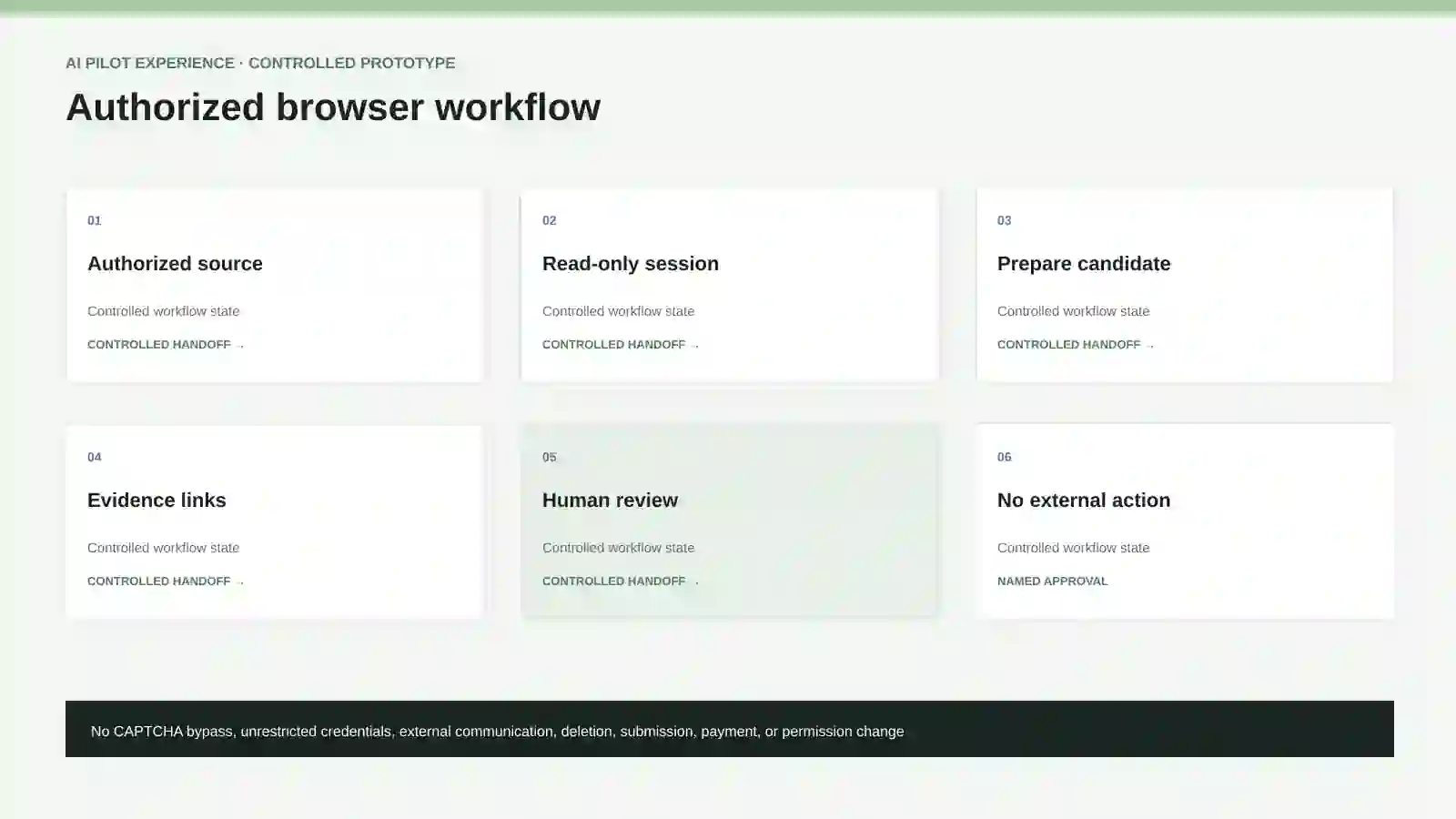
Approved inputs remain connected to preparation, deterministic checks, human review, acceptance, and release.
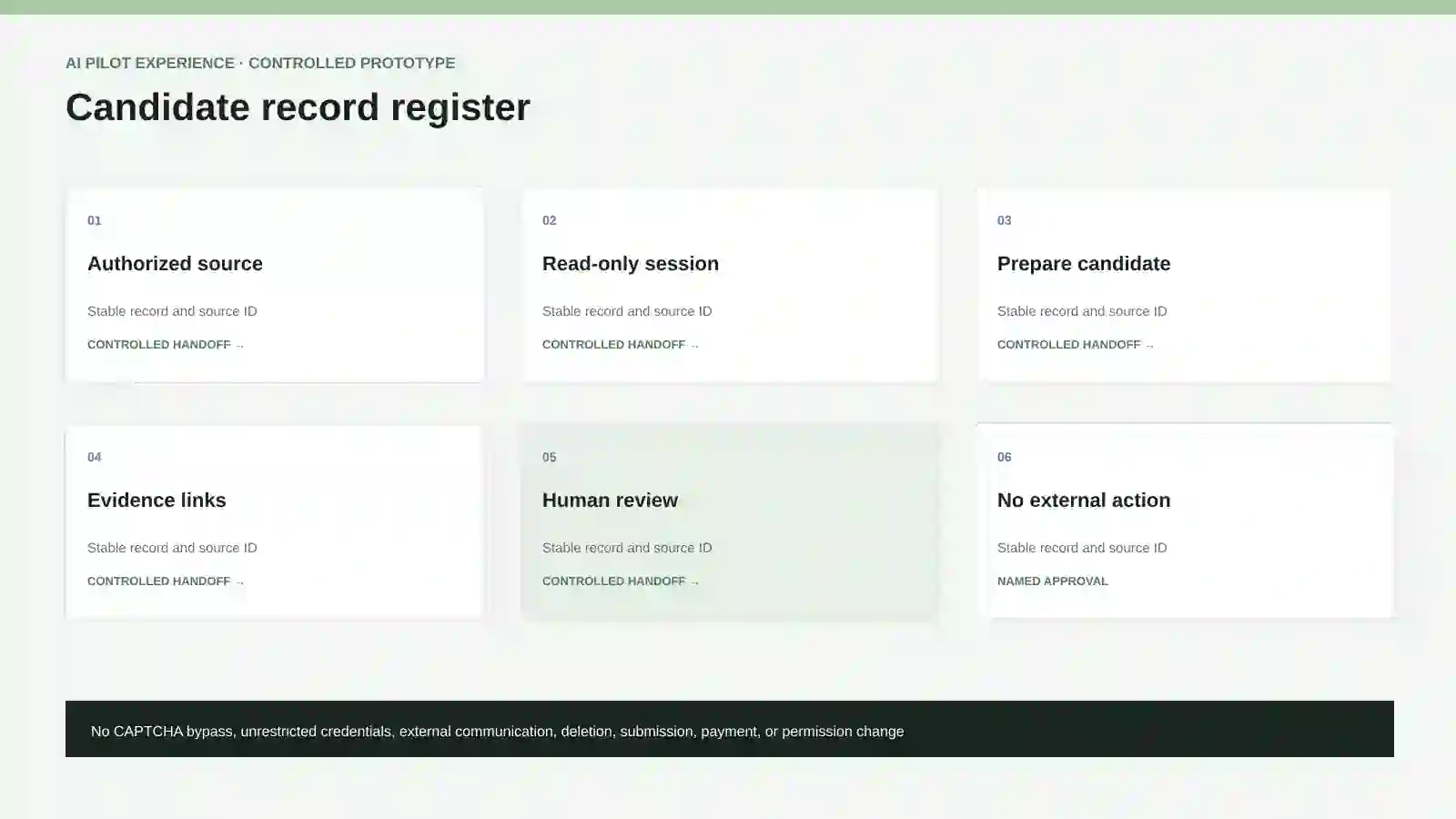
Stable source, run, output, version, evidence, correction, and review records remain visible.
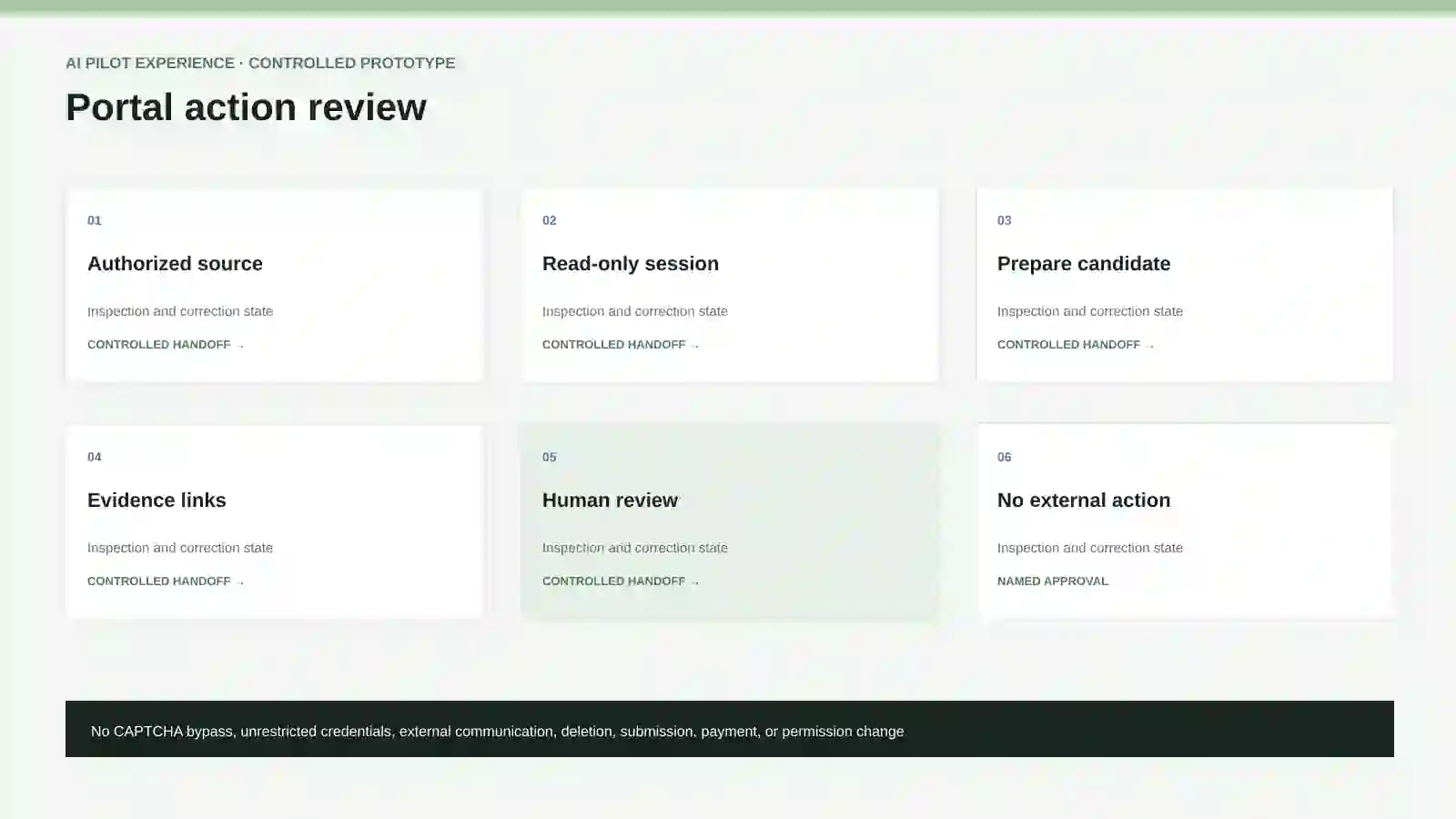
Reviewers inspect claims, actions, files, dependencies, geometry, behavior, and prohibited implications before acceptance.
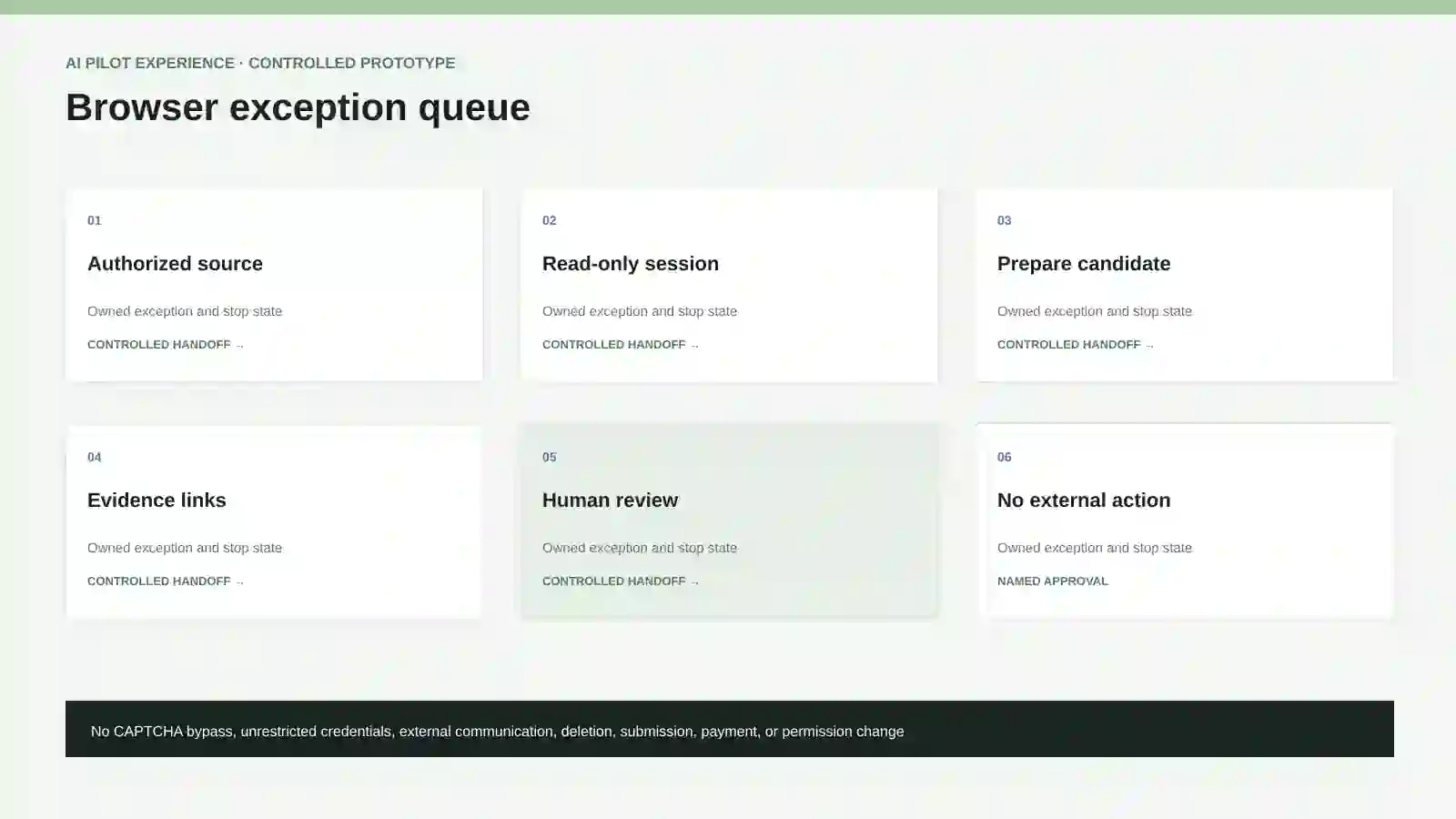
Uncertainty, failure, permission, security, rights, validation, and stop conditions receive named owners and states.
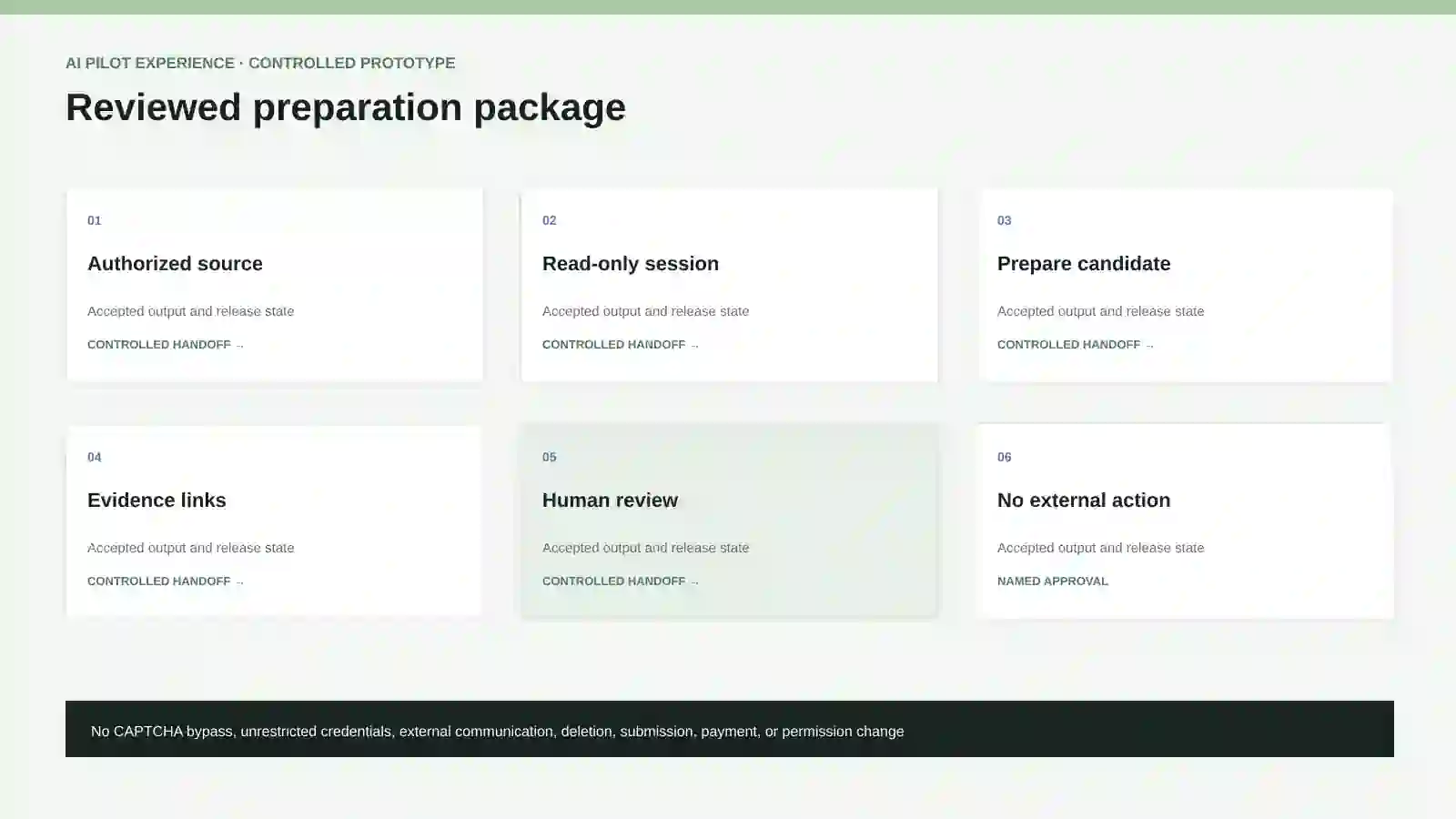
Only accepted outputs move to the approved audience or next controlled environment.
User journey
The interface can feel simple while the pilot preserves document identity, revision, permission, retrieval, uncertainty, and review evidence behind every result.
Register portal or inbox, owner, account, role, pages, folders, records, purpose, retention, and prohibited actions.
Use restricted credentials, managed browser, allowlisted domains, narrow downloads, redaction, logging, timeout, and teardown.
Use Playwright for deterministic navigation, selectors, downloads, captures, validations, and retries where suitable.
Route ambiguous visual interpretation through an approved model with screenshots, action proposals, and observation checks.
Create record fields, download entries, source URLs, timestamps, captures, file hashes, uncertainty, and exception states.
Escalate CAPTCHA, login change, unexpected domain, modal, missing source, ambiguous field, external write, or permission issue.
A named reviewer opens source evidence, corrects fields, rejects candidates, resolves exceptions, and accepts records.
Revoke temporary access where applicable and retain run, source, action, download, correction, acceptance, and incident records.
Technology options
The final selection records exact versions, licences, data handling, cost, limitations, replacement options, and the evidence required before use.
| Component | Examples | Pilot role | Boundary |
|---|---|---|---|
| OpenAI Computer Use | Current approved OpenAI computer-use tool and model | Interpret approved browser screenshots and propose bounded actions. | The application must validate proposed actions and keep consequential actions prohibited or human-approved. |
| Anthropic Computer Use | Current approved Anthropic computer-use tool | Operate an isolated desktop or browser inside explicit tool and action limits. | Provider tool use does not establish portal permission, source truth, or authority to act. |
| Gemini Computer Use | Current verified official Gemini computer-use capability | Remain a replaceable option after exact model, API, region, policy, and evaluation review. | Capability availability must be verified; screenshots and actions can still be wrong. |
| Grok Bot pattern | Monitored vendor pattern only after official identity, documentation, access, policy, and test review | Inform private monitoring or a future bounded comparison. | A product announcement, bot, wrapper, or demo does not qualify it for authorized portal use. |
| Playwright | Versioned browser, selectors, assertions, traces, downloads, screenshots, and tests | Perform deterministic browser steps where interface behavior is stable. | A passing script does not establish business correctness or continuing permission. |
Client-owned pilot outputs
Evaluation evidence
A fluent answer is not the acceptance unit. The pilot tests whether a reviewer can reach the controlling evidence efficiently and detect important failure.
Trace outputs to approved sources, actions, files, references, versions, and evidence.
Measure completion against frozen cases and acceptance criteria, including difficult and stop cases.
Record unauthorized action, false claim, security event, dependency issue, missing evidence, or prohibited use.
Measure inspection, correction, rerun, exception resolution, testing, and approval time.
Count outputs accepted by accountable reviewers, not processing completion or model agreement.
Include models, tools, compute, storage, preparation, testing, review, correction, monitoring, support, and replacement.
Cost drivers
Scaling factors
Use durable source, run, work-item, output, review, correction, acceptance, release, expiry, and withdrawal IDs with queues and checkpoints.
Constrain source, identity, credential, tool, repository, file, network, provider, destination, audience, and action scope.
Version models, APIs, browsers, tools, packages, dependencies, engines, operating systems, hardware, settings, tests, and policies.
Keep approved sources, prompts, scripts, records, assets, tests, evidence, corrections, and accepted outputs client-owned.
Measure queues, sessions, rate limits, rendering, build time, timeouts, retries, reviewer capacity, and cost.
Require separate security, integration, monitoring, recovery, service, rights, ownership, training, and deployment approval.
Cross-industry reuse
The reusable capability is permission-aware multilingual retrieval across versioned documents with citations. Each industry keeps its own source authority, terminology, consequence, retention, and qualified review.
Approved workflow sources, records, prototypes, media, references, tests, and review evidence.
Review: Named process, technical, security, subject, communications, legal, or release owner.
Approved workflow sources, records, prototypes, media, references, tests, and review evidence.
Review: Named process, technical, security, subject, communications, legal, or release owner.
Approved workflow sources, records, prototypes, media, references, tests, and review evidence.
Review: Named process, technical, security, subject, communications, legal, or release owner.
Approved workflow sources, records, prototypes, media, references, tests, and review evidence.
Review: Named process, technical, security, subject, communications, legal, or release owner.
Approved workflow sources, records, prototypes, media, references, tests, and review evidence.
Review: Named process, technical, security, subject, communications, legal, or release owner.
Approved workflow sources, records, prototypes, media, references, tests, and review evidence.
Review: Named process, technical, security, subject, communications, legal, or release owner.
Approved workflow sources, records, prototypes, media, references, tests, and review evidence.
Review: Named process, technical, security, subject, communications, legal, or release owner.
Approved workflow sources, records, prototypes, media, references, tests, and review evidence.
Review: Named process, technical, security, subject, communications, legal, or release owner.
Authority boundaries
Related paths
Continue into the operating, technical, security, and readiness guidance connected to this workflow.
Review browser identity, containment, evidence, approvals, monitoring, and recovery.
Open pageCompare APIs, MCP, browser automation, computer use, and native agents.
Open pageDefine identities, sources, credentials, tools, actions, providers, and destinations.
Open pagePrepare normal, exception, adversarial, stop, and recovery cases.
Open pageStart with one approved collection
Use general workflow information during the assessment. Do not submit confidential documents, passwords, API keys, authentication codes, or unrestricted system access.
Primary technical references
Plain-language route guide
Choose the smallest route that answers your next decision.
The formal service names remain useful for scope and contracts. The plain-language labels explain what each route actually does. These are alternatives, not four mandatory stages.
Operating-Layer Blueprint
Buyer question answered
What should we build, and where should the boundary be?
Typical input
One priority workflow, a named owner, current systems, representative records or files, and known failure points.
Output
A client-owned current-state map, target design, source inventory, implementation boundary, timeline, and fixed quote.
Bounded AI Agent Pilot
Buyer question answered
Can one specific AI-assisted task work reliably enough to justify more?
Typical input
One named task, approved sources and tools, representative cases, a human reviewer, and explicit stop conditions.
Output
A working pilot, evaluation evidence, cost and failure findings, review requirements, and a proceed, revise, or stop recommendation.
Single Workflow Implementation
Buyer question answered
How do we put one recurring workflow into controlled production?
Typical input
A defined trigger and completion point, accountable owners, approximately three core systems, rules, approvals, and test cases.
Output
Connected records, an operating view, integrations, a dashboard, acceptance testing, training, documentation, and handover.
Complete Operating Layer Implementation
Buyer question answered
How do we connect shared data and decisions across teams?
Typical input
Two to five related workflows, shared records, several departments or systems, an executive sponsor, and named operating owners.
Output
A phased operating layer with shared records, permissions, interfaces, integrations, reporting, controlled automation, training, and handover.
Still unsure which route fits?
Describe one broken workflow. The free assessment may recommend a Blueprint, pilot, implementation, a smaller discovery step, or no engagement.