
Retrieval relevance
Did the system retrieve the passages needed for the question across languages, terminology, document types, and layouts?
AI Pilot Experience · Document Search
Connect an approved document collection, ask questions in a preferred language, retrieve source passages across languages, show current revisions and conflicts, and require human review before accepted use.
Pilot experience
Project teams often know that an answer exists but not the exact file, language, terminology, revision, page, or responsible source. A multilingual retrieval pilot tests whether approved documents can be made easier to find without turning a generated answer into project authority.
The user selects a permitted project collection and asks a question in a preferred language. The system retrieves candidate passages using exact, structured, dense, sparse, or multilingual methods, reranks them, and presents document identity, revision, status, page, section, highlighted evidence, conflicts, and uncertainty.
A reviewer can open the source, accept or correct the retrieval result, reject an unsupported answer, or request more evidence. The pilot records what worked, what failed, how much review was required, and which missing records or permissions would block dependable production use.
Visual walkthrough
Each view shows how source records, system outputs, exceptions, corrections, and human decisions remain connected during the pilot.
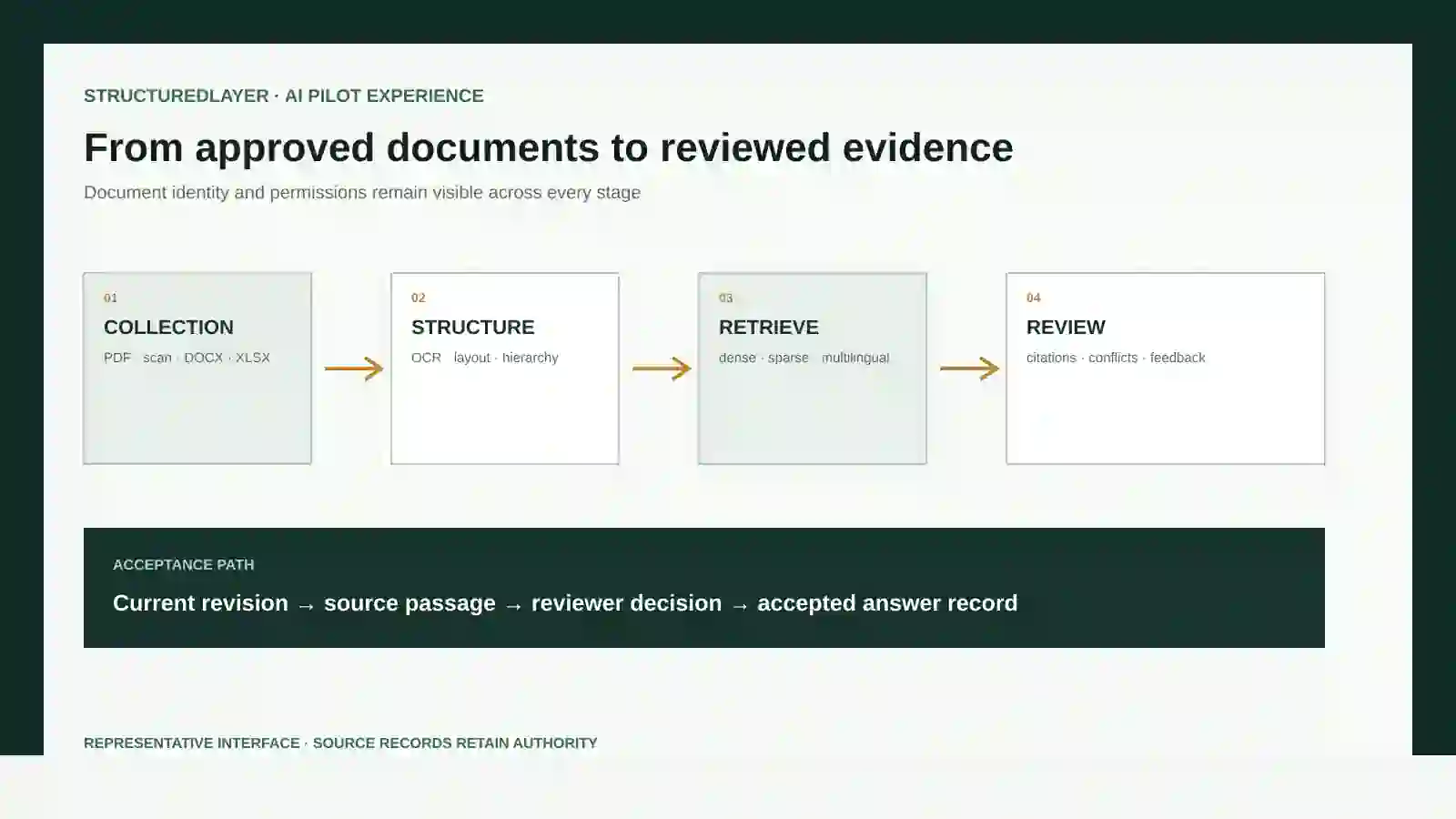
Approved documents are identified and structured before multilingual retrieval. Accepted use requires source passages, revision state, conflicts, and a recorded reviewer decision.
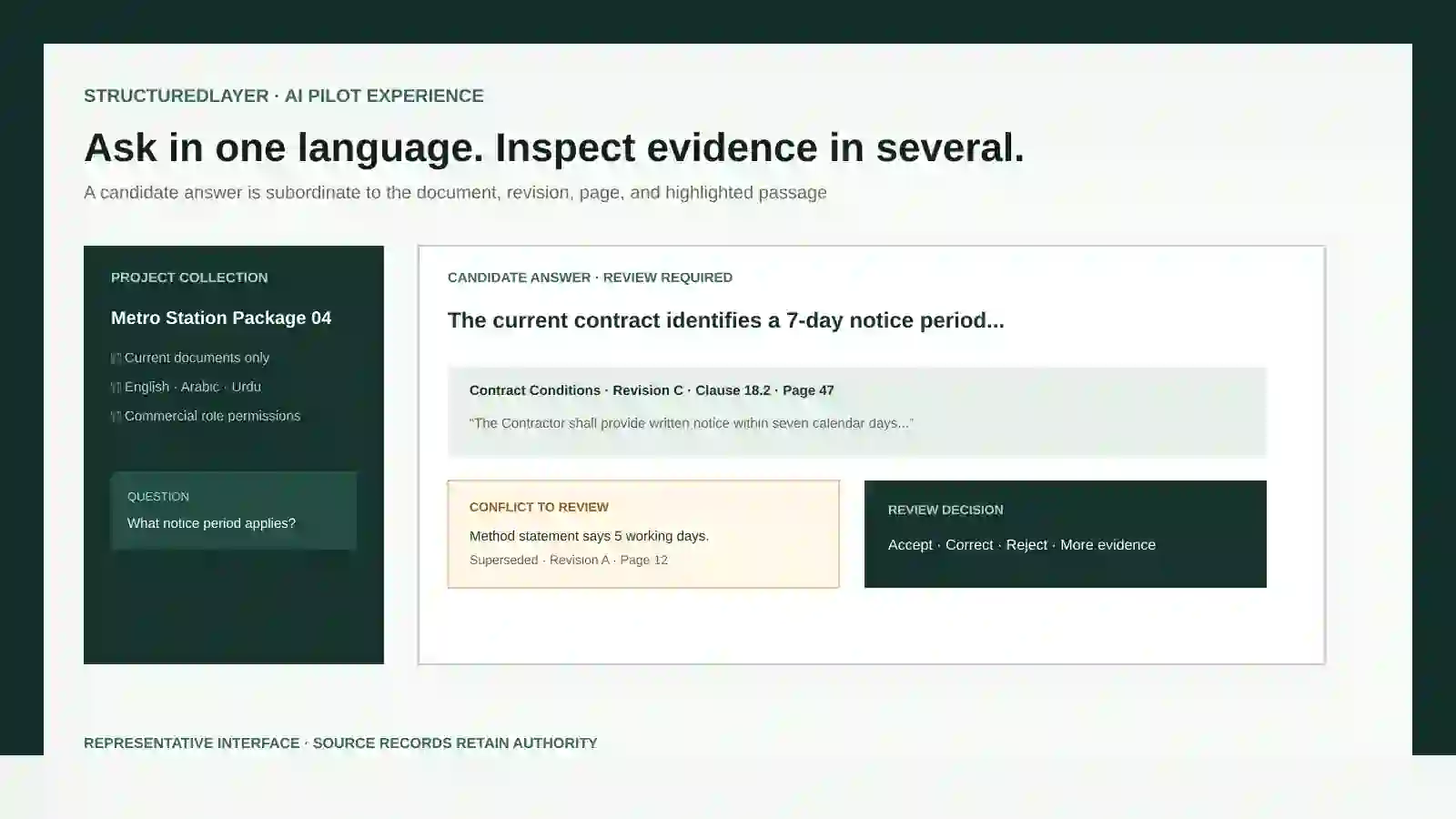
The candidate answer is secondary to the current document, clause, page, highlighted passage, and visible conflicting source.
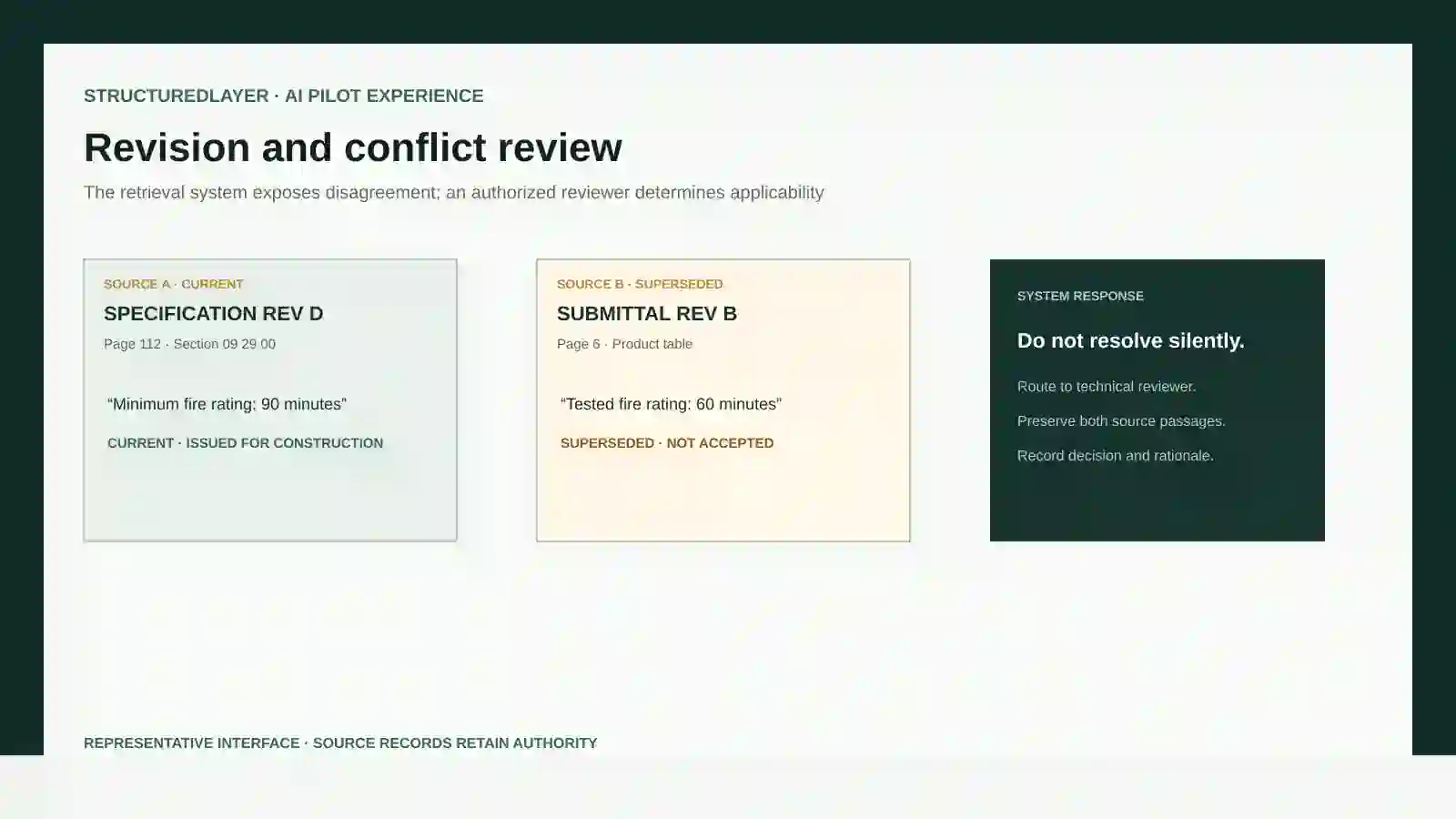
The retrieval system exposes disagreement rather than silently choosing the most fluent passage. An authorized reviewer determines applicability.
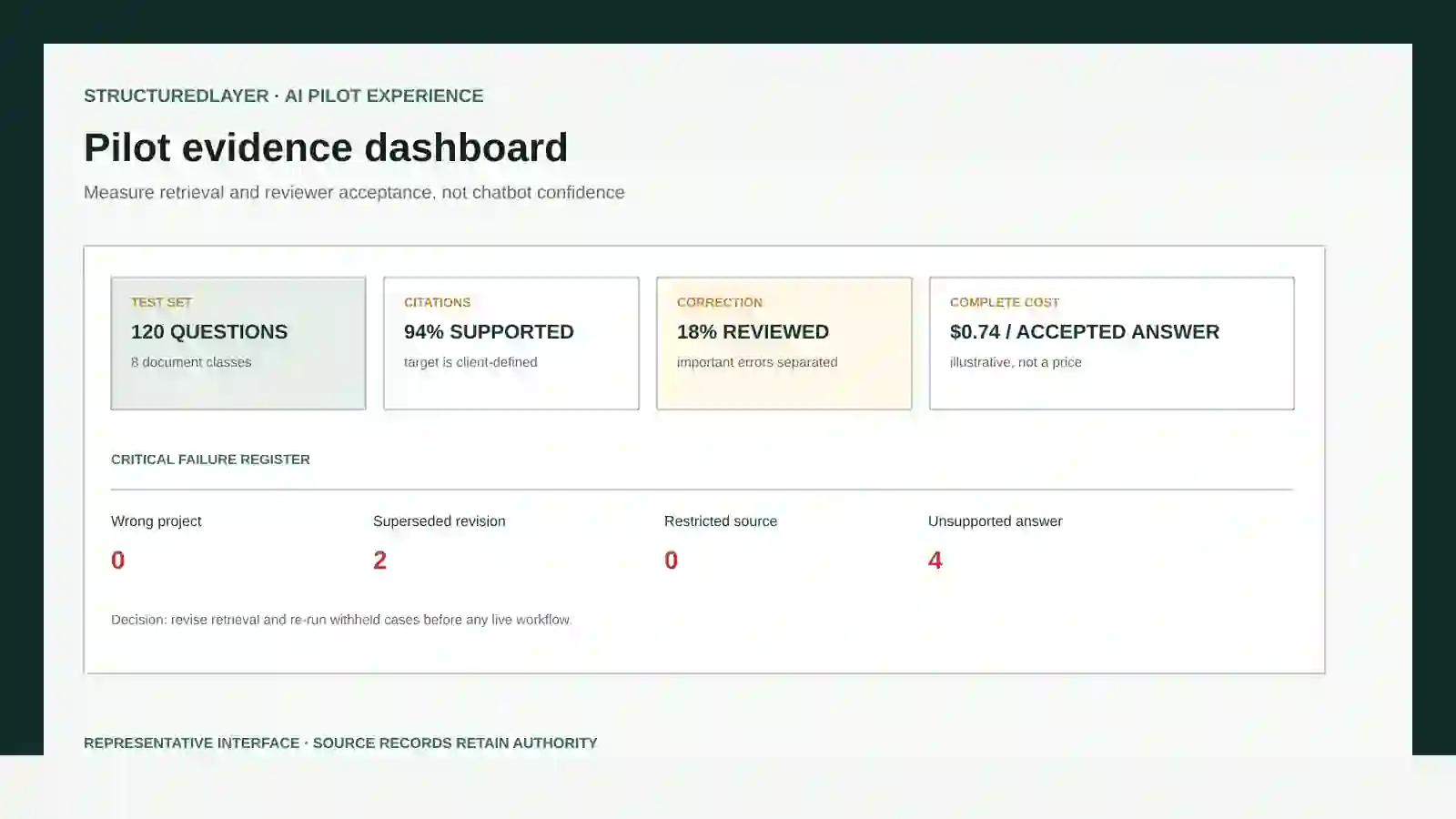
Track citation support, reviewer corrections, critical failures, latency, and complete cost across the agreed evaluation set.
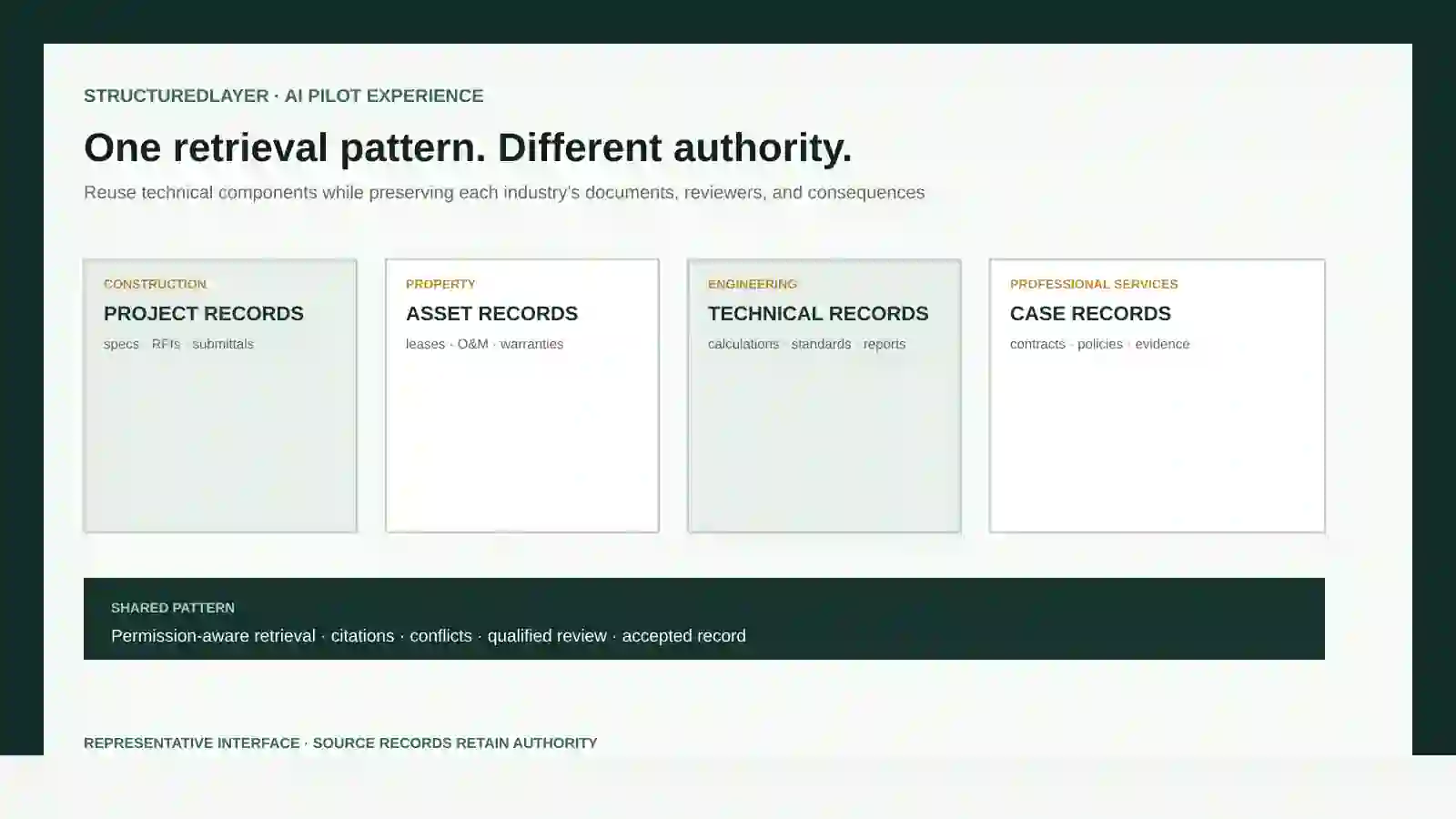
The technical pattern can be reused, while document authority, terminology, permissions, reviewers, consequences, and acceptance remain industry specific.
User journey
The interface can feel simple while the pilot preserves document identity, revision, permission, retrieval, uncertainty, and review evidence behind every result.
Select one project or document class, intended users, languages, permitted sources, excluded sources, purpose, retention, and named owner.
Record document ID, project, type, issuer, revision, status, issue date, authoritative location, fingerprint, permissions, supersession, and current-state rule.
Apply OCR, reading order, layout, tables, headings, hierarchy, page coordinates, language identification, and quality warnings while preserving the unchanged source.
Create structured fields and permission-aware search representations using exact terms, sparse retrieval, dense embeddings, multilingual signals, or parent-child relationships.
Accept a question in the user's preferred language, apply project and role filters, retrieve candidate passages, and rerank against the bounded task.
Show title, revision, status, page, section, highlighted passage, original language, optional translation, related sources, conflicts, and missing evidence.
An authorized person opens the source, accepts or corrects the candidate, rejects unsupported interpretation, records feedback, and determines any business action separately.
Evaluate citations, authority, permissions, conflicts, abstention, correction effort, latency, cost, and critical failures before stop, revise, assistive use, or production scoping.
Technology options
The final selection records exact versions, licences, data handling, cost, limitations, replacement options, and the evidence required before use.
| Component | Examples | Pilot role | Boundary |
|---|---|---|---|
| Document structure | Docling, provider document parsers, approved OCR and layout services | Preserve pages, hierarchy, reading order, tables, figures, coordinates, and document structure for retrieval. | A reconstructed tree, table, heading, reading order, or chunk can be wrong; the identified source and revision remain authoritative. |
| Multilingual retrieval | BGE-M3, hosted embedding APIs, sparse indexes, exact search | Retrieve candidate passages across different wording and languages using dense, sparse, or multi-vector signals. | Similarity does not establish applicability, equivalence, current revision, complete coverage, or permission to use the source. |
| Reranking | Cross-encoder rerankers, provider reranking APIs, task-specific scoring | Reorder retrieved passages for the defined question and document collection. | A higher rank is not source authority, factual correctness, or professional acceptance. |
| Candidate answer | Claude, GPT, Gemini, Qwen, or another evaluated language model | Prepare a concise candidate answer, comparison, or insufficient-evidence response linked to retrieved passages. | The model cannot create missing evidence or inherit contractual, technical, safety, legal, commercial, or professional authority. |
| Deterministic controls | Database filters, document registry, permission service, revision rules, schema validation | Enforce project, role, status, revision, source, expiry, citation, and output-schema conditions outside the model. | Rules require correct source records, tested logic, exception ownership, monitoring, and recovery. |
| Review interface | Client-owned web application, project-system extension, or controlled review queue | Expose sources, passages, conflicts, uncertainty, corrections, accepted state, and reviewer evidence. | An interface confirmation records acceptance for the named purpose; it does not create authority outside the reviewer's role. |
Client-owned pilot outputs
Evaluation evidence
A fluent answer is not the acceptance unit. The pilot tests whether a reviewer can reach the controlling evidence efficiently and detect important failure.
Did the system retrieve the passages needed for the question across languages, terminology, document types, and layouts?
Does each material claim point to the exact document, revision, page, section, table, or highlighted passage that supports it?
Did current, applicable, permitted sources outrank superseded, draft, unrelated, expired, or restricted material?
Did the workflow expose disagreement, missing evidence, and uncertainty instead of merging sources into unsupported certainty?
How long did qualified reviewers take to inspect, correct, reject, or accept results, and which errors could plausibly pass review?
Measure preparation, OCR, indexing, embedding, reranking, model use, storage, monitoring, review, correction, and re-indexing per accepted answer.
Cost drivers
Scaling factors
Batch ingestion and incremental updates require durable identity, deduplication, queues, retries, checkpoints, storage, and re-indexing controls.
Every retrieval route must preserve project, client, joint-venture, role, record, and purpose permissions as collections grow.
Add languages only after agreed terminology, OCR, retrieval, translation, citation, and qualified-review evaluation.
Measure queue behavior, caching, retrieval depth, reranking, model calls, timeouts, fallback, and reviewer capacity under expected use.
Name owners for source updates, access, failed ingestion, stale indexes, corrections, evaluation, provider changes, support, and retirement.
A successful pilot supports a separate decision on security, integrations, monitoring, recovery, service levels, training, handover, and ongoing cost.
Cross-industry reuse
The reusable capability is permission-aware multilingual retrieval across versioned documents with citations. Each industry keeps its own source authority, terminology, consequence, retention, and qualified review.
Specifications, drawings, RFIs, submittals, contracts, method statements, inspection records, minutes, and correspondence.
Review: Document control, estimator, commercial, project, design, engineering, safety, or other purpose-specific authority.
Leases, O&M manuals, warranties, inspections, work orders, compliance records, tenancy correspondence, and asset information.
Review: Property, facilities, legal, compliance, commercial, survey, or technical owner according to the question.
Standards, calculations, reports, specifications, technical queries, models, test evidence, and interdisciplinary records.
Review: Qualified engineer, discipline lead, information manager, quality role, or authorized technical approver.
Briefs, drawings, specifications, schedules, design reports, consultant comments, approvals, and change records.
Review: Architect, design manager, technical lead, contract administrator, or relevant qualified specialist.
Work instructions, product specifications, quality records, maintenance manuals, supplier files, and change notices.
Review: Production, quality, engineering, maintenance, procurement, or compliance owner.
Service manuals, asset histories, agreements, work orders, inspection forms, parts information, and completion evidence.
Review: Service manager, technician, engineering, warranty, commercial, or safety owner.
Contracts, policies, case records, research, prior deliverables, correspondence, and approved knowledge libraries.
Review: Matter owner, legal, risk, compliance, quality, client lead, or subject specialist.
Policies, forms, administrative records, agreements, guidance, and authorized operational knowledge.
Review: Qualified privacy, legal, compliance, security, operational, or clinical role where applicable.
Authority boundaries
Related paths
Continue into the operating, technical, security, and readiness guidance connected to this workflow.
Review the commercial scope, test boundary, evidence, price range, duration, and possible decisions.
Open pageInspect document identity, OCR, extraction, revisions, comparison, retrieval, and qualified-review controls.
Open pageReview source authority, context classes, permissions, citations, correction, refresh, expiry, and withdrawal.
Open pageUnderstand structure-aware parsing, hierarchical chunking, source records, and custom retrieval boundaries.
Open pageStart with one approved collection
Use general workflow information during the assessment. Do not submit confidential documents, passwords, API keys, authentication codes, or unrestricted system access.
Plain-language route guide
Choose the smallest route that answers your next decision.
The formal service names remain useful for scope and contracts. The plain-language labels explain what each route actually does. These are alternatives, not four mandatory stages.
Operating-Layer Blueprint
Buyer question answered
What should we build, and where should the boundary be?
Typical input
One priority workflow, a named owner, current systems, representative records or files, and known failure points.
Output
A client-owned current-state map, target design, source inventory, implementation boundary, timeline, and fixed quote.
Bounded AI Agent Pilot
Buyer question answered
Can one specific AI-assisted task work reliably enough to justify more?
Typical input
One named task, approved sources and tools, representative cases, a human reviewer, and explicit stop conditions.
Output
A working pilot, evaluation evidence, cost and failure findings, review requirements, and a proceed, revise, or stop recommendation.
Single Workflow Implementation
Buyer question answered
How do we put one recurring workflow into controlled production?
Typical input
A defined trigger and completion point, accountable owners, approximately three core systems, rules, approvals, and test cases.
Output
Connected records, an operating view, integrations, a dashboard, acceptance testing, training, documentation, and handover.
Complete Operating Layer Implementation
Buyer question answered
How do we connect shared data and decisions across teams?
Typical input
Two to five related workflows, shared records, several departments or systems, an executive sponsor, and named operating owners.
Output
A phased operating layer with shared records, permissions, interfaces, integrations, reporting, controlled automation, training, and handover.
Still unsure which route fits?
Describe one broken workflow. The free assessment may recommend a Blueprint, pilot, implementation, a smaller discovery step, or no engagement.