Search relevance
Did useful approved media enter review across projects, concepts, views, conditions, scale, occlusion, and quality?
AI Pilot Experience · Visual Grounding
Register approved media, search with text or visual similarity, prepare candidate boxes or points, expose exact source and component provenance, collect reviewer corrections and misses, and measure search value without replacing inspection.
Pilot experience
Project media is difficult to search when filenames and manual tags do not describe everything visible. This pilot tests whether approved photos and frames can be routed for inspection from a text concept without treating a model response as project evidence.
A user selects permitted project, date, source, media type, and purpose filters. Exact search and SigLIP-style similarity retrieve candidate media; Grounding DINO-style boxes or LocateAnything-style points can direct attention within selected frames.
A reviewer opens the original, corrects or rejects regions, records misses, and determines any inspection, safety, quality, progress, quantity, defect, or commercial conclusion separately. The pilot records exact wrappers, checkpoints, preprocessing, coordinates, confidence behavior, retention, cost, and failures.
Visual walkthrough
Each view shows how source records, system outputs, exceptions, corrections, and human decisions remain connected during the pilot.
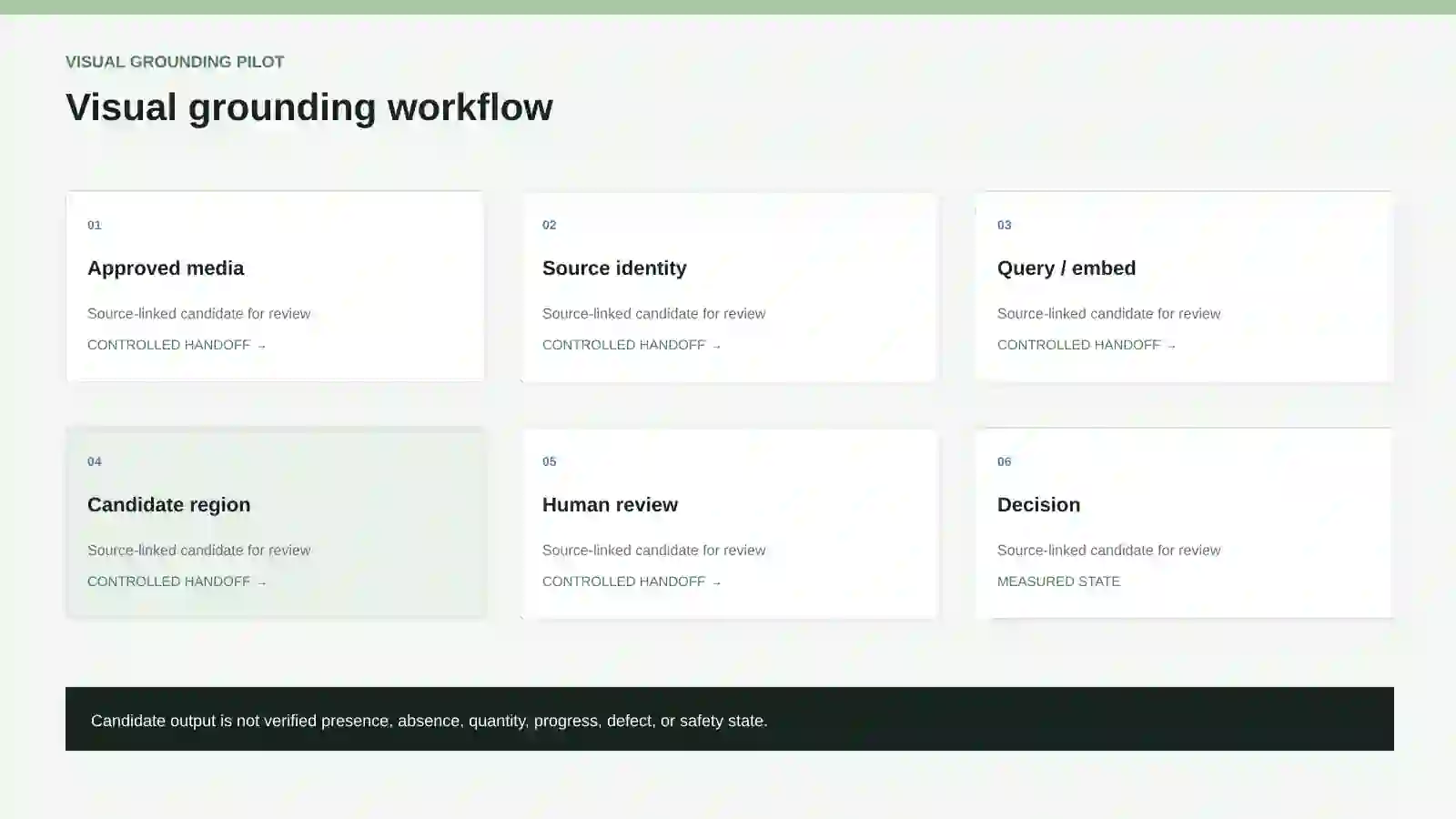
Approved sources, stable identity, exact components, raw candidates, corrections, and accepted assistive use remain connected.
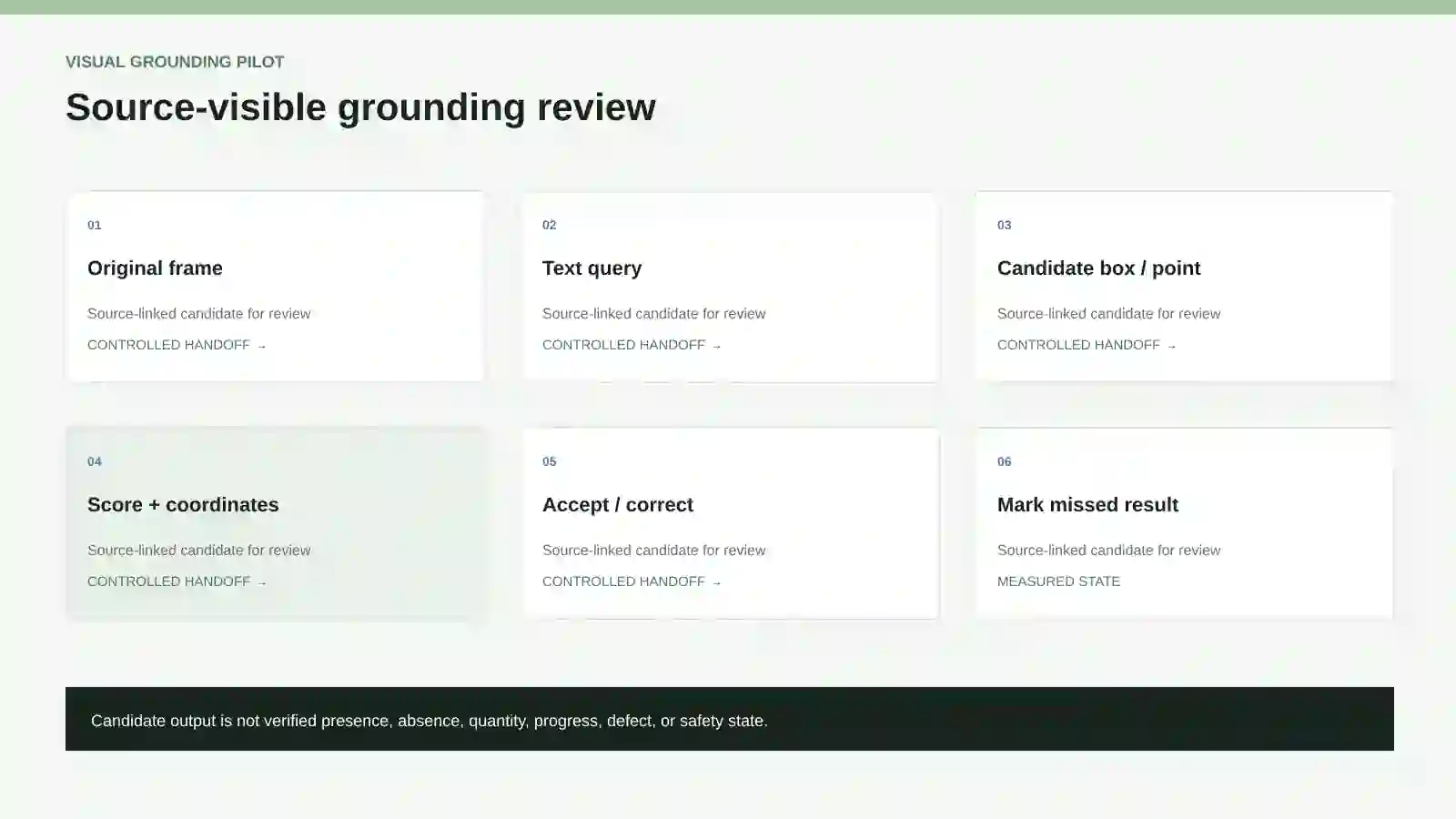
A region is a candidate location only; the original frame and possible misses remain visible.
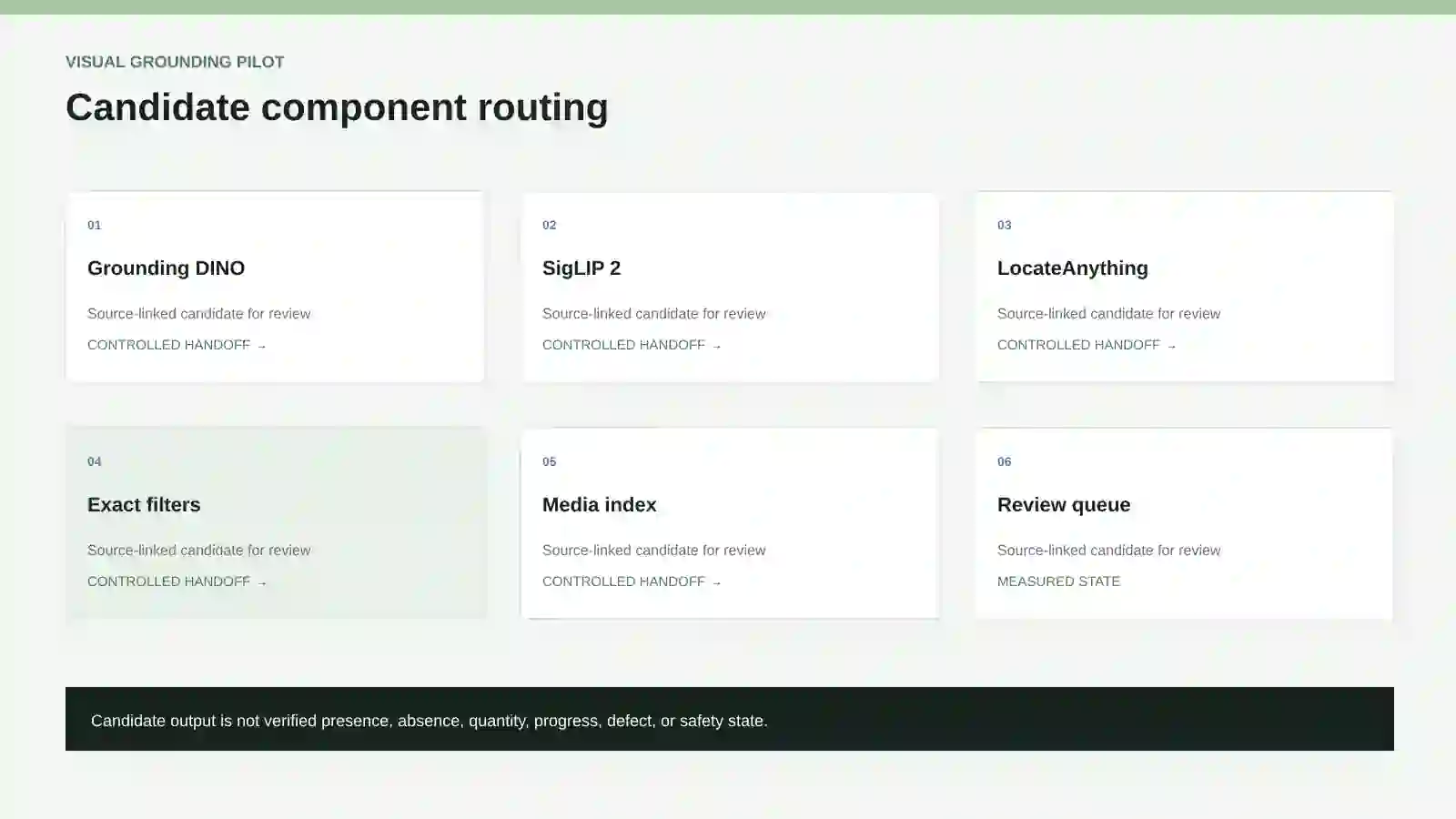
Semantic retrieval, boxes, points, filtering, and review solve different parts of the workflow.
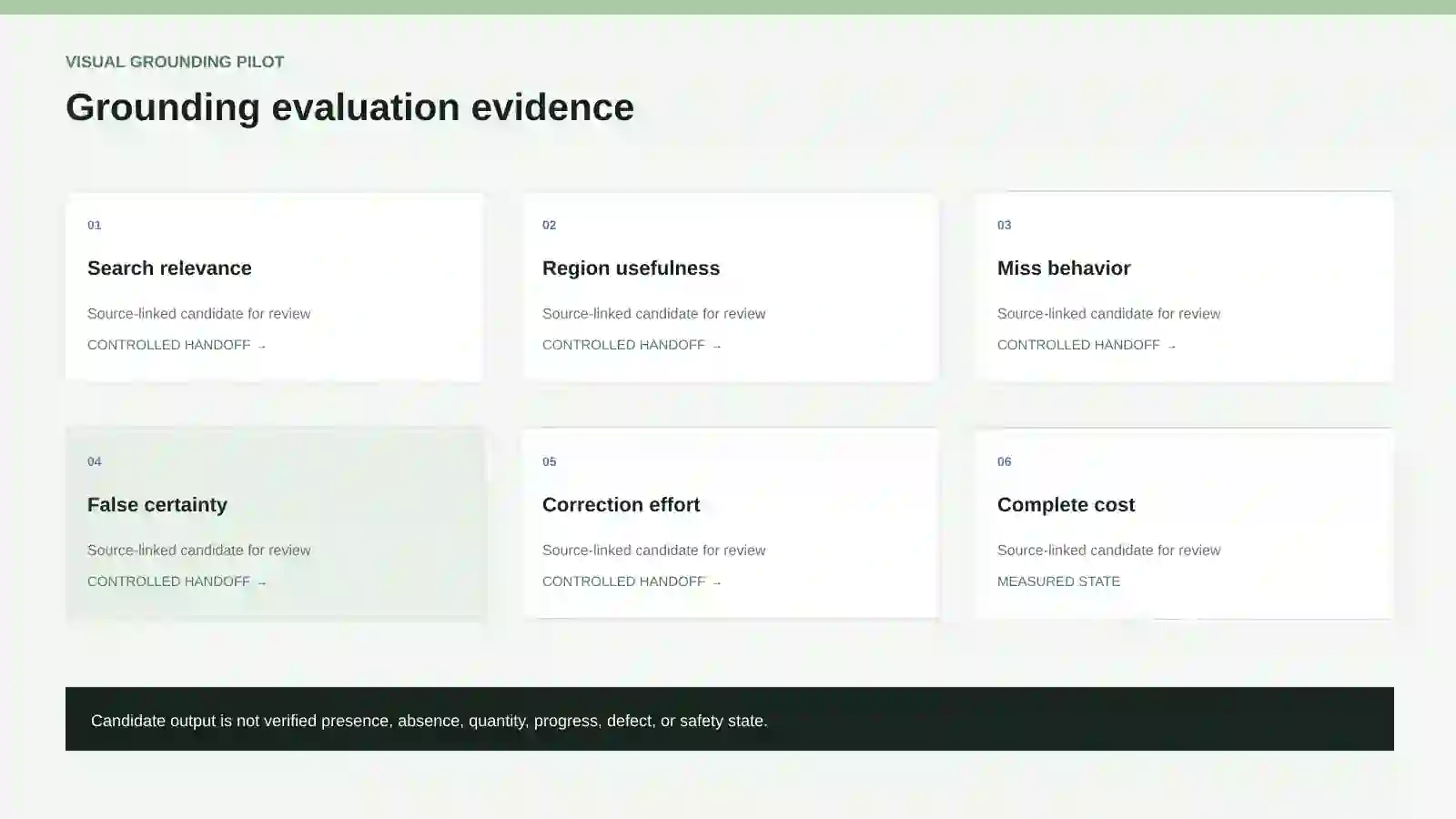
Track search relevance, region usefulness, misses, false certainty, correction effort, and complete cost across the agreed evaluation set.
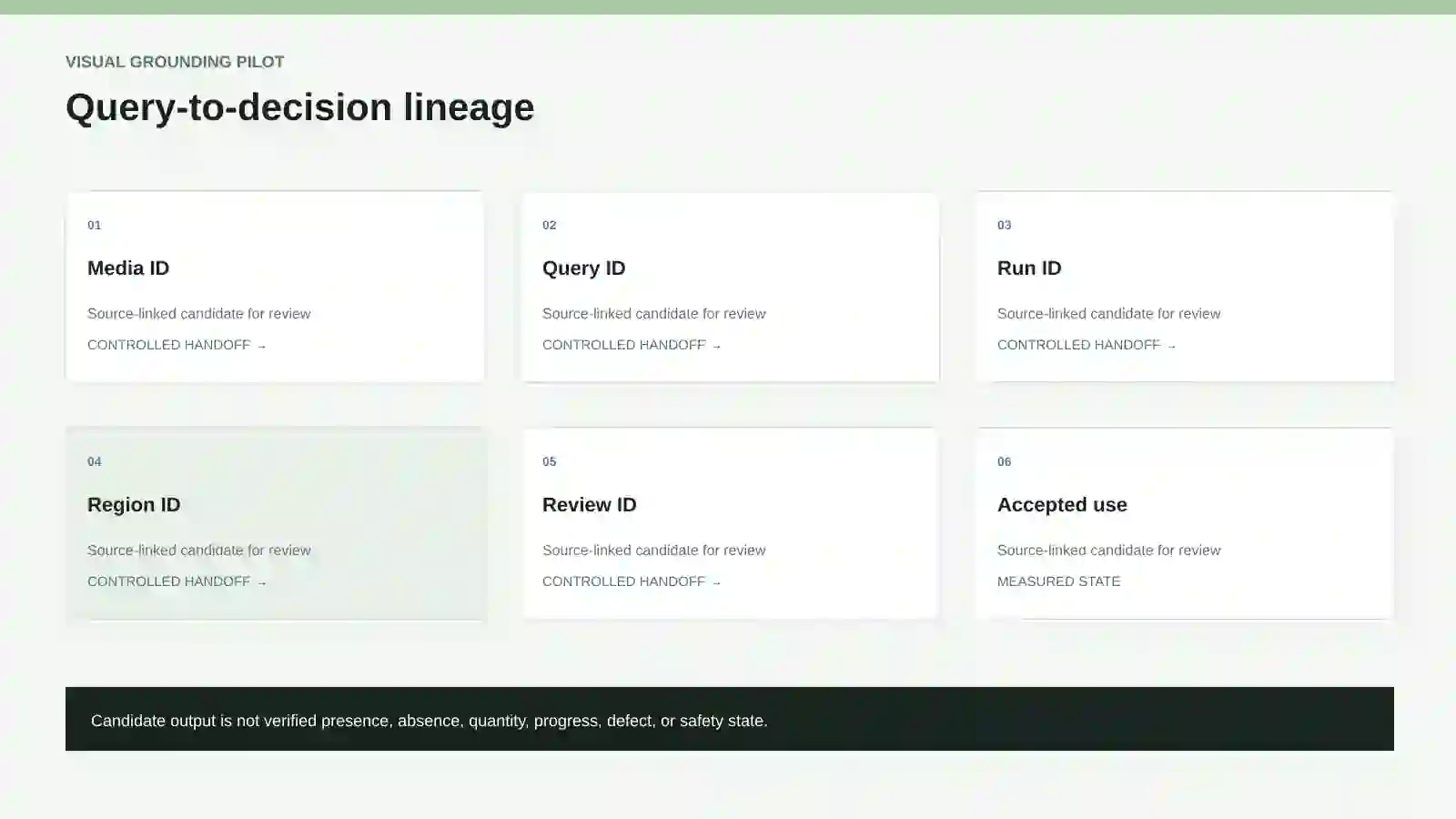
Stable IDs preserve what the wrapper returned, what a person changed, and the narrow purpose accepted.
User journey
The interface can feel simple while the pilot preserves document identity, revision, permission, retrieval, uncertainty, and review evidence behind every result.
Approve projects, users, media, purpose, concepts, rights, privacy, retention, prohibited inferences, and owner.
Preserve media ID, source-native ID, project, frame, timestamp, hash, dimensions, orientation, quality, permission, and original.
Version query wording, synonyms, positive, negative, ambiguous, occluded, small, rotated, and visually similar examples.
Use exact filters, SigLIP-style similarity, Grounding DINO-style boxes, LocateAnything-style points, or a tested combination.
Record repository or wrapper, checkpoint, code, licence, preprocessing, resize, prompt, threshold, hardware, coordinates, and retention.
Show source, filters, query, region, coordinate system, score, version, related media, uncertainty, and possible misses.
A named reviewer accepts, adjusts, rejects, marks misses or privacy issues, and makes project conclusions separately.
Evaluate retrieval, localization, misses, false certainty, correction, latency, cost, reproducibility, and ownership.
Technology options
The final selection records exact versions, licences, data handling, cost, limitations, replacement options, and the evidence required before use.
| Component | Examples | Pilot role | Boundary |
|---|---|---|---|
| Text-conditioned boxes | grounding-dino-swinb, official Grounding DINO Swin-B, or another evaluated detector | Return candidate boxes and scores for a text concept. | A box does not verify presence, identity, condition, quantity, completeness, progress, defect, or safety. |
| Semantic retrieval | siglip-2-large, Google SigLIP 2 Large, or another evaluated embedding model | Rank approved images or frames by image-text similarity. | Similarity is not factual support, complete recall, source authority, or verified concept presence. |
| Candidate points | locateanything-3b-h100, NVIDIA LocateAnything-3B, or another evaluated point model | Prepare candidate points around specified visual concepts. | Official model identity does not verify a hosted wrapper, coordinate transform, checkpoint, hardware path, or retention. |
| Wrapper route | Community or marketplace hosted inference | Potentially shorten a bounded experiment. | Verify exact code, checkpoint, dependency, licence, preprocessing, output coordinates, confidence, logs, retention, region, security, cost, and exit. |
| Deterministic controls | Media registry, permissions, project filters, metadata index, schemas, stable IDs | Enforce access, purpose, source, date, media type, coordinate, and result rules outside the model. | Controls depend on correct records, tested logic, exception ownership, monitoring, and recovery. |
| Review interface | Client-owned media search or controlled queue | Expose originals, candidates, scores, versions, corrections, misses, and accepted use. | Acceptance applies only to media search or organization and creates no downstream business authority. |
Client-owned pilot outputs
Evaluation evidence
A fluent answer is not the acceptance unit. The pilot tests whether a reviewer can reach the controlling evidence efficiently and detect important failure.
Did useful approved media enter review across projects, concepts, views, conditions, scale, occlusion, and quality?
Did the box or point direct attention without hiding coordinate, crop, resize, or rotation errors?
Can reviewers record missed media or objects, and does no-result behavior avoid claiming verified absence?
Does the workflow expose low confidence, ambiguity, unsupported concepts, disagreement, and wrapper failure?
Measure inspection, correction, rejection, missed-result capture, and exception resolution per accepted result.
Measure preparation, indexing, inference, hosting, transfer, storage, review, correction, monitoring, security, and replacement.
Cost drivers
Scaling factors
Use durable identity, incremental indexes, deduplication, queues, retries, checkpoints, and reprocessing.
Preserve client, project, user, media, location, purpose, retention, and record-level access.
Add concepts only with owners, examples, agreed evaluation cases, reviewer roles, consequences, and accepted uses.
Keep sources, queries, coordinates, outputs, corrections, metrics, and decisions outside any endpoint.
Measure index search, payloads, calls, queues, timeouts, fallback, reviewer capacity, and complete cost.
Require separate privacy, security, integration, monitoring, recovery, licensing, training, ownership, and service approval.
Cross-industry reuse
The reusable capability is permission-aware multilingual retrieval across versioned documents with citations. Each industry keeps its own source authority, terminology, consequence, retention, and qualified review.
Site photos, video, aerial imagery, equipment, logistics, materials, and inspection-support media.
Review: Project, site, quality, safety, commercial, or engineering authority.
Asset photos, surveys, inspections, maintenance, handover, defects, and inventory media.
Review: Property, facilities, survey, compliance, engineering, or asset owner.
Equipment, installations, tests, laboratories, anomalies, and technical imagery.
Review: Qualified engineer, test owner, quality role, or discipline lead.
Site observations, precedents, finishes, materials, mockups, and coordination views.
Review: Architect, design manager, technical lead, or specialist.
Products, components, lines, packaging, maintenance, and quality-support media.
Review: Production, quality, engineering, maintenance, or compliance owner.
Before-and-after photos, assets, parts, damage, visits, and completion media.
Review: Service manager, technician, warranty, commercial, or safety owner.
Yards, vehicles, pallets, packages, loading, damage, and inventory images.
Review: Warehouse, transport, inventory, claims, security, or safety owner.
Authorized property, damage, repair, inspection, and claim-support images.
Review: Adjuster, surveyor, engineer, privacy, legal, or claims authority.
Authority boundaries
Related paths
Continue into the operating, technical, security, and readiness guidance connected to this workflow.
Review source-linked detection, segmentation, classification, and reviewer queues.
Open pageReview scope, evaluation, price range, duration, and decisions.
Open pageInspect component provenance, boxes, masks, prompts, corrections, and release controls.
Open pageAssess identity, media access, credentials, retention, incidents, and handover.
Open pageStart with one approved collection
Use general workflow information during the assessment. Do not submit confidential documents, passwords, API keys, authentication codes, or unrestricted system access.
Plain-language route guide
Choose the smallest route that answers your next decision.
The formal service names remain useful for scope and contracts. The plain-language labels explain what each route actually does. These are alternatives, not four mandatory stages.
Operating-Layer Blueprint
Buyer question answered
What should we build, and where should the boundary be?
Typical input
One priority workflow, a named owner, current systems, representative records or files, and known failure points.
Output
A client-owned current-state map, target design, source inventory, implementation boundary, timeline, and fixed quote.
Bounded AI Agent Pilot
Buyer question answered
Can one specific AI-assisted task work reliably enough to justify more?
Typical input
One named task, approved sources and tools, representative cases, a human reviewer, and explicit stop conditions.
Output
A working pilot, evaluation evidence, cost and failure findings, review requirements, and a proceed, revise, or stop recommendation.
Single Workflow Implementation
Buyer question answered
How do we put one recurring workflow into controlled production?
Typical input
A defined trigger and completion point, accountable owners, approximately three core systems, rules, approvals, and test cases.
Output
Connected records, an operating view, integrations, a dashboard, acceptance testing, training, documentation, and handover.
Complete Operating Layer Implementation
Buyer question answered
How do we connect shared data and decisions across teams?
Typical input
Two to five related workflows, shared records, several departments or systems, an executive sponsor, and named operating owners.
Output
A phased operating layer with shared records, permissions, interfaces, integrations, reporting, controlled automation, training, and handover.
Still unsure which route fits?
Describe one broken workflow. The free assessment may recommend a Blueprint, pilot, implementation, a smaller discovery step, or no engagement.