
AI Technology Brief
Where can AI help construction estimating without becoming the estimator?
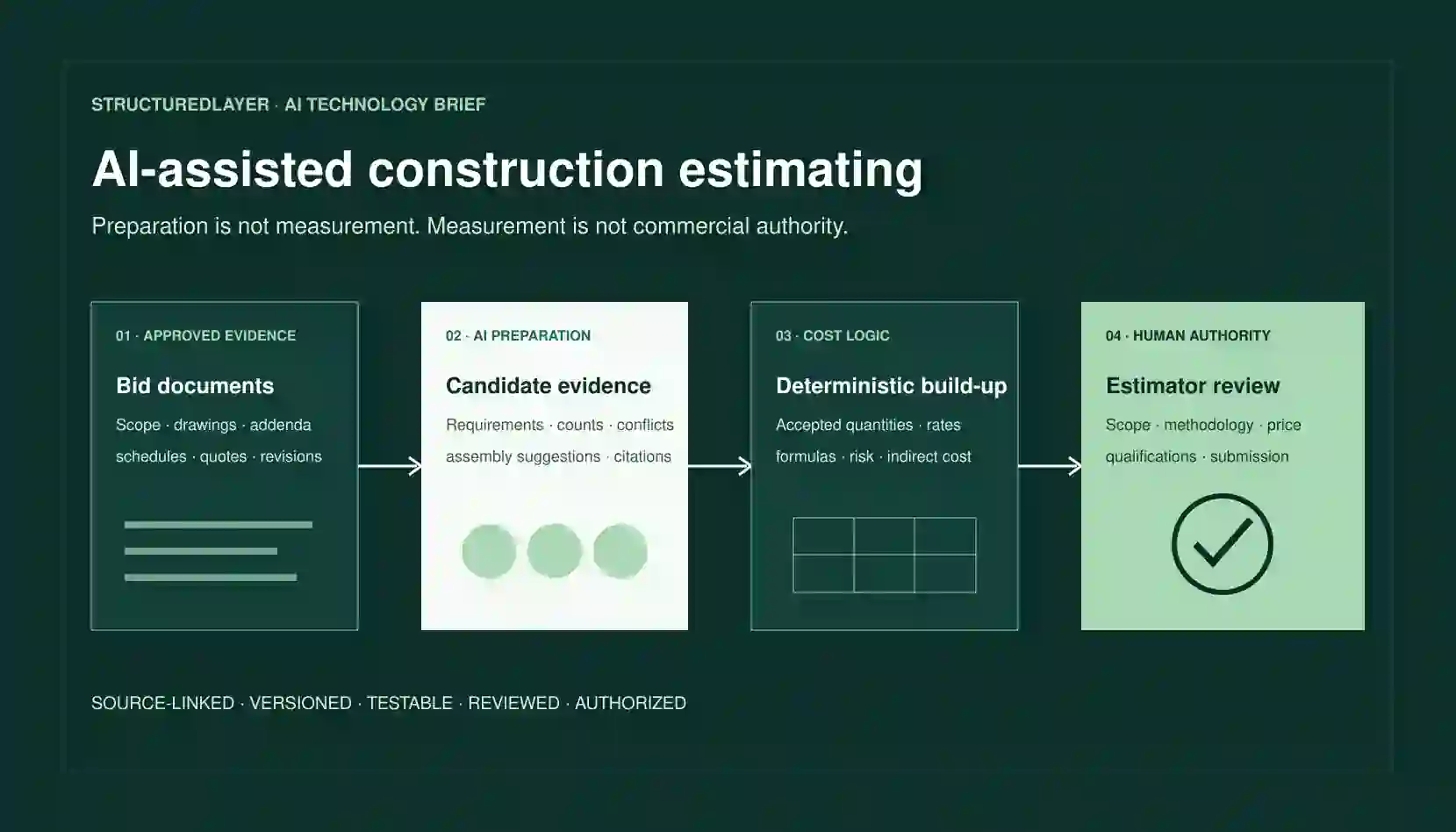
AI can inventory bid documents, extract candidate requirements, prepare selected counts, structure quote data, and support checking. It does not establish complete scope, measured quantities, productivity, current rates, estimate classification, risk, price, or authority to submit.
01 / Independently verifiable claims
Begin with what the technology and standards actually support.
- RICS separates order-of-cost estimating and cost planning from detailed measurement and requires the measurement basis, information relied upon, assumptions, risk, inflation, and exclusions to remain explicit.
- JLL's 7 July 2026 U.S. mid-year construction outlook reported goods-level material inputs 6.4% higher year over year against 3.5% growth in final-demand construction prices. JLL expects pressure for bid prices to close part of that gap; this is a dated U.S. market outlook, not a universal rate, project forecast, or estimate escalation instruction.
- AACE's 18R-97 recommended practice for process-industry EPC classifies estimates primarily by maturity of project-definition deliverables; its published accuracy ranges are secondary characteristics, not guaranteed tolerances or model confidence bands for every construction sector.
- The AECV-Bench preprint reports strong results for some text-heavy drawing questions while object-counting performance remains materially weaker for tested models.
- The AEC-Bench preprint evaluates cross-sheet navigation and project-level document coordination and reports continuing weaknesses in exhaustive traversal and visual grounding.
- The CEQuest preprint presents a pilot construction-estimation benchmark covering knowledge, drawing elements, spatial reasoning, quantity takeoff, and estimation; it is not proof of bid-ready autonomy.
- A 2026 commercial-project case study found near agreement for some counts but systematic differences for areas and weaker performance on irregular geometry; one project and one system cannot establish general accuracy.
- Anthropic documents file, page, format, and visual-processing limits for Claude uploads. Product support for a document does not establish correct scope, scale, quantity, rate, or commercial interpretation.
- RICS responsible-AI guidance keeps accountable professional judgment with the surveyor where AI materially affects surveying services.
02 / The practical distinction
Estimating is not one AI task.
Document inventory, interpretation, measurement, cost calculation, and commercial acceptance require different methods and authority.
Evidence
Scope preparation
Inventory bid documents, extract candidate requirements, detect addenda and conflicts, and preserve exact sources for review.
Measurement
Quantity takeoff
Count, length, area, and volume tasks depend on scale, geometry, symbols, schedules, revisions, and discipline-specific rules.
Cost logic
Estimate build-up
Apply approved assemblies, productivity, waste, rates, escalation, indirect cost, programme, risk, and contingency through inspectable calculations.
Authority
Commercial offer
An accountable estimator and authorized business roles approve scope, qualifications, price, risk, and submission.
03 / Operating architecture
Keep source interpretation, deterministic arithmetic, and commercial approval visibly separate.
AI can prepare candidate evidence and structured fields. Controlled systems calculate accepted quantities and rates. People retain estimate and bid authority.
Approved bid evidence
Stable document identity, issue, revision, discipline, page, scale, addendum, scope, pricing schedule, quote, and source authority.
AI-assisted preparation
Candidate requirements, classifications, schedules, conflicts, assembly suggestions, quote fields, and source-linked review queues.
Deterministic estimate engine
Accepted quantities, units, formulas, assemblies, productivity, rates, waste, escalation, indirect costs, risk, and totals.
Estimator and commercial approval
Methodology, completeness, assumptions, qualifications, contingency, margin, tender strategy, issue, and accountability.
04 / Required records
A reviewable estimate needs records beyond a generated spreadsheet.
Estimate basis
Purpose, class or maturity basis, estimate date, currency, location, price level, measurement standard, scope, assumptions, exclusions, and owner.
Source manifest
Document ID, title, issue, revision, status, page, scale, fingerprint, received time, addendum relationship, and authority.
Derived drawing item
Sheet, region, coordinates, tag or object, native text or vector source, extraction method, cross-reference, warning, confidence, processing version, and exact source link.
Quantity record
Element, location, drawing region, method, scale, unit, measured value, waste, source, reviewer, correction, and accepted value.
Assembly and rate
Resource components, productivity basis, conditions, supplier quote, validity, escalation, currency, location, date, and normalization.
Historical benchmark
Completed project and cost-account source, final accepted quantity and cost, unit, scope, location, date, delivery method, crew, access, shift, productivity conditions, exclusions, normalization, owner, and permitted reuse.
Qualification record
Inclusion, exclusion, clarification, conflict, reliance, order-of-precedence treatment, consequence, owner, and resolution.
Approval and version
Estimate version, model and workflow version, checks, reviewer, decision, tender authority, issue time, and superseded state.
05 / Construction example
An electrical estimate shows why counting devices is only one small part of the work.
Apply the workflow according to the project, trade, contract, jurisdiction, organization, and appointed professional responsibilities.
Prepare
Inventory and requirements
AI can list drawings, specifications, schedules, addenda, and candidate requirements with citations and unresolved conflicts.
Measure
Counts and routes
Supported extraction may prepare device counts or schedule fields; lengths, areas, scale, hidden conditions, and irregular geometry need stronger validation.
Calculate
Assemblies and cost
Accepted quantities feed deterministic assemblies, current supplier rates, labor productivity, equipment, waste, programme, and indirect costs.
Authorize
Estimator submits
The estimator confirms completeness, methodology, quote qualifications, risk, margin, inclusions, exclusions, and commercial issue.
06 / Deterministic controls
Carry one tender through nine visible estimating control stages.
1. Register the tender evidence
Inventory every identified document, drawing, specification, schedule, addendum, revision, submission rule, and pricing form. Preserve native IDs, fingerprints, issue status, received time, and controlling source; a text conversion or summary remains a derived aid.
2. Prepare a requirements register
Separate physical scope from process, submission, inspection, approval, programme, commercial, and contractual requirements. Link every candidate to its document, revision, page, clause, sheet, region, extraction method, and review state.
3. Prepare an early cost range
Compare reviewed scope with permitted historical evidence only after normalizing date, location, quantity, procurement conditions, productivity, method, access, exclusions, and price basis. Present ranges, gaps, and provenance rather than an AI-generated price as fact.
4. Support the go/no-go review
Prepare current evidence on strategic fit, client, capacity, technical delivery, programme, contract, commercial exposure, bid cost, and mandatory conditions. Delegated commercial leadership retains the pursuit decision.
5. Prepare clarification candidates
Identify missing, contradictory, ambiguous, unusual, or unallocated requirements with exact sources. Estimating, technical, commercial, or legal reviewers decide whether and how each clarification is issued.
6. Prepare assemblies and measurement evidence
Suggest project-specific assemblies from an approved company library and evaluate counts, lengths, areas, volumes, schedules, tags, vector geometry, and explicit dimensions separately. A model score is not calibrated quantity accuracy or estimator acceptance.
7. Connect schedule and indirect-cost inputs
Relate accepted quantities to sequence, production basis, crew assumptions, constraints, procurement, historical duration, project overheads, and tender requirements. Qualified reviewers own programme, productivity, resource, and duration decisions.
8. Build the detailed estimate
Feed accepted quantities, assemblies, current supplier evidence, labor, plant, waste, escalation, risk, and indirect costs into versioned estimating software or deterministic calculations. Keep candidate values separate from accepted values and commercial assumptions.
9. Reconcile before submission
Compare the detailed estimate with the early range; test arithmetic, duplicates, omissions, requirement coverage, quote qualifications, exclusions, departures, programme, and unresolved exceptions. Every material requirement should be priced, excluded, qualified, clarified, or assigned to an owned exception before authorized issue.
07 / Failure analysis
A plausible total can hide incomplete scope and unsupported assumptions.
Document omission
A schedule, addendum, note, specification, or contractual requirement is absent from the context and therefore absent from the estimate.
False measurement confidence
A model count or geometry value is accepted because it looks precise despite scale, overlap, symbol, or revision errors.
Assembly mismatch
A standard assembly is applied without project-specific product, support, access, testing, temporary works, or installation requirements.
Stale rate
Historical or supplier data is reused without current location, date, quantity, escalation, validity, qualification, and currency treatment.
False project comparison
A completed-project rate or benchmark is matched by description while scope, quantity, method, crew, access, shift, location, price date, risk, and commercial treatment materially differ.
Hidden productivity judgment
Labor output is inferred without methodology, crew, access, congestion, sequence, learning, weather, shift, or site constraints.
Confidence becomes assurance
A model score is presented as an estimate class, accuracy tolerance, contingency analysis, or professional conclusion.
Review repeats the estimate
A qualified estimator must recreate the original takeoff and pricing to find errors, so the claimed verification saving does not exist.
Premature submission
Generated price, qualification, programme, or letter of offer reaches a client without authorized commercial review.
08 / Deployment and cost
Deployment depends on document access, measurement authority, estimating systems, and review capacity.
Assistive workspace
Use approved files to prepare inventories, requirements, candidate fields, and comparisons with no direct estimate or submission write-back.
Connected estimating workflow
Integrate document control, takeoff, cost libraries, supplier quotes, estimating software, review queues, and versioned exports through supported interfaces.
Specialist vision pipeline
Use task-specific OCR, detection, geometry, or drawing tools for bounded measurements and retain marked source regions and correction evidence.
Client-controlled environment
Operate sensitive bids and rates in approved infrastructure with project permissions, provider controls, secrets, retention, logging, backup, and recovery.
- Document preparation, drawing calibration, OCR, parsing, indexing, storage, and retrieval
- Takeoff and estimating software, model, vision, API, connector, and infrastructure charges
- Assembly, productivity, rate, quote, escalation, and normalization maintenance
- Estimator review, correction, reconciliation, commercial approval, and rework
- Security, access, audit, evaluation, monitoring, support, change control, and recovery
- Missed scope, duplicate quantity, wrong revision, stale rate, qualification, and submission failure
09 / Evaluation
Evaluate complete estimate evidence, not one polished output.
- Document, page, revision, schedule, addendum, and requirement coverage
- Count exact match plus overcount, undercount, and missed-instance rates
- Length, area, and volume error by element, geometry, discipline, and tolerance band
- Scope, inclusion, exclusion, assembly, and quote-qualification precision and recall
- Formula, unit, rounding, waste, rate, escalation, indirect-cost, and total calculation accuracy
- Unsupported assumptions and source-citation correctness
- Estimator correction time, repeated original work, acceptance, rejection, and missed-error consequence
- Cost per accepted estimate output against the current process
- Performance after document, model, workflow, rate-library, and project-type changes
- Historical-match quality by scope, conditions, normalization, accepted correction, and estimator reuse
10 / Controlled pilot
Prove the operating boundary before expanding it.
Choose one estimate stage
Start with document inventory, requirement extraction, one count family, one assembly family, or quote normalization rather than an autonomous tender estimate.
Freeze the evidence set
Use approved historical bid documents, revisions, expected quantities, estimate records, qualifications, and known outcomes.
Define separate metrics
Measure source coverage, each quantity type, scope omissions, calculations, review effort, cost, and critical commercial failures independently.
Run in shadow mode
Keep the current estimating process authoritative while AI prepares parallel evidence and no client-facing action.
Adjudicate with expertise
Use qualified estimators and relevant trade specialists to resolve disagreements and record why the accepted answer controls.
Expand one boundary
Connect another document type, measurement, rate source, or write action only after the prior boundary remains accepted.
11 / StructuredLayer recommendation
Use AI to reduce evidence-handling and preparation burden around the estimator - not to hide estimating judgment inside a generated total.
Begin with one bounded stage inside the nine-stage path, preserve source and measurement evidence, run arithmetic deterministically, evaluate by quantity and consequence, and keep estimate classification, methodology, productivity, risk, price, qualifications, and submission under accountable estimator and commercial authority. Expand only after accepted evidence shows that the prior boundary reduces work without concealing omissions or moving authority.
12 / Primary sources
Capability, governance, and implementation claims remain inspectable.
RICS
NRM: New Rules of Measurement
RICS
Cost Prediction professional standard
JLL
2026 Construction Perspective: U.S. Mid-Year Update
RICS
Responsible use of artificial intelligence in surveying practice
AACE International
Cost Estimate Classification System 18R-97
arXiv
AECV-Bench: Architectural and Engineering Drawing Understanding
arXiv
AEC-Bench: Agentic Systems in AEC
arXiv
CEQuest: Construction Estimation Benchmark
EasyChair
Testing AI Accuracy in Quantity Takeoff
Anthropic Help Center
Document upload support and limitations
NIST
Artificial Intelligence Risk Management Framework 1.0
Sources reviewed 16 August 2026. Technology capabilities, laws, guidance, terms, and pricing can change.
13 / Related StructuredLayer guidance
Continue from model selection into operating architecture.
Best AI Estimating Software for Construction
Compare 10 current takeoff, estimating, managed-service, residential, and enterprise products by workflow, pricing, integrations, and estimator review.
Construction Estimating Software Stack Decision Guide
Compare opportunity, document, takeoff, estimate, approval, outcome, integration, portability, and AI components before selecting software.
Construction Document Intelligence
Prepare source identity, drawing-derived evidence, OCR, revisions, extraction, citations, and qualified review before estimating use.
Construction Project Controls
Connect the approved estimate to budget, schedule, procurement, field evidence, forecast, change, and authorized decisions.
Automated Subcontractor Quote Extraction
Convert quotes into traceable comparison records while preserving scope and commercial judgment.
RFQ-to-Bid Readiness Check
Assess intake, document control, estimator ownership, approval, submission, and reporting.