AI Technology Brief · Construction prompt workflow
ChatGPT for Construction RFIs: 8 Prompts, Examples and Review Checks
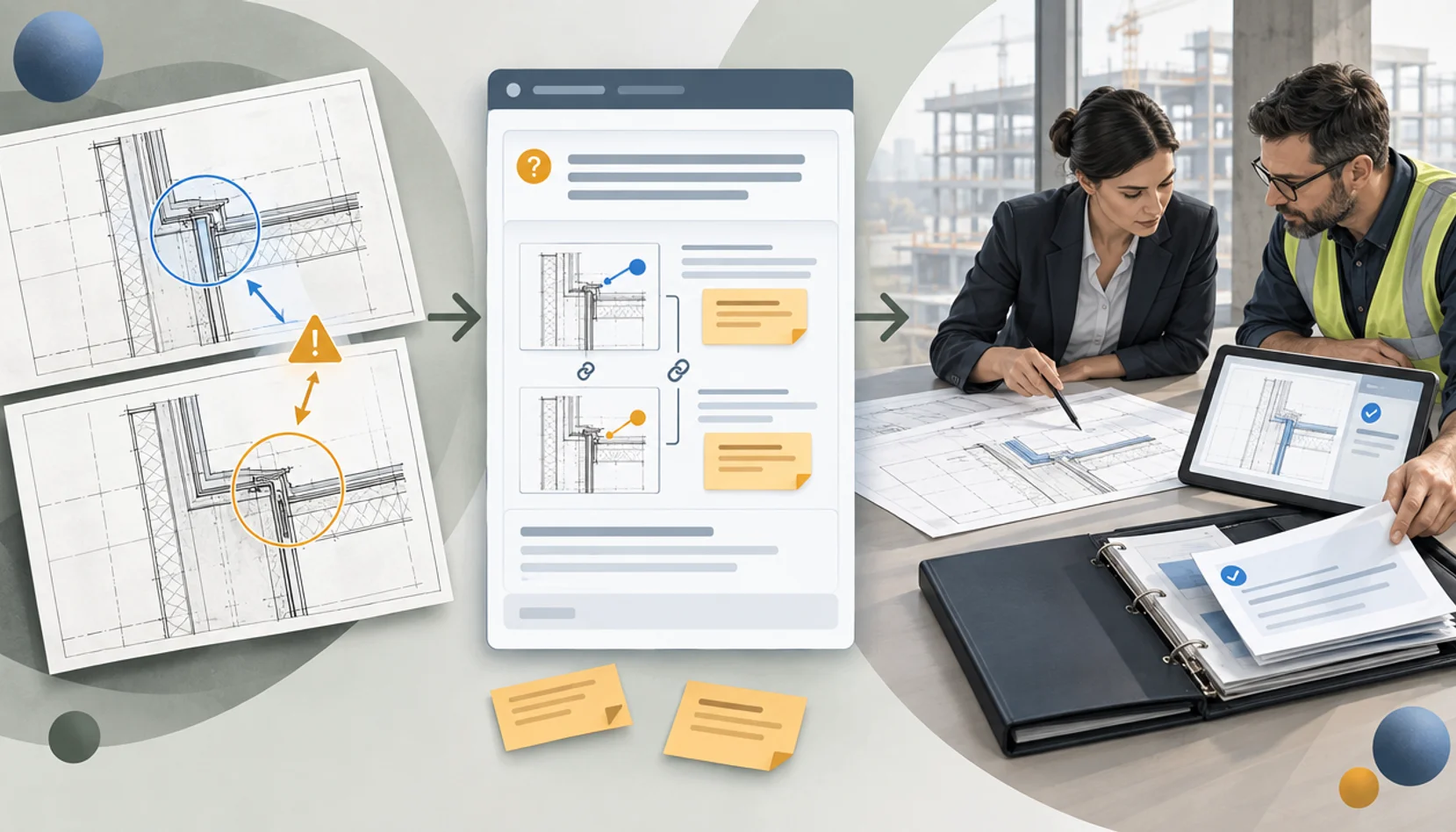
Prepare clearer questions from approved drawings, specifications and field observations. ChatGPT may expose a discrepancy or draft neutral wording, but cannot decide design intent, issue instructions or determine commercial effect.
What is documented
A candidate draft is not an accepted project record.
OpenAI documents working with supported uploaded files and clear, specific prompting. File parsing, embedded visuals, capacity and plan availability vary. A plausible citation does not prove the model inspected the current drawing detail correctly; open the original sheet.
Procore's RFI documentation describes a managed question with attachments, RFI manager, draft/open status and official response. It distinguishes a typed drawing number from a linked drawing. This illustrates the record structure; it is not evidence ChatGPT is connected to a project or can judge the designer's answer.
A good RFI identifies a real unresolved question with correct project, location and current sources. It does not turn the contractor's preferred option into an accepted design or mistake an old response for a current instruction.
Boundary: Confirm approved workspace, document-sharing permission, current issue and authorized recipients before uploading drawings. Qualified design, project and commercial teams retain interpretation, submission, response acceptance, notice, cost and time authority.
Prepare sources first
Identify the precise question, drawing issue and responsible route.
Confirm permission, source identity, current status and reviewer before uploading. A filename alone does not verify content or revision.
Project and location
Project ID, building, level, grid, trade and affected package; avoid confusing similar details elsewhere.
Current drawing
Document ID, sheet/detail, revision, date, issue purpose and superseded relationship.
Other requirements
Specification clause, schedule, addendum, site observation and attachment with exact source location.
Existing answer
Official prior RFIs, response IDs, addenda, current instructions and revised drawings.
Question and impact
One neutral request, supporting evidence for any effect, sourced response date and unknowns.
Authority and history
RFI manager, design reviewer, official response, follow-up and accepted record version.
Worked example · Fictional
Ask what the design requires without inventing the answer.
Illustrative input created for this guide. It is not a real project or approved result.
Supplied notes
Fictional project: Cedar Annex, level 2 corridor, grid C4. Site note: 'Ceiling service clashes with beam at C4. Detail 7 on A-214 rev B seems to show clearance; M-108 rev C has the duct at this crossing. We can't close up until design confirms routing.' Manifest: photo PH-22 and drawings named A-214 rev B and M-108 rev C. No accepted drawing register, specification, measured clearance, prior RFI export or designer response supplied.
| Candidate field | Draft from input | Check before use |
|---|---|---|
| Observed condition | Site note reports a service/beam clash at grid C4. | Site lead verifies exact service, location, condition and photo; no measurement supplied. |
| Document references | A-214 rev B detail 7 and M-108 rev C named by reporter. | Confirm both sheets are current and show the claimed detail at this location. |
| Candidate question | Please confirm coordinated routing and clearance at level 2 corridor C4, with revised detail if needed. | Coordinator ensures wording does not imply a preferred route is approved. |
| Open evidence | Register, specification, prior RFIs and measured clearance absent. | Retrieve them; do not assert no solution exists or infer a delay cause. |
| Work status | Field note says closure awaits design confirmation. | Site management checks actual restriction; planner and commercial lead assess separately. |
Review decision: This is not a submitted RFI or design conclusion. RFI manager checks current documents and prior answers; designer determines response; authorized parties decide any change, notice, cost or schedule action.
From prompt to workflow
Move repeated work into an owned operating path.
A prompt can draft a question. A repeatable RFI process needs current document identity, existing-answer checks, source-linked wording, authorized issue, official response tracking and controlled downstream action.
- 01
Receive
Capture query with reporter, date, location and original attachments.
- 02
Resolve sources
Match accepted drawings, clauses, addenda and prior RFI or instruction IDs.
- 03
Check
Validate required fields, revision, links and duplicates; route uncertainty.
- 04
Prepare
Draft one neutral question with citations and no invented solution.
- 05
Issue and respond
RFI manager reviews and sends; designated designer issues official response.
- 06
Reconcile
Link revised documents and downstream decisions without changing original history.
Copyable prompts
Eight tasks with sources, checks and authority boundaries.
Replace bracketed fields and use only approved records. Copying a prompt does not authorize a document upload or an official action.
Prompt 01
Draft a neutral clarification question
A drawing detail seems incomplete.
Attach first
Current drawing/detail, specification, register and marked observation.
Work only from the approved files and facts supplied for [PROJECT / DATE]. Cite source file or record ID, revision, page, sheet, row or timestamp for each claim where possible. Separate observations, reported statements and inference. Mark absent, conflicting, superseded or illegible evidence. Do not invent names, dates, quantities, instructions, responses or approvals. Return a candidate for named human review only.

Draft subject, location, exact revision, missing/conflicting fact, neutral question, references and gaps. Do not imply a design option is approved.
Verification checks
- 1Compare detail and clause in original current issue.
- 2Check addenda and prior RFIs.
- 3RFI manager approves wording before issue.
Authority boundary
Question draft is not an instruction or submitted RFI.
Prompt 02
Compare drawing and specification
Two approved sources seem inconsistent.
Attach first
Accepted sheets, specification clauses and addenda.
Work only from the approved files and facts supplied for [PROJECT / DATE]. Cite source file or record ID, revision, page, sheet, row or timestamp for each claim where possible. Separate observations, reported statements and inference. Mark absent, conflicting, superseded or illegible evidence. Do not invent names, dates, quantities, instructions, responses or approvals. Return a candidate for named human review only.

List sheet/detail, clause, revisions, apparent discrepancy, affected location and neutral question. Do not decide document precedence or design intent.
Verification checks
- 1Visually inspect each sheet and clause.
- 2Check document hierarchy with qualified reviewer.
- 3Route unresolved discrepancy formally.
Authority boundary
The model cannot resolve design or contract precedence.
Prompt 03
Search for an existing answer
A proposed query may already be resolved.
Attach first
Current index, relevant sheets and official RFI/response log.
Work only from the approved files and facts supplied for [PROJECT / DATE]. Cite source file or record ID, revision, page, sheet, row or timestamp for each claim where possible. Separate observations, reported statements and inference. Mark absent, conflicting, superseded or illegible evidence. Do not invent names, dates, quantities, instructions, responses or approvals. Return a candidate for named human review only.

Return potential answers with exact citation/status, contradictions, previous RFI IDs and unavailable sources. Never claim an exhaustive search if a source is missing.
Verification checks
- 1Check supplied manifest for completeness.
- 2Open current cited revisions and responses.
- 3RFI manager decides whether to submit.
Authority boundary
Do not suppress a necessary query based on a summary.
Prompt 04
Prepare a site observation
An encountered condition needs designer review.
Attach first
Dated observation, original photos, plan, drawing and permission to share.
Work only from the approved files and facts supplied for [PROJECT / DATE]. Cite source file or record ID, revision, page, sheet, row or timestamp for each claim where possible. Separate observations, reported statements and inference. Mark absent, conflicting, superseded or illegible evidence. Do not invent names, dates, quantities, instructions, responses or approvals. Return a candidate for named human review only.

Separate observed condition, actual measured values only if provided, photo IDs, applicable requirement, unknowns and one question. Do not infer hidden dimensions or direct work.
Verification checks
- 1Site lead confirms condition and measurement.
- 2Verify photo location and drawing issue.
- 3Designer assesses technical response.
Authority boundary
Design, safety and temporary-work decisions remain with competent people.
Prompt 05
Check a candidate RFI before issue
The draft needs source and recipient review.
Attach first
Draft, current drawings, clauses, attachments and submission rules.
Work only from the approved files and facts supplied for [PROJECT / DATE]. Cite source file or record ID, revision, page, sheet, row or timestamp for each claim where possible. Separate observations, reported statements and inference. Mark absent, conflicting, superseded or illegible evidence. Do not invent names, dates, quantities, instructions, responses or approvals. Return a candidate for named human review only.

Flag unclear subject, compound question, wrong revision, missing attachment, existing answer, unsourced due date, recipient and unsupported impact. Return defects, not an issued message.
Verification checks
- 1Verify linked documents and submission fields.
- 2Commercial reviewer checks notice language.
- 3Authorized sender accepts final text and recipients.
Authority boundary
Do not issue externally without project approval.
Prompt 06
Prepare unanswered-RFI follow-ups
A coordinator needs a controlled queue.
Attach first
Official RFI export, status, recipients, due-date rules and calendar.
Work only from the approved files and facts supplied for [PROJECT / DATE]. Cite source file or record ID, revision, page, sheet, row or timestamp for each claim where possible. Separate observations, reported statements and inference. Mark absent, conflicting, superseded or illegible evidence. Do not invent names, dates, quantities, instructions, responses or approvals. Return a candidate for named human review only.

List ID, date opened, live status, due date only if sourced, last response, documented dependency and follow-up owner. Distinguish missing due date from overdue status.
Verification checks
- 1Confirm live system status and recipient.
- 2Calculate dates under approved calendar.
- 3RFI manager authorizes escalation.
Authority boundary
Queue cannot assert delay or issue contractual notice.
Prompt 07
Compare a response with its question
A design reply needs qualified review.
Attach first
Submitted RFI, official response, revised drawings and attachments.
Work only from the approved files and facts supplied for [PROJECT / DATE]. Cite source file or record ID, revision, page, sheet, row or timestamp for each claim where possible. Separate observations, reported statements and inference. Mark absent, conflicting, superseded or illegible evidence. Do not invent names, dates, quantities, instructions, responses or approvals. Return a candidate for named human review only.

Match each question to response passage, candidate direct/partial/unanswered state, referenced revision and follow-up. Do not call a response technically adequate or approved for construction.
Verification checks
- 1Design lead reviews response and current issue.
- 2Planner and commercial lead assess effects separately.
- 3RFI manager records accepted status.
Authority boundary
Only project authorities can act on response or change.
Prompt 08
Trace an RFI through revisions
Several queries and drawings affect one location.
Attach first
Accepted RFI log, responses, drawing register and instructions.
Work only from the approved files and facts supplied for [PROJECT / DATE]. Cite source file or record ID, revision, page, sheet, row or timestamp for each claim where possible. Separate observations, reported statements and inference. Mark absent, conflicting, superseded or illegible evidence. Do not invent names, dates, quantities, instructions, responses or approvals. Return a candidate for named human review only.

Create event chronology with date, record ID, document revision, response, new document, location and gaps. Separate a response from a later instruction. No conclusion on fault, time or valuation.
Verification checks
- 1Verify official original for each event.
- 2Check drawing issue sequence.
- 3Qualified owners decide next action.
Authority boundary
Chronology cannot establish entitlement or authorize a change.
Operating controls
Make review and correction part of the result.
Document authority
Use accepted current issue and preserve version relationships; matching filename is not enough.
Visual verification
Inspect drawings, legends, dimensions and markups directly; visual PDF handling differs by plan.
Neutral wording
Do not embed preferred design, unsupported cause or unproven cost/time impact.
Previous answers
Search official RFIs, addenda, instructions and linked revisions before external query.
Two approval boundaries
Authorized coordinator issues; qualified designer and project parties review response and effects separately.
Contractual control
Keep notice, time bar, delay, valuation and entitlement in governed contract process.
Audit and status
Preserve draft, issued version, attachments, recipients, sourced dates, official response and follow-up.
Test difficult cases, not a clean demo.
Wrong revision
Old drawing appears to conflict with new specification; inspect accepted issue.
False visual read
OCR misses small dimension or callout; inspect the original sheet.
Prior answer missed
An addendum or earlier RFI already resolves the question; check official register.
Leading question
Draft assumes contractor's route is approved; ask for neutral clarification.
Informal reply
Partial comment becomes permission to build; verify official response and instruction route.
Unproven impact
Field concern becomes assertion of critical delay or extra cost without evidence.
Measure accepted work before expanding access.
- 01Correct project, location, document ID, issue and revision.
- 02Each claimed discrepancy is visible in cited current evidence.
- 03Existing-answer recall and false duplicate rate.
- 04Neutrality, attachment completeness, sourced due date and uncertainty flags.
- 05Human correction effort, unanswered questions and official response cycle time.
- 06Critical failures: wrong-project disclosure, invented design resolution, missed revision or unapproved issue.
- 07Complete cost per accepted RFI compared with manual baseline.
Questions before live project use.
- Can ChatGPT generate RFIs from drawings?
- It can draft candidate questions from permitted drawings and observations. Verify visual content, revisions, existing answers, location and attachments; qualified person decides whether to issue.
- Can it decide which drawing takes precedence?
- No. It can surface discrepancies, but contract hierarchy and authorized design or commercial interpretation govern.
- Can it read a scanned detail?
- It depends on plan, file type, visual handling and scan quality. A cited filename does not prove inspection of a callout; open the original.
- What if there is already an official response?
- Link existing RFI and check whether response and later revisions apply. Do not treat superseded reply as current instruction.
- Can a draft state cost or schedule impact?
- It may organize supplied evidence. Planner and commercial authorities assess impact, notices, valuation and entitlement separately.
- Can ChatGPT send an RFI to the architect?
- A copied prompt has no right to send. Integration needs approved identity, exact reviewed message, attachments, recipient, audit and action-time authorization.
Primary documentation
Sources and evidence limits.
OpenAI documents product boundaries; construction-platform documentation illustrates record structure, not ChatGPT accuracy. The workflow and fictional example are StructuredLayer analysis. Sources reviewed 29 September 2026; features and permissions may change.
- SOURCE 01File Uploads FAQ
OpenAI Help Center
- SOURCE 02Prompt engineering best practices for ChatGPT
OpenAI Help Center
- SOURCE 03Data Controls FAQ
OpenAI Help Center
- SOURCE 04Create an RFI
Procore Support
- SOURCE 05RFIs user guide
Procore Support