AI Technology Brief
Most media workflow steps do not need AI - they need deterministic, inspectable utilities
StructuredLayer evaluated a governed media-operations architecture for AI workflows. Most listed utilities - frame and audio extraction, split, merge, captions, watermarks, resize, transcode, waveform, and image composition - are deterministic transformations better handled by versioned media tooling. AI belongs only where the step interprets content, such as transcription, moderation, depth estimation, or classification. This is architecture evaluation, not completed deployment.
01 / Independently verifiable claims
Begin with what the technology and standards actually support.
- FFmpeg and ffprobe support stream inspection, explicit mapping, transcoding, filtering, splitting, concatenation, frame extraction, audio extraction, subtitles, overlays, metadata, and output verification.
- Autocaptioning, content classification, depth estimation, transcript-based editing, material-map generation, and source separation may use models; adding a watermark, joining files, extracting audio, or sampling frames generally does not require AI.
- Stream-copy cuts can align to keyframes rather than an exact requested frame. Merging incompatible files requires decoding and normalization. Burning captions changes pixels and requires video encoding.
- Exact byte reproducibility depends on tool version, build, libraries, codecs, platform, threads, metadata, and parameters. Frame or decoded-stream hashes can be more useful than comparing compressed containers.
- StructuredLayer's evaluated capability inventory includes autocaptioning, watermarking, content classification, video utilities, color matching, audio and frame extraction, merge, split, material maps, music separation, depth, waveform, ControlNet preprocessing, and transcript editing. Catalogue wrappers do not replace tool provenance or licence review.
02 / The practical distinction
Transformation and interpretation need different controls.
Use deterministic software for known operations and AI only for probabilistic content understanding.
Deterministic transform
Split, merge, extract, resize, pad, transcode, mux, overlay, watermark, waveform, and frame sampling execute explicit parameters.
Signal analysis
Loudness, color, depth, scene, quality, and content classifiers produce measurements or estimates requiring calibration.
AI interpretation
Transcription, caption generation, moderation, transcript editing, semantic cuts, and material inference can be wrong and need review.
03 / Operating architecture
Make media processing an inspectable subsystem of the workflow.
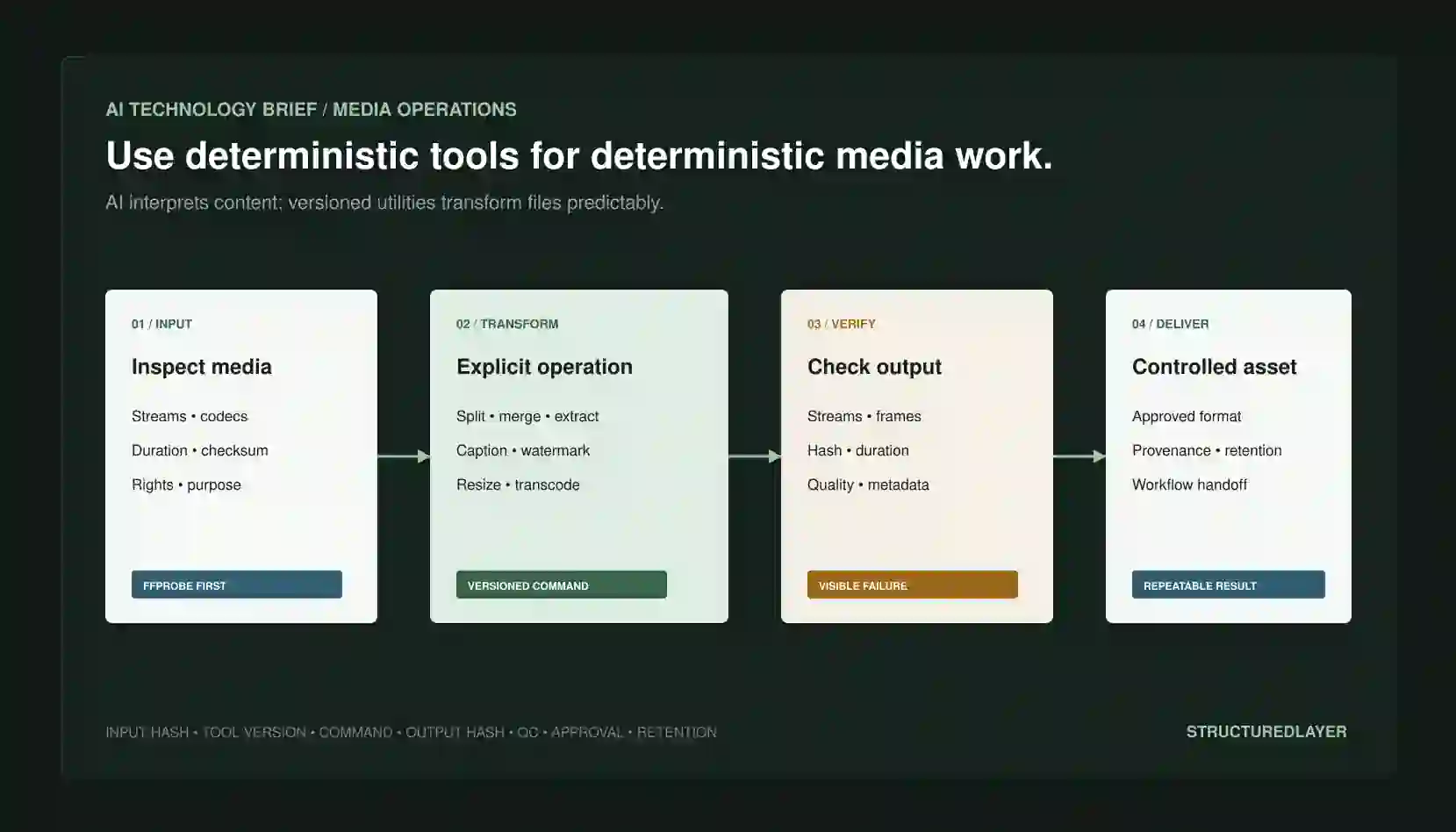
Every operation receives identified input, an explicit command or model configuration, output validation, and controlled delivery.
Inspect input
File hash, container, streams, codecs, duration, dimensions, frame rate, sample rate, channels, subtitles, metadata, rights, and purpose.
Execute operation
Tool and version, command, filter graph, stream maps, codecs, quality, frame selection, model if used, limits, and logs.
Verify output
Exit status, file hash, streams, duration, frames, audio, captions, watermark, quality, metadata, and visual or audible review.
Deliver safely
Approved format, destination, access, provenance, derivative relationship, retention, expiry, and downstream workflow state.
04 / Required records
A media derivative should remain connected to its source and exact transformation.
Source asset
ID, hash, owner, rights, project, purpose, sensitivity, streams, duration, dimensions, and storage.
Operation
Split, merge, extract, overlay, caption, resize, transcode, classify, depth, or other controlled operation.
Configuration
Tool or model, version, command, parameters, filters, stream maps, codecs, threads, timestamps, and environment.
Output asset
Hash, format, streams, dimensions, duration, quality, metadata, derivative relationship, and storage.
Quality control
Expected frames, audio, captions, watermark, clipping, sync, artifacts, corruption, and reviewer result.
Workflow use
Downstream task, approved purpose, owner, release, retention, deletion, and audit history.
05 / Construction example
Deterministic utilities make construction media ready for controlled AI and reporting.
The utility changes format or presentation; it does not change the factual authority of the underlying media.
Site-video preparation
Inspect, split approved time ranges, extract frames and audio, normalize formats, then send only necessary derivatives to transcription or vision review.
Evidence packaging
Add a visible project watermark or timestamp overlay to a derivative while preserving the untouched original and transformation record.
Training and handover
Generate reviewed captions, selectable subtitles, thumbnails, clips, and accessible formats with transcript correction and quality control.
Proposal media
Resize, color-normalize, compose, caption, and export approved images or clips using deterministic templates and brand rules.
06 / Deterministic controls
Prefer explicit commands, immutable sources, and output verification.
Never overwrite originals
Store derivatives separately with source hashes and operation records.
Explicit stream mapping
Select video, audio, and subtitle streams deliberately rather than relying on automatic behavior.
Version everything
Record tool build, codecs, libraries, model if any, command, parameters, environment, and timestamps.
Validate duration and sync
Check segment boundaries, frame count, audio sync, captions, sample rates, and output compatibility.
Separate AI review
Show generated captions, moderation, depth, or semantic edits as candidate outputs requiring acceptance.
Rights and privacy
Apply purpose, access, people and property permissions, retention, deletion, and channel approval to every derivative.
07 / Failure analysis
Simple media operations can fail silently when streams, time bases, and codecs differ.
Wrong stream
Automatic mapping can select commentary audio, omit subtitles, or drop required tracks.
Inexact cut
Stream-copy splitting may begin at a keyframe rather than the exact visual moment.
Merge incompatibility
Different codecs, dimensions, rates, channels, time bases, or metadata can break concatenation or sync.
Caption error
Generated transcripts can misstate names, quantities, safety terms, or technical language; burned captions make errors part of pixels.
Quality loss
Repeated lossy encoding, wrong color conversion, scaling, frame rates, or audio settings can degrade evidence and communication.
Provenance loss
A derivative without source, command, hash, or label can be mistaken for the original.
08 / Deployment and cost
A local deterministic worker often provides the clearest control boundary.
Local worker
Run approved commands in a sandbox with allowlisted codecs, resource limits, temporary storage, logs, and restricted paths.
Queued service
Use job IDs, immutable inputs, idempotency, retries, timeouts, progress, output validation, and dead-letter handling.
AI sidecar
Call transcription, classification, moderation, depth, or semantic models only for approved tasks and preserve candidate status.
Asset registry
Keep sources, derivatives, hashes, operations, quality checks, rights, releases, and deletion in client-owned records.
- Storage, transfer, temporary files, archive, retention, and deletion
- CPU or GPU processing, encoding time, codecs, workers, queues, retries, and monitoring
- Transcription, classification, depth, moderation, semantic editing, or other AI usage
- Caption correction, visual and audio quality review, accessibility, brand, and release approval
- Security, sandboxing, patching, codec vulnerabilities, contracts, licences, and incident response
- Workflow integration, asset registry, templates, maintenance, regression testing, and replacement
09 / Evaluation
Test exact operations and accepted derivatives, not wrapper popularity.
- Input and output stream, codec, duration, dimensions, frame rate, audio, subtitle, and metadata correctness
- Cut accuracy, merge sync, frame extraction timing, caption alignment, watermark position, and quality
- Visual and audio artifacts, clipping, loudness, color, scaling, pixel format, and compatibility
- Hash and provenance completeness from source through every derivative
- AI caption, classification, moderation, depth, or semantic-edit accuracy where used
- Failure, timeout, corruption, retry, idempotency, cleanup, recovery, and resource-limit behavior
- Reviewer time, throughput, latency, and complete cost per accepted asset
- Rights, privacy, access, retention, deletion, version change, and security evidence
10 / Controlled pilot
Prove the operating boundary before expanding it.
Choose one repeatable derivative
Use one task such as extracting frames and audio from approved site video.
Freeze command and environment
Record versions, stream maps, filters, codecs, parameters, and resource limits.
Build edge cases
Include missing audio, subtitles, variable frame rate, rotation, odd codecs, corruption, and long files.
Verify outputs
Check streams, duration, hashes, frames, sync, captions, and visual quality.
Add AI only if needed
Keep transcription or classification as a separate candidate stage.
Set stop conditions
Stop for source overwrite, lost streams, sync errors, corruption, provenance loss, privacy, or unreviewed AI output.
11 / StructuredLayer recommendation
Use deterministic media tools for deterministic work, and isolate AI interpretation as a separate reviewable stage.
Start with immutable source files, ffprobe-style inspection, explicit stream mapping, versioned commands, output hashes, and quality checks. Add transcription, moderation, classification, depth, or semantic editing only where it creates measured value, and never let a convenient hosted wrapper obscure the exact transformation or model used.
12 / Primary sources
Capability, governance, and implementation claims remain inspectable.
FFmpeg
FFmpeg documentation
FFmpeg
FFmpeg filters
FFmpeg
FFmpeg formats
FFmpeg
FFmpeg command documentation
FFmpeg
FFmpeg FAQ
NIST
AI Risk Management Framework
Sources reviewed 22 July 2026. Technology capabilities, laws, guidance, terms, and pricing can change.