Original integrity
Does the registered original remain byte-for-byte unchanged, readable, permissioned, retained, and linked to every derivative?
AI Pilot Experience · Media Utilities
Preserve an approved original, inspect technical metadata, create a purpose-specific derivative with versioned tools, validate dimensions, orientation, color, metadata, timing and labels, assign a new hash and identity, and release only the reviewed derivative.
Pilot experience
Many media tasks do not need a generative model. Metadata inspection, image normalization, compression, watermarking, and video-frame extraction can use predictable tools that are easier to test, reproduce, secure, and replace.
The workflow records the original byte hash and media properties, writes a new derivative rather than overwriting the source, applies versioned parameters, then validates dimensions, orientation, color, metadata preservation or removal, timing, visible labels, and destination requirements.
Candidate wrappers media-metadata, compress-image, image-watermark, video-frame-custom, and cadence-fast may shorten a bounded test, but each still needs code, dependency, licence, retention, region, output, and failure review. Prefer self-controlled FFmpeg, ffprobe, ExifTool, and image libraries where practical.
Visual walkthrough
Each view shows how source records, system outputs, exceptions, corrections, and human decisions remain connected during the pilot.
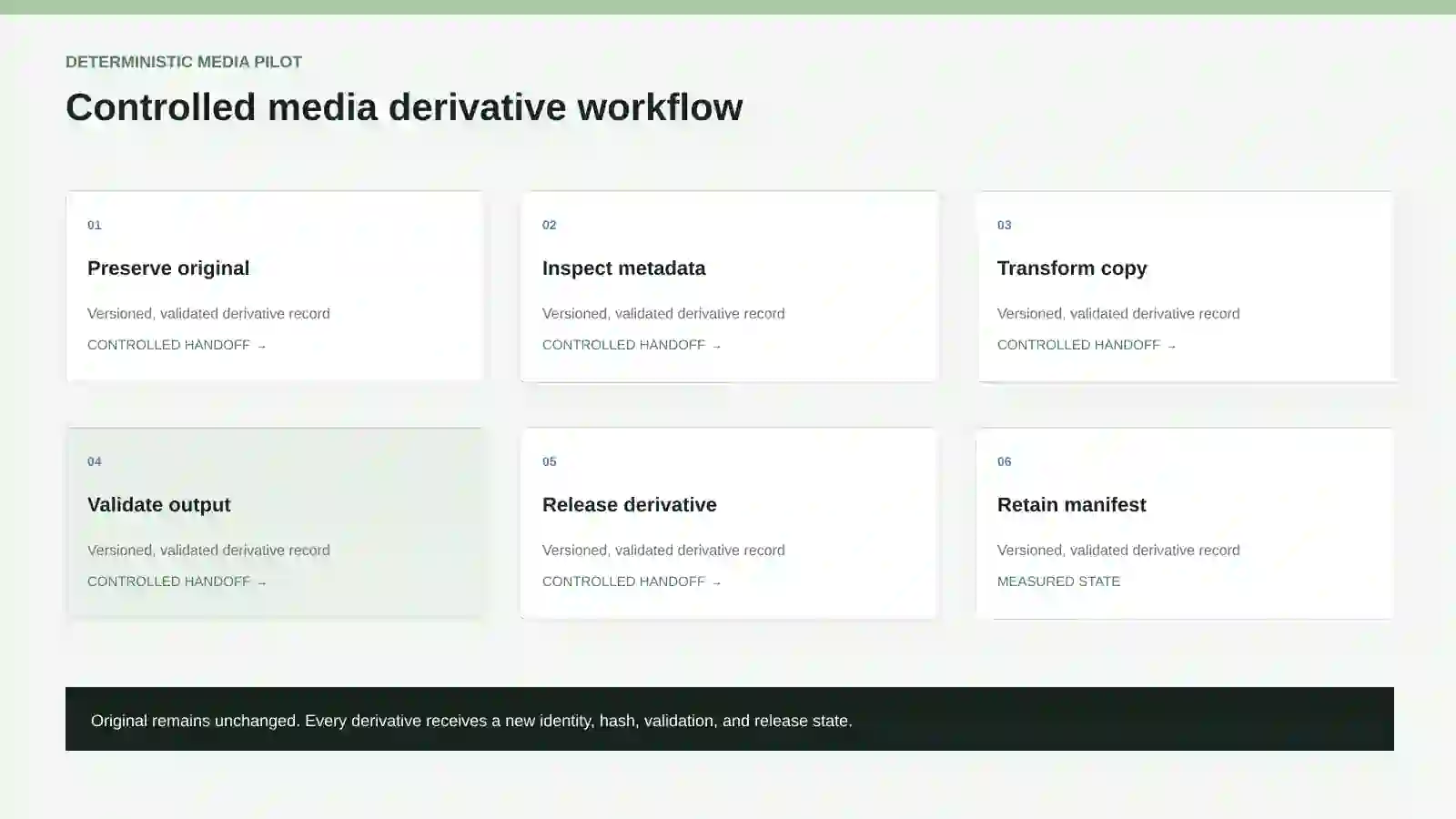
The original remains byte-for-byte unchanged; every output receives a separate derivative identity and hash.
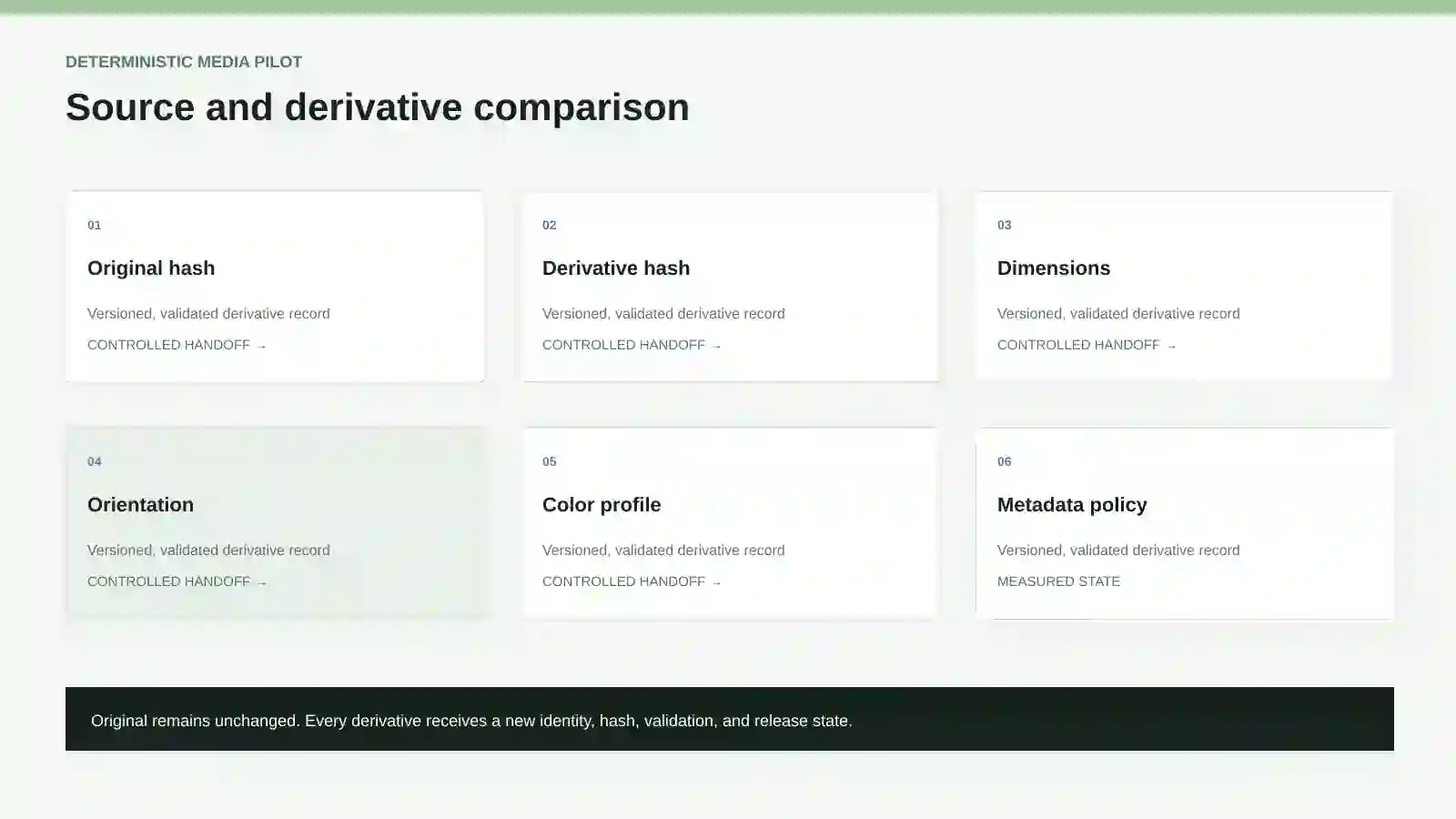
Technical completion is not acceptance. Reviewers compare visible output and recorded properties.
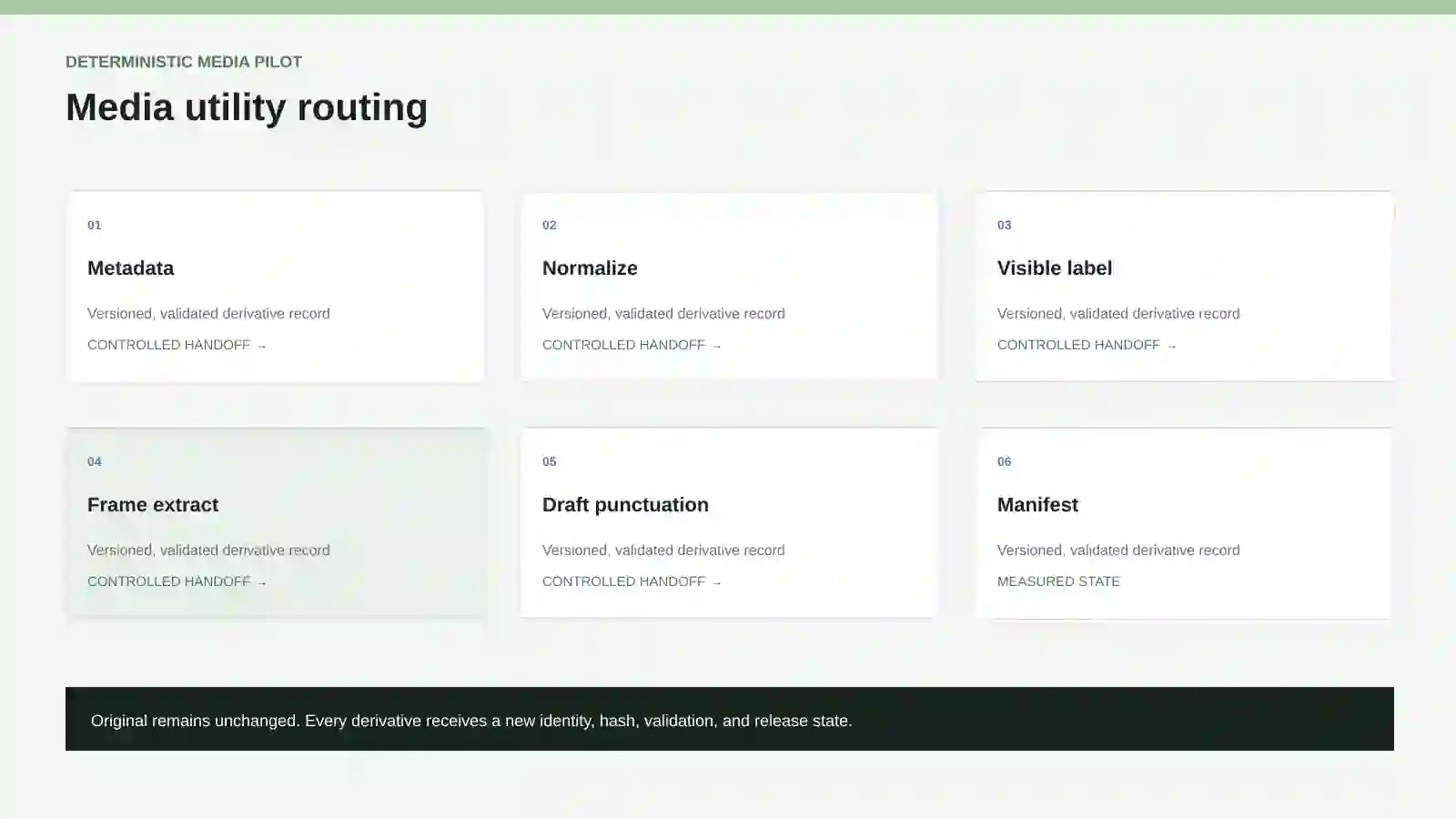
Deterministic tools handle predictable transforms; punctuation remains a candidate text edit reviewed against audio.
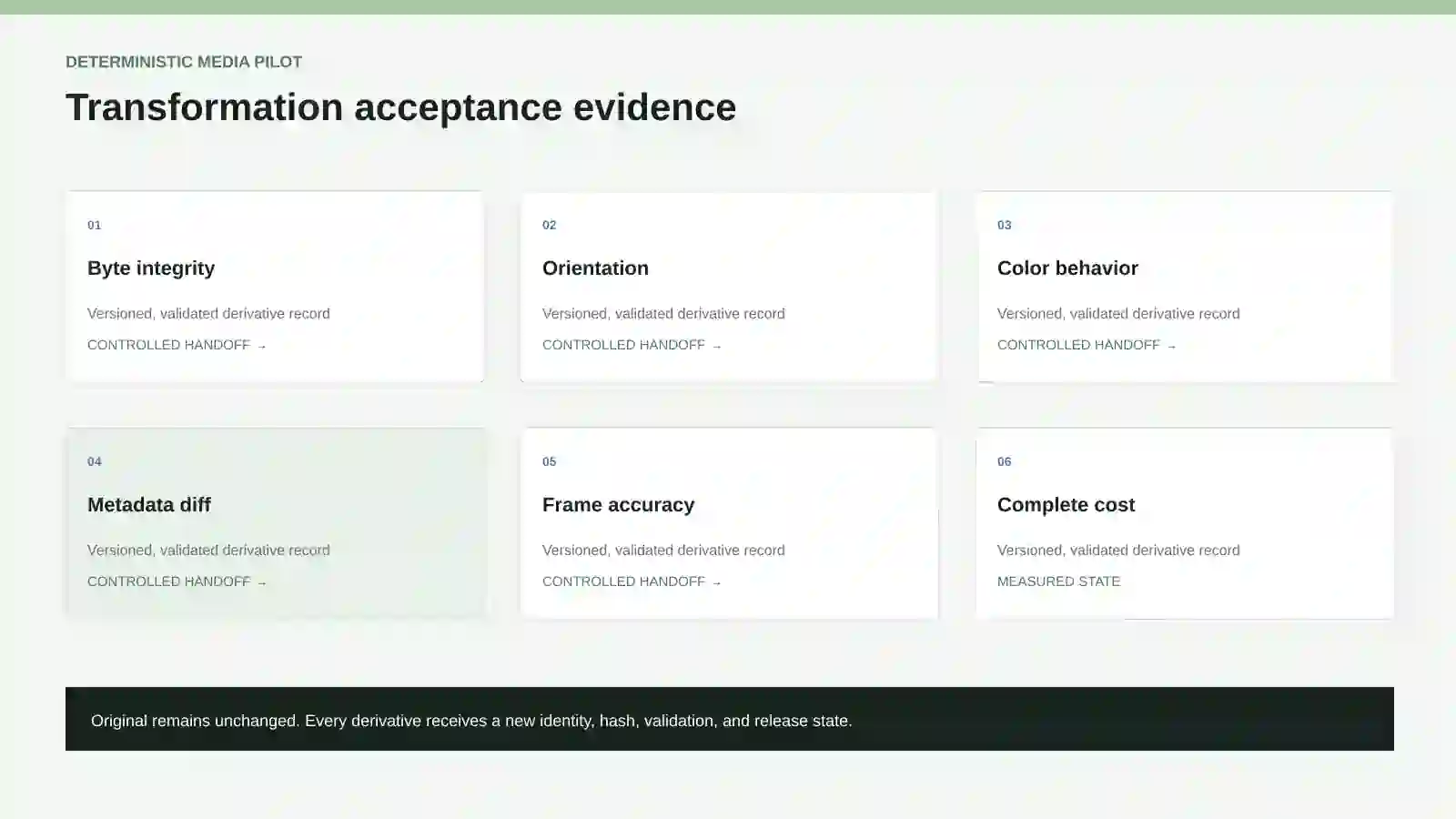
Pass/fail controls and agreed evaluation cases test reproducibility and destination fit.
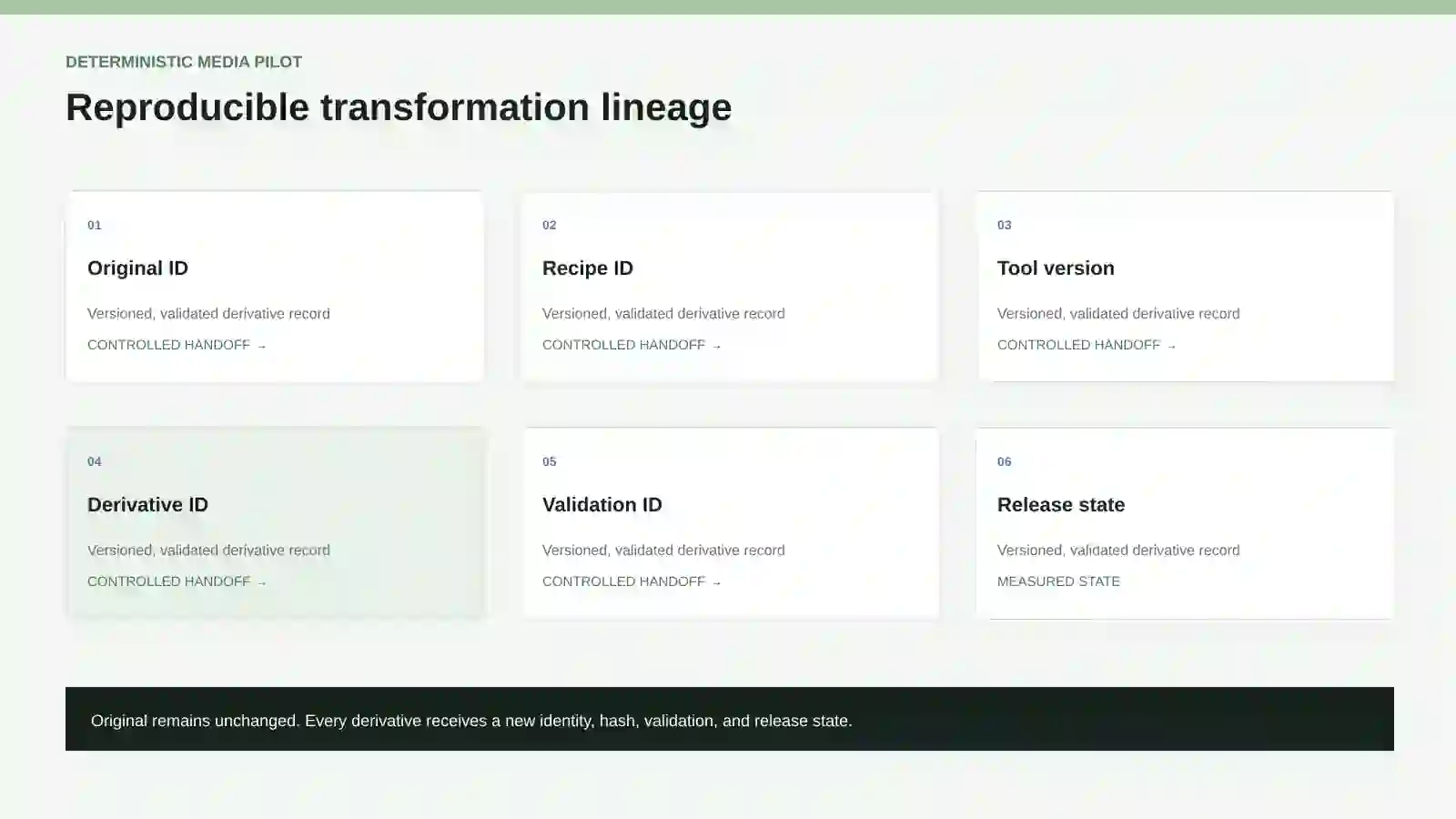
The manifest preserves source, recipe, version, parameters, output hash, validation, release, expiry, and withdrawal.
User journey
The interface can feel simple while the pilot preserves document identity, revision, permission, retrieval, uncertainty, and review evidence behind every result.
Confirm owner, rights, project, purpose, sensitivity, user, location, retention, prohibited destinations, and original-file policy.
Record source IDs, hash, bytes, format, dimensions, orientation, color profile, streams, duration, frame rate, and metadata snapshot.
Version output format, dimensions, quality, color, metadata policy, watermark, frame selector, transcript instruction, and destination.
Prefer self-controlled FFmpeg, ffprobe, ExifTool, or established image libraries; verify hosted wrappers separately.
Process a controlled copy into staging and capture version, command or parameters, logs, warnings, duration, and output hash.
Check decode, dimensions, orientation, ratio, color, metadata diff, timestamp, cadence, frame count, audio sync, watermark, and limits.
Compare original and derivative, review punctuation against audio, accept or reject, and correct the recipe rather than overwrite evidence.
Publish only the accepted derivative with destination, owner, expiry, and withdrawal; retain original, manifest, checks, and decision.
Technology options
The final selection records exact versions, licences, data handling, cost, limitations, replacement options, and the evidence required before use.
| Component | Examples | Pilot role | Boundary |
|---|---|---|---|
| Metadata inspection | media-metadata candidate, ffprobe, ExifTool | Read streams and metadata before transformation and create a source snapshot. | Metadata can be missing, stale, spoofed, sensitive, timezone-dependent, or removed; it is not proof of capture facts, authorship, location, or authority. |
| Image normalization | compress-image candidate, Sharp, ImageMagick, FFmpeg | Create resized, recompressed, reformatted, or color-normalized derivatives. | Conversion can rotate, crop, resample, strip metadata, alter color, lose transparency, or create artifacts. |
| Visible labeling | image-watermark candidate, FFmpeg drawtext, controlled compositing | Add conceptual, synthetic, draft, confidential, review, or provenance labels to a derivative. | A watermark does not establish accuracy, rights, consent, security, authenticity, or disclosure compliance and may be cropped. |
| Frame extraction | video-frame-custom candidate, FFmpeg selectors | Create source-linked frames at approved timestamps, intervals, scene changes, or reviewer-selected positions. | Frames can omit events, shift timestamps, lose orientation or color metadata, and cannot represent the whole video alone. |
| Draft punctuation | cadence-fast candidate or another evaluated text-restoration tool | Prepare punctuation and casing candidates for an existing draft transcript without changing source audio. | Punctuation can change meaning, names, quantities, obligations, or emphasis; preserve raw text and review against audio. |
| Transformation manifest | Client-owned media registry, hashes, job queue, validation schema | Connect original, recipe, version, derivative, checks, reviewer, release, expiry, correction, and withdrawal. | A completed job or valid hash proves processing identity, not visual correctness, rights, factual accuracy, or acceptance. |
Client-owned pilot outputs
Evaluation evidence
A fluent answer is not the acceptance unit. The pilot tests whether a reviewer can reach the controlling evidence efficiently and detect important failure.
Does the registered original remain byte-for-byte unchanged, readable, permissioned, retained, and linked to every derivative?
Can the same recipe, exact version, inputs, parameters, and environment reproduce an equivalent derivative and manifest?
Did orientation, ratio, color, transparency, frame timing, audio sync, labels, and intended visible information remain acceptable?
Were required fields preserved and prohibited or sensitive fields removed under an explicit field-level policy?
Measure comparison, acceptance, rejection, correction, rerun, release, and transcript review against source audio.
Measure compute, hosted calls, transfer, storage, review, correction, retries, monitoring, licensing, retention, deletion, and support.
Cost drivers
Scaling factors
Use immutable originals, deterministic job IDs, queues, idempotency, checksums, retries, storage tiers, retention, and deletion.
Version each transformation with approval, regression cases, destination constraints, owner, expiry, and rollback.
Apply field-level rules by media type, source, sensitivity, project, destination, jurisdiction, and retention.
Keep originals, recipes, manifests, hashes, validations, and accepted derivatives independent of wrappers and providers.
Measure CPU, GPU, memory, disk, network, payload limits, concurrency, queue latency, retries, and reviewer capacity.
Require separate security, service levels, monitoring, recovery, patching, licensing, training, ownership, and cost approval.
Cross-industry reuse
The reusable capability is permission-aware multilingual retrieval across versioned documents with citations. Each industry keeps its own source authority, terminology, consequence, retention, and qualified review.
Site photos, video, drone media, drawings, progress evidence, training media, and communications.
Review: Document control, project, quality, safety, commercial, or communications owner.
Asset, inspection, maintenance, tenancy, marketing, survey, handover, and condition media.
Review: Property, facilities, survey, compliance, communications, or asset owner.
Tests, equipment, laboratory media, diagrams, reports, and training footage.
Review: Engineer, test owner, quality role, information manager, or communications owner.
Site observations, models, renders, materials, presentations, drawings, and design media.
Review: Architect, design manager, technical lead, visualization, or communications owner.
Products, components, line video, quality evidence, instructions, maintenance, and training media.
Review: Production, quality, engineering, maintenance, training, or marketing owner.
Before-and-after photos, asset videos, completion evidence, damage, parts, and customer media.
Review: Service manager, technician, warranty, commercial, safety, or communications owner.
Meetings, webinars, research images, reports, presentations, transcripts, and client deliverables.
Review: Matter owner, legal, privacy, quality, communications, or specialist.
Approved explainers, conceptual media, social clips, accessibility derivatives, transcripts, and archives.
Review: Content, subject, legal, rights, accessibility, brand, privacy, or release authority.
Authority boundaries
Related paths
Continue into the operating, technical, security, and readiness guidance connected to this workflow.
Review scope, evaluation approach, price range, duration, and decisions.
Open pageInspect media identity, reproducible transformations, validation, hashes, manifests, and provider boundaries.
Open pageSee how prepared media can enter source-linked vision review without becoming authority.
Open pageAssess source access, transfer, retention, incidents, deletion, and handover.
Open pageStart with one approved collection
Use general workflow information during the assessment. Do not submit confidential documents, passwords, API keys, authentication codes, or unrestricted system access.
Plain-language route guide
Choose the smallest route that answers your next decision.
The formal service names remain useful for scope and contracts. The plain-language labels explain what each route actually does. These are alternatives, not four mandatory stages.
Operating-Layer Blueprint
Buyer question answered
What should we build, and where should the boundary be?
Typical input
One priority workflow, a named owner, current systems, representative records or files, and known failure points.
Output
A client-owned current-state map, target design, source inventory, implementation boundary, timeline, and fixed quote.
Bounded AI Agent Pilot
Buyer question answered
Can one specific AI-assisted task work reliably enough to justify more?
Typical input
One named task, approved sources and tools, representative cases, a human reviewer, and explicit stop conditions.
Output
A working pilot, evaluation evidence, cost and failure findings, review requirements, and a proceed, revise, or stop recommendation.
Single Workflow Implementation
Buyer question answered
How do we put one recurring workflow into controlled production?
Typical input
A defined trigger and completion point, accountable owners, approximately three core systems, rules, approvals, and test cases.
Output
Connected records, an operating view, integrations, a dashboard, acceptance testing, training, documentation, and handover.
Complete Operating Layer Implementation
Buyer question answered
How do we connect shared data and decisions across teams?
Typical input
Two to five related workflows, shared records, several departments or systems, an executive sponsor, and named operating owners.
Output
A phased operating layer with shared records, permissions, interfaces, integrations, reporting, controlled automation, training, and handover.
Still unsure which route fits?
Describe one broken workflow. The free assessment may recommend a Blueprint, pilot, implementation, a smaller discovery step, or no engagement.