AI Technology Brief
What remains under contractor control when Procore provides construction AI agents?
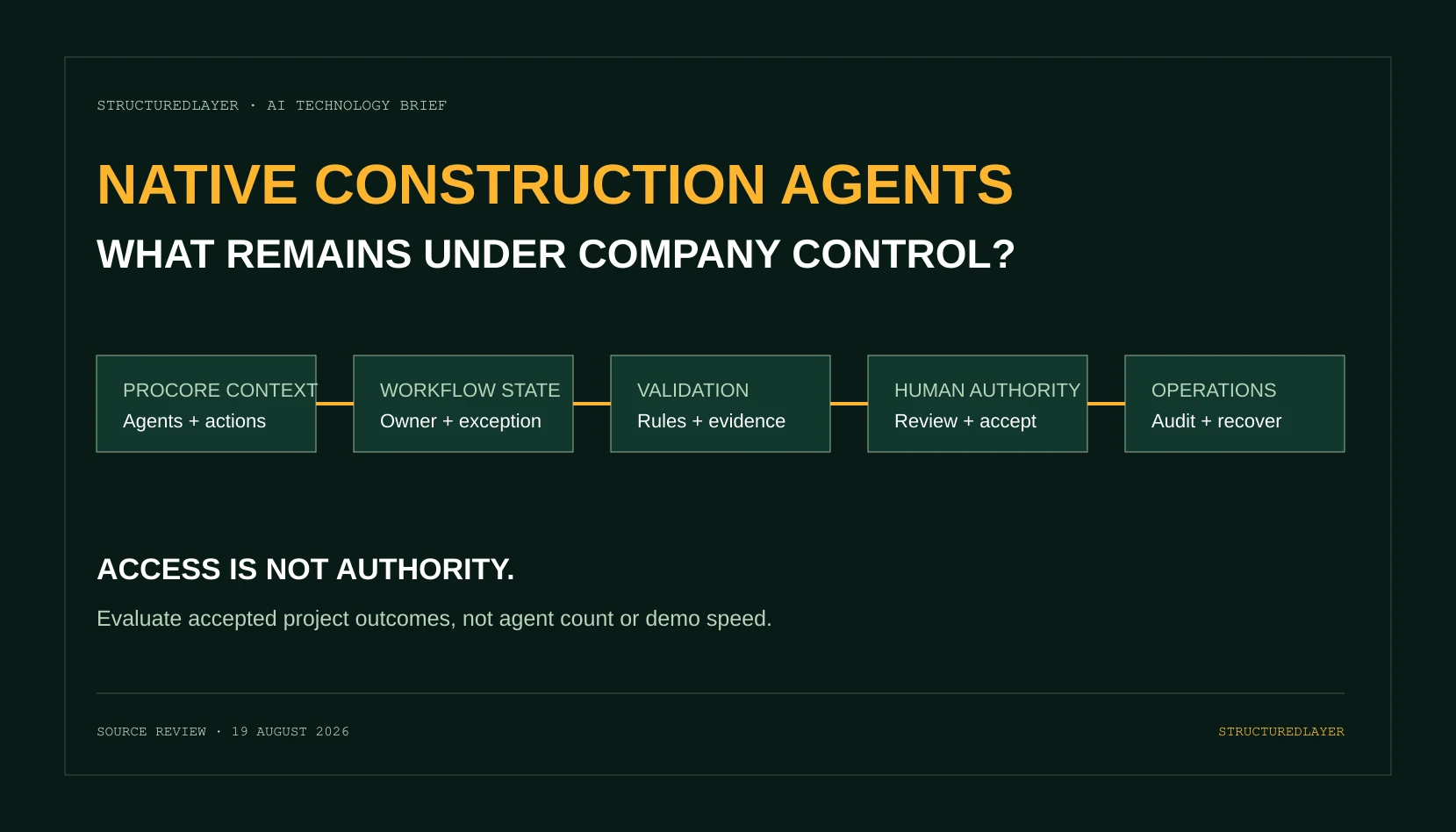
Procore now offers Digital Coworker packages with prebuilt construction agents, native project context, event-triggered workflows, actions, citations, permissions, and customization. Contractors still need source authority, workflow state, deterministic validation, qualified approval, accepted records, complete cost evidence, and recovery.
01 / Independently verifiable claims
Begin with what the technology and standards actually support.
- Procore announced generally available Digital Coworker packages on 23 July 2026. Its current plans page lists 5 agents for Starter, 20 for Pro, and 25+ for Enterprise.
- The five Starter agents cover Deep Search, Submittal Review, RFI preparation, Daily Logs, and Contract Review. Procore describes citations or links to underlying project documents for supported retrieval.
- Pro and Enterprise add scheduled or event-triggered workflows; Procore says agents can invoke more than 150 actions within its platform.
- Procore states that existing user permissions govern accessible project information and that users approve final actions in the workflows described in its product article.
- Control Tower provides activity and credit visibility by agent, user, and project. Enterprise includes Agent Studio for customized agents and organization-specific instructions.
- Public prices, exact credit costs, independent accuracy results, service levels, and complete technical limits are not published on the reviewed plan page.
- Published customer time and savings examples are Procore-supplied anecdotes without an independent study design, sample, or external validation in the reviewed sources.
- RICS reported that 74% of surveyed organizations had limited or no AI preparation in its 2025 construction research, so product availability should not be treated as industry-wide operational adoption.
02 / The practical distinction
A native agent feature and an accepted construction outcome are not the same thing.
Procore can supply project context, interface, agents, actions, and platform permissions. The contractor still has to define source authority, workflow rules, consequential approval, and operating evidence.
Product
Native agent
Searches, analyzes, drafts, flags, or invokes supported Procore actions using accessible project context.
Configuration
Company instruction
Applies approved SOPs, standards, Skills, or custom Agent Studio behavior within the available package and controls.
Workflow
Controlled operating path
Connects trigger, records, state, validation, exceptions, approval, accepted result, downstream effects, and recovery.
Authority
Accountable decision
Named people retain commercial, contractual, design, safety, quality, payment, issue, and release authority.
03 / Operating architecture
Place native Procore agents inside the contractor's operating controls.
The durable architecture begins before the agent and continues after its output. Access to project data is necessary but does not establish which record controls or who may accept the result.
Approved source
Procore and connected records with stable IDs, project identity, current revision, owner, permission, status, and authoritative purpose.
Workflow state
Trigger, required inputs, current stage, assigned owner, due date, permitted action, exception, and completion condition.
Agent preparation
Selected agent, instruction version, accessible context, action budget, citations, candidate output, and disclosed limitations.
Validation and authority
Deterministic checks, source review, corrections, named approval, accepted record, exact action, audit history, and recovery.
04 / Required records
Keep the evidence needed to reconstruct every consequential result.
Source record
Project, object type, native ID, revision, status, permission, owner, retrieval time, and authoritative role.
Agent definition
Package, agent, Skill or custom instruction, version, purpose, allowed sources, actions, limits, and prohibited uses.
Run
Run ID, user, trigger, source set, timestamps, invoked actions, usage, output, citations, status, and failures.
Candidate result
Draft, finding, discrepancy, recommendation, assumptions, missing evidence, affected records, and proposed next action.
Decision
Reviewer, evidence inspected, correction, acceptance or rejection, authority, reason, timestamp, and downstream effect.
Exception and recovery
Permission denial, stale source, wrong revision, unsupported result, partial action, owner, retry, reversal, and closure.
05 / Construction example
A submittal review shows where native capability ends and project authority begins.
The agent can compare accessible documents and prepare discrepancies. Qualified project participants still determine interpretation, response, acceptance, and issue.
Source
Identify the controlling package
Confirm submittal identity, specification section, current drawings, contract references, revisions, and required reviewers.
Prepare
Generate candidate findings
Use the supported agent to compare accessible evidence, link citations, and draft possible discrepancies or substitutions.
Validate
Check completeness and identity
Detect missing documents, superseded sources, incorrect project mapping, unsupported conclusions, and unresolved conflicts.
Approve
Record the authorized response
Qualified reviewers decide the exact response, status, conditions, issue authority, and resulting project record.
06 / Deterministic controls
Configure product controls and business controls as separate layers.
Least privilege
Use managed users, current project membership, existing permissions, approved connected sources, and role-specific access.
Current-source checks
Verify project, object, revision, status, effective date, and superseded relationships before accepting output.
Action allowlist
Define which supported actions may be prepared, previewed, executed, reversed, or blocked by workflow and role.
Independent validation
Check required fields, calculations, duplicates, destinations, citations, and prohibited conclusions outside the prompt.
Named human authority
Require qualified approval for consequential design, safety, quality, commercial, contract, cost, schedule, payment, and external actions.
Monitoring and recovery
Track accepted outcomes, corrections, exceptions, usage, failed triggers, partial effects, model or agent changes, and manual recovery.
07 / Failure analysis
Native integration reduces friction but does not remove operating failure modes.
Accessible is mistaken for authoritative
The agent can read a file or record, but it is superseded, incomplete, unapproved, or not controlling for the decision.
A citation is mistaken for correctness
A linked source improves inspection but does not prove complete retrieval, correct interpretation, or qualified conclusion.
Platform permission becomes business authority
A user can access or invoke an action but is not authorized to approve its commercial, professional, or contractual effect.
Custom instructions encode a weak process
An SOP or Skill reproduces an unclear, outdated, inconsistent, or unauthorized operating practice at scale.
Provider anecdotes become the business case
Published time or savings examples are applied to another company without comparable baselines, controls, review effort, or outcome definitions.
Event automation hides partial effects
A trigger runs twice, misses a change, uses stale context, or performs only part of a multi-step action without a recovery owner.
08 / Deployment and cost
Adopt according to workflow consequence, evidence quality, and operating ownership.
Starter evaluation
Use a bounded read-and-prepare task on representative projects with source, correction, review-time, and exception measurement.
Prebuilt agent workflow
Use Pro agents where the supported role matches an approved workflow and event triggers, actions, monitoring, and recovery are understood.
Customized enterprise agent
Use Agent Studio only after the company process, source authority, instruction ownership, tests, prohibited actions, and change control are explicit.
Cross-system operating layer
Keep durable state and acceptance outside one vendor where work spans accounting, email, document, scheduling, client, authority, or other systems.
- Package term, credits, actions, storage, connectivity, and support
- Project records, permissions, revisions, SOPs, and source-authority preparation
- Agent configuration, custom instructions, testing, security, privacy, and administration
- Human review, corrections, exceptions, duplicate or missed runs, and recovery
- Cross-system integration, monitoring, reporting, documentation, training, and handover
- Complete cost per accepted outcome plus export, replacement, and provider-change testing
09 / Evaluation
Evaluate accepted project work, not agent count or demo speed.
- Required-source coverage, current-revision accuracy, permission correctness, and citation support
- Material omissions, unsupported findings, wrong-project mappings, false risk flags, and missed exceptions
- Reviewer correction rate, qualified review time, accepted output rate, and consequential errors reaching action
- Trigger reliability, duplicates, failed or partial actions, latency, recovery time, and operating ownership
- Usage, credits, administration, support, integration, and complete cost per accepted outcome
- Behavior after instruction, agent, model, permission, source, project-template, or platform changes
10 / Controlled pilot
Prove the operating boundary before expanding it.
Choose one agent and outcome
Use one bounded search, RFI, daily-log, contract, or submittal preparation task with a named owner and accepted result.
Prepare representative evidence
Include current, superseded, incomplete, conflicting, inaccessible, unusual, and high-consequence cases.
Define authority
Document what the agent may retrieve, prepare, flag, or invoke and what requires qualified human approval.
Record every run
Preserve source versions, citations, instructions, output, actions, corrections, decisions, usage, and exceptions.
Test failure and recovery
Exercise permission loss, stale context, duplicate triggers, unsupported requests, partial actions, and provider unavailability.
Decide from evidence
Compare baseline time, accepted quality, review effort, critical failures, complete cost, adoption, and ownership before expansion.
Buyer classification test
Classify what the system controls before accepting the label.
- 01
Is the required project information current, accessible, identified, and authoritative for this task?
- 02
Does a prebuilt agent match the operating outcome without encoding material company-specific rules?
- 03
Can deterministic checks catch wrong identity, revision, required fields, duplicates, and prohibited actions?
- 04
Is the named reviewer qualified and authorized to accept the exact downstream effect?
- 05
Can failed, duplicate, partial, or incorrect actions be detected, stopped, reversed, and closed?
- 06
Will the company retain its records, workflow definition, tests, decisions, and operating history if the agent or provider changes?
11 / StructuredLayer recommendation
Use Procore agents where native project context reduces friction, while keeping business authority and accepted operating state explicit.
Start with one read-and-prepare workflow and representative project evidence. Verify current package capabilities, permissions, sources, citations, actions, limits, and commercial terms. Keep deterministic validation, qualified review, accepted records, audit history, recovery, and cross-system ownership under company control.
12 / Primary sources
Capability, governance, and implementation claims remain inspectable.
Procore
Procore Introduces Digital Coworker Packages
Procore
Your digital coworkers are ready to work
Procore
Procore AI plans
Procore Support
Which agents are included in my Procore AI plan?
RICS
Artificial Intelligence in Construction Report 2025
Sources reviewed 19 August 2026. Technology capabilities, laws, guidance, terms, and pricing can change.
13 / Related StructuredLayer guidance
Continue from model selection into operating architecture.
August 2026 Construction AI and Operations Signals
Place Procore's agent direction beside current infrastructure, commercial, regulatory, and property-operations developments.
AI Agents for Business Operations
See how agents fit inside bounded context, tools, tests, approvals, monitoring, and recovery.
AI Vendor Independence
Keep durable records, workflow state, evidence, and operating history portable as providers change.
Systems and Integrations
Connect existing construction systems without making one platform authoritative for every field.