
Construction and property operations report
Construction AI and Operations Trends: 10 Signals for August 2026
A source-checked monthly view of the market developments changing how contractors, consultants, developers, and facilities teams qualify work, control evidence, and introduce AI.
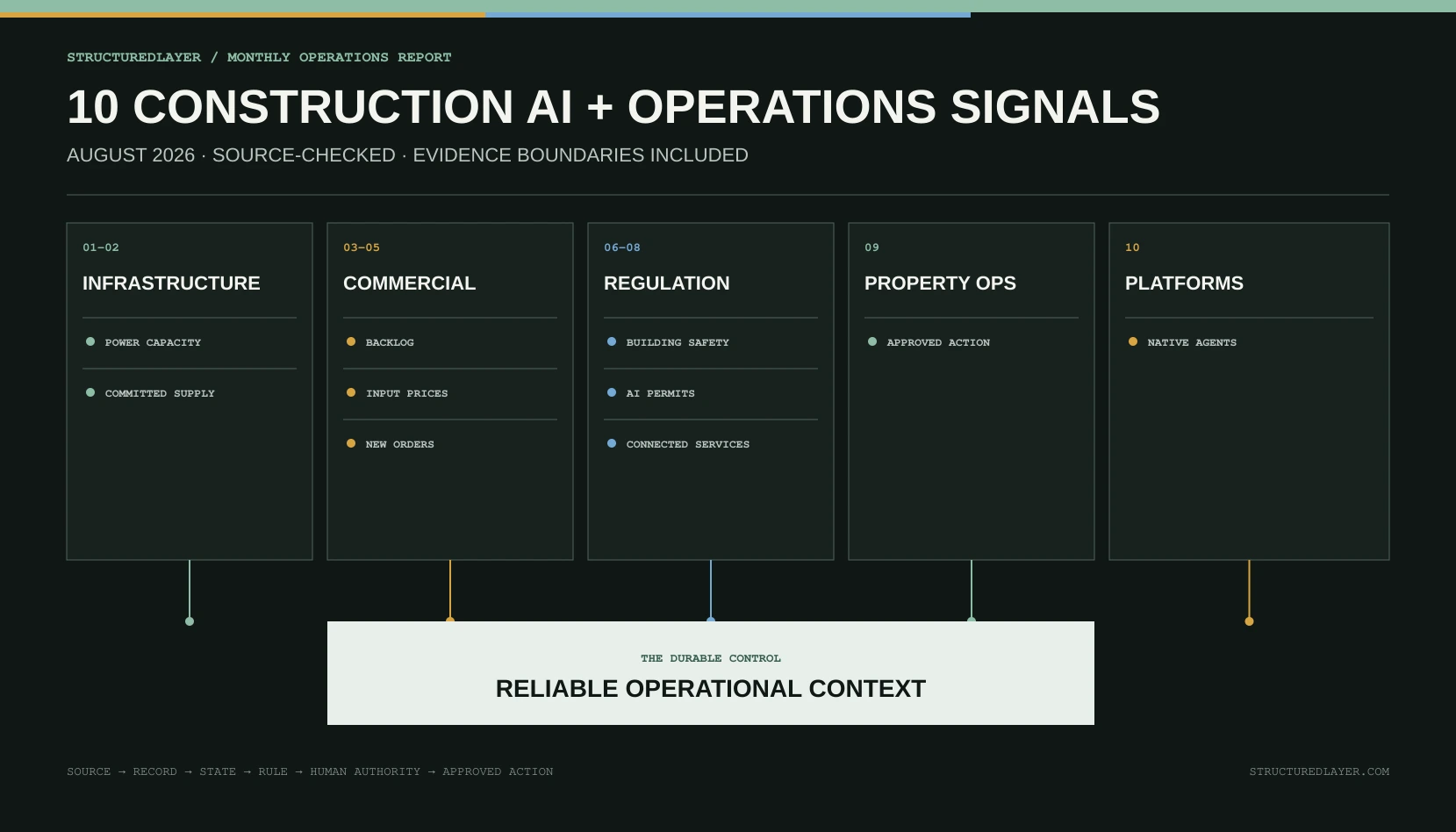
Executive view
AI is moving inside operating systems while physical and information constraints become more consequential.
Construction AI is increasingly appearing inside project, estimating, permitting, and facilities platforms rather than only through general-purpose chat interfaces. At the same time, data-center power constraints, earlier supplier commitments, weaker bid pipelines, price movement, and regulator expectations are raising the cost of weak project information.
The construction industry is not short of AI tools. It is short of reliable operational context.
The practical response is not to treat every announcement as deployment evidence. It is to connect files and systems to stable records, current workflow state, ownership, approvals, accepted outcomes, and complete history.
Ten consequential signals
Separate the reported development from the operating conclusion.
Each signal below states what the source establishes, what it does not establish, and which records or controls become more important.
United States · Infrastructure constraint
Data-center demand is colliding with available power capacity.
Review Data Center ReadinessReported evidence
PJM reported that its 2028/29 capacity auction secured 138,318 MW but remained 6,831 MW below its reliability requirement. The auction cleared at the approved $325 per MW-day ceiling, while PJM linked tightening conditions partly to large new loads including data centers.
Evidence boundary
The auction result is a regional power-market signal. It does not prove that a specific announced data center has land, interconnection, permits, financing, design maturity, equipment, or construction authority.
Operational implication
Opportunity qualification should treat power as a connected readiness record: requested load, utility, interconnection stage, generation strategy, agreement, evidence date, energization dependency, and accountable owner.
Global supply chain · Committed capacity
AI infrastructure suppliers are asking customers to commit earlier.
Map Long-Lead DependenciesReported evidence
Reuters reported that semiconductor-materials supplier Soitec was moving photonics customers into multi-year capacity agreements using fixed pricing, deposits tied to committed volumes, inventory sharing, and consequences for unpurchased commitments as AI data-center demand increased.
Evidence boundary
This is an upstream supplier example, not evidence that every mission-critical equipment category now uses the same contract model. The construction implication is directional and must be checked with actual vendors and packages.
Operational implication
Long-lead control should connect the design requirement to equipment, specification, approved vendor, commercial quote, capacity reservation, release authority, required-on-site date, delivery, and commissioning dependency.
United States · Commercial pressure
Lower contractor backlog raises the value of bid selection.
Review Bid Go/No-Go ControlReported evidence
ABC's July Construction Backlog Indicator fell to 8.0 months, down 0.8 months from both June 2026 and July 2025. Every reported industry, region, and company-size group declined; confidence measures nevertheless remained above the threshold indicating expected six-month growth.
Evidence boundary
ABC's indicator comes from its member survey conducted 20 July to 4 August. It is not a complete census, and backlog should not be confused with sales, staffing, or margin confidence.
Operational implication
A reusable bid history should connect opportunity, client, project type, estimator effort, bid/no-bid decision, accepted estimate, proposed margin, result, loss reason, and later outcome.
United States · Cost evidence
Construction input prices remain materially above last year.
Compare Estimating Software BoundariesReported evidence
ABC's analysis of US Bureau of Labor Statistics Producer Price Index data reported that overall construction input prices rose 0.1% in July and 7.4% year over year. Nonresidential input prices also rose 0.1% for the month and 7.2% over the year.
Evidence boundary
The index describes broad input-price movement, not a current project quote. July energy categories moved in different directions: natural gas increased 10.4%, while crude petroleum and unprocessed energy materials declined.
Operational implication
Every estimate input should retain description, supplier, location, quote date, validity, quantity basis, freight, tax, escalation, exclusions, revision, and the person who accepted it for use.
United Kingdom · Pipeline pressure
New orders are weaker than headline construction output.
Structure Tender QualificationReported evidence
ONS estimated that Great Britain construction output increased 0.3% quarter over quarter in Q2 2026 while new orders fell 11.8%, equivalent to £1.232 billion. Private commercial and public-other work were the largest contributors to the decline.
Evidence boundary
These are seasonally adjusted estimates and include revisions. Current output and future new orders measure different parts of the market; neither determines an individual contractor's pipeline or win probability.
Operational implication
Contractors need pipeline views that separate submitted value from probability, capacity, estimating cost, repeat-client history, margin quality, sector exposure, and evidence behind the forecast.
United Kingdom · Regulatory evidence
Building-safety workflows continue to reward disciplined evidence.
Review Submission ReadinessReported evidence
The Building Safety Regulator announced a more targeted, intelligence-led approach to building assessment certificates while prioritizing existing cases and developing updated support. Its current charging scheme applies a £156 hourly staff rate to specified functions from 1 April 2026, alongside other applicable fees and recoverable specialist costs.
Evidence boundary
The revised assessment approach is prospective, and the charging scheme does not impose an automatic penalty for a poor submission. Actual charges depend on the regulatory work and external input required.
Operational implication
Regulated workflows should connect requirement, building, accountable role, source document, evidence, review, submission, comment, response, decision, cost record, and complete history.
United Arab Emirates · Machine review
Dubai's planned AI permit review raises the information standard.
Read the Digital Permitting AnalysisReported evidence
Dubai Municipality announced a project to develop automated review for private and investment villa permit applications. The planned system would examine planning, architectural, structural, MEP, and supporting information through three phases over 26 weeks, including development, a selected-consultancy pilot, and wider rollout.
Evidence boundary
This is an announced development initiative, not evidence that automated permits are already generally available or that the stated move from days to minutes has been independently achieved.
Operational implication
Machine-reviewable submissions depend on stable project identity, current revisions, complete required items, aligned discipline records, named professional responsibility, visible exceptions, and frozen issue packages.
United Arab Emirates · Connected services
Dubai is consolidating previously separate building transactions.
Connect the Submission LifecycleReported evidence
Dubai Municipality separately announced the reorganization of 20 services. Building-related examples move drainage changes, historic-area approvals, advertising structures, and some completion requests into broader licensing, modification, or completion workflows.
Evidence boundary
The announcement did not provide an effective date proving every reorganized path was operational. It is also a separate initiative from the planned AI villa-permit system.
Operational implication
When an authority treats a building as one service journey, internal records should connect the same project across permits, consultants, drawings, inspections, comments, completion evidence, and decisions.
Property operations · Human-approved action
Facilities AI is moving from insight toward approved workflow action.
Explore Connected Property OperationsReported evidence
Johnson Controls says its OpenBlue Intelligence release can identify building insights, recommend responses, and execute approved workflows such as placing work orders and prioritizing maintenance. It also claims automated device discovery and classification can reduce onboarding time by up to 95%.
Evidence boundary
These are vendor claims without an independent benchmark for the reported onboarding reduction. A separate Johnson Controls survey covered 260 US facilities managers at organizations with more than 200 employees; methodology details such as fieldwork dates, weighting, and margin of error were not published in the reviewed article.
Operational implication
Operational AI still needs connected building, space, asset, system, alarm, work order, technician, contractor, inspection, evidence, approval, and service-history records.
Construction software · Platform direction
Construction platforms are productizing agent capabilities.
Review Procore Agent ControlsReported evidence
Procore made three Digital Coworker packages generally available in July, with five agents in Starter and a 20-agent library in Pro, while previewing organization-specific Skills. Its August updates also positioned a Starter Pack for specialty contractors. Autodesk is similarly positioning Forma around connected design and construction data with embedded AI capabilities.
Evidence boundary
Availability, packaging, entitlement, geography, credits, actions, and preview status must be checked against current vendor terms. Platform announcements do not establish independent accuracy, contractor adoption, or accepted project outcomes.
Operational implication
As agent features become native, the durable control remains outside any single prompt: source authority, current state, permissions, cross-system identity, validation, human approval, accepted records, audit, and recovery.
Signal versus hype
Do not convert a product release, survey, or market statistic into an autonomous-workflow claim.
The durable operating path
Build the context before asking software or AI to act.
The provider can change. The business still needs identifiable sources, connected records, explicit state, named authority, accepted outcomes, and recovery.
- 01
Files and systems
Approved source, native ID, revision, owner, permission, and retrieval time.
- 02
Connected records
Stable project, company, asset, document, cost, action, and decision relationships.
- 03
Workflow state
Trigger, current stage, required evidence, owner, due date, and exception.
- 04
Rules and checks
Deterministic validation, source comparison, completeness, and conflict handling.
- 05
Human authority
Qualified review, correction, approval, release, and accountable decision.
- 06
AI action
Bounded preparation or approved action with logs, monitoring, and recovery.
Reader questions
Questions raised by the August signals.
- What were the most important construction AI trends in August 2026?
- The strongest operational signals were native AI agents moving into construction and facilities platforms, planned machine review for Dubai villa permits, and increasing emphasis on approved workflow actions. These developments increase the value of current, permissioned, source-linked project and asset records.
- Why does power availability matter to data-center construction?
- A project can be announced or funded without confirmed grid capacity, interconnection, generation strategy, utility agreements, or energization milestones. Power evidence can therefore control site viability, design, procurement, schedule, and mobilization decisions.
- Does Dubai already issue villa permits automatically with AI?
- The reviewed 9 August announcement describes a project to develop the system through three phases over 26 weeks. It should not be presented as generally deployed or as independently proven to issue permits in minutes.
- Are construction AI agents replacing estimators or project managers?
- The reviewed releases support retrieval, preparation, recommendations, and platform actions. They do not transfer estimating, contractual, design, safety, commercial, payment, permit, or project authority away from accountable people and qualified professionals.