
AI Technology Brief
Can a self-hosted AI assistant safely work through WhatsApp, Slack, and project tools?
Hermes Agent combines messaging, persistent memory, skills, schedules, subagents, and tools in an open-source runtime. Self-hosting can improve runtime control, but it does not automatically localize model inference, secure messaging data, or authorize project-record changes.
01 / Independently verifiable claims
Begin with what the technology and standards actually support.
- Nous Research publishes Hermes Agent as an MIT-licensed open-source agent with messaging gateways, persistent memory, reusable skills, scheduled jobs, subagents, terminal and browser tools, and multiple model-provider options.
- Official Hermes documentation lists messaging support that includes WhatsApp, Slack, Telegram, Signal, Discord, email, Microsoft Teams, Home Assistant, and CLI use.
- Hermes can run on local hardware, a server, container, VPS, or supported hosted execution environment, while model inference may use a separate local or cloud provider.
- Official Hermes security documentation describes user authorization, dangerous-command approval, file-write restrictions, container isolation, credential filtering, context scanning, session isolation, and terminal-input sanitization.
- Agent Skills defines a portable folder-based format for task instructions and supporting resources; compatibility does not establish that a downloaded skill is trustworthy or suitable for one business.
- OWASP identifies excessive functionality, permissions, and autonomy as agent risks and recommends minimum tools, minimum permissions, and human approval for high-impact actions.
- NIST AI RMF requires risks to be governed, mapped, measured, and managed across the lifecycle rather than inferred from self-hosting or open-source availability.
02 / The practical distinction
Self-hosted agent, model inference, messaging transport, and business system are separate boundaries.
Keeping one component on your server does not automatically keep prompts, memory, messages, files, or tool calls inside the same trust zone.
Runtime
Agent host
The Hermes process, sessions, memory, skills, schedules, terminal, browser, and local workspace run in an approved environment.
Reasoning
Model provider
A local model may keep inference local; a cloud API transmits approved prompts and context under separate provider terms.
Channel
Messaging platform
WhatsApp, Slack, Teams, Telegram, email, or another gateway has its own identity, metadata, retention, administration, and platform rules.
Authority
Business systems
Email, files, calendars, project records, registers, and external actions retain source permissions and human approval requirements.
03 / Operating architecture
Treat the messaging assistant as a restricted application, not a person with ambient access.
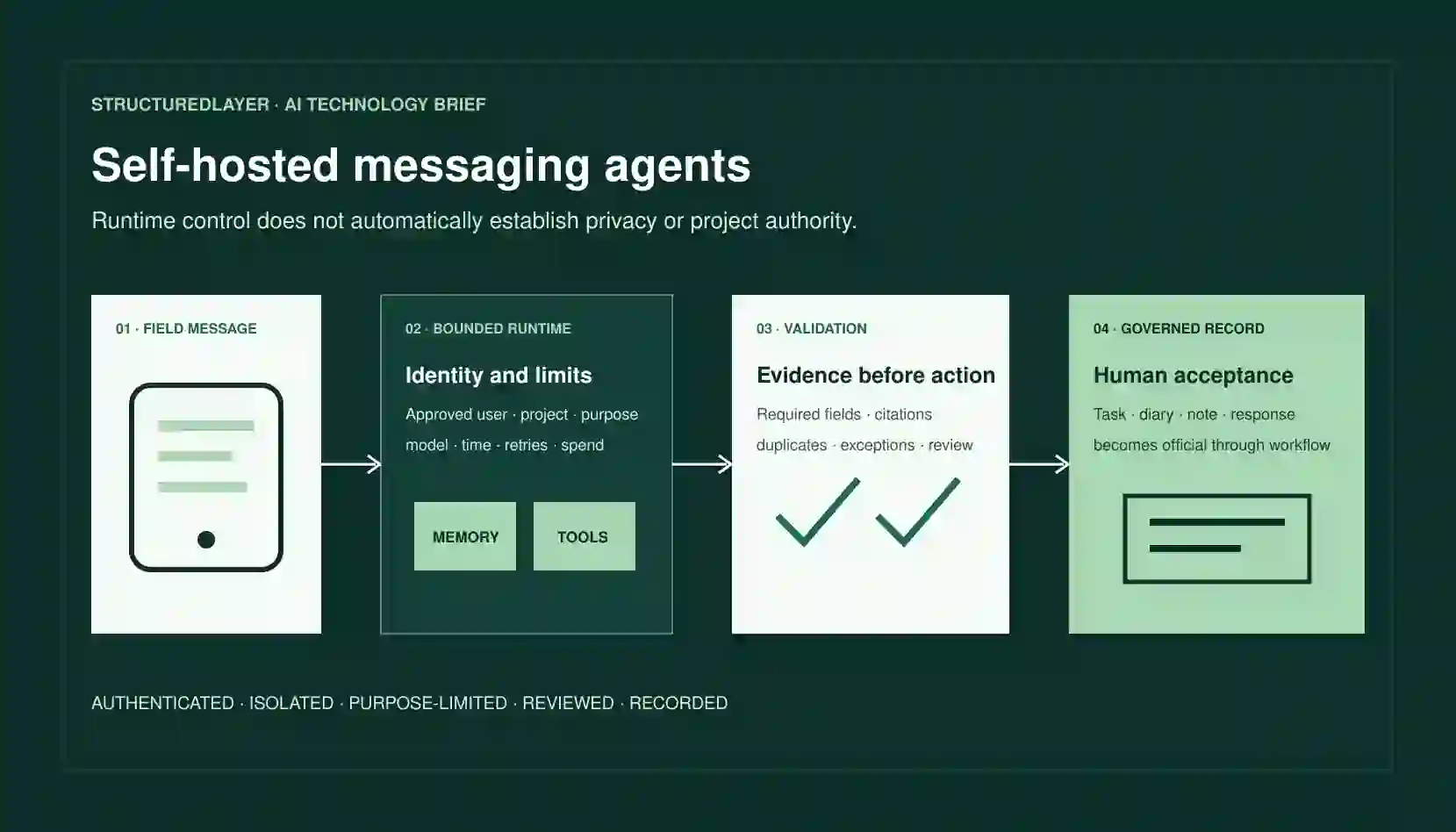
A field message can create useful preparation only after identity, project, purpose, source, action, validation, and approval are resolved.
Authenticated field message
Known user, approved channel, project or work identity, timestamp, purpose, attachments, location where appropriate, and retention notice.
Bounded agent runtime
Approved model, memory namespace, skills, tools, file roots, schedules, time, retries, spending, network, and prohibited actions.
Validation and review
Identity matching, required fields, duplicate checks, source citations, uncertainty, exception routing, and informed approval.
Governed record or response
Draft task, note, diary entry, reminder, or message becomes official only through the accepted system and authorized workflow.
04 / Required records
Persistent assistants need records for memory, messages, tools, and accepted outcomes.
Messaging identity
Platform, account, verified user, organization, channel, conversation, device where available, role, project assignment, and allowlist state.
Memory record
Type, source, subject, purpose, sensitivity, owner, created time, confidence, approval, correction, expiry, deletion, and retrieval history.
Skill and schedule
Skill origin, version, files, scripts, permissions, review, trigger, recurrence, timezone, model, limits, owner, and disable state.
Tool authorization
User, agent, system, resource, action, scopes, credential reference, approval, conditions, expiry, and result.
Agent run
Message, context selected, model, tool calls, files, validation, exception, retries, cost, proposed action, and completion evidence.
Business acceptance
Target record, source evidence, reviewer, corrections, approval, issued response, accepted state, and later outcome.
05 / Construction example
A supervisor can capture a site reminder without letting chat become the site diary.
The example is representative. Messaging, employment, privacy, safety, contractual, and record requirements vary by organization and jurisdiction.
Capture
Voice or text note
An authenticated supervisor records a reminder, observation, attachment, or requested follow-up through an approved messaging channel.
Prepare
Structured candidate
The agent identifies the project, task, source, date, responsible role, missing fields, and possible destination without inventing evidence.
Review
Human confirms meaning
The responsible person resolves ambiguity, consequence, assignment, privacy, and whether the note belongs in a task, diary, issue, or no record.
Record
Accepted system update
A controlled workflow writes the approved fields to the project system and preserves message provenance and review history.
06 / Deterministic controls
Constrain who can ask, what can be remembered, and what can happen next.
Allowlist messaging identities
Use approved work accounts, pairing or allowlists, channel restrictions, group rules, and revocation rather than trusting a display name.
Separate memory namespaces
Keep user, project, company, and workflow memory purpose-limited; do not let personal notes silently become shared business facts.
Restrict workspace and network
Use dedicated file roots, containers or low-privilege hosts, domain allowlists, protected secrets, and no unnecessary business-system access.
Review skills and scripts
Inspect origin, licence, instructions, dependencies, tool calls, file writes, network use, secrets, and updates before installation.
Confirm consequential action
Bind approval to the exact recipient, message, record, amount, document, schedule, source evidence, and next effect.
Operate lifecycle controls
Log runs, monitor schedules, cap retries and cost, rotate credentials, patch dependencies, back up approved state, and test recovery.
07 / Failure analysis
Persistence and convenience increase the impact of wrong identity, memory, or authority.
Self-hosting overstatement
The runtime is local or on a VPS, but prompts, context, files, telemetry, messaging, or tools still cross third-party boundaries.
Memory becomes truth
A generated, stale, personal, or misunderstood statement is recalled as an approved project or company fact.
Channel identity mismatch
A phone number, forwarded message, shared device, group member, or display name is mistaken for an authorized project actor.
Excessive tool access
A reminder assistant inherits broad email, drive, calendar, terminal, browser, or project-system permissions unrelated to the task.
Untrusted skill
A third-party skill or script reads secrets, writes outside the workspace, contacts an external service, or changes behavior after update.
Prompt injection through content
An email, attachment, webpage, chat message, or retrieved file attempts to redirect tools or disclose protected data.
Schedule without ownership
A recurring task continues after a project, role, source, permission, model, or business rule changes.
Chat becomes official record
A convenient note, draft, reminder, or AI summary is treated as a diary, instruction, notice, safety record, or accepted commitment.
08 / Deployment and cost
Choose the trust boundary before choosing the convenience channel.
Dedicated local device
Agent and approved files run on managed local hardware. Cloud models and messaging still create separate data paths unless replaced with local equivalents.
Dedicated low-privilege server
A VPS or client server provides continuous operation but needs hardening, patching, secrets, backups, monitoring, network policy, and incident ownership.
Container or isolated worker
Restrict terminal, browser, files, network, memory, and credentials per workflow or project and discard unneeded execution state.
Hybrid business integration
Keep authoritative records in client systems while the agent prepares bounded requests through approved APIs, connectors, or review queues.
- Dedicated device, server, container, storage, database, backup, monitoring, and network
- Model API, local inference hardware, messaging platform, tool, search, browser, and connector usage
- Identity, allowlists, secrets, credentials, skill review, security testing, and incident response
- Memory curation, correction, retention, deletion, project separation, and legal or employment review
- Human review, exception resolution, schedule ownership, support, training, updates, and recovery
- Unauthorized message, wrong record, stale memory, excessive action, duplicate work, and remediation
09 / Evaluation
Test messaging identity, memory, and denied action - not only successful replies.
- Correct user, channel, project, purpose, and source identification
- Denied unapproved users, groups, projects, files, tools, domains, recipients, and actions
- Memory creation, retrieval, correction, expiry, deletion, project separation, and leakage
- Skill and script behavior before and after dependency or version changes
- Prompt injection, unsafe content, secret exposure, tool chaining, and excessive-agency cases
- Scheduled-task timezone, duplication, missed runs, revocation, pause, retry, and recovery
- Source support, required-field completeness, abstention, human correction, and accepted record accuracy
- End-to-end latency, review effort, failure cost, model cost, infrastructure cost, and cost per accepted outcome
10 / Controlled pilot
Prove the operating boundary before expanding it.
Start with capture only
Use one approved channel and user group to prepare reminders or structured drafts with no send, delete, terminal, browser, or source-system write authority.
Define memory policy
Specify what may be remembered, source and purpose, sensitivity, project boundary, retention, correction, deletion, and prohibited personal profiling.
Use a dedicated environment
Limit files, tools, network, credentials, model provider, recipients, schedule, time, retries, and spending.
Test hostile and stale cases
Include wrong users, forwarded messages, shared channels, malicious attachments, stale memory, revoked access, duplicate triggers, and provider failure.
Require record review
Keep all project diary, task, correspondence, safety, contractual, and external communication changes in a visible approval queue.
Expand one capability
Add one memory class, tool, schedule, project, user group, or write action only after the prior boundary remains accepted.
11 / StructuredLayer recommendation
Use a persistent messaging agent as a bounded capture and preparation interface - not as a project participant with inherited authority.
Self-hosting can improve control over the agent runtime, but it does not automatically localize model inference or messaging data. Start with authenticated capture, isolated memory, minimum tools, no consequential write or send authority, source-linked review, and an accepted project-system record.
12 / Primary sources
Capability, governance, and implementation claims remain inspectable.
Nous Research
Hermes Agent repository
Nous Research
Hermes Agent features overview
Nous Research
Hermes Agent security
Nous Research
Hermes Agent providers
Nous Research
Hermes Agent quickstart
Agent Skills
Agent Skills specification
OWASP
AI Agent Security Cheat Sheet
OWASP Gen AI Security Project
LLM06:2025 Excessive Agency
NIST
Artificial Intelligence Risk Management Framework 1.0
Sources reviewed 30 July 2026. Technology capabilities, laws, guidance, terms, and pricing can change.
13 / Related StructuredLayer guidance
Continue from model selection into operating architecture.
AI Agent Authorization
Separate authentication, tool access, authorization, and business approval for every agent action.
AI Agent Reliability
Evaluate bounded tasks, difficult cases, exceptions, monitoring, recovery, and accepted outcomes.
AI Workflow Training
Build capability around agents, tools, context, permissions, verification, and ownership without implying production readiness.