AI Technology Brief
Visual anomaly detection can flag unusual construction conditions - but it cannot approve the inspection
Anomaly-detection systems can produce scores, masks, heatmaps, and descriptions for unusual visual conditions. Construction use needs representative project data, capture controls, source evidence, calibrated thresholds, licensing review, exceptions, and qualified inspection authority.
01 / Independently verifiable claims
Begin with what the technology and standards actually support.
- AnomalyGPT combines a vision-language model with anomaly-focused components to classify and localize industrial anomalies, describe them in language, and support few-shot adaptation and dialogue.
- INP-Former is a specialized anomaly-detection architecture that extracts normal prototypes from an image and supports single-class, multi-class, few-shot, zero-shot, and combined-dataset research workflows.
- MVTec AD contains more than 5,000 industrial images across 15 object and texture categories with defect-free training images, anomalous test images, and pixel-level masks.
- MVTec AD 2 contains more than 8,000 high-resolution images across eight industrial scenarios and introduces lighting-condition shifts plus a public evaluation server with withheld private-test ground truth.
- MVTec datasets are industrial benchmarks. Their categories, capture rigs, labels, and operating conditions do not establish performance on construction sites, buildings, infrastructure, or project photographs.
- AnomalyGPT is published under CC BY-NC-SA 4.0 and MVTec AD and AD 2 are noncommercial under their standard public terms. INP-Former repository code is MIT, but dependencies, backbones, weights, and datasets require separate review.
- A high image-level or pixel-level benchmark score does not mean the model understands contractual defects, workmanship tolerances, causation, severity, safety, code compliance, or required remediation.
- A Hugging Face anomaly-detection Space is a demonstration operated by its author. Public access and visible source do not establish privacy, retention, support, licensing, or production readiness for project images.
02 / The practical distinction
Unusual appearance, detected defect, and accepted nonconformance are different conclusions.
Anomaly models compare visual patterns with learned or supplied concepts of normality. Construction inspection requires additional context, requirements, capture evidence, qualified judgment, and an accountable decision.
Candidate
Image-level score
Estimates whether an image appears normal or anomalous relative to the model, examples, prompts, and threshold.
Localization
Pixel map or mask
Highlights regions associated with the anomaly signal. It does not by itself identify cause, depth, material, tolerance, or consequence.
Interpretation
Language description
May summarize a visible difference, but can introduce unsupported object, defect, cause, severity, or remedy claims.
Operating record
Construction observation
Connects the source image to project, location, element, time, capture conditions, reference requirement, and responsible reviewer.
Human authority
Inspection finding
A qualified person evaluates the condition using required views, measurements, documents, standards, tolerances, and site context.
Business decision
Contractual disposition
Accept, monitor, recapture, test, repair, reject, issue a nonconformance, or seek professional direction under the approved process.
03 / Operating architecture
Preserve the source and route candidates into the inspection process.
The model should create reviewable candidate records without replacing the authoritative image, inspection requirement, qualified reviewer, or project decision.
Source
Governed capture intake
Identify project, asset, element, location, orientation, date, device, operator, lighting, distance, resolution, and original file hash.
Method
Task and reference router
Select the approved model, checkpoint, prompt, normal references, class, threshold, expected views, and applicable use boundary.
Output
Candidate evidence record
Store score, mask, heatmap, text, model version, inference settings, uncertainty, and links to the untouched source and comparison set.
Authority
Qualified review queue
Route by project, discipline, severity rule, uncertainty, missing evidence, due date, reviewer, decision, corrective path, and closure evidence.
04 / Required records
The anomaly result needs visual provenance, context, and a review decision.
Source media
Original file, hash, capture time, device, operator, project, location, element, view, resolution, retention, and access.
Reference and requirement
Approved normal examples, drawing, specification, standard, tolerance, inspection plan, manufacturer instruction, and version.
Inference run
Model, checkpoint, code, dependencies, license, prompt, image processing, threshold, hardware, start time, and cost.
Candidate anomaly
Image score, region score, mask or heatmap, language description, uncertainty, comparison reference, and candidate category.
Review decision
Reviewer, qualification, inspected evidence, additional measurement, accept or reject, rationale, severity, and required action.
Outcome and feedback
Recapture, test, repair, nonconformance, closeout, false positive, missed condition, correction, and regression-case eligibility.
05 / Construction example
A finish-quality assistant can prioritize photographs without accepting the work.
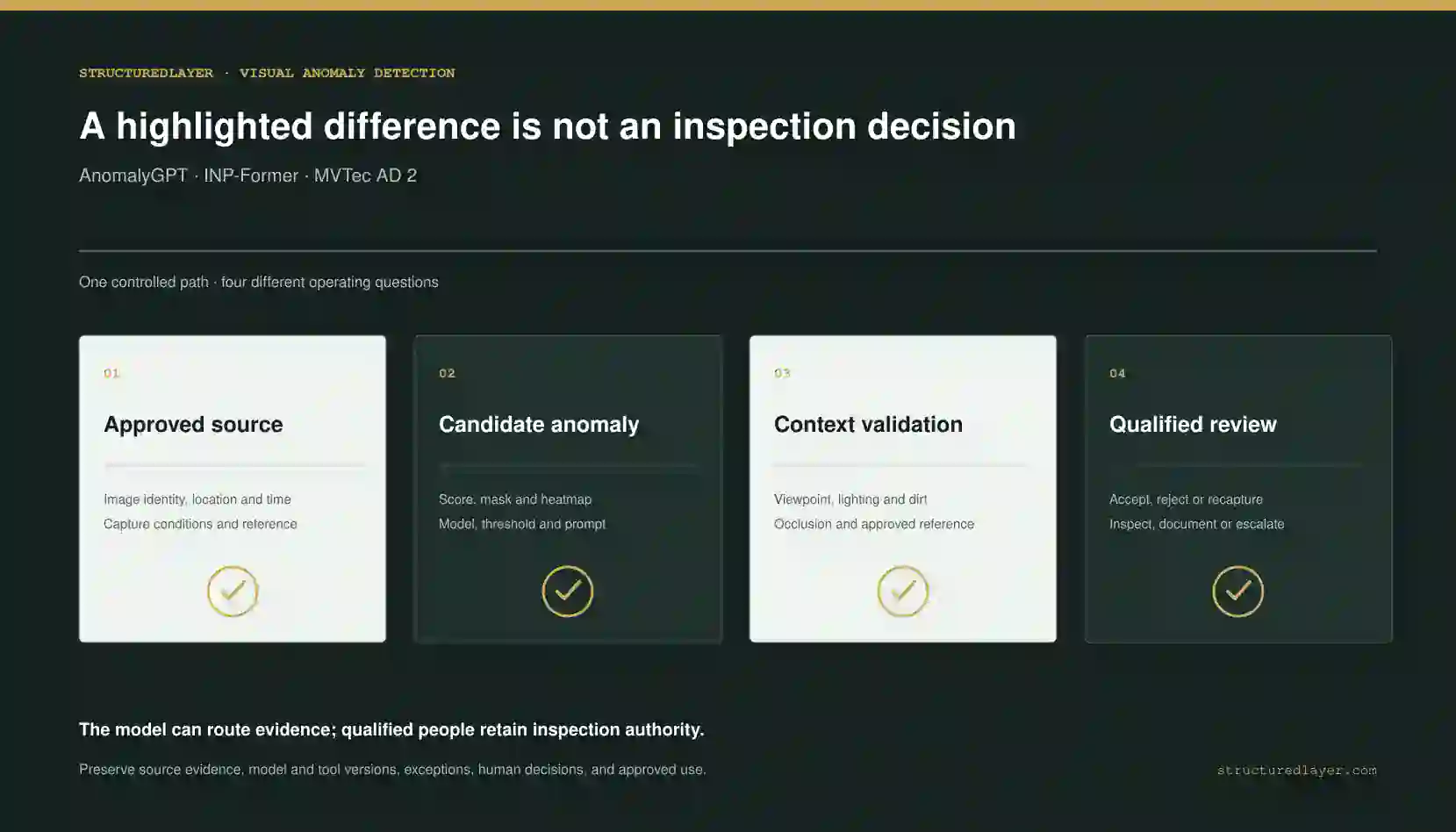
Consider repeated photographs of prefabricated panels or installed finishes captured under a controlled inspection plan. The model can rank unusual regions for review while the approved inspection process retains the finding and disposition.
Input
Capture
Use required viewpoints, distance, lighting, scale reference, focus, image quality, and element identity rather than arbitrary progress photographs.
Candidate
Compare
Run the approved checkpoint and references; preserve the score, heatmap, threshold, source image, and model version.
Context
Validate
Check whether shadows, dirt, protective film, reflection, occlusion, texture, camera processing, or the wrong reference explains the signal.
Authority
Decide
A qualified reviewer accepts, recaptures, measures, tests, monitors, repairs, rejects, or escalates under the project process.
06 / Deterministic controls
Capture controls and human review matter as much as the model.
Purpose-specific normality
Define normal for the element, stage, view, material, supplier, finish, environment, and accepted requirement rather than one universal visual baseline.
Capture-quality gate
Reject blurred, compressed, cropped, overexposed, underexposed, obstructed, unidentifiable, or wrong-view images before inference.
Threshold by consequence
Calibrate separate routing thresholds and false-negative tolerance by task; do not reuse a benchmark threshold as a project acceptance rule.
No generated source evidence
Do not enhance, synthesize, inpaint, or alter the authoritative source in a way that hides what the reviewer actually received.
License and dependency register
Track code, model, backbone, checkpoint, dataset, annotation, pretrained weight, and deployment rights separately.
Qualified disposition
Keep safety, engineering, workmanship, code, contractual, warranty, and payment decisions with authorized people and required evidence.
07 / Failure analysis
A plausible heatmap can be wrong for reasons unrelated to workmanship.
Lighting becomes the anomaly
Different sun angle, artificial lighting, exposure, white balance, shadow, glare, or wetness changes appearance more than the actual condition.
The reference set is not comparable
A different product, batch, orientation, installation stage, finish, background, camera, or accepted tolerance makes normal examples misleading.
The model detects dirt or protection
Dust, labels, tape, wrapping, temporary works, water, debris, tools, or workers create unusual regions without a permanent defect.
A serious condition remains visually ordinary
Hidden, internal, dimensional, structural, thermal, acoustic, electrical, chemical, or subsurface problems may not be visible in an RGB image.
Language overstates the evidence
The model names a crack, corrosion, cause, severity, code failure, or repair even though the pixels support only an unusual visual pattern.
Benchmark licensing blocks deployment
A promising public model or dataset cannot be used commercially under its standard terms, or a dependency and checkpoint remain uncleared.
08 / Deployment and cost
Move from benchmark study to one controlled visual triage task.
Understand
Research review
Inspect official code, paper, checkpoint, dataset, labels, metrics, license, hardware, dependencies, failure examples, and current maintenance.
Prepare
Project dataset study
Build an approved, rights-cleared, representative set covering normal variation, known findings, capture shifts, difficult negatives, and qualified labels.
Evaluate
Shadow triage
Rank or highlight candidates without changing the inspection workflow; compare with qualified review and measure misses, false alerts, and recapture.
Operate
Controlled review assistant
Route candidates into the existing inspection queue with source evidence, uncertainty, reviewer authority, monitoring, fallback, and documented limits.
- Rights-cleared construction images, capture plans, labeling, qualified review, adjudication, anonymization, storage, and retention
- Model, checkpoint, dependency, dataset, and commercial-license review plus replacement or permission where required
- Capture equipment, lighting, reference markers, mobile workflow, upload, quality gates, connectivity, and field support
- Compute, image processing, model serving, masks and heatmaps, monitoring, versioning, storage, and reprocessing
- Threshold calibration, difficult negatives, distribution-shift tests, false-positive review, missed-condition analysis, and regression sets
- Inspection integration, reviewer queues, recapture, measurements, professional review, nonconformance workflow, documentation, and handover
09 / Evaluation
Evaluate construction decisions and capture shifts, not only industrial benchmark metrics.
- Separate projects, sites, suppliers, products, capture devices, dates, and locations between development and final evaluation where possible.
- Include lighting, weather, distance, viewpoint, background, compression, dirt, obstruction, temporary protection, and accepted visual variation.
- Measure image-level detection, region localization, calibration, false negatives, false positives, reviewer agreement, recapture rate, and time per accepted finding.
- Score whether the model preserves uncertainty and avoids unsupported defect, cause, severity, safety, code, contractual, and remediation claims.
- Evaluate hidden or nonvisual conditions as explicit out-of-scope cases and confirm the workflow does not claim that no visible anomaly means no defect.
- Run license, privacy, security, retention, access, model-change, and fallback checks alongside visual performance.
10 / Controlled pilot
Prove the operating boundary before expanding it.
Choose one repeatable visual task
Select a bounded element, stage, capture plan, candidate condition, reviewer group, and operational decision that benefits from prioritization.
Build the approved evidence set
Collect comparable normal variation, confirmed findings, difficult negatives, capture shifts, rights, provenance, and qualified labels.
Qualify the technical stack
Review code, weights, dependencies, datasets, licenses, hardware, security, privacy, model behavior, and replacement options.
Calibrate routing
Set thresholds and uncertainty states around review capacity and missed-condition consequence, not around a leaderboard score.
Run in shadow mode
Compare model candidates with the existing inspection outcome without hiding images, changing approvals, or suppressing normal review.
Operate as assistive evidence
Proceed only when the model improves prioritization without weakening capture, review, professional authority, or record quality.
11 / StructuredLayer recommendation
Use visual anomaly detection to prioritize source-linked construction evidence for qualified review - never to convert an unusual pixel pattern directly into an approved inspection finding.
Start with one controlled visual task, construction-specific representative data, fixed capture requirements, rights-cleared models and datasets, calibrated thresholds, visible uncertainty, and a reviewer queue. Preserve the original image and every model version, measure missed conditions and false alerts, and keep safety, engineering, quality, contractual, warranty, and payment authority with qualified people.
12 / Primary sources
Capability, governance, and implementation claims remain inspectable.
CASIA
AnomalyGPT official repository
CASIA
AnomalyGPT project and paper
INP-Former authors
INP-Former official repository
CVF Open Access
INP-Former CVPR 2025 paper
MVTec
MVTec AD
MVTec
MVTec AD 2
MVTec
MVTec 3D-AD
Amazon Science
VisA dataset
Hugging Face
Hugging Face Spaces overview
Sources reviewed 25 July 2026. Technology capabilities, laws, guidance, terms, and pricing can change.
13 / Related StructuredLayer guidance
Continue from model selection into operating architecture.
Detection, Segmentation, and Tracking
Route visual models by task while preserving source frames, scores, versions, exceptions, and review.
YOLO for Construction Vision
Use detection and segmentation as reviewable evidence rather than inspection approval.
Workflow Library
Review buyer-focused patterns for evidence capture, inspection support, approvals, exceptions, and project records.