
AI Technology Brief
StructuredLayer evaluates YOLO for construction vision - detection is not inspection approval
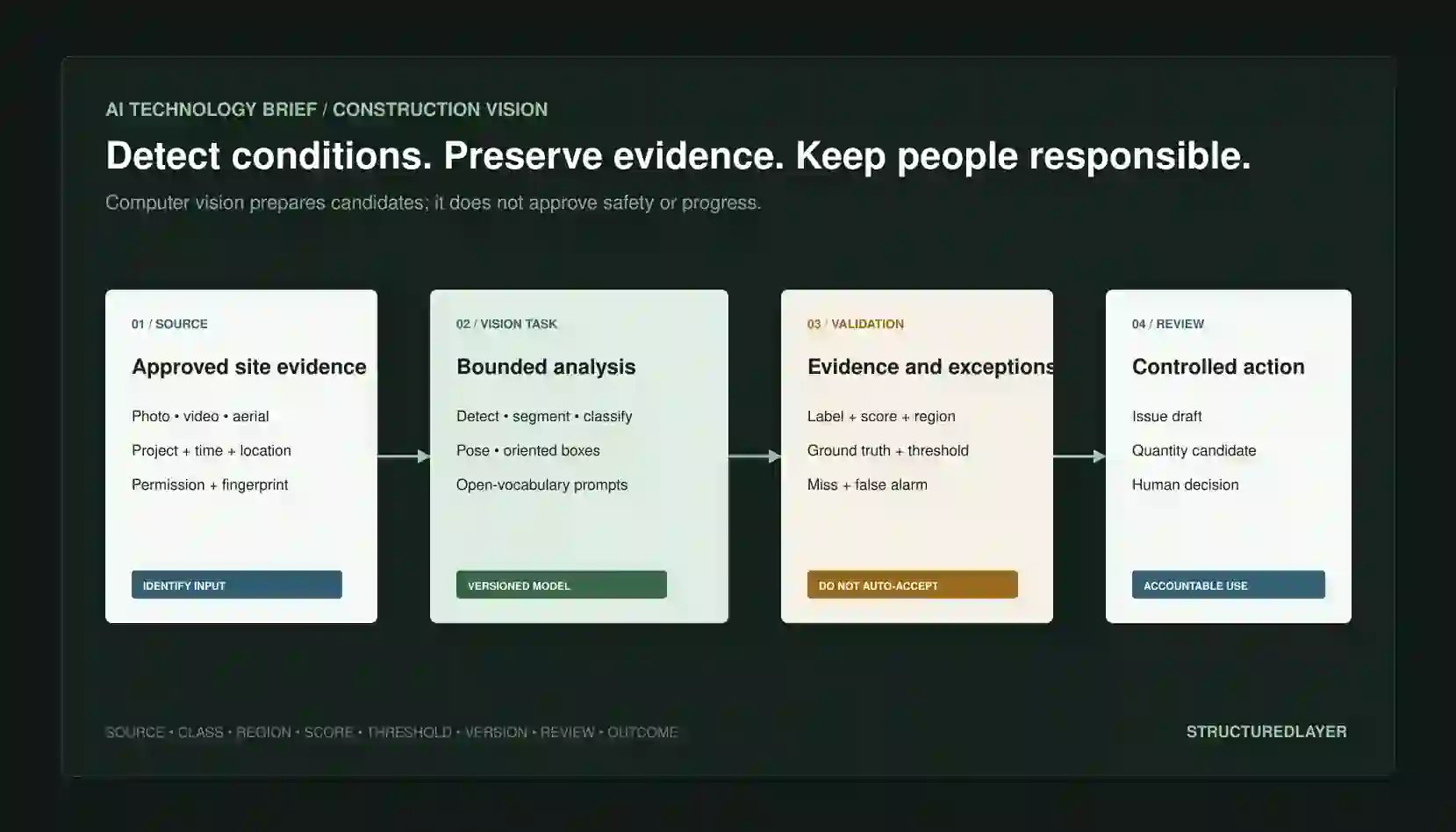
StructuredLayer evaluated an operating architecture for applying YOLO computer-vision tasks to approved construction photos, video frames, drone imagery, documents, and equipment views. This is architecture evaluation, not a claim of completed production deployment. The useful output is a source-linked candidate observation for review, not an autonomous inspection, progress certification, safety judgment, or quantity approval.
01 / Independently verifiable claims
Begin with what the technology and standards actually support.
- YOLO26 officially supports object detection, instance segmentation, semantic segmentation, image classification, pose estimation, and oriented bounding boxes, with n, s, m, l, and x model scales documented across task families.
- YOLO26 detection models are pretrained on COCO, classification on ImageNet, pose on COCO-Pose, oriented boxes on DOTAv1, and segmentation families on their documented datasets. Those datasets do not establish construction-site accuracy.
- YOLO-World supports open-vocabulary detection using text-defined classes; YOLOE supports promptable open-vocabulary detection and segmentation using text, visual prompts, or prompt-free vocabulary.
- YOLO11n remains a distinct earlier detection family. YOLOv8s-WorldV2 and YOLOE-11S are earlier open-vocabulary options and should not be confused with YOLO26 task checkpoints.
- A detection returns a class, confidence, and region; segmentation returns pixels or masks; classification describes a whole image; pose returns keypoints; oriented boxes represent rotated regions. These outputs are not interchangeable.
- Ultralytics distributes its software under AGPL-3.0 and offers a separate Enterprise licence. Proprietary, internal, embedded, SaaS, or closed-source use requires licence review rather than assuming permissive commercial use.
- Catalogue run counts and public labels do not prove accuracy, latency, fairness, robustness, or suitability on a client's projects, cameras, trades, environments, and classes.
02 / The practical distinction
Choose the vision task from the business question, not from the newest checkpoint.
Each task creates a different evidence object and needs its own labels, ground truth, thresholds, review interface, and acceptance criteria.
Locate
Detection and oriented boxes
Detect candidate people, vehicles, equipment, materials, openings, signs, or rotated aerial objects. Oriented boxes can fit angled objects more closely than axis-aligned rectangles.
Measure visible extent
Instance and semantic segmentation
Create candidate masks for individual objects or pixel classes such as surfaces, access areas, stockpiles, water, vegetation, or site zones. Masks are not measured quantities without calibration.
Describe state
Classification and pose
Classify an approved image into trained categories or estimate visible keypoints. Pose is not identity, intent, ergonomic diagnosis, or proof of safe behavior.
Prompt new concepts
YOLO-World and YOLOE
Use text or visual prompts to explore classes without a fixed closed vocabulary. Promptability improves discovery but does not replace class definition, ground truth, or validation.
03 / Operating architecture
Put computer vision inside a governed evidence and review workflow.
StructuredLayer's evaluated architecture keeps source identity, model configuration, permissions, validation, exceptions, and business decisions outside the detector.
Approved capture
Project, camera or source, timestamp, location where authorized, media fingerprint, frame, permission, purpose, sensitivity, and retention.
Bounded task
Approved class vocabulary or prompt, model checkpoint, scale, image size, thresholds, regions, tracking settings, and prohibited inferences.
Candidate evidence
Class, confidence, box, oriented box, mask, keypoints, frame time, crop reference, model version, and processing record.
Controlled outcome
Ground-truth checks, rule validation, duplicate handling, exception routing, reviewer correction, approved issue or record, and audit history.
04 / Required records
Every detection needs a source, configuration, review state, and outcome.
Media record
Project, source, fingerprint, capture time, location policy, uploader, frame, revision, privacy state, quality, and original file.
Class and policy
Class definition, inclusion and exclusion examples, consequence, minimum size, region, threshold, reviewer, and release condition.
Model run
Task family, exact checkpoint, scale, training or fine-tune version, image size, thresholds, prompt, device, duration, and output.
Candidate observation
Label, score, box or mask, keypoints, frame, source link, duplicate group, validation state, and uncertainty.
Exception
Miss, false alarm, occlusion, low light, blur, unusual view, prompt ambiguity, drift, unauthorized subject, owner, and resolution.
Decision
Reviewer correction, accepted observation, issue or record, professional interpretation, action owner, timestamp, and audit trail.
05 / Construction example
Construction uses are valuable when the visible evidence and authority boundary are explicit.
The system can reduce review volume and prepare records. Qualified people still determine safety, quality, progress, compliance, payment, and contractual meaning.
Detection
Site logistics and equipment
Locate approved equipment, vehicles, barriers, signs, stored materials, or access obstructions in site media and route candidates to operations review.
Segmentation
Visible condition masks
Prepare candidate regions for surface coverage, standing water, stockpile extent, protective zones, or progress areas; validate calibration and measurement separately.
Pose
Training review support
Use visible keypoints to organize approved training footage or flag frames for review. Do not infer identity, intent, injury, fatigue, or compliance from pose alone.
OBB and open vocabulary
Aerial and emerging classes
Use rotated boxes for angled aerial objects and prompts for exploratory classes, then build labeled evidence before operational acceptance.
06 / Deterministic controls
Use deterministic capture, threshold, and release controls around model output.
Authorized sources
Allowlist projects, cameras, folders, media types, users, purposes, locations, time windows, retention, and prohibited surveillance uses.
Versioned class definitions
Define each class with positive, negative, ambiguous, occluded, small, rotated, and environmental examples. Freeze definitions with the evaluation set.
Threshold by consequence
Calibrate confidence and overlap thresholds per class and use. A low-risk review queue and safety-critical decision cannot share acceptance logic.
Privacy and minimization
Avoid face identity, protected-attribute inference, hidden monitoring, or unnecessary worker tracking. Apply notice, access, retention, deletion, and local legal review.
Source-visible review
Show the original frame, region, score, class definition, model version, related evidence, and exact proposed downstream action.
Human authority
Block autonomous safety findings, progress certification, payment, defect acceptance, disciplinary action, design decisions, or regulatory conclusions.
07 / Failure analysis
Visible detections can look precise while the business conclusion remains wrong.
Missed object
Small, distant, occluded, dirty, poorly lit, unusual, or partially visible objects may not be detected.
False alarm
Similar textures, equipment, shadows, reflections, signage, materials, or site clutter can produce an incorrect class.
Dataset transfer
COCO, ImageNet, COCO-Pose, DOTAv1, and other pretraining datasets do not represent the client's trades, PPE, equipment, site rules, or camera conditions.
Prompt ambiguity
Open-vocabulary labels can shift meaning with wording, synonyms, context, and visual similarity. A prompt is not a validated class specification.
Quantity overstatement
Pixel area, masks, boxes, and counts are not physical quantities without camera geometry, calibration, occlusion handling, scale, and reconciliation.
Pose overinterpretation
Keypoints do not establish identity, intent, health, competence, unsafe conduct, or employment conclusions.
Privacy harm
Workers, visitors, vehicles, badges, screens, neighboring property, and location patterns can create personal, labor, security, and surveillance risks.
Licence mismatch
Using AGPL software in a proprietary workflow without satisfying obligations or obtaining appropriate rights can create material deployment risk.
08 / Deployment and cost
Edge, private, and central processing trade bandwidth against operating responsibility.
Edge or camera-adjacent
Can reduce media transfer and latency. Requires secured hardware, model updates, device identity, health monitoring, local storage, tamper controls, and fallback.
Private central service
Keeps media and records in a controlled environment. Requires GPU capacity, queues, scaling, monitoring, backup, access, patching, and incident response.
Managed processing
Can accelerate evaluation but requires contracts, region, retention, training-use controls, subprocessors, availability, cost, and exit review.
Client-owned wrapper
Preserve media identity, class definitions, model versions, thresholds, outputs, reviewer corrections, and downstream decisions independently of deployment.
- Cameras, approved capture, media transfer, frame extraction, storage, retention, and deletion
- Annotation, class definitions, ground truth, quality review, fine-tuning, and representative evaluation
- GPU or edge hardware, serving, scaling, monitoring, updates, security, and incident response
- Inference, tracking, retries, duplicate suppression, exception queues, reviewer time, and correction
- Privacy assessment, workforce consultation where applicable, contracts, licensing, legal review, and audit
- Integration with project records, issue workflows, dashboards, mobile review, maintenance, and model replacement
09 / Evaluation
Measure missed and false construction observations, not generic benchmark rank.
- Precision, recall, false negatives, false positives, average precision, calibration, and confusion by class and threshold
- Mask, box, oriented-box, and keypoint quality against accepted annotations where relevant
- Performance by project, trade, camera, view, distance, scale, lighting, weather, occlusion, clutter, rotation, and image quality
- Open-vocabulary prompt stability, synonyms, unsupported classes, and disagreement against fixed class definitions
- Critical misses and false alarms reaching safety, quality, progress, payment, compliance, or workforce decisions
- Reviewer correction time, agreement, duplicate handling, exception resolution, and accepted outcome rate
- Latency and complete cost per image, frame, accepted observation, issue, inspection review, or rejected candidate
- Privacy, access, retention, deletion, model change, drift, failure, recovery, and licensing evidence
10 / Controlled pilot
Prove the operating boundary before expanding it.
Choose one bounded class set
Use one approved source and low-consequence outcome, such as equipment inventory candidates or site-log photo organization.
Define ground truth
Label representative positive, negative, ambiguous, small, occluded, rotated, night, weather, and clutter examples with qualified reviewers.
Compare task families
Test detection, oriented boxes, segmentation, classification, or open vocabulary only where the output matches the business question.
Keep read-only
Create candidates and exceptions only. Do not issue safety findings, certify progress, approve quantities, or trigger disciplinary action.
Set stop conditions
Stop for critical misses, unacceptable false alarms, privacy violations, invisible model changes, licensing uncertainty, or excessive review burden.
Gate expansion
Require accepted accuracy, stable thresholds, operational cost, reviewer usability, privacy, security, recovery, licensing, and named ownership.
11 / StructuredLayer recommendation
Use YOLO as a candidate-evidence layer for one controlled construction vision task, not as an autonomous inspector or decision-maker.
Start with approved media, a narrow class set, representative construction ground truth, explicit thresholds, source-visible review, privacy controls, and read-only outputs. Select detection, segmentation, pose, classification, oriented boxes, or open vocabulary according to the evidence needed. Expand only when misses, false alarms, licensing, drift, complete cost, and human-review effort remain inside agreed acceptance limits.
12 / Primary sources
Capability, governance, and implementation claims remain inspectable.
Ultralytics
YOLO26 model overview
Ultralytics
Computer vision tasks
Ultralytics
Object detection
Ultralytics
Instance segmentation
Ultralytics
Semantic segmentation
Ultralytics
Pose estimation
Ultralytics
Oriented bounding boxes
Ultralytics
Image classification
Ultralytics
YOLOE promptable vision
Ultralytics
Ultralytics licensing
NIST
Artificial Intelligence Risk Management Framework 1.0
RICS
Artificial intelligence in construction project management
Sources reviewed 22 July 2026. Technology capabilities, laws, guidance, terms, and pricing can change.