
Construction operations insight
Why Digital Permitting Raises the Standard for Project Information
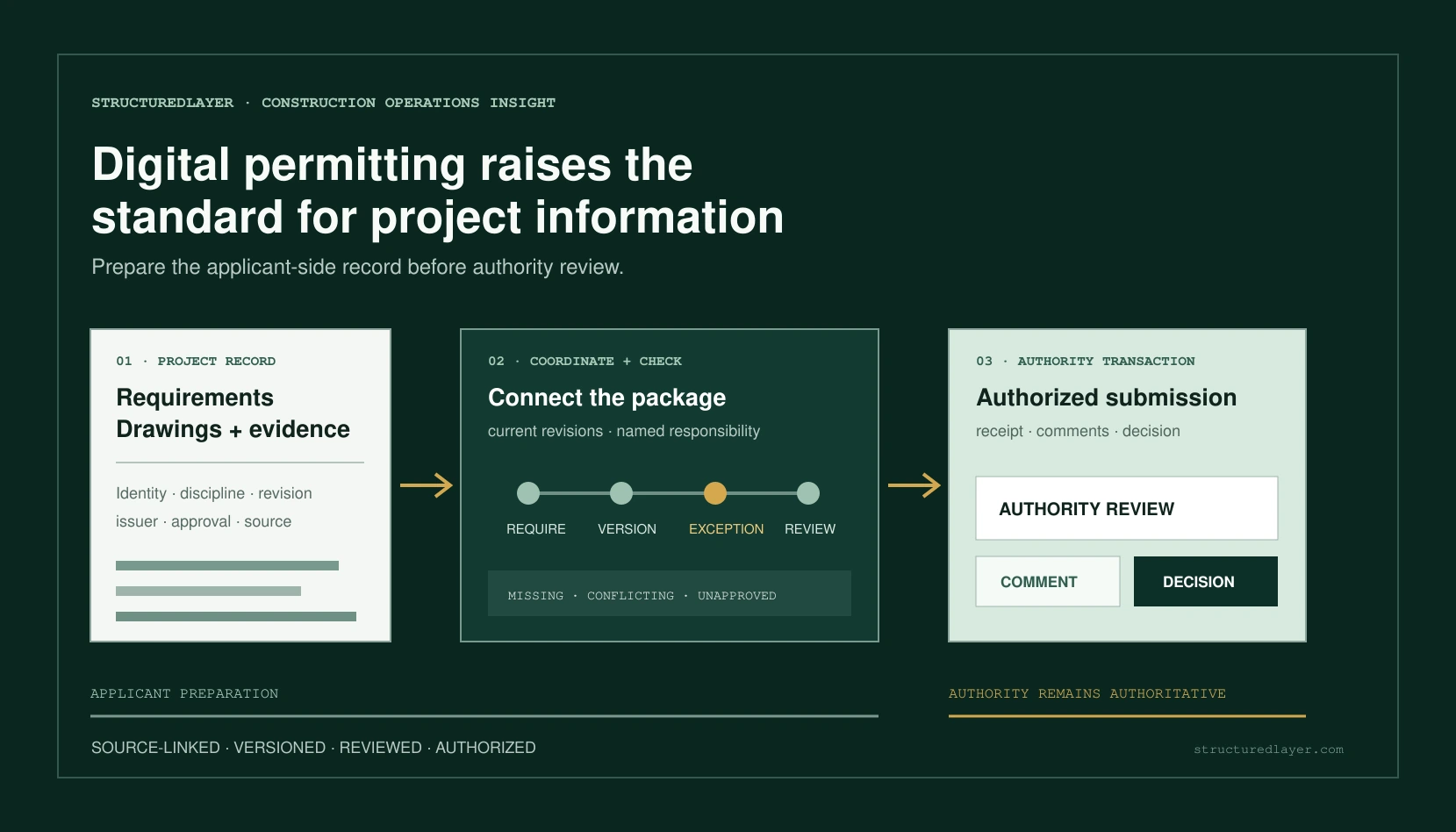
Digital authority systems can review and route information faster. They do not remove the applicant's responsibility to coordinate requirements, drawings, documents, professional approvals, comments, revisions, and evidence before and after submission.
Claim boundary
Dubai's system was announced on 9 August 2026 and remains subject to development, testing, a selected-consultancy pilot, and wider rollout. This article does not present it as already available to every applicant, does not infer performance beyond the announcement, and does not treat Dubai, Saudi, or UK requirements as interchangeable.
The verified signal
Dubai has announced automated review for private and investment villa permits.
The Government of Dubai Media Office reported that Dubai Municipality is developing an AI agent intended to analyze submitted drawings and supporting documents for private and investment villa applications from engineering consultancies.
The announced checks cover plot-planning requirements, architectural comparison with the Dubai Building Code, structural safety and stability, mechanical, electrical and plumbing systems, cross-document consistency, and building-card information. The stated objective is to issue compliant permits in minutes rather than days while limiting manual review to exceptional cases.
The announcement describes three phases across 26 weeks: development and testing across engineering disciplines, a live pilot with selected engineering consultancies, and wider rollout with integration into the Build in Dubai platform. It does not publish accuracy, security, detailed exception, appeal, or accountability measures.
What changes for applicants
Machine review makes information defects visible earlier.
A faster authority check does not make the submission package coherent. It increases the importance of being able to answer basic operational questions before issue:
- Are all required drawings and documents present?
- Does every file carry the current approved revision?
- Do project, plot, applicant, and consultant identities agree?
- Do schedules and supporting documents correspond to the drawings?
- Are discipline discrepancies visible and assigned?
- Can each declaration and approval be traced to its responsible person?
- What exactly was included in each submitted package?
- How was every authority comment answered and closed?
A wider service pattern
Government workflows are also becoming more connected.
Dubai Municipality separately announced the restructuring of 20 services on 20 August 2026. Its building-related examples include moving drainage-location requests, historic-area maintenance and interior-design approvals, advertising structures, and some completion-certificate requests into related licensing or modification services.
That is a separate initiative from the AI permit announcement. Together, however, the two official announcements point in the same operational direction: the authority increasingly treats building-related transactions as parts of a connected service journey.
Your regulator sees one project. Your internal data should too.
International context, not equivalence
UK Gateway 2 data reinforces the value of complete, defensible applications.
The UK Building Safety Regulator reported that, for new higher-risk buildings and conversions in the rolling 12 weeks to 1 August 2026, the approval rate was 91% and median approval time was 22 weeks. The comparison published by the regulator was 39% and 43 weeks in August 2025.
Those figures apply to that specific Gateway 2 category, exclude invalidated and withdrawn applications from the approval rate, and do not establish causation. They should not be generalized to all applications or jurisdictions.
The practical lesson is narrower: when authority processing improves, applicants still need requirement coverage, current evidence, named responsibility, visible exceptions, and a defensible response history.
The operating model
Prepare the project record around the authority transaction.
- 01
Requirements
Applicable authority source, requirement, discipline, evidence, owner, due date, and acceptance.
- 02
Drawings and documents
Stable identity, discipline, revision, status, issuer, approval, fingerprint, and superseded relationship.
- 03
Coordination
Compared records, discrepancy, consequence, responsible reviewer, correction, and accepted resolution.
- 04
Submission
Frozen package version, included files, approvals, authorized submitter, receipt, and portal reference.
- 05
Comments
Original authority wording, affected records, owner, response, revised evidence, review, and closure.
- 06
Outcome
Decision, conditions, accepted package, permit or approval record, responsibilities, and complete history.
What this does not mean
- AI permit review means zero human or professional accountability.
- An applicant-side workflow can issue, certify, approve, or guarantee a permit.
- A clean document register proves architectural, structural, MEP, fire, planning, or legal compliance.
- Requirements and records from Dubai, Saudi Arabia, or the UK can be reused without jurisdiction-specific review.
- A faster reported median guarantees a faster decision for an individual application.