Episode overview
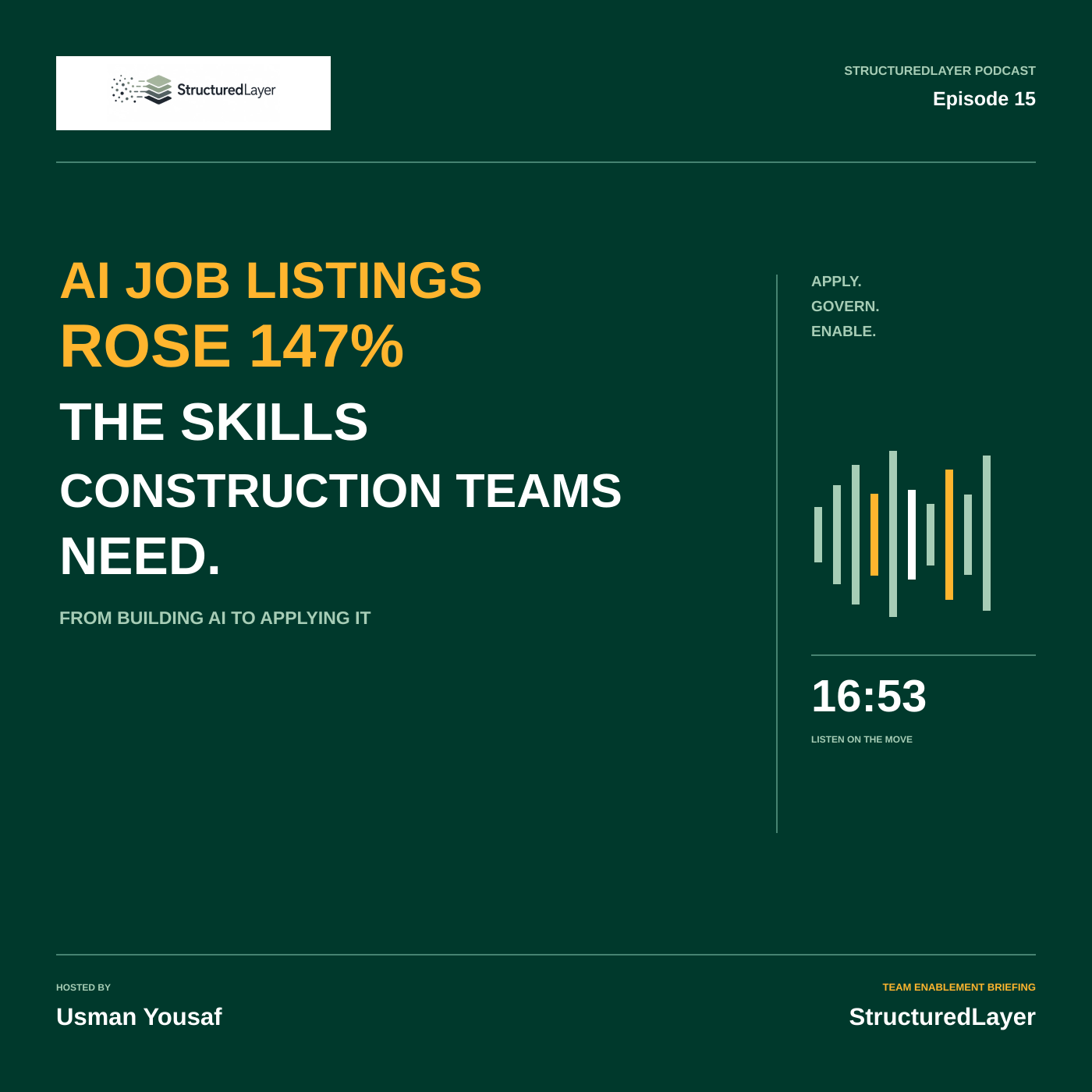
Autodesk's 2026 AI Jobs Report found that AI-related job listings across Design and Make industries grew 147% over two years and 33% during the most recent year. The figures cover architecture, engineering, construction, product design, manufacturing, media, and entertainment. They describe growth in AI-related listings within those industries, not a 147% increase in all construction employment.
In Episode 15 of the StructuredLayer Podcast, Usman Yousaf examines what this demand means for construction and property teams. The practical shift is from concentrating only on people who can build models toward developing people who can apply AI inside real work: redesigning workflows, connecting records, defining controls, training colleagues, managing change, and retaining accountable human oversight.
From building AI to applying AI
Technical AI capability remains important. AI engineering, model development, software integration, security, and infrastructure still determine what can be built and operated. But most construction organizations do not create value merely by possessing a model or buying another tool.
Value appears when a team can connect AI to an accepted business outcome:
- An RFQ is captured, classified, assigned, reviewed, and accepted into the bid process.
- Project documents can be retrieved with the correct identity, revision, permission, and citation.
- A weekly report is prepared from governed project records and approved by the responsible manager.
- Missing compliance information becomes a visible exception with an owner and deadline.
- Candidate classifications, summaries, or recommendations remain separate from commercial, contractual, professional, safety, and financial authority.
This is the difference between access to AI and operational capability.
Five capabilities construction teams need
1. Workflow design
Define the trigger, current steps, required records, owner, completion condition, exception path, and accepted outcome before selecting the AI tool. A prompt is not a workflow, and a generated answer is not an accepted business record.
2. Operations and governance
Control identities, permissions, approved sources, data retention, model and tool access, review points, prohibited actions, audit evidence, monitoring, recovery, and change. Technical access does not grant business authority.
3. Training and enablement
Give people task-specific practice with the tools and records they actually use. Training should cover source selection, prompting, verification, correction, escalation, privacy, security, and the point where a person must take over.
4. Change and communication
Explain which work is changing, what remains under human control, how quality will be measured, who owns exceptions, and what support is available. Adoption depends on clear roles and usable operating procedures, not launch announcements alone.
5. Human oversight
Name the person authorized to review and accept each consequential outcome. Human review requires the relevant evidence, sufficient time, a clear decision, and the ability to reject, correct, stop, or reverse the process.
What AI-ready teams do differently
AI-ready teams invest in operating capability as well as software. They:
- Start with one material workflow and one measurable accepted outcome.
- Identify authoritative records, permissions, owners, and failure conditions.
- Separate deterministic rules from tasks that require model interpretation.
- Test normal, incomplete, conflicting, stale, and unsafe cases.
- Measure corrections, review effort, exceptions, reliability, and complete cost per accepted outcome.
- Document the workflow, train its owners, and retain the ability to replace the provider or model.
The objective is not unrestricted autonomy. It is a dependable operating capability that helps people complete real work with better context, clearer controls, and visible accountability.
What to listen for
- What Autodesk's 147% figure measures and what it does not
- Why AI demand is expanding beyond model-building roles
- Which workflow, governance, enablement, change, and oversight skills teams need
- Why connected records and clear source authority come before dependable AI use
- How to start with one workflow instead of a company-wide technology rollout
- Why training should include verification, exceptions, escalation, and ownership
- How to measure business outcomes rather than tool activity
Source
Related StructuredLayer guidance
- AI Workflow Training
- Team and Tool Readiness for AI
- AI Use-Case Readiness
- AI Evaluation Readiness
- Start With One Workflow
About the series
The StructuredLayer Podcast covers connected operating data, governed workflows, responsible automation, controlled AI, implementation boundaries, and practical team ownership for construction and property organizations.