Episode overview
Generative AI can produce a convincing city, building, site, or simulation-like scene. Visual realism does not establish coordinate accuracy, model authority, geometric validity, code compliance, engineering correctness, planning approval, constructability, safety, cost, programme, or operational truth.
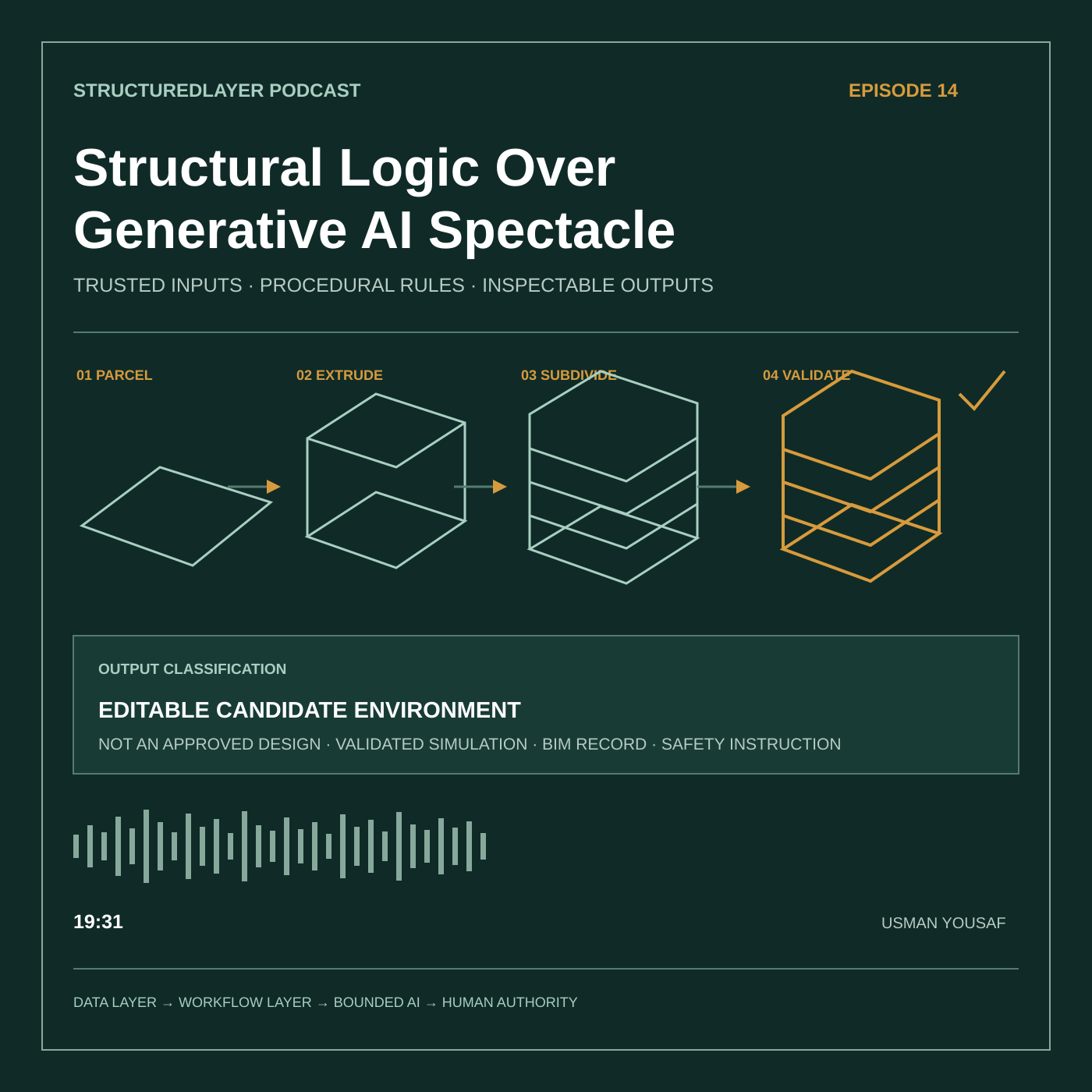
In Episode 14 of the StructuredLayer Podcast, Usman Yousaf explains why structural logic should come before generative spectacle in architecture, engineering, construction, and property workflows. The useful pattern begins with identified project records, approved or clearly classified model versions, the correct project coordinate reference system, stable element relationships, procedural operations, validation, and professional authority. AI can help select or prepare bounded operations; it should not silently invent the conditions that make an output trustworthy.
This episode follows Episode 13's broader discussion of Unreal Engine and controlled AI by concentrating on the internal logic required to make an editable environment inspectable and repeatable.
The operating sequence
1. Identify trusted inputs
Start with the purpose and the exact source package: project, parcel, building, level, zone, document, model, element, revision, owner, status, permission, intended use, units, origin, orientation, elevation basis, and coordinate reference system.
No coordinate system should be treated as universal. A project may use a local grid, national grid, survey control, geographic or projected CRS, or a federated BIM origin. The selected basis must match the project purpose and exchange requirements.
IFC, RVT, NWD, CAD, GIS, point clouds, meshes, drawings, schedules, and registers are also not interchangeable. Each format, export, federation, and revision carries different geometry, semantics, relationships, authority, and loss.
2. Define procedural operations
Prefer a narrow, inspectable operation set over unconstrained world generation. Candidate operations may include create parcel, import identified footprint, extrude mass, subdivide levels, apply a setback, place an approved asset, attach metadata, compare versions, validate coordinates, run scene checks, and export a review package.
Each operation should declare required inputs, parameter types, units, limits, prohibited actions, expected output, validation, failure behavior, and evidence. Project-specific values must come from approved requirements or be clearly labelled assumptions. Illustrative heights, setbacks, stepbacks, or floor-to-floor dimensions are not default design rules.
3. Preserve structure and traceability
Every generated or transformed object should retain stable identity, parent-child and spatial relationships, source references, parameters, tool and script version, run ID, status, reviewer, correction, and accepted purpose. The authoritative source files remain unchanged.
An editable candidate environment is more useful than a flattened visual because a reviewer can inspect objects, test assumptions, change parameters, compare versions, and regenerate a controlled result. Editability alone, however, does not prove correctness.
4. Keep output classes separate
- Plausible concept: A visual or spatial option for early discussion under stated assumptions.
- Editable 3D environment: Structured objects, metadata, parameters, scripts, interactions, and versions that can be inspected and changed.
- Connected interface: A view linked to identified project or operational records under controlled permissions, latency, data quality, and failure handling.
- Validated simulation: A purpose-specific analytical model with documented equations or physical logic, assumptions, boundary conditions, calibration, verification, validation, uncertainty, and qualified interpretation.
- Approved BIM or project record: Controlled geometry and information developed and accepted under adopted project standards, responsibilities, exchanges, reviews, revisions, and professional authority.
A realistic or interactive environment does not move automatically from one class to another.
5. Retain human authority
Architects, engineers, VDC specialists, planners, surveyors, information managers, safety roles, project owners, facility teams, and other accountable professionals review the parts within their authority. They inspect sources, coordinates, geometry, rules, assumptions, exceptions, and intended use before downstream release.
An AI-generated or procedurally assembled scene remains an editable candidate environment until the defined checks and authorized review are complete. It is not automatically an approved design, validated simulation, coordinated BIM deliverable, logistics plan, digital twin, planning submission, or safety instruction.
Candidate first workflows
A narrow pilot may examine one low-consequence visual problem such as:
- Early massing or layout alternatives under explicit assumptions
- Construction logistics or phasing communication for review
- Project-record or asset-interface prototypes using identified data
- Stakeholder walkthroughs of a reviewed concept or project state
- Purpose-specific access, hazard, or procedure rehearsal that remains separate from approved safety planning
These uses require different source packages, tolerances, reviewers, and acceptance criteria. None establishes universal feasibility, compliance, accuracy, savings, programme improvement, or safety performance.
A controlled pilot
- Choose one narrow visual outcome with a named business owner and qualified reviewer.
- Freeze the approved or clearly classified source package, IDs, coordinate basis, units, permissions, and intended output class.
- Define the procedural tool set, parameter schema, checks, limits, and prohibited actions.
- Test normal, incomplete, conflicting, stale, misaligned, wrongly scaled, and invalid cases.
- Compare geometry, metadata, relationships, versions, scene structure, interactions, and exports with authoritative records and withheld checks.
- Measure accepted quality, correction effort, exceptions, reproducibility, latency, complete cost, and reviewer confidence.
- Document operation, maintenance, ownership, handover, model or tool replacement, expiry, withdrawal, and stop conditions.
A successful pilot demonstrates one useful visualization or interaction under explicit acceptance criteria. It does not prove an autonomous design, engineering, construction-management, planning, safety, or digital-twin capability.
What to listen for
- Why visual realism is not evidence of technical or professional validity
- Why the project coordinate basis must be identified rather than assumed
- Why IFC, RVT, NWD, GIS, drawings, and other sources are not interchangeable
- How narrow procedural operations make generation more predictable and inspectable
- Why stable object identity, metadata, parameters, versions, and run evidence matter
- How plausible concepts, editable environments, connected interfaces, validated simulations, and approved project records differ
- Why AI can prepare candidate operations while deterministic tools and qualified reviewers retain control
- How to select a narrow pilot that can be measured without overstating authority
Related StructuredLayer guidance
- Building Skyscrapers with Unreal Engine and Controlled AI
- Approved BIM to an Editable Unreal Engine Construction Environment
- AI Coding Agents for Interactive 3D Prototypes
- 3D Generation, Depth, and Reconstruction for Construction
- Specialist AI Agent Capabilities
- Operating-Layer Blueprint
About the series
The StructuredLayer Podcast is an audio series about connected operating data, governed workflows, responsible automation, controlled AI, implementation boundaries, and practical team ownership for construction and property organizations.