Episode overview
Construction and property businesses already operate across project-management systems, ERP and finance software, field tools, document platforms, bid portals, inboxes, drawings, specifications, PDFs, spreadsheets, and databases. The problem is rarely that none of these tools work. The problem is that useful information remains fragmented across them, requiring people to repeatedly search, copy, reconcile, re-key, chase, and explain.
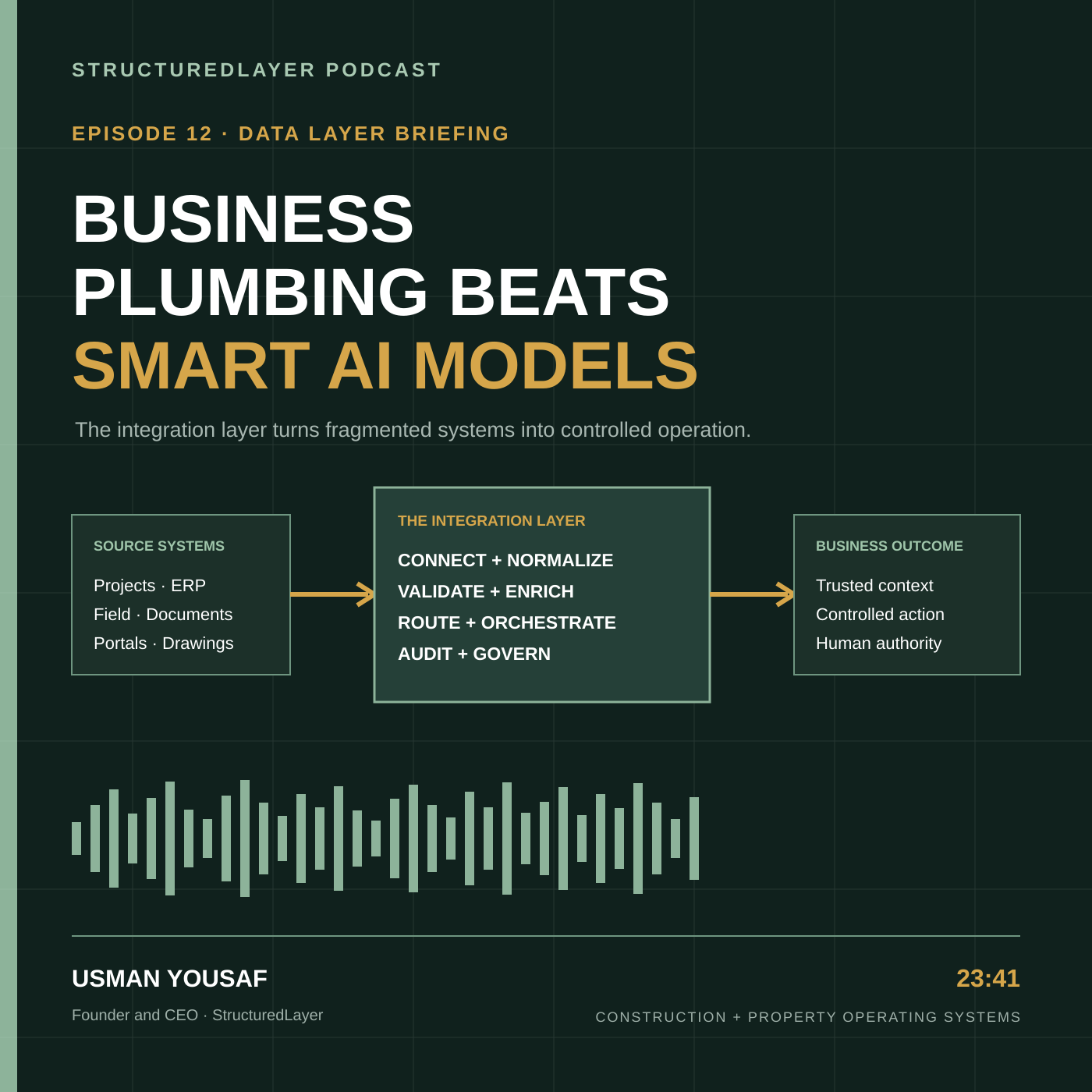
In this StructuredLayer Podcast episode, Usman Yousaf argues that the practical AI opportunity sits in the integration layer: the governed operating capability that connects existing systems and evidence, normalizes identities and fields, validates and enriches candidate records, routes work through visible states, applies permissions and approvals, and records what happened. A capable model can still produce poor work when its context is incomplete, stale, conflicting, unauthorized, or detached from the workflow where a result must be accepted.
The source systems
The episode considers information distributed across:
- Project-management and project-control platforms
- ERP, accounting, finance, procurement, and commercial systems
- Field operations, diaries, inspections, progress, photographs, and mobile capture
- Document-management platforms and controlled project repositories
- Bid portals, tender inboxes, email, and attached opportunity documents
- Drawings, specifications, schedules, contracts, reports, and PDFs
- Spreadsheets, databases, registers, exports, and specialist applications
These systems do not need to be replaced or copied into one uncontrolled repository. Useful systems can remain authoritative for the records they govern while an operating layer preserves stable business identities, source-native IDs, relationships, versions, permissions, and workflow state across them.
What the integration layer does
A practical integration layer performs six connected jobs:
- Connect and normalize: Use approved APIs, databases, webhooks, exports, inboxes, folders, or bounded browser routes. Preserve native IDs and map records into a controlled company structure.
- Validate and enrich: Check required fields, formats, relationships, duplicates, versions, totals, permissions, and source authority. AI may prepare classifications or candidate fields where interpretation is required.
- Secure and comply: Apply authenticated identity, least privilege, purpose limits, retention, credential controls, data boundaries, and applicable contractual or regulatory requirements.
- Route and orchestrate: Move durable work items through assignments, queues, exceptions, deadlines, retries, approvals, accepted states, and recovery instead of relying on informal handoffs.
- Audit and monitor: Record sources, runs, transformations, tool calls, validation, failures, corrections, reviews, accepted outcomes, cost, and operating health.
- Govern: Keep permissions, approval gates, prohibited actions, business authority, correction, withdrawal, ownership, and handover explicit.
Why this improves AI work
The integration layer gives AI selected current evidence for a defined purpose rather than asking a model to infer the business from an arbitrary folder or conversation. It can reduce repeated reconstruction, expose missing context, distinguish source evidence from accepted records, and connect generated work to the people and systems that must review or act on it.
The durable advantage is not the model output alone. It is the company-controlled record of customers, projects, opportunities, documents, work items, sources, runs, reviews, decisions, and accepted outputs, plus the business rules, permissions, evaluations, and correction history around them. Models and providers can change while this operating context remains usable and transferable.
Start with one workflow
The recommended implementation route is deliberately narrow:
- Choose one recurring workflow with material reconstruction, delay, duplication, or exception handling
- Name the business outcome, accountable owner, reviewer, and authority boundary
- Identify the systems, documents, records, and source-native IDs involved
- Decide which source governs each field and how conflicts are resolved
- Define triggers, states, required fields, validation, exceptions, approvals, accepted output, and recovery
- Test representative normal, incomplete, conflicting, duplicate, stale, unauthorized, and failure cases
- Measure reviewer acceptance, corrections, processing time, exceptions, cost, and accepted outcomes
- Roll out in stages with monitoring, documentation, client ownership, and operational handover
A fixed-scope workflow assessment should establish the work, evidence, controls, ownership, implementation options, and acceptance test before selecting a model, connector, agent framework, or automation platform.
Human-control boundary
An integration route establishes technical possibility, not authority, security, compatibility, correctness, or accepted business state. AI may classify, extract, match, summarize, prepare options, draft communication, and route exceptions. It does not independently approve project records, merge uncertain identities, accept contractual scope, issue consequential communication, commit money, change permissions, or make professional, safety, legal, commercial, accounting, or executive decisions.
What to listen for
- Why model capability is not the same as production workflow capability
- How fragmented systems and missing context create weak AI outputs
- What connect, normalize, validate, enrich, secure, route, audit, monitor, and govern mean in practice
- Why source-native IDs and stable business identities matter across existing software
- How permissions, approval gates, exceptions, accepted states, and recovery make automation controllable
- Why one high-value workflow is a better starting point than a broad AI transformation programme
- How client-owned operating context creates continuity when models, providers, and tools change
Related StructuredLayer guidance
- Systems and Integrations
- Connected Records
- Why Multiple Construction AI Agents Need Workflow Orchestration
- AI Vendor Independence for Construction Operating Systems
- Operating-Layer Blueprint
About the series
The StructuredLayer Podcast is an audio series about connected operating data, governed workflows, responsible automation, controlled AI, implementation boundaries, and practical team ownership for construction and property organizations.