Episode overview
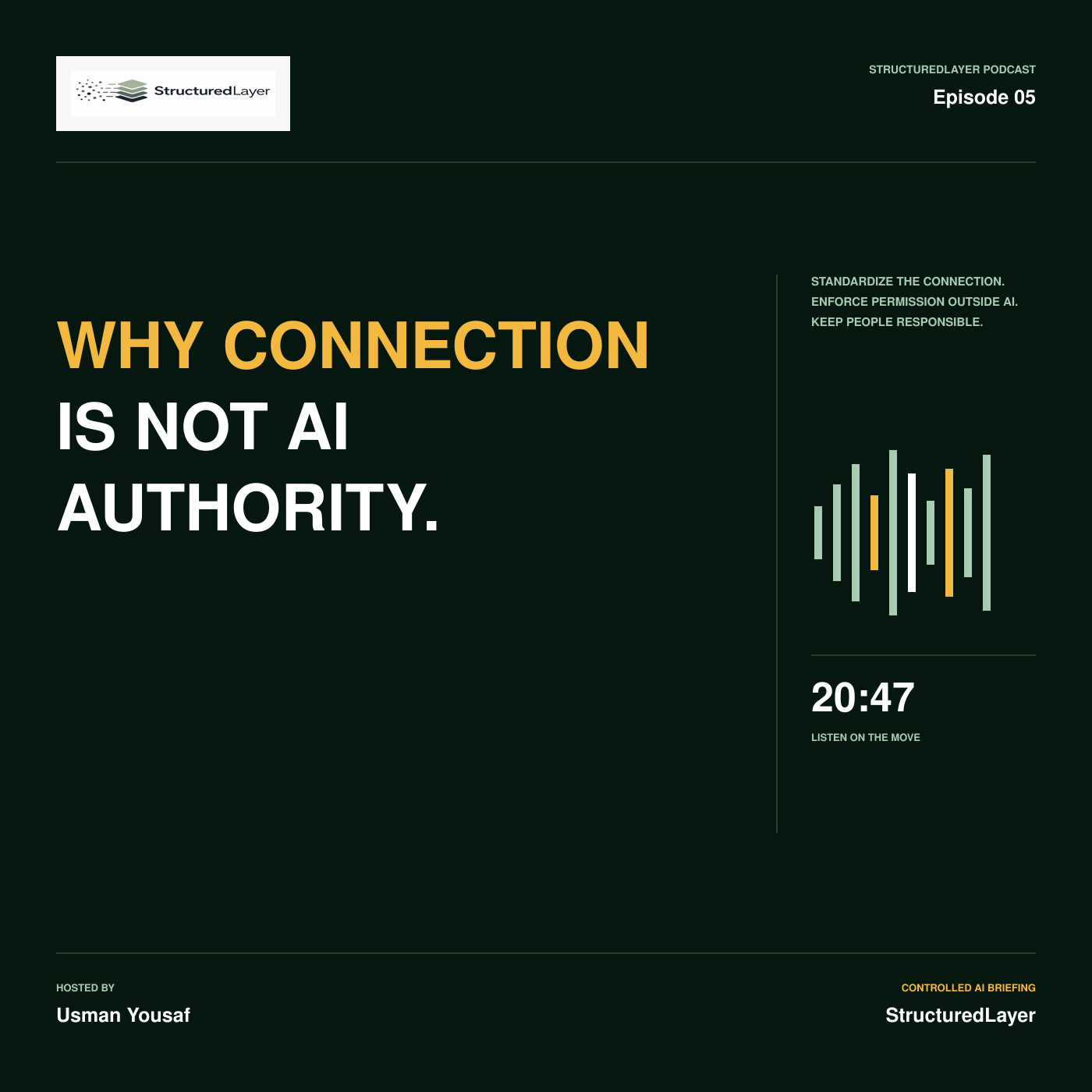
The Model Context Protocol (MCP) can standardize how AI systems connect to business tools, records, and data. That connection can make useful context available to an AI agent, but it does not make the model authoritative and does not provide the complete governance, permission, validation, or approval system required for secure business operations.
This episode applies that distinction to construction and property organizations. It explains why safe agentic workflows need a structured operating layer with stable data identifiers, explicit workflow rules, and a permission matrix enforced outside the AI model. The objective is to gain the benefits of connected AI while keeping high-consequence authority with accountable people.
Questions discussed
How does MCP bridge the gap between AI and data?
MCP provides a standardized way for AI applications to discover and use tools, resources, and business context. It can reduce bespoke integration work and make it easier to connect an agent with different systems. However, a standardized connection does not determine which record is authoritative, whether information is current, what a user is permitted to access, or whether a proposed action should be approved.
What are the risks and security requirements for agentic workflows?
Connected agents can introduce unauthorized actions, excessive access, data leakage, prompt injection, incorrect tool selection, stale or conflicting evidence, and failures that propagate into downstream systems. Security therefore needs to be enforced outside the model through least-privilege credentials, scoped tool access, stable identifiers, permission checks, explicit workflow states, source validation, audit records, visible exceptions, rate and spending limits, and fail-safe recovery paths.
How should businesses design a safe human-in-the-loop approval process?
Human review should be a defined operating control rather than a general instruction to supervise the AI. Each consequential action needs a named owner, the source evidence used, the proposed change, validation results, known exceptions, and a clear approve, reject, or return-for-correction decision. Financial commitments, contractual positions, payment decisions, safety approvals, compliance judgments, and project-critical changes should remain with qualified people.
A structured operating layer
A resilient implementation separates four responsibilities:
- Connection: MCP or another integration method exposes approved tools and context.
- Data authority: Governed records preserve stable identifiers, source ownership, revision state, and evidence.
- Workflow control: Explicit rules define stages, permissions, exceptions, validation, and recovery.
- Human authority: Named people approve high-consequence decisions and remain accountable for their use.
This separation also reduces dependence on a specific AI model or vendor. Models and connectors can change while the organization's records, permissions, workflow rules, evidence, and approval responsibilities remain under business control.
Adoption boundary
A technology demonstration proves that a connection can work. It does not prove that the workflow is safe for production. A controlled pilot should measure source accuracy, permission enforcement, tool behavior, exception handling, review effort, failure severity, recovery, operating cost, and the quality of evidence presented to approvers.
About the series
The StructuredLayer Podcast is an audio series about connected operating data, governed workflows, responsible automation, controlled AI, implementation boundaries, and practical team ownership for construction and property organizations.