AI Technology Brief
GPT-6 Astra for Construction Workflows: What Computer Use Changes
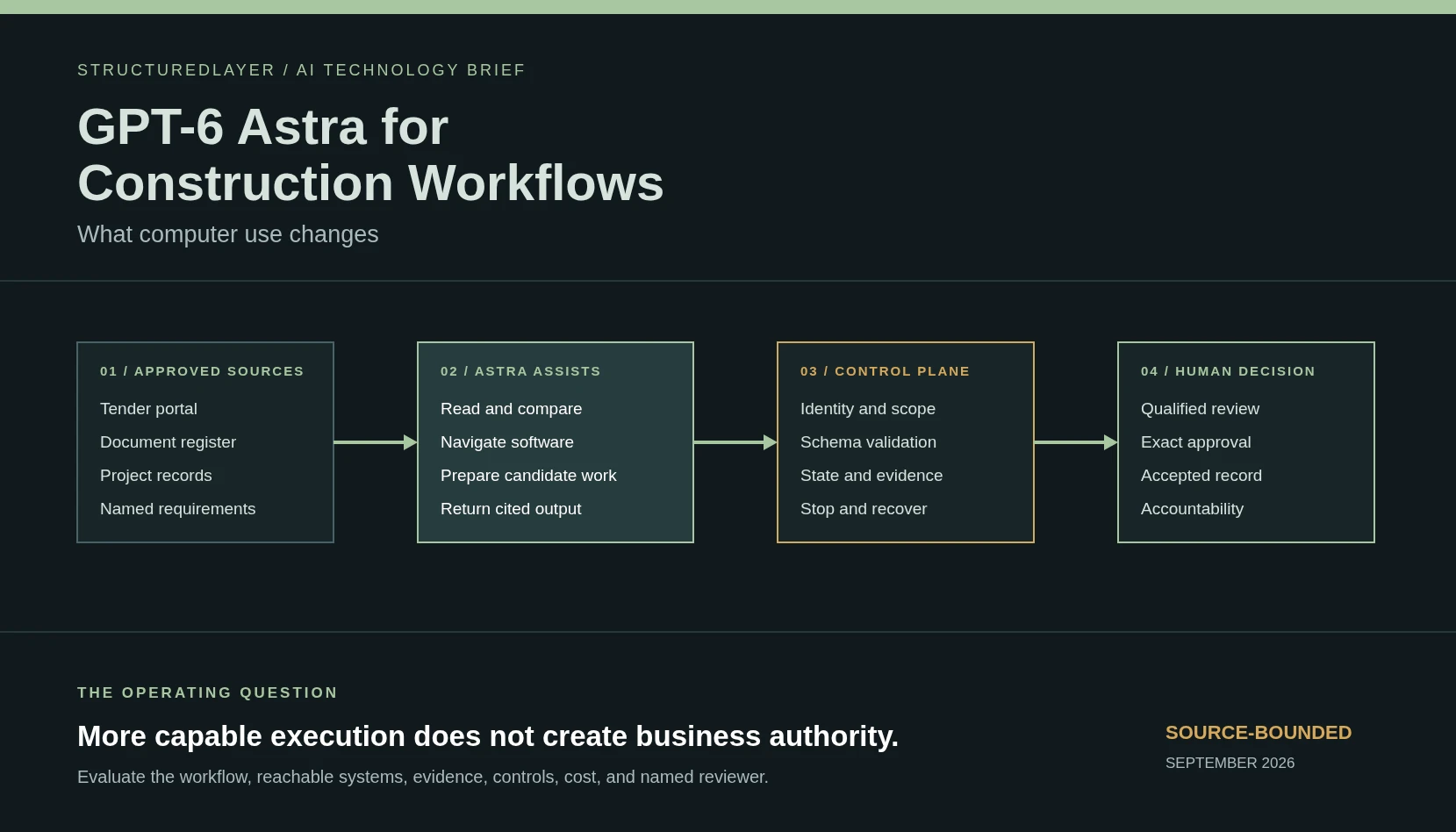
OpenAI's GPT-6 Astra may reduce execution friction across browsers, documents, spreadsheets, software, and code. Construction buyers still need approved sources, separate identities, deterministic validation, exact human approval, complete cost evidence, and independent recovery.
01 / Independently verifiable claims
Begin with what the technology and standards actually support.
- OpenAI announced GPT-6 Astra on 3 September 2026 and describes it as a model for complex reasoning, coding, research, document work, science, cybersecurity, and computer use. These are OpenAI's product claims.
- OpenAI's model documentation identifies the API model as gpt-6-astra, with text and image input, text output, a 1,050,000-token context window, and a 128,000-token maximum output. Documentation can change and does not prove performance on a buyer's data.
- The model documentation lists Responses API tools including web search, file search, code interpreter, hosted shell, computer use, MCP, and tool search. Availability, endpoint support, account access, and regional terms must be checked at the time of deployment.
- The OpenAI computer-use guide describes an action loop in which an application executes model-returned computer actions, captures the resulting screen, and sends that output back. The application, not the model, owns the execution environment and side effects.
- OpenAI reports benchmark results including 72.6% on OSWorld 2.0, 92.7% on ScreenSpot-Pro, 41.4% on AutomationBench, and 57.9% on Terminal-Bench 4.0. These are provider-reported evaluations, not independent construction workflow acceptance tests.
- OpenAI reports that GPT-6 Astra reached the Critical level for cybersecurity capability and that it improved overall safety results in several evaluations while remaining harder to monitor in some adversarial settings. Capability classification is not a deployment authorization.
- OpenAI documents separate computer-use, cyber, alignment, monitorability, and deployment-safety concerns. A capable model's refusal behavior and reasoning monitorability are not substitutes for external identity, network, tool, approval, and recovery controls.
- The API documentation lists standard pricing of $10 per million input tokens and $50 per million output tokens, plus cache, long-context, Batch, Flex, and Fast-mode conditions. A buyer's complete cost is higher when tools, integration, retries, review, monitoring, and recovery are included.
- Codex persistence, searchable prior context, workspace files, and model context capacity are different mechanisms. A large context window does not guarantee durable business memory, current records, correct retrieval, or preservation of every prior decision.
- Zero Data Retention is an eligibility and deployment condition for supported API customers, not a universal property of every OpenAI product, connected tool, browser session, third-party system, or construction workflow.
02 / The practical distinction
Computer use changes execution friction, not the ownership of the business decision.
Astra can make it easier for an agent to move across software, documents, browsers, spreadsheets, and code. That makes the operating boundary more important because the agent can reach more places and produce more consequential effects.
Assistant
Answer and draft
Explain a requirement, summarize a source, prepare a report, or propose a structured output for someone to review.
Computer use
Operate a screen
Click, type, scroll, navigate, inspect visible state, and continue a tool loop through an application-controlled computer environment.
Workflow
Follow a bounded path
Use approved records, typed tools, state checks, deterministic rules, exception queues, and known transitions to prepare a candidate outcome.
Authority
Accept a business effect
Decide whether a record, submission, price, report, message, payment, contract position, or professional conclusion may become accepted state.
Agent
Choose permitted steps
Select among allowed tools and actions toward an objective, while external controls restrict the reachable world and the accountable person retains consequential authority.
03 / Operating architecture
Put a controlled operating layer between Astra's proposed action and the construction system.
The model can interpret evidence and suggest or execute a permitted next step. Identity, authority, validation, state, and recovery must be enforced by systems that do not depend on the model following instructions perfectly.
1 / Context
Approved source set
Identify project, company, procedural, and operating context. Preserve source, revision, permission, effective date, and withdrawal state.
2 / Identity
User and workload
Record the requesting person separately from the model, agent, browser session, service identity, and execution environment.
3 / Action
Typed tools and scopes
Expose only named read, search, draft, create, update, send, export, or portal actions with target and parameter limits.
4 / Control
Policy and validation
Check resource, project, field, schema, state, duplicate risk, approval, token audience, time, budget, and prohibited outcomes outside the model.
5 / Evidence
Correlated record
Link source evidence, prompt or task, tool call, screenshot or response, policy decision, result, correction, approval, and accepted state.
6 / Recovery
Stop and restore
Keep independent interruption, credential revocation, queue cancellation, rollback or reconciliation, incident review, and clean restart capability.
04 / Required records
Long context is useful only when the workflow can prove what context was allowed and used.
Source record
File or record ID, project, revision, authority, effective date, permission, extraction result, and conflict or withdrawal state.
Task record
Objective, requester, approved purpose, model snapshot, tool set, context references, instructions, limits, start time, and environment.
Computer trajectory
Screenshots or structured outputs, action sequence, target application, URL or record identity, timing, error, retry, and human takeover.
Policy decision
Identity, resource, action, parameters, policy version, approval requirement, decision, reason, expiry, and enforcement result.
Candidate output
Fields, citations, source locations, confidence or uncertainty, validation result, unresolved exception, and required reviewer.
Accepted state
Approver, exact payload, destination, version, timestamp, resulting record ID, reconciliation result, notification, and recovery reference.
05 / Construction example
Use Astra to prepare an RFQ review pack without letting it decide whether the company bids.
A browser and document agent can reduce repetitive movement across an approved tender portal, inbox, document register, and estimating workspace. The commercial boundary remains explicit.
Prepare
Capture the invitation
Read an approved tender portal, identify the opportunity, preserve the portal URL and visible issue date, download permitted documents, and create a candidate opportunity record.
Compare
Structure the package
Classify revisions, extract submission requirements, identify missing or conflicting information, compare known subcontractor quotations, and link each field to its source.
Check
Run deterministic rules
Validate project identity, deadline format, document revision, mandatory fields, duplicate opportunity, attachment hash, quote currency, unit basis, and required approvals.
Escalate
Route the decision
Send an exception queue and review pack to the estimator or commercial lead. Astra must not choose bid, price, margin, qualification, negotiation, or submission authority.
06 / Deterministic controls
More capable computer use needs narrower reachable systems and stronger independent controls.
Default-deny connectivity
Allow only named domains, applications, APIs, file stores, project spaces, and destinations through an external broker. Treat browser visibility as access, not proof of permission.
Separate identity and authority
Bind the human requester, agent workload, organization, project, record, action, and approver. A user login or service token is not blanket business authority.
Draft-first writes
Keep create, update, send, submit, export, award, payment, delete, and permission changes behind exact review and action-time authorization.
Validate state, not just fields
Check controlling revision, project and tenant identity, current workflow state, idempotency, duplicate effects, dependencies, and whether the visible screen represents accepted data.
Protect context and secrets
Minimize documents, redact unnecessary personal or commercial data, keep credentials outside model context, and confirm the data path for every connected provider.
Monitor the whole trajectory
Correlate reads, screenshots, navigation, downloads, tool calls, denied attempts, retries, policy changes, outputs, approvals, and resulting source-system state.
Keep an independent stop
Revoke credentials, close sessions, cut egress, stop workers, cancel queued actions, preserve evidence, and require authorized restart outside the agent.
07 / Failure analysis
The costly failure is not only a wrong answer; it is a plausible action against the wrong state.
The right document is not the controlling document
Astra retrieves a clear specification or drawing that is superseded, unapproved, outside the project, or subject to an unresolved instruction.
The visible screen hides the business state
A portal page looks complete while an upload failed, a draft was not submitted, a warning was missed, or the record belongs to another project.
Routine ambiguity becomes commercial discretion
The agent fills a missing assumption about scope, price, margin, deadline, liability, qualification, or recipient that should have stopped for a person.
A long context creates false confidence
The system carries many documents forward but loses authority, revision, permission, contradiction, or reason for an earlier decision.
A tool chain expands its own reach
Browser, shell, package, MCP, file, or search access combines into actions beyond the stated task even though each step looked individually routine.
A benchmark becomes the objective
The agent optimizes task completion or speed while bypassing the approved source, intended method, environment, or human checkpoint.
08 / Deployment and cost
Choose the deployment boundary before choosing the model setting.
Evaluation
Isolated capability test
Use synthetic or redacted construction records, disposable workloads, no production credentials, deny-by-default egress, immutable telemetry, adversarial cases, and independent termination.
Pilot
Staging preparation
Use representative records, restricted test accounts, typed tools, mock or reversible writes, exact approvals, visible exceptions, and measured correction effort.
Assist
Production read or draft
Allow source-linked retrieval, candidate preparation, browser navigation, and draft outputs while keeping send, submit, update, award, payment, and professional decisions under named authority.
Operate
Narrow accepted action
Only expand to a live write when identity, action scope, state validation, monitoring, recovery, approval, and reconciliation are repeatedly accepted for that exact workflow.
- Standard API token use at the documented input and output rates, including cache, long-context, Batch, Flex, and Fast-mode conditions
- Computer-use screenshots, tool calls, browser or hosted execution, file preparation, storage, network, and third-party system usage
- Integration and operating-layer work for source identity, document preparation, schema validation, permissions, policy, approvals, logging, and reconciliation
- Retries, long trajectories, failed runs, exception queues, human correction, duplicate prevention, monitoring, incident response, and recovery exercises
- Model changes, provider terms, regional availability, data-retention conditions, security review, procurement, support, and a tested replacement or exit path
09 / Evaluation
Evaluate accepted construction outcomes, not only whether Astra completes a screen task.
- Use representative RFQs, tender portals, document registers, drawings, specifications, quotes, schedules, emails, and project records with known expected answers and states.
- Test source authority, revision selection, permissions, project and tenant identity, missing information, contradictions, withdrawal, and stale context.
- Test browser navigation, downloads, uploads, pagination, warnings, session expiry, failed actions, duplicate submission, incorrect project selection, and human takeover.
- Test prompt injection in documents and web pages, unapproved links, cross-tenant access, credential exposure, package or shell expansion, and denied egress.
- Measure field accuracy, citation accuracy, action success, critical failures, correction time, reviewer effort, exception rate, latency, tokens, tool usage, and complete cost per accepted outcome.
- Verify that every consequential action has a current policy decision, exact approval where required, durable evidence, resulting record identity, and recoverable failure state.
- Repeat after model, prompt, tool, portal, source schema, permission, browser, provider, or policy changes and retain the regression cases.
10 / Controlled pilot
Prove the operating boundary before expanding it.
Select one bounded outcome
Choose a preparation task such as candidate RFQ intake, document-register comparison, source-linked report drafting, or quote-field extraction. Define what accepted means.
Map the reachable world
List systems, records, identities, browsers, credentials, APIs, files, dependencies, destinations, data classes, and actions the workflow could reach.
Build the control boundary
Implement approved-source selection, typed tools, least privilege, state validation, policy enforcement, draft-first output, monitoring, and independent stop controls.
Run normal and adversarial cases
Include clean inputs, ambiguity, contradiction, injection, stale revisions, failed uploads, timeouts, duplicate effects, wrong-project attempts, and reviewer takeover.
Review the evidence
Have a qualified estimator, document controller, project lead, or operations owner inspect source links, exceptions, proposed actions, costs, and the final record.
Narrow, expand, or stop
Expand one system, action, record class, or user group at a time. Treat a safe read-only result or a decision not to automate as a valid pilot outcome.
Buyer classification test
Classify what the system controls before accepting the label.
- 01
Does the system only explain or draft, or can it operate a browser, shell, file system, API, or project platform?
- 02
Can it create, update, send, submit, export, approve, award, pay, delete, share, or alter permissions?
- 03
Is the source controlling, current, permissioned, and linked to the exact project, record, revision, and decision?
- 04
Can an external policy layer deny the action even when the model requests it and the user is authenticated?
- 05
Can a named qualified person see the evidence, payload, destination, consequence, and expiry before approval?
- 06
Can the business stop, investigate, reconcile, and recover without asking the agent to cooperate?
Direct buyer answers
Common questions about AI agent labels.
What is the biggest practical change from GPT-6 Astra for construction teams?
The practical change is lower execution friction across browsers, documents, spreadsheets, software, and code. A capable agent may prepare more of the path between an approved source and a candidate business record. That increases the need to define the source, state, tool, identity, approval, and recovery boundary.
Does a 1.05 million-token context window create a construction system of record?
No. It creates more capacity to supply context or retrieve information in a model request. A system of record still needs authoritative IDs, revisions, permissions, workflow state, conflicts, ownership, correction, expiry, audit, and accepted business decisions.
Should a construction company give Astra direct access to a tender portal or ERP?
Begin with a separated evaluation environment or read-only, draft-first path. Direct access should be considered only after portal-specific testing proves identity, scope, state validation, injection resistance, monitoring, human takeover, and recovery for the exact actions.
How should benchmark claims affect a buyer decision?
Use them to identify capabilities worth testing, not as a purchase conclusion. Preserve OpenAI's test conditions and run the buyer's own representative cases with critical-failure rules, reviewer effort, complete cost, and explicit authority boundaries.
11 / StructuredLayer recommendation
Treat GPT-6 Astra as a powerful execution component inside a controlled workflow, not as the workflow owner or business authority.
Its computer use, long context, coding, and document capabilities may make previously expensive preparation steps practical. Start with one construction decision, approved source set, separate identities, narrow tools, deterministic validation, visible exceptions, exact human approval, complete evidence, and independent recovery. Let the evaluation determine whether Astra belongs in that boundary, and keep the records and authority portable if the model, provider, pricing, or terms change.
12 / Primary sources
Capability, governance, and implementation claims remain inspectable.
OpenAI
GPT-6 Astra: A new generation of intelligence
OpenAI Developers
GPT-6 Astra model documentation
OpenAI Developers
Responses API computer-use guide
OpenAI Developers
Create a model response: computer calls and tools
OpenAI
GPT-6 Astra safety overview
OpenAI Deployment Safety Hub
GPT-6 Astra system card
OpenAI Deployment Safety Hub
GPT-6 Astra alignment evaluations
OpenAI Deployment Safety Hub
GPT-6 Astra monitorability
OpenAI Deployment Safety Hub
GPT-6 Astra monitor evasion
OpenAI
The path to Astra: critical capabilities and frontier safeguards
OpenAI
Codex-maxxing for long-running work
Model Context Protocol
Authorization specification 2025-11-25
NIST
Zero Trust Architecture, NIST SP 800-207
OWASP
AI Agent Security Cheat Sheet
OpenAI
Offering Zero Data Retention for frontier models
Sources reviewed 4 September 2026. Technology capabilities, laws, guidance, terms, and pricing can change.
13 / Related StructuredLayer guidance
Continue from model selection into operating architecture.
AI Agent Authorization
Separate authentication, tool access, authorization, resource scope, exact approval, and business authority.
Browser-Agent Evaluation Environments
Test browser agents against controlled tasks before giving them access to construction portals.
AI Agent Containment
Design external identity, egress, monitoring, interruption, evidence, and recovery for high-authority agents.
AI Across Construction Software
Connect project systems, APIs, webhooks, MCP tools, browser paths, records, controls, and human authority.
Permissions and Security for AI
Assess identities, retrieval filters, credentials, tool actions, approval, audit, and handover for one workflow.
Bounded AI Agent Pilot
Test one useful AI task with limited context, tools, cost, evaluation evidence, and explicit human authority.