
AI Technology Brief
Build construction situation awareness without turning the site into a surveillance system
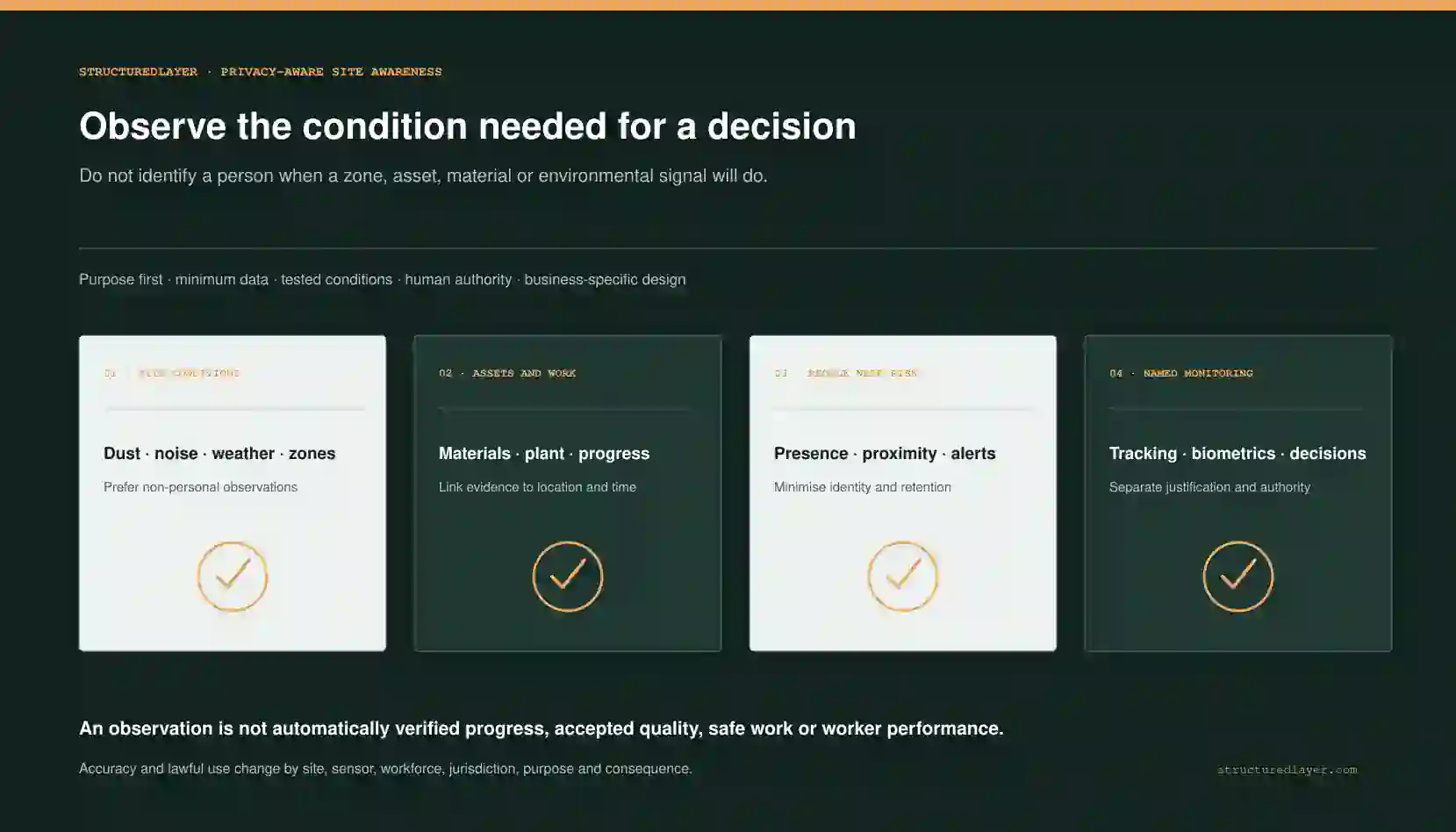
Construction sensors, cameras, tags, and AI can support useful awareness, but accuracy and lawful use change by site, sensor, workforce, jurisdiction, purpose, and consequence. Start with non-personal observations and justify every step toward named monitoring.
01 / Independently verifiable claims
Begin with what the technology and standards actually support.
- Construction situation-awareness systems have been researched and field-tested for environmental conditions, material movement, equipment, worker location, proximity, progress, and visual safety signals.
- Published field results are not transferable accuracy guarantees. Construction geometry, reinforced concrete, metal, occlusion, weather, lighting, dust, device placement, network coverage, calibration, site phase, and worker density change performance.
- One construction localization study reported mean horizontal errors of 3.69 m for UWB, 3.02 m for Wi-Fi FTM, and 2.40 m for fusion at its test site; another 17-day study reported a maximum UWB error of 1.44 m. These are study conditions, not procurement promises.
- UK ICO and EU EDPB guidance require a specific purpose, lawful basis, necessity, proportionality, transparency, minimisation, retention, security, and rights handling for qualifying personal-data monitoring. High-risk processing may require a DPIA before deployment.
- Worker location, photographs, video, audio, device records, and identifiers can be personal data. Biometric recognition used to identify a person can involve special-category data and materially stronger requirements.
- ILO guidance says workers should be informed in advance about electronic monitoring and representatives should be consulted; it cautions against using monitoring data as the sole basis for performance evaluation.
- Worker-acceptance studies report that privacy, security, job consequences, and perceived productivity surveillance affect whether workers will carry or cooperate with sensing technology.
- IFC and buildingSMART structures can connect sensor identities, objects, locations, properties, and time-series references, but they do not by themselves supply telemetry transport, device management, data quality, legal basis, or operational acceptance.
- An observed person, object, environmental reading, image, trajectory, or model inference is not automatically verified progress, quality acceptance, safety status, productivity evidence, payment evidence, or contractual fact.
- The correct design will differ by business, jurisdiction, employment and subcontracting arrangements, collective or workforce agreements, client requirements, site, sensor, purpose, consequence, risk tolerance, and available reviewers. This brief is operational guidance, not legal, employment, safety, or regulatory advice.
02 / The practical distinction
Use the least identifying observation that can support the decision.
Situation awareness is a family of bounded observations, not permission to create a permanent named record of everyone on site.
Usually non-personal
Environmental condition
Dust, noise, vibration, temperature, humidity, weather, gas, water, or equipment-state readings with calibrated device, time, location, and quality.
Object-level
Asset and material state
Tagged delivery, plant, temporary works, component, tool, storage zone, or installed item connected to package and location.
Presence-level
Anonymous presence
A person or vehicle is near a defined hazard zone without preserving employment identity or a long-lived trajectory.
Limited identity
Pseudonymous session
A rotating or site-session identifier supports immediate proximity alerts or evacuation accounting with short retention and controlled re-identification.
High scrutiny
Named worker record
A persistent location, behaviour, attendance, productivity, health, or disciplinary record linked to an identifiable person.
Special case
Biometric recognition
Face, fingerprint, gait, or another biometric template used to identify a person; requires separate legal and technical assessment.
03 / Operating architecture
Separate sensing, interpretation, evidence, and authority.
Every layer should preserve source quality and uncertainty instead of turning model confidence into an operational fact.
Why
Purpose and requirement
Name the decision, condition to observe, minimum information, frequency, consequence, owner, less intrusive alternatives, and prohibited reuse.
Observe
Sensor and edge
Register device, location, field of view, calibration, firmware, connectivity, sampling, local filtering, privacy masks, and health state.
Interpret
Context and interpretation
Link readings to zone, asset, work package, schedule, threshold, model version, confidence, missing coverage, and exception rules.
Act
Evidence and decision
Preserve source, review, correction, alert, response, acceptance state, authorized decision, retention, access, and deletion.
04 / Required records
A defensible system records why an observation exists and what it cannot prove.
Purpose record
Business need, affected outcome, exact use, prohibited uses, alternative considered, owner, lawful basis where relevant, and review date.
Observation record
Sensor, timestamp, zone, object or session ID, raw reference, reading or detection, units, confidence, latency, and quality state.
Condition record
Lighting, weather, dust, occlusion, range, angle, density, material obstruction, connectivity, calibration, and site phase.
Privacy record
Personal-data state, identification level, notice, consultation, DPIA, access role, processor, transfer, retention, deletion, and rights process.
Alert and review
Rule, threshold, uncertainty, evidence, recipient, acknowledgement, human review, correction, response, closure, and false-alert reason.
Decision boundary
What the observation may support, what additional evidence is required, who has authority, appeal or challenge route, and issued result.
05 / Construction example
A crane-zone alert does not need a permanent productivity record.
The safety purpose may be met by short-lived presence detection, local alerting, and an exception record without storing named movement histories.
Purpose
Define the hazard
Specify crane operating zone, exclusion rule, warning latency, responsible controller, response, and conditions where the system is unavailable.
Privacy
Minimise identity
Detect anonymous presence or use rotating session identifiers; permit named re-identification only for a separately approved emergency need.
Evidence
Test the site
Measure missed detections and false alerts by weather, distance, occlusion, PPE, worker density, equipment movement, and camera or radio coverage.
Control
Keep authority human
The system warns. Authorized site teams control lifting, exclusion zones, work stoppage, incident review, and any employment action.
06 / Deterministic controls
Privacy and measurement quality are operational controls, not policy appendices.
Purpose firewall
Prevent security, safety, progress, access, and environmental data from silently becoming productivity or disciplinary monitoring.
Minimum identification
Prefer condition, object, zone, or rotating session IDs; justify every step toward persistent named or biometric records.
Visible workforce process
Provide understandable notice, consultation where appropriate, access and challenge routes, and a non-retaliatory way to report problems.
Context-specific evaluation
Test actual devices and models on representative sites and phases; report uncertainty, missed events, false alerts, latency, coverage, and subgroup effects where relevant.
Retention and access
Set deletion by purpose, separate live alerting from retained evidence, restrict roles, log access, protect exports, and govern suppliers and transfers.
Fail-safe operations
Show stale, uncalibrated, disconnected, obscured, or out-of-scope states and retain manual safety, quality, progress, and emergency procedures.
07 / Failure analysis
The most damaging failure may be a plausible signal used for the wrong decision.
Purpose expansion
Safety or security data is reused for attendance, productivity, discipline, commercial allocation, or performance ranking without a fresh assessment.
Headline accuracy
A laboratory or one-site metric is presented as reliable across different layouts, workers, weather, devices, phases, and consequences.
Identity by default
Named tracking is deployed when a zone-level alert, object record, or short-lived pseudonymous session would satisfy the purpose.
Observation becomes acceptance
A model detection or sensor reading is treated as verified installation, accepted quality, safe condition, earned progress, or payment evidence.
Worker resistance becomes hidden data loss
Poor notice, mistrust, discomfort, charging failures, tag swapping, device removal, or workarounds degrade coverage while the dashboard appears complete.
Business template becomes legal conclusion
A design copied from another employer, client, country, workforce, or site is assumed lawful and appropriate without local review.
08 / Deployment and cost
Start with useful non-personal observations before considering individual monitoring.
Scope
Purpose register
List decisions and rank whether each can use environmental, object, zone, anonymous, pseudonymous, named, or biometric data.
Learn
Non-personal pilot
Test one material, asset, environmental, or zone condition with source quality, manual comparison, and clear exception handling.
Approve
Privacy and workforce gate
Before person-level sensing, complete local legal, employment, safety, security, supplier, DPIA, notice, consultation, and alternatives review.
Operate
Controlled operation
Release only tested use cases, monitor drift and misuse, preserve manual fallback, review retention, and withdraw uses that no longer remain necessary.
- Sensors, cameras, tags, gateways, edge devices, power, mounting, protection, calibration, replacement, connectivity, and site moves
- Network, telemetry, storage, event processing, BIM or GIS mapping, device registry, identity mapping, integration, and cybersecurity
- Data labelling, model development, context-specific evaluation, field trials, false-alert review, monitoring, retraining, and rollback
- Privacy, employment, safety, security, legal, workforce, client, subcontractor, processor, transfer, insurance, and contractual review
- Worker communication, consultation, training, signage, alternatives, support, charging, device issue and return, access requests, and incident handling
- Human alert review, operational response, calibration, maintenance, audit, retention, deletion, dispute handling, and supplier exit
09 / Evaluation
Evaluate the observation and the decision it informs.
- Measure sensor coverage, uptime, calibration state, missingness, latency, timestamp alignment, location error, and environmental interference.
- For vision, report precision, recall, missed detections, false alerts, identity switches where used, and results by lighting, distance, angle, occlusion, density, PPE, weather, device, and site phase.
- Compare model or sensor observations with independent reviewed records; do not validate the system against its own downstream output.
- Test misuse controls: prohibited purpose, unauthorized identity lookup, excessive retention, unlogged export, supplier access, rights request, and deletion.
- Measure worker understanding, refusal or alternative process where applicable, device compliance, reported concerns, workarounds, and non-retaliatory issue resolution.
- Track decision value, reviewer effort, false interventions, missed hazardous or operational events, manual fallback, and the consequence of each error type.
10 / Controlled pilot
Prove the operating boundary before expanding it.
Choose one decision
Select a bounded condition such as material arrival, dust threshold, plant-zone entry, or location-specific progress evidence.
Choose minimum data
Document why object, zone, anonymous presence, pseudonymous session, named identity, or biometrics are necessary - and reject excess levels.
Build the local case
Review jurisdiction, business purpose, workforce, site, employment and subcontract terms, client requirements, less intrusive alternatives, and authority.
Test representative conditions
Use the actual device, network, site geometry, weather, lighting, density, workflow, and manual reference record.
Run controlled response
Keep existing procedures, show uncertainty and outages, review alerts before consequential action, and record false and missed events.
Decide with evidence
Scale, redesign, restrict, or stop based on decision value, privacy, acceptance, accuracy, operating burden, and failure consequence.
11 / StructuredLayer recommendation
Begin with purpose-limited observations of site conditions, materials, assets, equipment, zones, and progress evidence. Move toward person-level monitoring only when the business can demonstrate a necessary, proportionate, locally lawful, technically tested, and workforce-aware case.
There is no universal construction situation-awareness design. Each business needs its own decision register, local legal and employment review, workforce process, site evaluation, sensor and model tests, evidence boundary, retention rules, human authority, and fallback. A deployment suitable for one country, client, employer, union or non-union workforce, subcontract model, project phase, or safety consequence may be unsuitable elsewhere. Obtain qualified local advice before processing worker personal or biometric data.
12 / Primary sources
Capability, governance, and implementation claims remain inspectable.
UK Information Commissioner's Office
Monitoring workers
European Data Protection Board
Guidelines 3/2019 on video devices
European Union
General Data Protection Regulation
International Labour Organization
Protection of workers' personal data
National Institute of Standards and Technology
AI Risk Management Framework 1.0
National Institute of Standards and Technology
AI RMF Core: Measure
Occupational Safety and Health Administration
OSHA use of small unmanned aircraft systems
buildingSMART International
IFC 4.3 introduction
UK BIM Framework
UK BIM Framework: developing information requirements
Sensors
WiFi FTM and UWB characterization for construction-site localization
Sensors
Integrated smart construction monitoring field study
Results in Engineering
Construction labor acceptance of wearable sensing devices
Frontiers in Built Environment
Location tracking for productivity monitoring: worker acceptance case study
Sensors
IoT particulate-matter monitoring on construction sites
Sensors
Construction safety management using computer vision
Sources reviewed 25 July 2026. Technology capabilities, laws, guidance, terms, and pricing can change.
13 / Related StructuredLayer guidance
Continue from model selection into operating architecture.
Visual Anomaly Detection in Construction
Separate unusual visual patterns from verified defects, nonconformance, or unsafe conditions.
Schedule-to-Field Execution
Connect observations to make-ready planning, field evidence, variance, and authorized schedule decisions.
AI Evaluation Readiness
Define representative cases, critical failures, release gates, fallback, and production monitoring.