The model is not the whole operating system
A construction company can subscribe to a more capable AI model and still receive weak results. The model may reason well, summarize clearly, and use several tools. But it cannot reliably reconstruct business context that the organization has not connected or governed.
The required information may be spread across:
- A project-management platform
- ERP, accounting, procurement, and commercial systems
- Field applications, diaries, inspections, progress records, and photographs
- Document-management platforms and controlled folders
- Bid portals, tender inboxes, email, and attached documents
- Drawings, specifications, programmes, contracts, reports, and PDFs
- Spreadsheets, databases, registers, and specialist tools
Each system may be useful. The failure appears between them. People repeatedly search, download, rename, copy, re-key, reconcile, chase, and explain because the business lacks a durable operating path connecting what the records describe, which version is current, who owns the next action, and what has been accepted.
A better model does not automatically solve that problem. It can produce a more persuasive answer from incomplete, stale, duplicated, conflicting, unauthorized, or wrongly matched context.
This article presents a representative operating pattern. It is not a named client case, verified savings claim, product endorsement, or promise that every system can or should be integrated.
What disconnected really means
Disconnected does not only mean that two applications lack an API connection. It can mean that the business cannot reliably answer one or more of these questions:
- Which customer, project, property, parcel, package, asset, document, or work item does this record describe?
- Which source-native ID must be preserved for reconciliation?
- Which system governs each field?
- Which document or model version is current for this purpose?
- Which records are approved, proposed, superseded, disputed, measured, certified, paid, or accepted?
- What starts the workflow and what state has it reached?
- Who owns the next action, exception, approval, correction, or external communication?
- What may an integration or AI agent read, prepare, change, or issue?
- What happened during the last run, and how should partial failure be recovered?
A point-to-point connector can transfer data while leaving every one of these questions unresolved. Technical connectivity is necessary for some workflows, but it is not the same as shared meaning or accepted state.
Why stronger models still fail
The wrong identity
A company name, project title, filename, email address, or spreadsheet row is not a durable relationship. Names change, abbreviations differ, and duplicate projects can look similar. Without stable company, project, opportunity, document, work-item, source, run, review, decision, and accepted-output IDs, the model can retrieve convincing information about the wrong business object.
The wrong authority
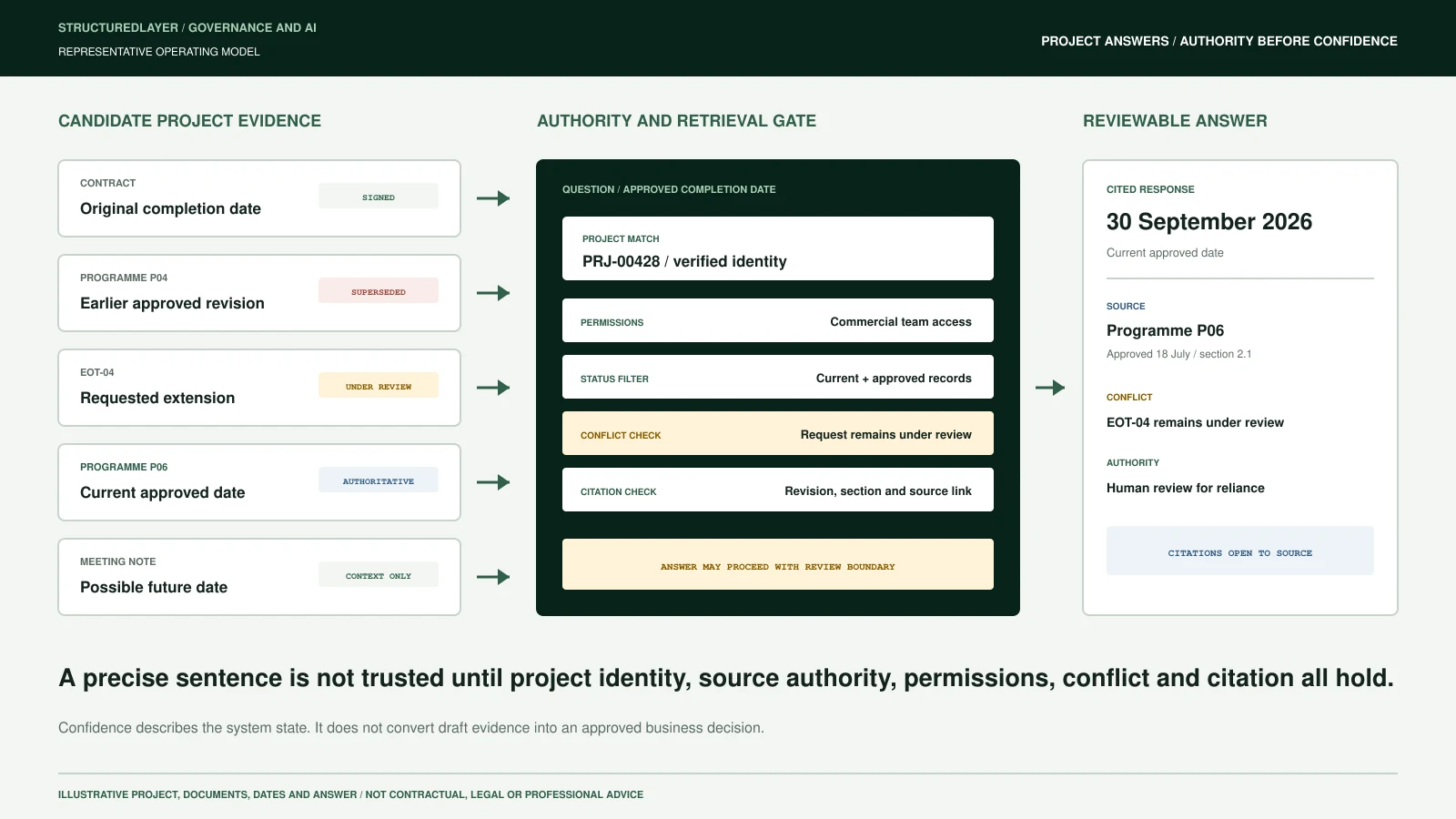
A meeting note, draft programme, submitted variation, observed site quantity, supplier invoice, and approved commercial record may all contain a value for the same subject. They do not carry the same authority. Retrieval quality cannot be judged only by textual similarity.
The wrong version
The model may find a clear answer in a superseded drawing, specification, schedule, policy, model, or report. A current file is not always the controlling file, and the latest timestamp is not always the accepted revision.
The missing workflow state
A technically completed extraction may still require correction. A reviewed output may still await commercial approval. An approved internal record may still be unauthorized for external issue. Treating every completed model run as business completion removes the human and procedural distinctions that make the work dependable.
The missing exception
A workflow that processes 98 records and fails on two should not silently report zero issues or mark the complete run successful. Localized failures, stale credentials, duplicate candidates, inaccessible files, conflicting sources, and validation errors need visible ownership and recovery.
The integration layer is the practical AI opportunity
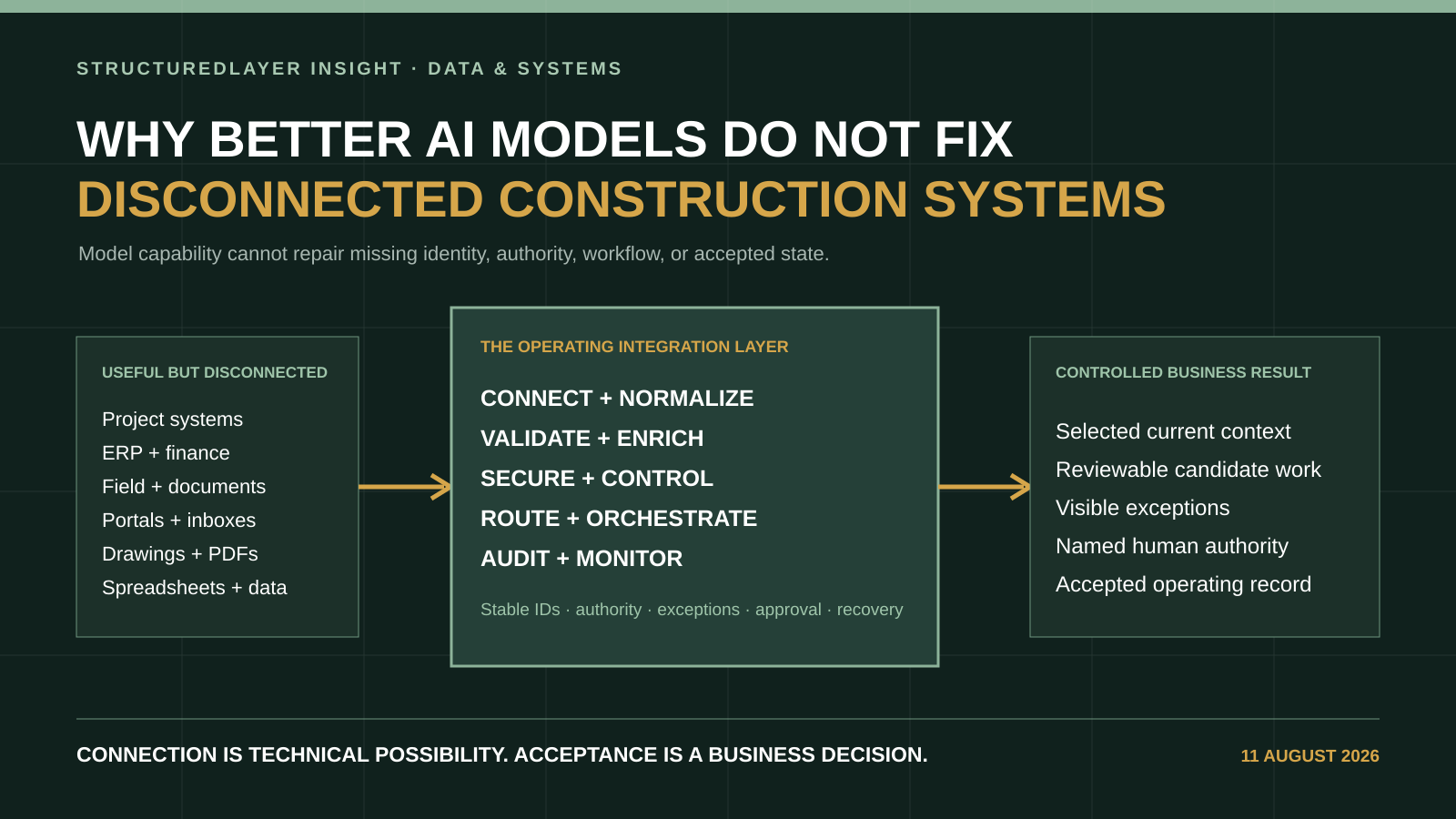
The integration layer is not one product or one database. It is the governed operating capability that connects existing systems and evidence while preserving identity, source authority, workflow state, permissions, review, and accepted outcomes.
It performs six connected jobs.
1. Connect and normalize
Use the least invasive approved interface suitable for the work: API, webhook, database, export, inbox, controlled folder, or bounded browser workflow. Preserve native IDs, raw evidence, source timestamps, and run status. Map candidate records into a company-controlled structure without pretending the source systems are identical.
2. Validate and enrich
Check required fields, types, formats, relationships, duplicates, totals, dates, revisions, units, coordinate systems, and source authority. Deterministic rules should control exact checks. AI can assist where classification, extraction, comparison, or interpretation is useful, but its candidate output remains linked to the source.
3. Secure and comply
Apply authenticated identity, least privilege, purpose limitation, permitted projects and records, credential boundaries, retention, deletion, logging, and applicable contractual, privacy, security, and regulatory requirements. A successful API or browser session does not establish permission to use every accessible record.
4. Route and orchestrate
Represent the work as durable items with triggers, states, assignments, deadlines, dependencies, queues, retries, exceptions, approvals, accepted output, and recovery. Separate read, prepare, review, approve, and execute identities.
5. Audit and monitor
Record source IDs, run IDs, transformation versions, tool calls, model versions, validation, failures, corrections, reviewer decisions, external side effects, accepted outcomes, latency, and complete operating cost. Monitor source changes and production drift rather than assuming a successful pilot remains reliable.
6. Govern
Define which system owns each field, who can resolve conflict, which actions require approval, what the AI must not infer, how accepted records are corrected, when derived context expires, and what the client owns at handover.
What should remain authoritative
An operating layer does not require replacing every useful tool or copying every file into one repository. Different systems can remain authoritative for different records:
| Record or decision | Possible governing system | Operating-layer responsibility |
|---|---|---|
| Accounting transaction | ERP or accounting platform | Preserve native transaction ID and crosswalk it to project and cost records |
| Issued drawing or specification | Controlled document platform | Preserve document, revision, status, source link, and downstream review state |
| Project activity and forecast | Approved planning or controls record | Preserve baseline, data date, current forecast, accepted change, and authority |
| Field observation | Field application or authenticated source | Preserve original evidence and prepare a candidate mapping for review |
| Opportunity listing | Portal, inbox, or CRM source | Preserve native listing and acquisition evidence before opportunity acceptance |
| Business decision | Governed workflow record | Preserve options, recommendation, reviewer, authority, decision, and closure evidence |
The integration layer should make field authority explicit. It should not create an ungoverned master copy that silently competes with the systems people still use.
A representative opportunity workflow
Consider an opportunity that arrives through a bid portal and email.
Source observation
The acquisition run records the authorized source account, run time, native listing ID, page or message evidence, attachment fingerprints, and localized failures. Capturing the source does not yet create an accepted opportunity.
Identity resolution
The workflow proposes matches to company, project, location, contact, and opportunity records. Deterministic and human checks resolve duplicates or uncertain identities. Names and filenames do not become the permanent join.
Document control
Documents receive stable IDs, source-native IDs, versions, types, dates, permissions, and relationships. AI may extract candidate scope, deadline, contact, submission, or qualification fields with page-level citations.
Validation and exception
Rules check required fields, dates, duplicates, inaccessible files, conflicting deadlines, missing addenda, unsupported formats, and stale source state. Exceptions remain assigned until corrected, accepted, or closed.
Human release gate
An authorized person decides whether the record is a real opportunity, whether the company may pursue it, which estimator owns it, and whether any external communication or commercial work may begin.
Accepted operating record
The result preserves source evidence, stable IDs, reviewer, decision, accepted fields, workflow events, and downstream assignments. AI helped prepare the work but did not inherit commercial authority.
What a buyer should define before choosing technology
A useful assessment should establish:
- The recurring workflow and measurable business outcome
- The systems, documents, records, interfaces, and manual work involved
- Stable business identities and source-native ID crosswalks
- Field-level authority and conflict-resolution ownership
- Trigger, states, required fields, assignments, deadlines, and terminal outcomes
- Validation, deterministic calculations, exceptions, retries, and recovery
- User, integration, agent, reviewer, approver, and executing identities
- Approved AI tasks, prohibited assumptions, and maximum actions
- Representative normal, incomplete, duplicate, stale, unauthorized, and failure cases
- Acceptance criteria, reviewer effort, corrections, latency, cost, and accepted outcomes
- Security, privacy, retention, incident, export, and deletion requirements
- Client ownership, documentation, training, maintenance, and handover
Only then should the buyer compare a model, connector, workflow engine, database, agent framework, browser tool, or implementation partner.
Start with one workflow
The safest practical route is not a company-wide AI transformation. Start with one recurring workflow where people spend material effort reconstructing context or managing exceptions.
Use approved historical examples. Freeze the sources and expected outcomes. Build the minimum connected record and workflow required. Test normal and difficult cases. Measure whether authorized reviewers reach a supported decision with less reconstruction, not whether the AI produces an impressive demonstration.
A good first implementation may remain partly manual. It may show that one system should stay separate, that an API is unavailable, that a browser route is too fragile, that source ownership is unresolved, or that human review remains the efficient control. These are useful findings.
The buyer conclusion
A better model can improve a bounded task. It cannot independently create durable project identity, choose the governing record, resolve business authority, define workflow state, establish permissions, recover partial failure, or accept the result.
The durable advantage is the buyer-controlled operating context around the model:
Connected records → governed workflow → bounded AI assistance → visible exception → accountable review → accepted business outcome
That is where experimentation becomes implementation.
Sources and further reading
- Microsoft: Integration architecture design
- Microsoft: Event-driven architecture style
- NIST: AI Risk Management Framework
- NIST: Zero Trust Architecture
Related StructuredLayer guidance
- Systems and Integrations
- Connected Records
- Why Multiple Construction AI Agents Need Workflow Orchestration
- AI Vendor Independence for Construction Operating Systems
- Business Plumbing Beats Smart AI Models podcast
Assess one disconnected workflow
Identify the work, governing sources, IDs, field authority, exceptions, approvals, and accepted result before selecting the technology.