Episode overview
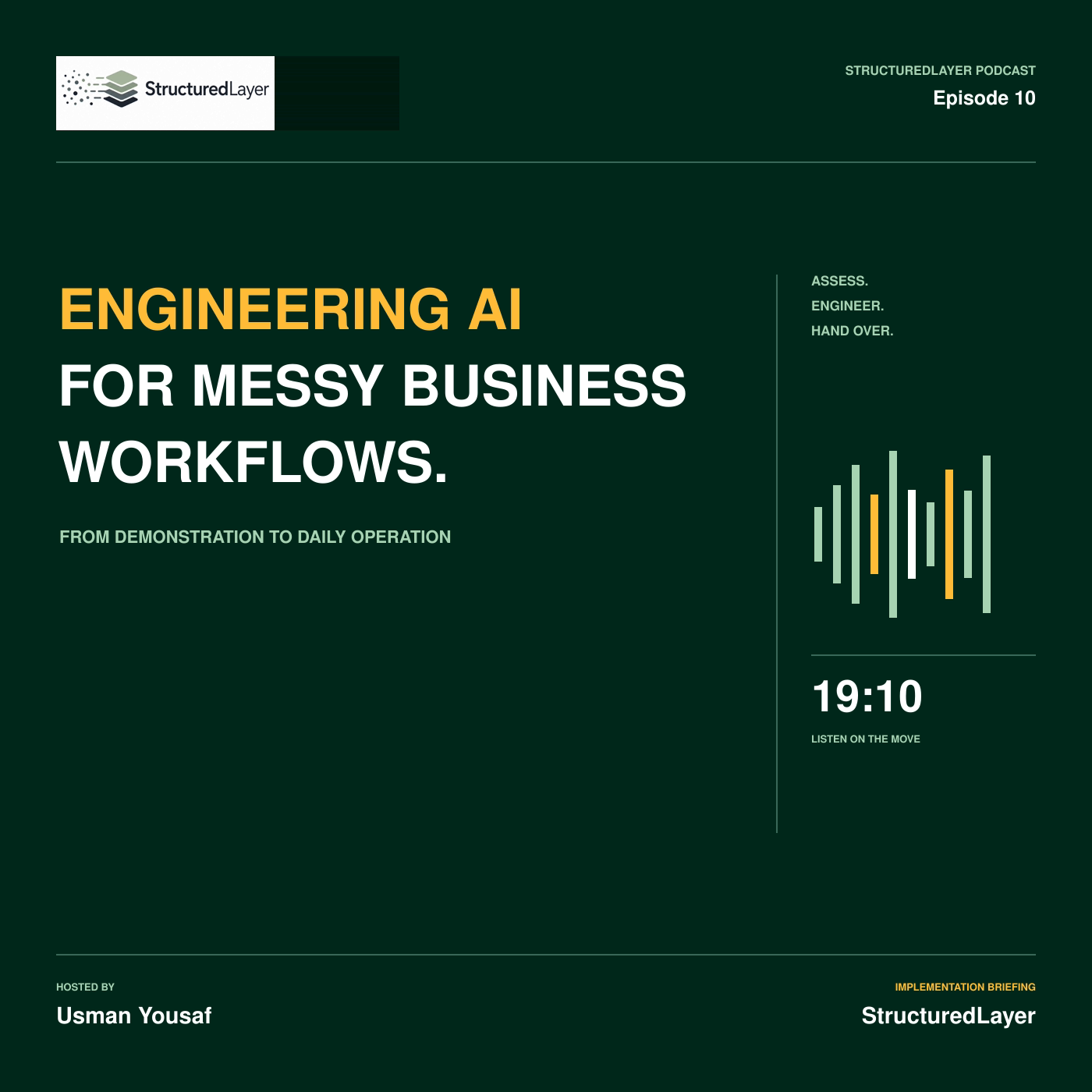
AI demonstrations usually begin with a clean prompt, selected documents, and a narrow success case. Daily business operation is different. Information arrives through email, portals, PDFs, spreadsheets, estimating tools, project systems, and conversations. Names conflict, revisions change, exceptions interrupt the normal path, and consequential decisions require accountable people.
In this StructuredLayer Podcast episode, Usman Yousaf explains why enterprise AI adoption is an implementation and engineering problem, not simply a software-purchasing decision. Construction and property teams need someone to connect the real records, redesign the workflow, define authority, test failure and recovery, and transfer practical ownership to the people who will operate the result.
From demonstration to daily operation
A production workflow needs more than model access:
- Authoritative context: Identify which customer, project, property, document, estimate, schedule, cost, and decision records may support the task.
- Connected systems: Preserve useful estimating, project, document, CRM, finance, email, and portal systems while governing the links between them.
- Explicit workflow: Define triggers, stages, owners, required information, validation, approvals, exceptions, completion evidence, and recovery.
- Bounded AI work: State what the agent may read, draft, classify, update, or propose and what it may never approve or release independently.
- Operational evidence: Preserve sources, run configuration, tool actions, outputs, checks, review, decision, accepted record, cost, and incident history.
- Client capability: Document the system, train internal owners, transfer administration, and make provider replacement and future change possible.
Forward-deployed AI engineering
Forward-deployed AI engineering is useful here as a delivery description, not a separate product category. An accountable technical lead works close to the client workflow to reconcile business requirements with data, software, permissions, testing, and operating reality. The objective is a controlled system the client can understand and own, not permanent dependence on an outside specialist.
The work can include:
- Observing the current workflow and its exceptions
- Identifying authoritative records and system boundaries
- Designing permissions, review points, and acceptance conditions
- Building and testing one bounded workflow against representative cases
- Monitoring failures, corrections, cost, and recovery
- Producing documentation, training, administration, and handover
What to listen for
- Why a successful AI demonstration may still fail in daily construction or property work
- How fragmented documents and estimating workflows affect implementation
- Why workflow redesign and data readiness often matter more than model selection
- Where an accountable technical lead differs from advisory-only delivery
- Why internal champions still need permissions, evidence, training, and operating procedures
- How a Workflow Assessment, Operating-Layer Blueprint, bounded pilot, implementation, and AI Operations provide alternative starting routes rather than one compulsory sales sequence
Human authority remains outside the agent
Commercial commitments, estimates, bids, contracts, payments, safety decisions, professional conclusions, employment decisions, compliance positions, and external publication remain subject to named human review and approval. Embedded engineering does not transfer that authority to the model, agent, software provider, or implementation specialist.
Related StructuredLayer guidance
- Forward-deployed AI engineering for construction
- Construction workflow automation consulting
- Operating-Layer Blueprint
- Bounded AI Agent Pilot
- Workflow implementation
- AI Operations
About the series
The StructuredLayer Podcast is an audio series about connected operating data, governed workflows, responsible automation, controlled AI, implementation boundaries, and practical team ownership for construction and property organizations.