
AI Technology Brief
Can AI coding agents build and validate interactive 3D prototypes for construction?
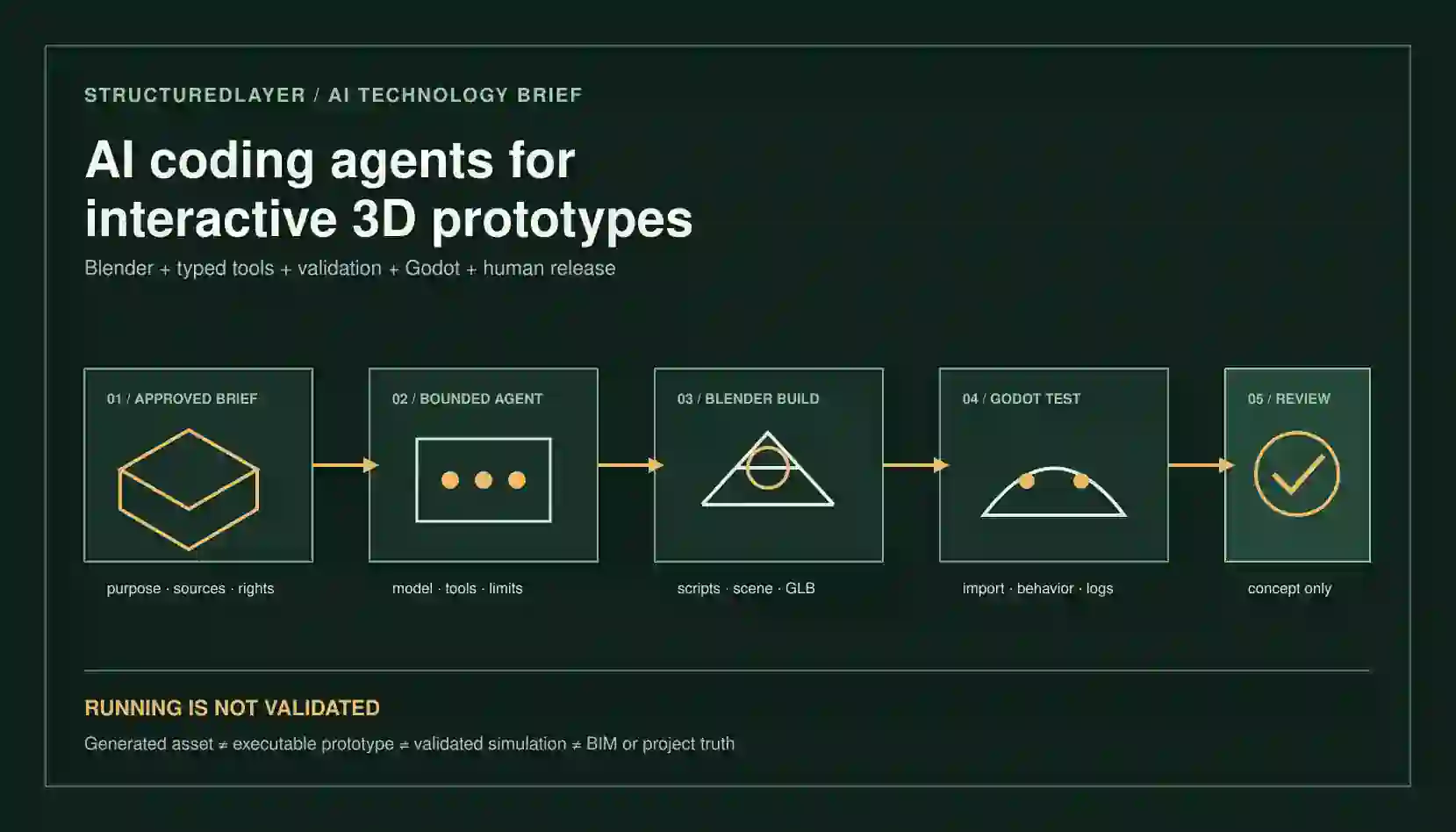
Kimi K3, Claude, Codex, and other coding agents can script Blender, operate tools, export assets, and build Godot prototypes. A rendered scene or running application still does not establish valid geometry, reliable behavior, BIM semantics, simulation accuracy, or construction authority.
01 / Independently verifiable claims
Begin with what the technology and standards actually support.
- Moonshot AI officially describes Kimi K3 as an open-weight, native multimodal agentic model with 2.8 trillion total parameters, 104 billion activated parameters, and a 1,048,576-token context window.
- Moonshot positions Kimi K3 for long-running coding, terminal and tool orchestration, CAD, and vision-in-the-loop game development. These are provider claims, not independent Blender, Godot, construction, or BIM validation.
- Kimi K3 uses a custom Kimi K3 License rather than a standard OSI-approved software licence. Hosted API access, certified inference, and self-managed weights create different cost, data, infrastructure, and licence boundaries.
- Blender officially exposes scene data, meshes, materials, nodes, animation, rendering, import, export, and application state through its Python API and supports command-line background processing.
- Blender operators are context-sensitive, Python threads are not supported for interacting with Blender data, and data references can become invalid. Agent-generated scripts still require bounded execution and validation.
- Godot officially supports headless resource import, project or scene execution, bounded iterations, command-line scripts, parsing checks, logs, fixed frame rates, benchmarking, and frame or movie output under documented conditions.
- MCP tools expose discoverable, schema-described operations; MCP authorization secures the MCP resource boundary. Neither establishes Blender scene correctness, Godot behavior, downstream file safety, or business authority.
- glTF compatibility describes a transport format. Successful GLB export or import does not establish dimensional accuracy, topology quality, correct physics, acceptable interaction, BIM semantics, or suitability for construction decisions.
02 / The practical distinction
A generated asset, an executable prototype, a simulation, and an authoritative model answer different questions.
The same visual scene can move between these categories only through explicit reconstruction, validation, ownership, and approval.
Candidate
Generated 3D asset
A mesh, material, texture, rig, animation, script, or scene prepared probabilistically from approved references.
Interactive
Executable prototype
A bounded application that imports assets, runs scripts, accepts defined input, exposes state, and passes specified structural, behavioral, and visual tests.
Analytical
Validated simulation
A purpose-specific model with documented assumptions, equations, calibration, boundary conditions, verification, validation, uncertainty, and qualified interpretation.
Authoritative
BIM or project record
Controlled geometry and information developed under project standards, coordinates, responsibilities, revisions, exchanges, reviews, and professional authority.
03 / Operating architecture
Use the coding agent as a bounded orchestrator around deterministic 3D applications.
The model proposes scripts and tool calls. Blender, validators, the glTF exporter, Godot, tests, and accountable reviewers produce the evidence required for acceptance.
Approved prototype brief
Purpose, audience, source assets, rights, scene specification, units, interactions, acceptance tests, prohibited uses, owner, and reviewer.
Bounded coding agent
Exact model, harness, context, repository, working directory, tool allowlist, network policy, secrets boundary, reasoning setting, time, retries, and cost limits.
Deterministic build path
Versioned Blender Python, scene inspection, structural validator, preview render, GLB export, manifest, Godot import, scene assembly, scripts, and headless checks.
Reviewed conceptual release
Validation report, logs, fixed-camera captures, known limitations, corrections, approved purpose, visible status, expiry, and no authoritative write-back.
04 / Required records
Preserve every source, environment, tool action, artifact, test, and approval.
Prototype request
Business purpose, construction or property scenario, audience, expected interaction, consequence, source authority, reviewer, and release condition.
Source package
Images, sketches, models, dimensions, scripts, references, licences, permissions, fingerprints, revisions, and prohibited inference.
Execution environment
Model, harness, Blender, Python, Godot, renderer, exporter, plugins, MCP servers, packages, operating system, hardware, and configuration versions.
Tool run
Prompt, context, tool name, validated arguments, script, file reads and writes, command, duration, output, error, retry, tokens, and cost.
Asset manifest
Objects, meshes, dimensions, units, transforms, triangles, materials, textures, rigs, animations, collisions, files, hashes, and source relationships.
Acceptance record
Structural, import, script, behavioral and visual results; reviewer corrections; unresolved limits; approved use; decision; release; and history.
05 / Construction example
Use interactive 3D prototypes for bounded communication and workflow learning - not hidden professional conclusions.
These are representative patterns, not completed StructuredLayer deployments or proof that Kimi K3, Claude, Codex, Blender, Godot, or an MCP server is suitable without testing.
Preconstruction
Logistics option
Create a clearly conceptual scene for discussing access, laydown, routing, temporary zones, and sequence assumptions; verify dimensions and constraints separately.
Property
Experience walkthrough
Prototype navigation, choices, information panels, and operational scenarios without presenting generated finishes, performance, or geometry as approved design.
Training
Generic scenario
Build a reviewed interactive exercise using fictional conditions and explicit learning objectives, not a recreation of a real incident or approved safety method.
Operations
Digital-twin interface prototype
Test controls, state presentation, alerts, and user flows with synthetic data before connecting live assets, telemetry, building controls, or project records.
06 / Deterministic controls
Validate structure and behavior before anyone reviews visual appeal.
Typed tool surface
Expose narrow inspect, create, validate, render, export, import, run, test, capture, and log operations with schema validation, path restrictions, timeouts, and output limits.
Disposable environment
Use a dedicated repository and working directory with no production credentials, project systems, unrestricted shell, personal files, or uncontrolled network access.
Blender structural checks
Test expected objects, units, dimensions, transforms, axes, names, geometry, normals, manifold state, UVs, materials, textures, rigs, weights, animations, and collisions.
Export and import checks
Create a manifest, export GLB, open it in a clean target project, reconcile objects and materials, and preserve every warning or unsupported feature.
Godot runtime checks
Parse scripts, load expected nodes and resources, simulate bounded input, assert state and signals, inspect logs, and capture fixed-camera frames in a suitable rendering environment.
Human release gate
Require rights, technical, design, engineering, safety, brand, client, and publication review according to the proposed use and consequence.
07 / Failure analysis
A scene can render while geometry, behavior, evidence, and authority remain wrong.
Tool-context failure
A Blender operator runs in the wrong mode, on the wrong active object, or against stale data and silently changes an unintended target.
Visual success, structural failure
A render looks convincing while units, scale, topology, normals, hidden geometry, rigs, collisions, or materials are defective.
Import loss
Textures, material features, animation, naming, hierarchy, scale, collisions, or custom data change during GLB export and Godot import.
Runtime illusion
A first screen opens but controls, physics, restart, failure recovery, scoring, state transitions, or boundary cases do not work.
Unsafe tool access
An agent reaches an unrestricted shell, downloads unreviewed code, reads secrets, overwrites unrelated files, or connects to live systems.
Benchmark transfer
Provider coding scores, visual preference, game tasks, and one-prompt demonstrations are treated as evidence for construction, BIM, simulation, or production performance.
Rights and licence conflict
Reference assets, plugins, MCP servers, generated outputs, model weights, fonts, textures, or music cannot legally support the planned commercial use.
Authority contamination
A conceptual prototype is copied into design, quantities, coordination, safety, training, digital-twin, control, or client records without approved reconstruction.
08 / Deployment and cost
Model hosting, agent execution, 3D applications, and rendering are separate deployment decisions.
Hosted model and local tools
A local harness may operate Blender and Godot while approved context is transmitted to a hosted model. Review provider routing, retention, region, account, and confidential-data policy.
Self-managed open weights
Kimi K3 weights create deployment options but add substantial hardware, serving, inference, licence, security, monitoring, upgrade, and support requirements.
Isolated cloud workstation
Run the repository, Blender, Godot, renderer, validators, and agent in a disposable GPU environment with narrow identity, storage, network, logging, and teardown controls.
Client-owned artifact pipeline
Keep source packages, scripts, manifests, assets, tests, reports, captures, approvals, and replacement paths independent of one model, harness, or MCP server.
- Model input, cached input, output, reasoning, images, tool results, retries, compaction, and provider plans
- GPU workstation or cloud rendering, Blender, Godot, storage, transfer, build minutes, generated assets, and third-party APIs
- MCP servers, plugins, packages, sandboxing, identities, network controls, secrets, logging, security review, and maintenance
- Source preparation, rights clearance, scene specification, deterministic scripts, validators, manifests, tests, captures, and documentation
- 3D artist, developer, technical, design, engineering, safety, brand, client, and accessibility review
- Failed generations, cleanup, retopology, rig repair, material repair, runtime debugging, regression, replacement, and complete cost per accepted prototype
09 / Evaluation
Measure reproducible accepted prototypes, not subjective visual preference.
- Task completion against a frozen scene and interaction specification
- Object, unit, dimension, transform, topology, material, texture, rig, animation, collision, and export accuracy
- Godot import completeness, script parse, scene load, expected nodes, input behavior, state transitions, restart, logs, and bounded recovery
- Fixed-camera frame coverage, nonblank rendering, reference differences, visual artifacts, text, identity, and misleading realism
- Tool-call validity, path enforcement, network behavior, secret protection, timeout, retry, interruption, and audit completeness
- Human correction time by 3D, code, technical, professional, rights, and release role
- Repeatability after model, harness, prompt, Blender, exporter, Godot, plugin, MCP server, package, operating system, or hardware change
- Complete cost and elapsed time per accepted prototype, plus any conceptual artifact reaching authoritative records
10 / Controlled pilot
Prove the operating boundary before expanding it.
Choose one low-consequence interaction
Use a fictional logistics, property, training, or interface scenario with no live controls, safety instruction, design approval, or project-record write-back.
Freeze the environment
Record exact model, harness, tools, Blender, Godot, plugins, packages, renderer, source assets, licences, scripts, and acceptance tests.
Restrict the tools
Allow only the required repository paths and typed 3D operations; block production credentials, unrelated files, unrestricted network, and external release.
Validate every stage
Run Blender structural checks, export manifest reconciliation, clean Godot import, script parsing, behavioral tests, logs, and fixed-camera captures.
Adjudicate with expertise
Have relevant 3D, development, technical, rights, and business reviewers correct and classify every material failure.
Set stop conditions
Stop for rights uncertainty, secret or network exposure, missing provenance, invalid geometry, failed interaction, excessive correction, or authoritative-data confusion.
11 / StructuredLayer recommendation
Use coding agents to orchestrate controlled 3D prototype production - not to turn one-prompt visual output into BIM, simulation, or project truth.
Begin with one low-consequence interaction, approved source assets, a frozen environment, typed Blender and Godot tools, deterministic structural and behavioral checks, fixed-camera review, visible conceptual status, and accountable human release. Compare Kimi K3, Claude, Codex, or another eligible model only against the same harness, versions, evidence, acceptance tests, reviewer effort, and complete cost.
12 / Primary sources
Capability, governance, and implementation claims remain inspectable.
Moonshot AI
Kimi K3 official repository
Moonshot AI
Kimi K3 License
Moonshot AI
Kimi K3 API pricing
Blender Foundation
Blender Python API overview
Blender Foundation
Blender command-line arguments
Godot Engine
Godot command-line tutorial
Godot Engine
Godot importing 3D scenes
Khronos Group
glTF 2.0 specification
Model Context Protocol
MCP tools specification
Model Context Protocol
MCP authorization specification
buildingSMART International
Industry Foundation Classes
OWASP
Secure Coding with AI
NIST
Artificial Intelligence Risk Management Framework 1.0
Sources reviewed 30 July 2026. Technology capabilities, laws, guidance, terms, and pricing can change.
13 / Related StructuredLayer guidance
Continue from model selection into operating architecture.
Generated 3D Assets for Construction
Separate conceptual meshes and textures from BIM, fabrication, survey, and as-built authority.
3D Generation, Depth, and Reconstruction
Distinguish generation, depth estimation, matching, Gaussian rendering, and measured reconstruction.
LLMs and Coding Agents for Construction
Choose the operating role, model, harness, permissions, tests, deployment boundary, and human release authority.
AI Agent Authorization
Separate authentication, MCP access, downstream permissions, exact action authority, and business approval.