AI Technology Brief
Which LLM and coding agent should a construction business use? Start with the operating role
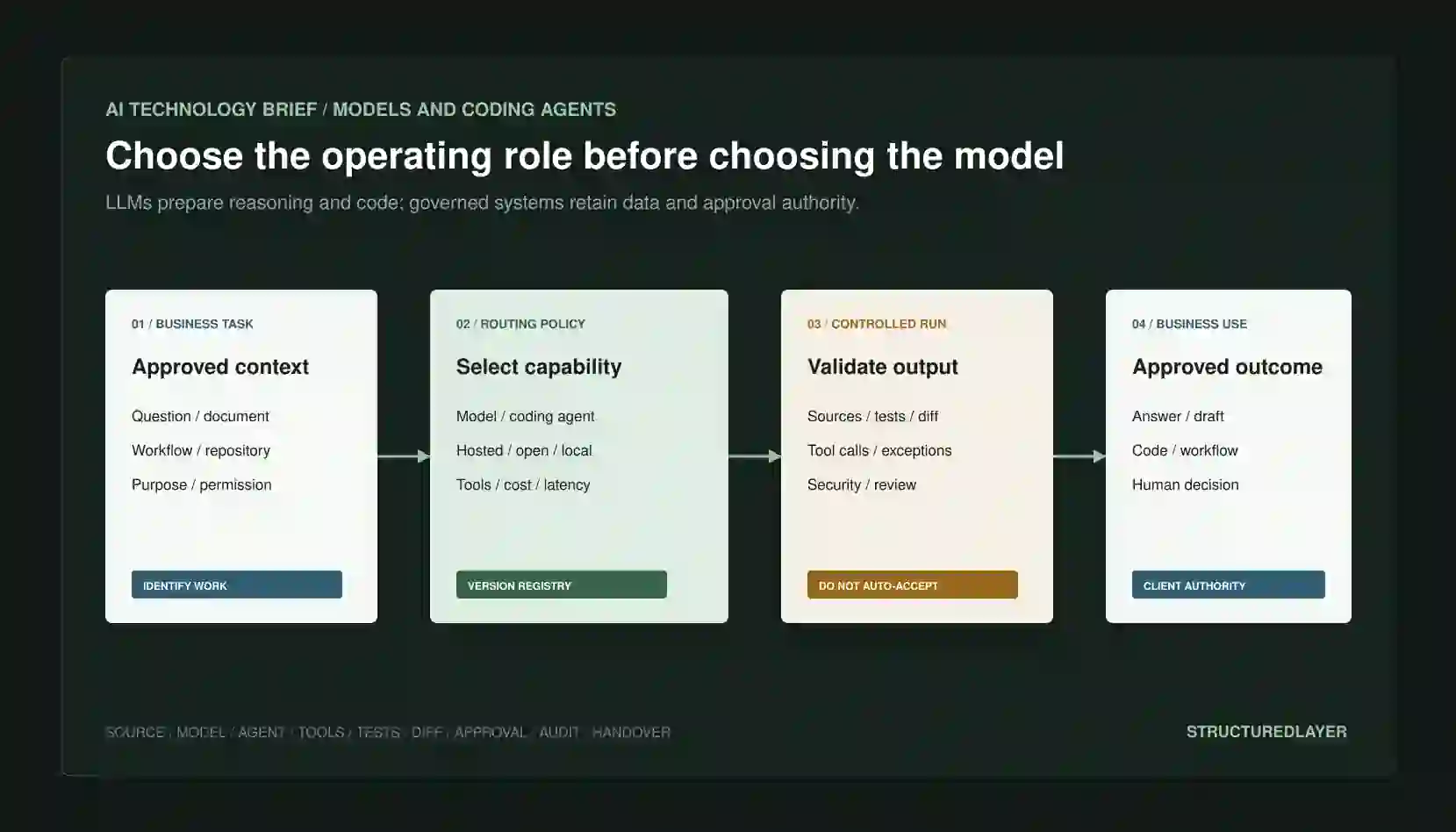
StructuredLayer evaluated an architecture for selecting language models and coding agents according to the business task, authoritative context, permitted tools, deployment boundary, cost, failure consequence, and human approval. This is architecture evaluation, not a claim that one model has been deployed across a client. A model can draft or reason; a coding agent can inspect repositories and execute tools; neither becomes the company's source of truth or accountable decision-maker.
01 / Independently verifiable claims
Begin with what the technology and standards actually support.
- Claude Fable 5 is an official Anthropic model and is available through Claude and Claude Code. Claude Opus 4.6, Claude Sonnet and Haiku 4.5, Claude Sonnet 4, Claude 3.7 Sonnet, and Claude 3.5 Haiku are different generations and tiers with lifecycle and cost implications.
- OpenAI officially documents GPT-5.6 Sol, Terra, and Luna, GPT-5.2, GPT-5, GPT-5 mini and nano, GPT-4.1 and its mini and nano variants, GPT-4o and mini, o1, o1-mini, and o4-mini, and open-weight GPT-OSS 20B and 120B families. Exact availability and recommendations change.
- Google officially documents Gemini 3.1 Pro Preview, Gemini 3 Pro, Gemini 2.5 Flash, and related model lifecycle. Preview aliases require change control.
- DeepSeek R1, V3, and V3.1; Qwen3 235B MoE instruction models; Kimi K2.5; IBM Granite 3.3 and Granite Speech 4.1; Llama 3 and later families; Gemma; StableLM; FLAN-T5; and LLaVA represent reasoning, instruction, speech, open-weight, legacy, or multimodal roles with different licences and deployment requirements.
- Claude Code and Codex CLI can operate against local repositories, edit files, and run tools installed on the user's machine. Codex Cloud is a separate delegated environment rather than the same execution boundary.
- OpenAI distinguishes Chat for conversational help, ChatGPT Work for longer research, analysis, document, spreadsheet, presentation, report, and site tasks, and Codex for software engineering and technical work. These are different task surfaces rather than one universal agent mode.
- OpenAI defines a skill as reusable instructions and resources, an app as a connection to external data or actions, and a plugin as a distributable workflow package that can contain skills, apps, and app templates. Installation does not replace source-system permissions, workspace administration, or action approval.
- OpenAI documents remote access to Codex from ChatGPT mobile while execution remains on the connected trusted laptop, devbox, SSH host, or managed environment. Files, credentials, permissions, and local setup remain on the execution machine; remote control does not turn that machine into a cloud sandbox.
- OpenAI documents Codex local execution, remote-machine execution, and isolated cloud execution as distinct boundaries. Each requires its own filesystem, identity, credential, network, approval, logging, and recovery assessment.
- Anthropic states that Claude Code runs locally but sends prompts, model outputs, relevant code or file contents, and other required context over the network to the configured model provider. Local tool execution does not mean on-device model inference or that all project information remains on the computer.
- Claude Code Auto Mode can automatically approve tool calls classified as lower risk and block or escalate calls classified as potentially destructive. Provider classification is useful triage, not a complete company authorization policy or permission to perform a consequential business action.
- Claude Code Channels is a research-preview route for pushing messages, alerts, webhooks, and chat events into a running session and supporting replies through configured channels. Sender authorization, session and project routing, message provenance, duplicate and replay handling, tool permissions, remote approval, reply authority, expiry, and recovery remain deployment responsibilities.
- Claude Code, OpenAI Codex, Gemini CLI, GitHub Copilot cloud agent, Cursor, Devin Desktop or Cascade, Aider, and Cline are coding applications or agents. They can read repositories, modify files, execute commands, call tools, and sometimes use networks; they require stronger controls than chat-only use.
- Catalogue run counts and labels such as most intelligent, best for coding, fastest, flagship, leading, or on par are not independent construction or software-delivery benchmarks.
02 / The practical distinction
Choose the interface from the task, context, permissions, evidence, and operating responsibility.
No personal usage ratio establishes the right interface for a construction business. Compare source volume, read and write scope, duration, repeatability, deterministic tooling, audit evidence, review capacity, deployment boundary, and maintenance ownership.
Narrow
Chat
Useful for a bounded question with limited approved inputs. Context is manually assembled, repeatability is weak, and uploaded content follows provider controls.
Deliverable
ChatGPT Work
Prepares research, analysis, documents, spreadsheets, presentations, reports, and sites. Review sources, formulas, revisions, file integrity, rights, and release before business use.
Build
Codex local or remote
Uses files, terminals, Git, tests, packages, apps, plugins, skills, and sometimes networks on an approved execution machine. Remote mobile control does not change that machine's authority boundary.
Delegate
Codex Cloud
Runs a task in a hosted isolated environment. Treat repository access, setup, internet, credentials, results, and handback as a separate controlled deployment.
Repeat
Governed workflow
Runs recurring work through stable records, deterministic rules, queues, validation, approvals, exceptions, monitoring, recovery, and operating ownership.
Persistent
Automation
Performs scheduled or event-driven activity over time. Identity, execution availability, source permissions, separate read and write authority, spending limits, interruption, audit, and recovery must be explicit.
03 / Operating architecture
Use one governed registry for models, coding agents, tools, and approved tasks.
StructuredLayer's evaluated pattern routes each task to an eligible capability and preserves enough evidence to replace the model or application later.
Approved task
Business purpose, user, workflow, source records, documents or repository, expected output, consequence, and human owner.
Model and app registry
Official model ID, coding application, version, context, tools, deployment, data controls, lifecycle, licence, cost, and approved task.
Controlled execution
Permission-aware retrieval, prompt, schema, sandbox, tool allowlist, network policy, secrets boundary, limits, tests, and logs.
Reviewed outcome
Sources, answer or diff, validation, test results, security review, exception, approval, release, monitoring, and rollback.
04 / Required records
Every answer or code change needs source, configuration, validation, and ownership.
Task request
Workflow, purpose, requester, project, sources, repository, output, deadline, consequence, reviewer, and release condition.
Model selection
Official ID, version, tier, reasoning, context, deployment, region, retention, training setting, tools, limits, and cost.
Agent environment
Chat, Work, Codex local, SSH, managed remote, or cloud surface; execution machine; repository; branch; sandbox; filesystem; network; apps; plugins; skills; MCP servers; commands; packages; identities; credentials; and secrets policy.
Run record
Prompt, retrieved sources, tool calls, files read, commands, network actions, output, diff, tokens, duration, warnings, and cost.
Validation
Schema, citations, business rules, tests, lint, type checks, security scans, peer review, acceptance, and exception state.
Release
Approved answer, record, pull request, workflow, deployment, owner, timestamp, monitoring, rollback, documentation, and handover.
05 / Construction example
Approve the rules, specification, plan, and tasks before the coding agent implements.
These four versioned artifacts reduce improvisation and make scope reviewable. They remain implementation controls, not proof that the requirements or resulting software are correct.
Approve project rules
Define simplicity, accessibility, data handling, security, dependency, testing, and ownership rules that every feature must follow.
Specify behavior
State users, required behavior, acceptance scenarios, edge cases, prohibited actions, and explicit non-goals without prescribing implementation.
Clarify
Resolve ambiguity around identity, authority, integrations, data, failure behavior, and acceptance before code is prepared.
Approve the plan
Define architecture, data, interfaces, dependencies, security, migration, tests, rollback, and how the plan complies with the project rules.
Approve the tasks
Break the plan into dependency-ordered, reviewable work linked to requirements and acceptance cases.
Implement incrementally
Prepare small code, test, documentation, and configuration changes in a bounded branch or environment.
Verify independently
Run deterministic tests, security checks, source checks, human review, and end-to-end acceptance cases.
Release and converge
Approve separately, monitor, compare the system with the specification, and record gaps, corrective work, or rollback.
06 / Deterministic controls
Treat coding agents as privileged automation with a developer-sized blast radius.
Sandbox by default
Use disposable environments, nonprivileged identities, restricted filesystem, resource limits, and default-deny network access.
Keep secrets inaccessible
Exclude environment files, private keys, production credentials, cloud profiles, client data, and unrestricted tokens; use short-lived task identities.
Allowlist tools and MCP
Approve commands, packages, repositories, network destinations, APIs, and MCP servers; validate tool arguments and configuration changes.
Treat reusable procedures as environment-specific
Version the instructions, templates, examples, schemas, commands, tools, permissions, dependencies, and tests required by each approved agent environment. A procedure package that can be opened elsewhere is not automatically interoperable or behaviorally equivalent.
Approve the plan before execution
Review scope, non-goals, files, data sources, transformations, dependencies, migrations, commands, tests, rollback, and release boundary before allowing implementation. A generated plan that no accountable person reads is not a control.
Control packages and generated artifacts
Pin approved dependencies, verify provenance and licence, install only inside the authorized environment, inspect generated files and configuration, and prevent automatic commits or broad accept-all actions from becoming release approval.
Review data transformations semantically
For SQL, pipelines, metrics, reports, or notebooks, inspect grain, joins, filters, sources, definitions, null handling, cardinality, reconciliation, and downstream effects. Compilation and passing configured tests do not establish correct business meaning.
Keep authorization outside Auto Mode
Treat automatic approval as provider risk triage inside a narrower external policy. Independently enforce repository, path, command, network, credential, spending, production, and business-action limits, and test allowed, blocked, ambiguous, indirect, and chained actions.
Govern persistent Channels
Authorize senders and channel adapters, bind every event to the correct organization, project, session, and work item, preserve message and reply provenance, reject duplicates and replay, constrain tools, expire stale sessions, and require explicit authority for external replies or consequential actions.
Assume prompt injection
Treat issues, comments, documents, websites, terminal output, dependencies, and repository instructions as untrusted content.
Independent testing
Do not allow the agent to weaken tests or define its own acceptance. Require human review for security, auth, infrastructure, dependencies, and CI/CD.
No direct production authority
Block production systems, payments, building controls, operational technology, client records, deployments, and consequential decisions without explicit approval.
Re-verify every release
Confirm the exact model, harness, access route, lifecycle, pricing, data terms, tools, and supported execution boundary from current primary documentation. Treat rankings and demonstrations as investigation signals, not task acceptance.
07 / Failure analysis
The strongest model can still act on the wrong source, tool, permission, or acceptance rule.
Confident unsupported answer
The response can be fluent while using stale, incomplete, conflicting, or unauthorized context.
Wrong model alias
Preview and latest aliases can change behavior, context, cost, safety, and tool support without an obvious workflow change.
Prompt injection
Repository files, tickets, websites, documents, dependencies, tool output, channel messages, alerts, and webhook payloads can manipulate the agent into unsafe actions.
Approval misclassification
A nominally lower-risk tool call can have destructive or consequential effects through arguments, current state, chained actions, credentials, indirect writes, or the wrong project context.
Persistent-session confusion
A delayed, duplicated, replayed, unauthorized, or misrouted channel event can act on stale state or the wrong repository, project, work item, user, or recipient.
Secret exposure
An agent can read files ignored by Git, echo credentials to logs, transmit sensitive context, or include secrets in code and commits.
Plausible broken code
Generated code can pass superficial review while failing edge cases, permissions, concurrency, migration, security, or recovery.
Green pipeline, wrong meaning
Generated SQL or transformations compile and pass configured tests while duplicating values, using the wrong grain, applying incorrect filters, selecting the wrong authority, or redefining a business metric.
Self-repair becomes assurance
An agent diagnoses and changes its own failed implementation, then labels the pipeline reliable without independent review, representative regression cases, reconciliation, monitored operation, or accepted recovery evidence.
Automation of the wrong process
A correct implementation can still encode unclear ownership, bad records, weak approval, or unsupported business rules.
Vendor and tool dependency
Agent applications, models, extensions, MCP servers, cloud environments, pricing, and terms can change or disappear.
Authority confusion
A generated estimate, contract interpretation, safety recommendation, design response, or payment decision may be mistaken for professional approval.
08 / Deployment and cost
Choose hosted, open, or hybrid models separately from the coding application.
Hosted frontier models
Fable, Claude, GPT, Gemini, Kimi, and other services can provide broad capability; review exact model, region, retention, training, tools, price, availability, and exit.
Open and private models
GPT-OSS, DeepSeek, Qwen, Granite, Llama, Gemma, StableLM, FLAN-T5, and related models add hardware, serving, licences, security, evaluation, and maintenance.
Local coding applications
Claude Code, Codex CLI, Gemini CLI, Cursor, Aider, Cline, and Devin Desktop can operate against local repositories and tools. Local access still needs sandboxing, permissions, network, provider-data, and secrets controls.
Cloud coding agents
Codex Cloud and Copilot cloud agent can work in isolated hosted environments and create pull requests; repository access, setup, internet access, identities, secrets, and review remain critical.
- Input, output, cached, reasoning, image, audio, tool, search, and long-context usage
- Coding-application plans, cloud environments, parallel agents, repository indexing, storage, and network
- Open-model GPU, serving, scaling, weights, licences, monitoring, patching, and support
- Source preparation, retrieval, schemas, prompts, tests, evaluation, security review, and human correction
- Sandboxing, secrets, identities, MCP governance, dependency review, CI/CD, audit, and incident response
- Integration, deployment, monitoring, rollback, documentation, training, handover, model replacement, and exit
09 / Evaluation
Measure accepted construction outcomes and software changes, not model reputation.
- Answer accuracy, source coverage, citation correctness, conflicts, unsupported additions, and abstention
- Structured-field accuracy, schema validity, business-rule results, and exception routing
- Code correctness, tests, type checks, lint, security scans, migration safety, performance, and recovery
- Tool-call accuracy, permission enforcement, prompt-injection resistance, secrets handling, and network behavior
- Human correction time, reviewer agreement, critical errors, and accepted output rate
- Latency and complete cost per accepted answer, record, pull request, workflow, or deployment
- Repeatability and regression after model, alias, prompt, tool, MCP, package, repository, or source change
- Production incidents, rollback, monitoring, documentation, client ownership, and provider portability
10 / Controlled pilot
Prove the operating boundary before expanding it.
1. Define the problem
Name intended users, business decision, expected result, failure consequence, source boundary, prohibited actions, and explicit non-goals before generating an interface or code.
2. Build a bounded prototype
Use synthetic or explicitly approved test data in an isolated environment with no production credentials, live external actions, or assumption that generated architecture is production-ready.
3. Observe representative users
Record workflow sequence, missing information, confusing states, repeated actions, accessibility barriers, operating context, and recovery behavior through appropriately selected real participation.
4. Create a discovery register
Connect each observation to source evidence, affected role and step, proposed requirement, reviewer, decision, rationale, owner, status, and next test. Mark requirements accepted, rejected, deferred, or unresolved.
5. Specify invisible controls
Add separation of duties, restricted fields, cross-project boundaries, duplicate prevention, calculations, concurrency, migration, retention, security, incident, and recovery requirements that a user walkthrough may not expose.
6. Convert requirements into tests
Define allowed, prohibited, boundary, wrong-user, wrong-project, missing-approval, duplicate, failed-integration, interruption, rollback, and regression cases before implementation acceptance.
7. Approve the implementation plan
Review files, components, data model, dependencies, integrations, migrations, security controls, testing, monitoring, rollback, tasks, and release boundary before execution.
8. Implement incrementally
Prepare small reviewable changes linked to approved requirements and tasks. Preserve deviations, diffs, tool calls, test results, errors, retries, corrections, and unresolved exceptions.
9. Verify independently
Separate development from functional, security, data, permission, accessibility, operational, and representative-user acceptance. The agent does not define or approve its own release evidence.
10. Authorize production separately
Approve production architecture, credentials, live data, migration, users, tools, integrations, monitoring, training, support, incident response, rollback, and named release authority as a distinct decision.
11 / StructuredLayer recommendation
Prototype quickly to discover the workflow. Specify what was learned. Test what users cannot see. Verify independently. Authorize production separately.
Do not buy a construction AI strategy by choosing one flagship LLM. Define the workflow, authoritative records, permitted tools, expected output, failure consequence, tests, reviewer, and handover first. Use Fable 5, Claude, GPT, Gemini, DeepSeek, Qwen, Kimi, Granite, Llama, or other models only where representative evaluation supports the task. Use Claude Code, Codex, Gemini CLI, Copilot, Cursor, Devin Desktop, Aider, or Cline in sandboxes with restricted tools, no production secrets, independent tests, and human-owned release.
12 / Primary sources
Capability, governance, and implementation claims remain inspectable.
Anthropic
Claude Fable 5
Anthropic
Claude Code overview
Anthropic
Claude Code data usage
Anthropic
Auto mode for Claude Code
Anthropic
Claude Code Channels
Anthropic
Claude Code Channels reference
Anthropic
Effective context engineering for AI agents
OpenAI
OpenAI models
OpenAI
Codex CLI
OpenAI
Codex agent approvals and security
OpenAI
Codex cloud
OpenAI
ChatGPT Work and Codex
OpenAI
Plugins in ChatGPT and Codex
OpenAI
Introducing the Codex app
OpenAI
Work with Codex from anywhere
OpenAI
Codex for knowledge work
Gemini models
Gemini CLI
GitHub
Copilot cloud agent
Cursor
Cursor Agent
Devin
Devin Desktop and Cascade
Aider
Aider documentation
Cline
Cline
DeepSeek
DeepSeek V3.1
Qwen
Qwen3
Moonshot AI
Kimi prompt guidance
Meta
Llama models
Gemma models
IBM
Granite models
OWASP
Secure Coding with AI
NIST
AI Risk Management Framework
GitHub
Spec Kit specification-driven development
GitHub
Spec Kit workflow overview
Sources reviewed 16 August 2026. Technology capabilities, laws, guidance, terms, and pricing can change.
13 / Related StructuredLayer guidance
Continue from model selection into operating architecture.
AI coding agents for interactive 3D prototypes
Use bounded Blender and Godot tools, deterministic structural and behavioral checks, and human-approved conceptual release.
Why ChatGPT or Claude is not your source of truth
See how governed business records retain authority while models retrieve and synthesize.
AI agent vs automation vs workflow
Separate bounded tool selection from deterministic rules and governed workflow state.
Vision model routing
Apply the same registry and evaluation discipline to drawings, images, video, and documents.
OCR model routing
Route construction documents by layout, language, tables, formulas, quality, and source authority.
Construction AI governance
Review permissions, human approval, evidence, monitoring, recovery, and accountability.
AI Workflow Training with Usman Yousaf
Learn local-versus-hosted boundaries, permissions, task framing, Git, testing, review, rollback, and production limits through an independent coding-agent session.
Construction workflow examples
Start with one real operating problem and map records, stages, exceptions, and outcomes.