Episode overview
Unreal Engine can provide a high-performance, editable environment for exploring buildings, sites, logistics, phasing, interfaces, and operational information. AI and procedural tools can help prepare geometry, relationships, alternatives, metadata, scripts, and interaction. But a visually complete world is not automatically an approved design, validated simulation, coordinated BIM deliverable, digital twin, construction plan, or site-safety instruction.
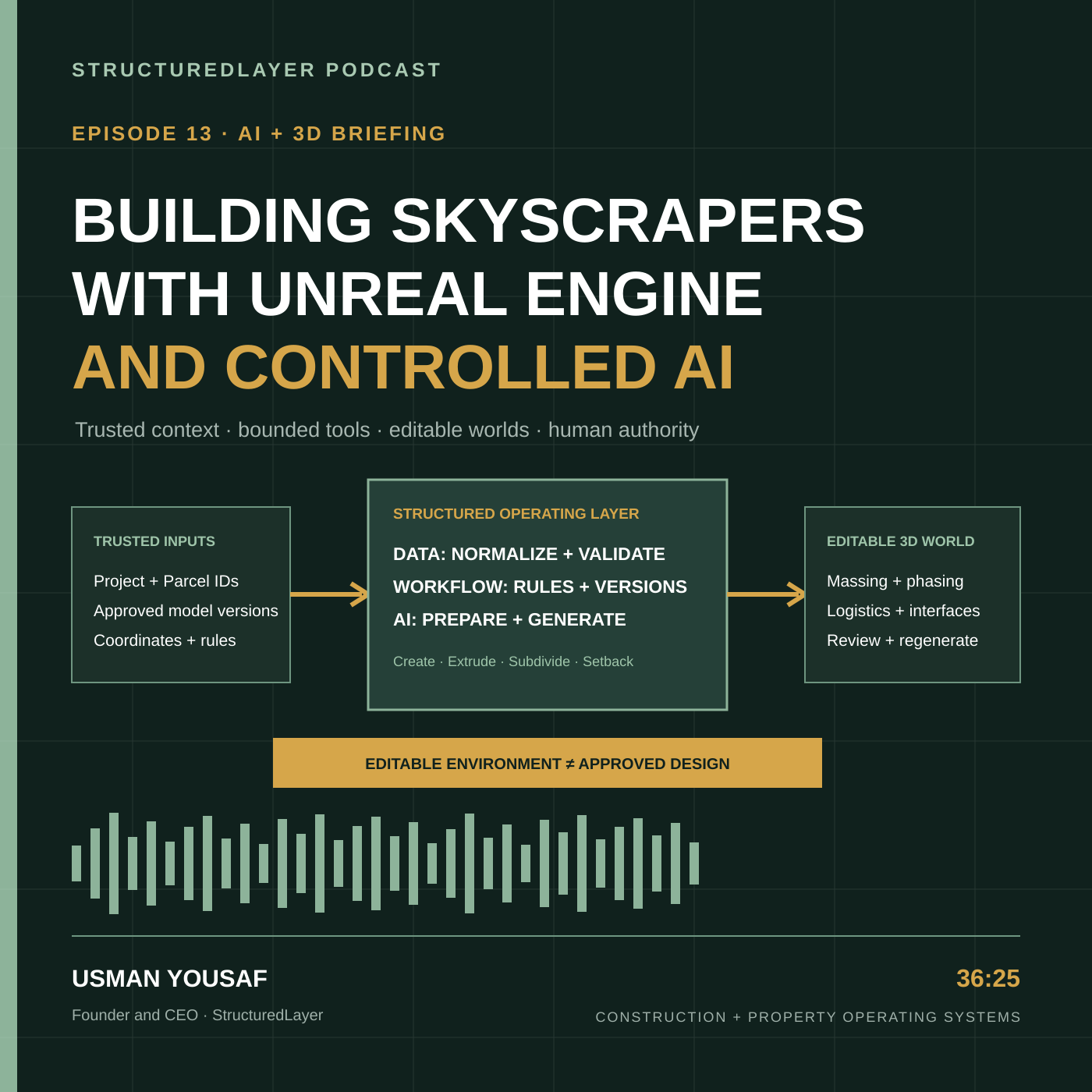
In this StructuredLayer Podcast episode, Usman Yousaf explains a controlled approach to AI-assisted 3D construction: begin with trusted project records and approved model versions, connect them through stable identities and governed workflow, expose only bounded spatial operations, generate inspectable elements, and retain professional review for every consequential use. The objective is not an autonomous city generator. It is a useful, editable environment whose sources, parameters, versions, limitations, and approvals remain visible.
Candidate uses
A controlled Unreal environment may support several different business purposes:
- Early master planning and layout options: Explore massing, parcels, heights, setbacks, floor-to-floor assumptions, programme, orientation, circulation, and site relationships as candidate schemes.
- Construction logistics and phasing communication: Visualize access, staging, temporary works zones, work fronts, sequence, status, and spatial constraints for review.
- Digital-twin interface prototypes: Test how asset records, telemetry, alarms, work orders, energy, water, environmental, or occupancy information could be presented before connecting live systems.
- Site-access and safety rehearsal: Prepare reviewed, purpose-specific visual scenarios for access routes, isolations, hazards, interfaces, and procedure discussion without presenting the environment as an approved method or verified site condition.
- Option and stakeholder communication: Explain a reviewed concept, project state, operating scenario, or proposed workflow in an interactive form while labeling assumptions and unapproved content.
These are candidate applications, not promises of feasibility, compliance, accuracy, accident reduction, cost saving, programme improvement, or asset-performance improvement. Each purpose requires its own evidence, tolerances, validation, reviewer, authority, and acceptance criteria.
Trusted inputs
The 3D workflow should begin with identified, current, permitted information:
- Stable company, project, parcel, building, level, zone, system, asset, document, model, element, run, review, and accepted-output IDs
- Source-native IDs from BIM, GIS, document, project, asset, and operational systems
- Approved or clearly classified IFC, RVT, NWD, CAD, GIS, point-cloud, mesh, schedule, drawing, specification, photograph, and register versions
- Coordinate reference system, origin, orientation, units, scale, elevation basis, survey control, site boundaries, and known dimensions
- Asset classifications, property sets, model discipline, level, zone, package, status, phase, owner, and revision
- Applicable planning, design, safety, operational, contractual, brand, privacy, licensing, and information-management requirements
File presence does not establish approval. Every input should carry source, owner, version, status, effective period, permission, intended use, known omissions, and withdrawal or supersession state.
The three operating layers
Data Layer
Normalize identities, coordinates, units, classifications, versions, relationships, and metadata. Keep authoritative source files unchanged, preserve native IDs through crosswalks, and distinguish observed, approved, measured, inferred, generated, and accepted information.
Workflow Layer
Define the use case, required inputs, procedural rules, parameter limits, task states, assignment, validation, exceptions, review, correction, approval, release, expiry, and recovery. Version the workflow and every transformation.
AI and Automation Layer
Use bounded tools to inspect, classify, map, script, create, extrude, subdivide, setback, place, tag, compare, render, test, or prepare alternatives. AI may propose operations and candidate outputs; deterministic geometry engines and validators should execute and check exact rules where possible.
Human Control applies across all three layers. Architects, engineers, VDC specialists, planners, project owners, safety roles, facility managers, surveyors, information managers, and other accountable reviewers retain the authority required by the specific purpose.
Keep the output classes separate
- Plausible concept: A generated massing, layout, material, environment, or visual alternative suitable for early discussion under stated assumptions.
- Editable 3D environment: Structured objects, metadata, parameters, scripts, interactions, cameras, and versions that can be inspected and changed in Unreal Engine.
- Connected interface: A view linked to identified records or live data under controlled identity, latency, permissions, data quality, and failure handling.
- Validated simulation: A purpose-specific analytical model with documented equations, assumptions, boundary conditions, calibration, verification, validation, uncertainty, and qualified interpretation.
- Approved BIM or project record: Controlled geometry and information developed under adopted project standards, coordinates, responsibilities, exchanges, reviews, revisions, and professional authority.
One class does not become another because it looks realistic or runs interactively.
Procedural and AI controls
A controlled tool surface might expose narrow operations such as create parcel, extrude footprint, set height, subdivide floors, apply setback, place approved object, import identified model, attach metadata, set phase, compare versions, validate coordinates, run scene checks, render fixed views, or export a review package.
Every operation should record the Work Item ID, source IDs and versions, parameters, tool and script versions, result, validation, exception, reviewer, correction, and accepted purpose. Prevent unrestricted shell access, uncontrolled downloads, production credentials, unrelated project files, silent overwrites, and automatic issue to project systems.
A controlled pilot
Start with one bounded visualization problem:
- Choose one low-consequence use case with a named owner and reviewer
- Freeze approved source files, IDs, coordinates, rules, permissions, and intended output class
- Define a narrow procedural toolset and prohibited actions
- Build representative normal, incomplete, conflicting, misaligned, stale, and invalid cases
- Validate units, coordinates, geometry, metadata, references, versions, scene structure, interactions, and exports
- Compare candidate output with approved source records and withheld checks
- Measure correction effort, accepted quality, latency, cost, exceptions, reproducibility, and reviewer confidence
- Document operation, ownership, handover, maintenance, model replacement, and stop conditions
A good pilot proves one useful visualization or interaction under explicit acceptance criteria. It does not prove an autonomous design, planning, safety, engineering, digital-twin, or construction-management capability.
What to listen for
- Why Unreal Engine is an editable environment rather than a source of project authority
- How trusted records, model versions, coordinates, classifications, and permissions shape AI-assisted 3D work
- Where procedural tools provide more control than unconstrained generation
- How early master planning, logistics, phasing, interface prototypes, and safety rehearsal require different validation
- Why plausible, editable, connected, simulated, and approved outputs must remain separate
- How architects, engineers, VDC specialists, owners, safety roles, and facility teams close the review loop
- Why a narrow pilot with measurable acceptance is a better first step than autonomous world generation
Related StructuredLayer guidance
- AI Coding Agents for Interactive 3D Prototypes
- 3D Generation, Depth, and Reconstruction for Construction
- Specialist AI Agent Capabilities
- Construction Project Controls Operating System
- Operating-Layer Blueprint
About the series
The StructuredLayer Podcast is an audio series about connected operating data, governed workflows, responsible automation, controlled AI, implementation boundaries, and practical team ownership for construction and property organizations.