Source support
Trace outputs to approved sources, actions, files, references, versions, and evidence.
AI Pilot Experience · Conceptual 3D
Generate or assemble one visibly conceptual object or environment for a reviewed presentation, interaction, or workflow demonstration with deterministic structural checks and human release.
Pilot experience
A conceptual object or environment can support presentations and workflow demonstrations where plausible appearance and interaction are useful but measured project geometry is not required.
Hunyuan3D, TRELLIS, Rodin, Blender, Three.js, Godot, or controlled Unreal import can prepare or assemble assets. The workflow retains source identity, licences, units, hierarchy, transforms, materials, scripts, exports, tests, captures, and corrections.
Reviewers confirm conceptual status, rights, visual fit, structure, behavior, performance, and prohibited implications before release. The result remains separate from BIM, survey, fabrication, simulation, and approved project records.
Visual walkthrough
Each view shows how source records, system outputs, exceptions, corrections, and human decisions remain connected during the pilot.
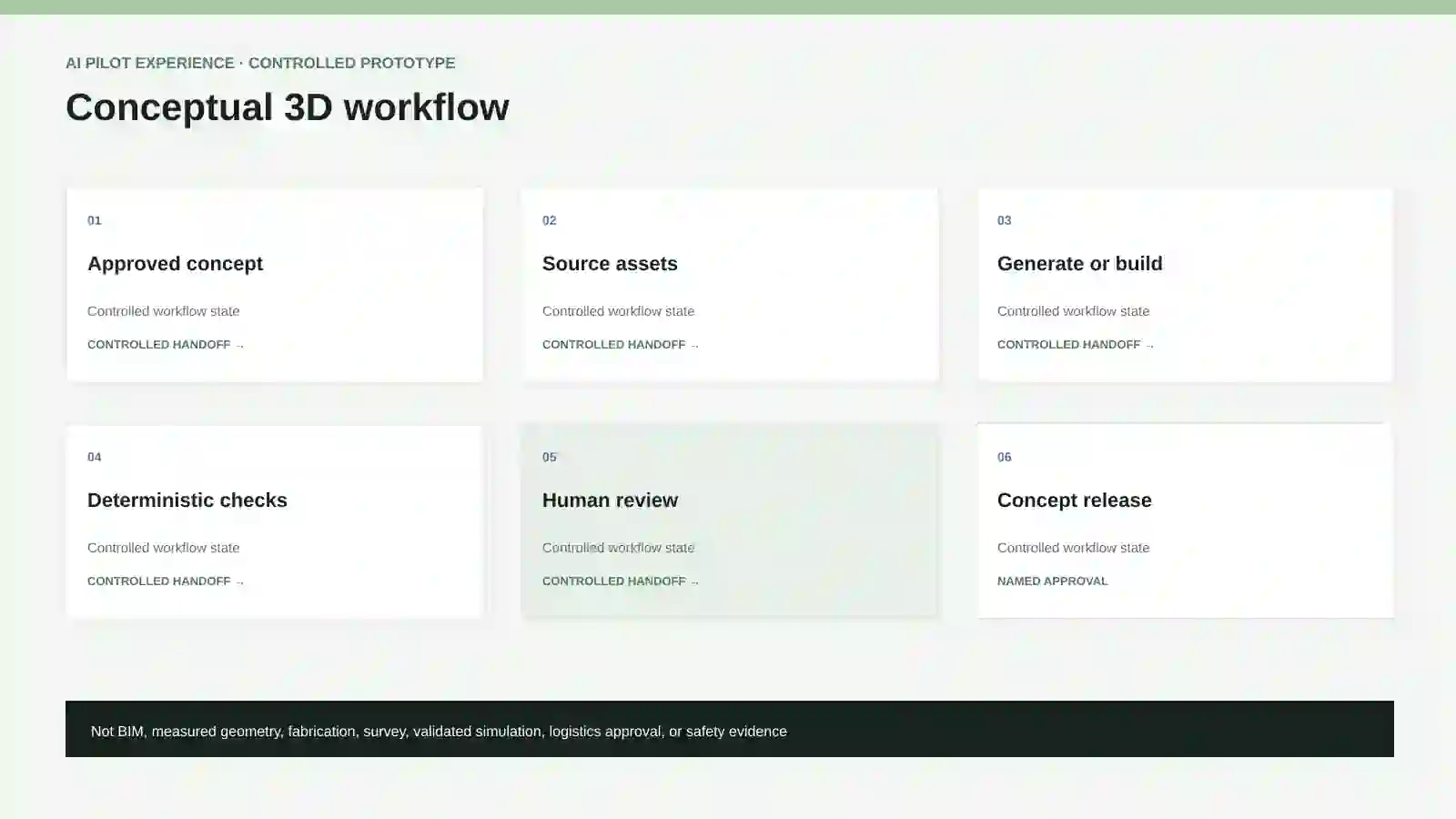
Approved inputs remain connected to preparation, deterministic checks, human review, acceptance, and release.
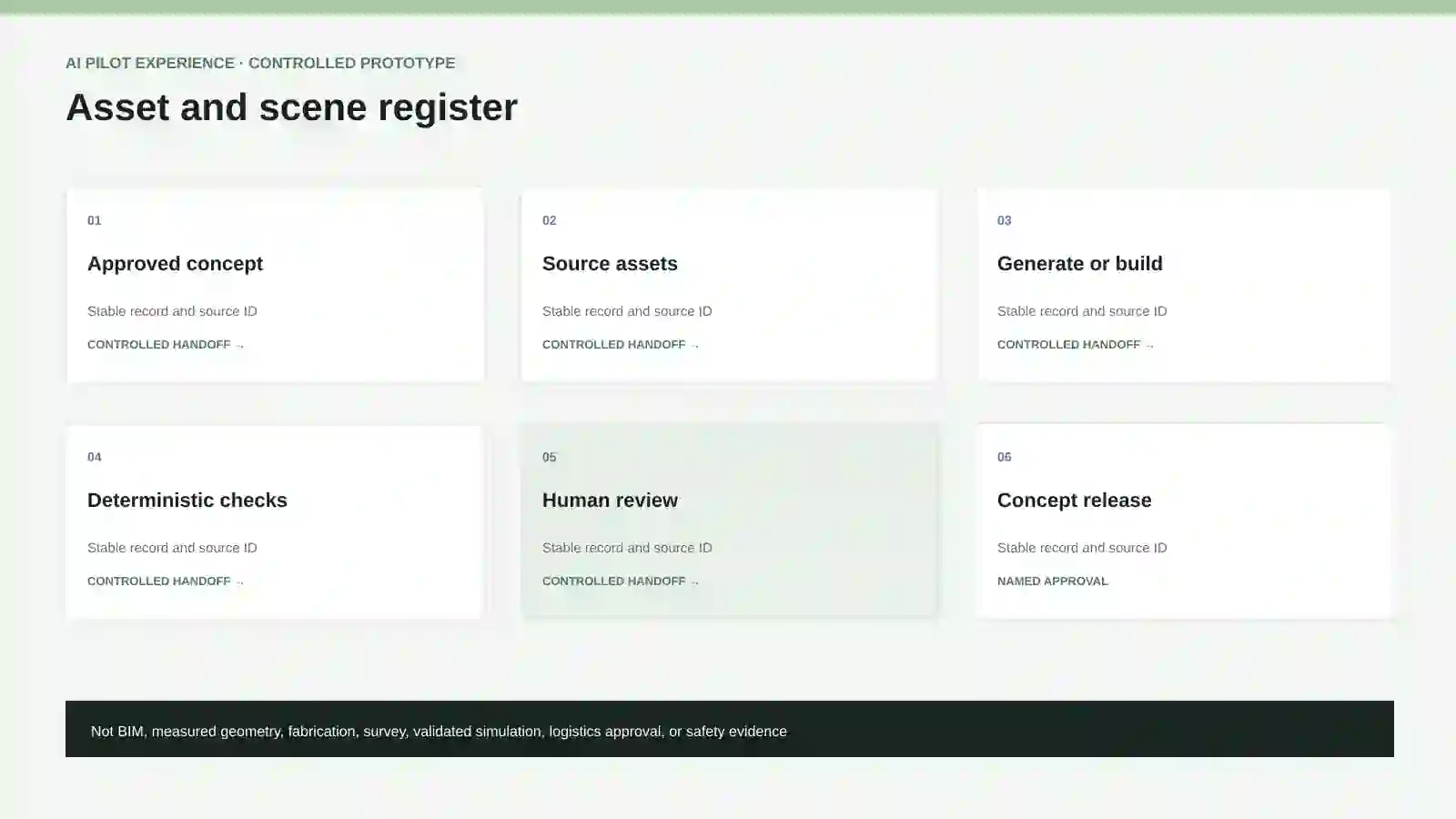
Stable source, run, output, version, evidence, correction, and review records remain visible.
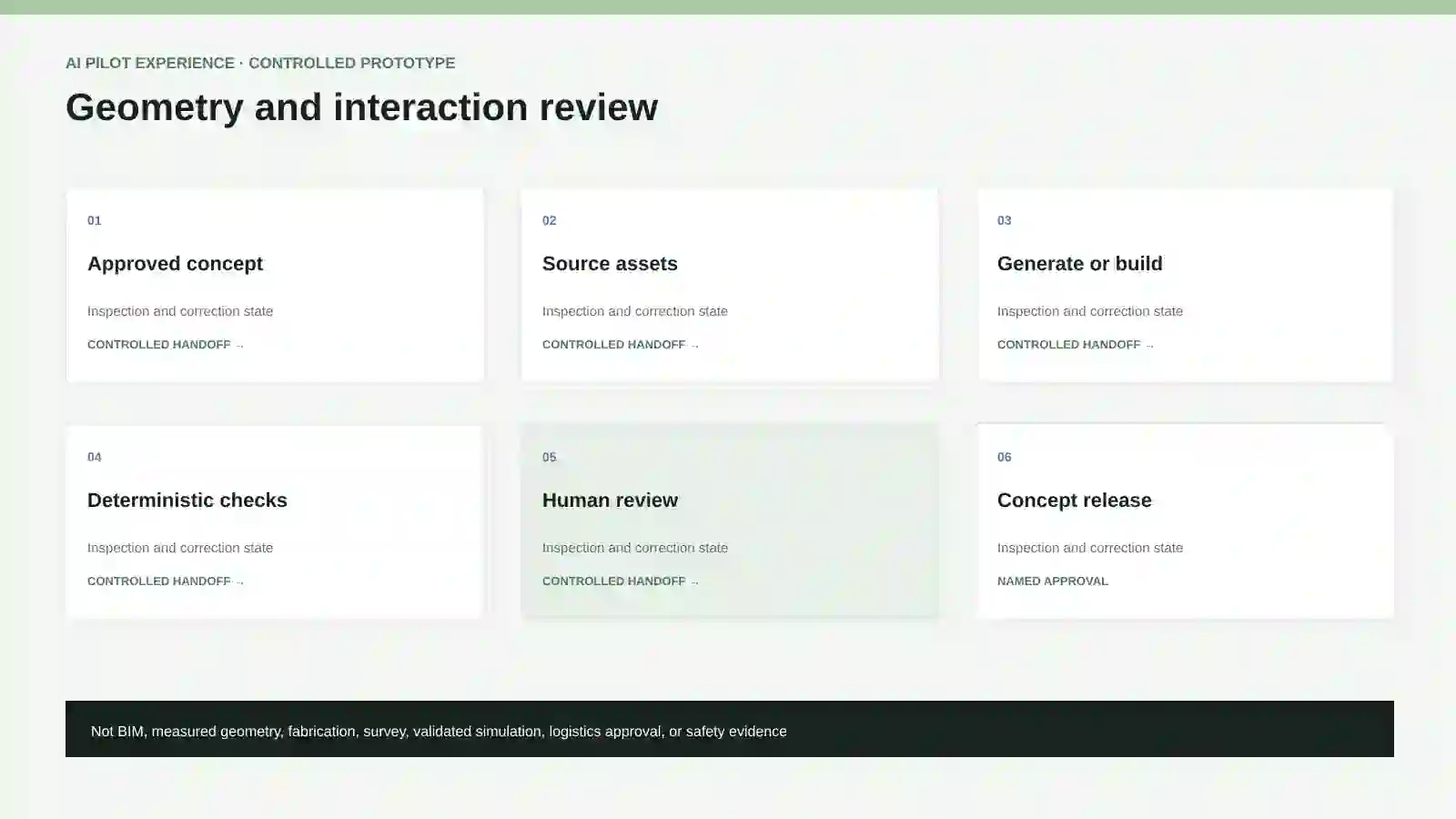
Reviewers inspect claims, actions, files, dependencies, geometry, behavior, and prohibited implications before acceptance.
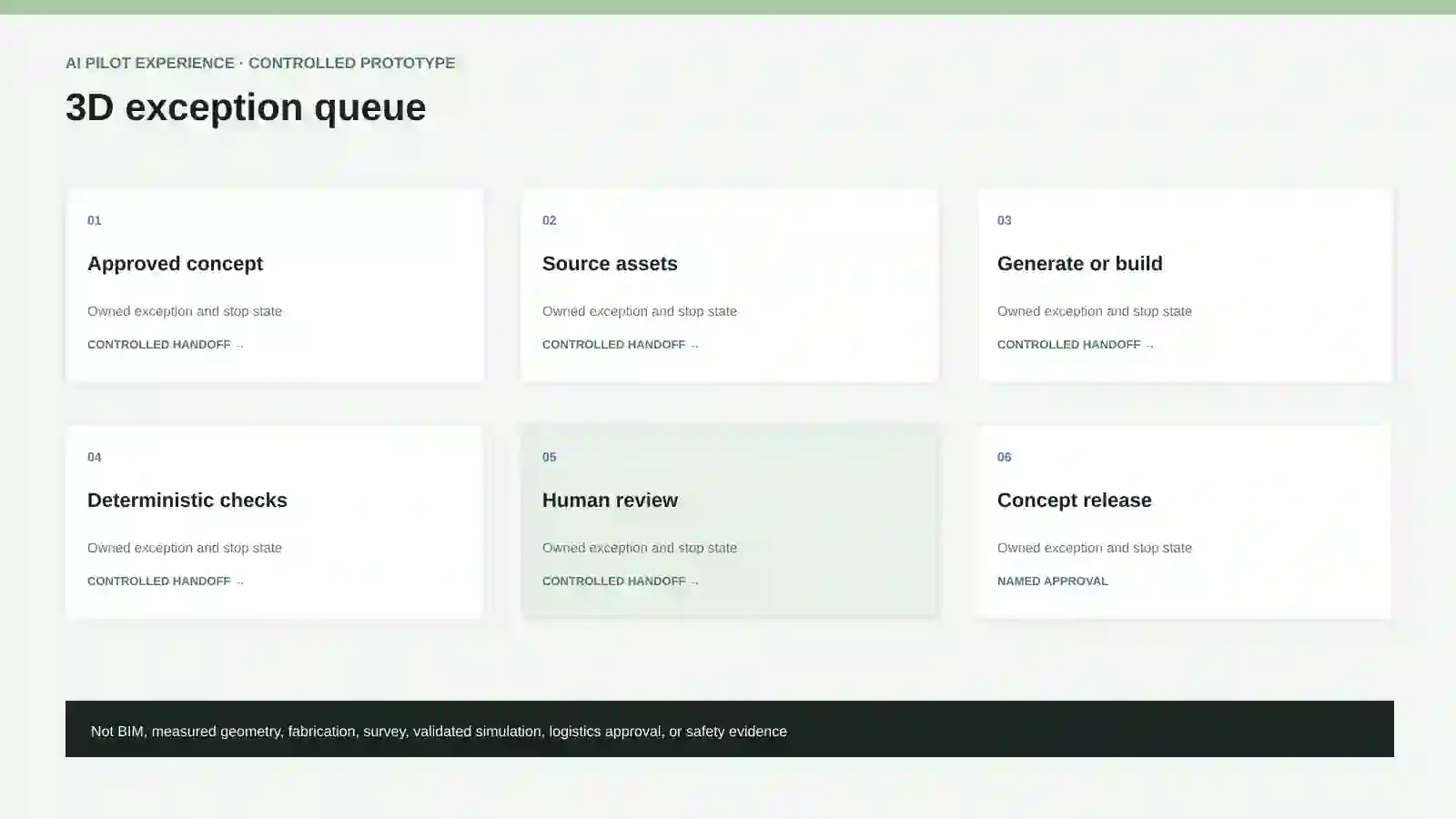
Uncertainty, failure, permission, security, rights, validation, and stop conditions receive named owners and states.
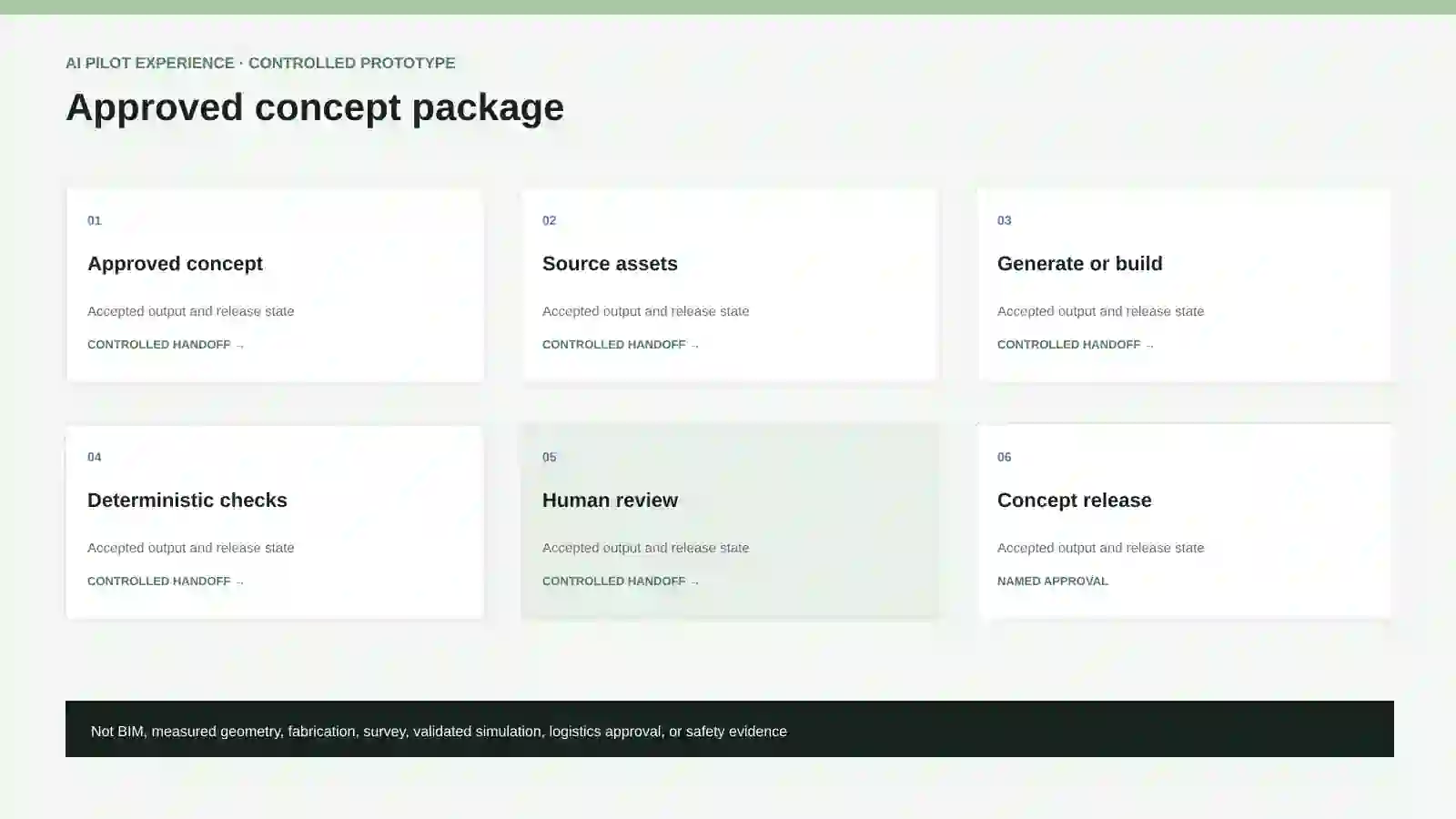
Only accepted outputs move to the approved audience or next controlled environment.
User journey
The interface can feel simple while the pilot preserves document identity, revision, permission, retrieval, uncertainty, and review evidence behind every result.
Define audience, purpose, object or environment, interaction, source references, rights, exclusions, conceptual label, and release owner.
Record identity, origin, licence, permission, scale status, coordinate status, people, brands, products, and permitted influence.
Choose generative asset, procedural Blender, Three.js, Godot, or controlled Unreal import by output, control, editability, tests, cost, and exit.
Record model, tool, version, settings, prompts, scripts, assets, units, hierarchy, transforms, materials, animations, collisions, and interactions.
Check files, parse, scene load, expected objects, naming, hierarchy, scale assumptions, transforms, materials, textures, animation, collision, and export.
Run bounded input, state, navigation, interaction, reset, performance, log, frame, and nonblank-render checks.
Inspect conceptual label, rights, visible fit, inferred geometry, behavior, unsafe implications, limitations, and release purpose.
Freeze source, manifest, build scripts, assets, exports, tests, captures, corrections, reviewers, version, audience, expiry, and withdrawal.
Technology options
The final selection records exact versions, licences, data handling, cost, limitations, replacement options, and the evidence required before use.
| Component | Examples | Pilot role | Boundary |
|---|---|---|---|
| Hunyuan3D | Verified Hunyuan3D model, service, checkpoint, dependencies, and licence | Prepare plausible conceptual mesh and texture candidates. | Generated geometry, hidden surfaces, scale, topology, materials, and identity are inferred rather than measured. |
| TRELLIS | Verified TRELLIS model, checkpoint, dependencies, licence, and environment | Prepare image-to-3D concept assets where plausible completion is acceptable. | A visually complete asset does not establish geometry, dimensions, products, BIM semantics, or construction truth. |
| Rodin | Current verified official Rodin route and terms | Remain an eligible conceptual asset candidate after identity, API, rights, privacy, cost, and evaluation review. | A demo or hosted output is not sufficient evidence for approved project use. |
| Blender and Three.js | Versioned Blender scripts, glTF export, Three.js scene, controls, tests, and captures | Assemble, edit, validate, export, and present conceptual assets with reproducible structure. | Deterministic assembly cannot make unmeasured source geometry accurate. |
| Godot or Unreal Engine | Controlled import, scene assembly, scripts or Blueprints, packaged interaction, logs, and captures | Create bounded interaction or presentation environments after validated import. | A running scene is not validated simulation, logistics approval, method approval, or safety evidence. |
Client-owned pilot outputs
Evaluation evidence
A fluent answer is not the acceptance unit. The pilot tests whether a reviewer can reach the controlling evidence efficiently and detect important failure.
Trace outputs to approved sources, actions, files, references, versions, and evidence.
Measure completion against frozen cases and acceptance criteria, including difficult and stop cases.
Record unauthorized action, false claim, security event, dependency issue, missing evidence, or prohibited use.
Measure inspection, correction, rerun, exception resolution, testing, and approval time.
Count outputs accepted by accountable reviewers, not processing completion or model agreement.
Include models, tools, compute, storage, preparation, testing, review, correction, monitoring, support, and replacement.
Cost drivers
Scaling factors
Use durable source, run, work-item, output, review, correction, acceptance, release, expiry, and withdrawal IDs with queues and checkpoints.
Constrain source, identity, credential, tool, repository, file, network, provider, destination, audience, and action scope.
Version models, APIs, browsers, tools, packages, dependencies, engines, operating systems, hardware, settings, tests, and policies.
Keep approved sources, prompts, scripts, records, assets, tests, evidence, corrections, and accepted outputs client-owned.
Measure queues, sessions, rate limits, rendering, build time, timeouts, retries, reviewer capacity, and cost.
Require separate security, integration, monitoring, recovery, service, rights, ownership, training, and deployment approval.
Cross-industry reuse
The reusable capability is permission-aware multilingual retrieval across versioned documents with citations. Each industry keeps its own source authority, terminology, consequence, retention, and qualified review.
Approved workflow sources, records, prototypes, media, references, tests, and review evidence.
Review: Named process, technical, security, subject, communications, legal, or release owner.
Approved workflow sources, records, prototypes, media, references, tests, and review evidence.
Review: Named process, technical, security, subject, communications, legal, or release owner.
Approved workflow sources, records, prototypes, media, references, tests, and review evidence.
Review: Named process, technical, security, subject, communications, legal, or release owner.
Approved workflow sources, records, prototypes, media, references, tests, and review evidence.
Review: Named process, technical, security, subject, communications, legal, or release owner.
Approved workflow sources, records, prototypes, media, references, tests, and review evidence.
Review: Named process, technical, security, subject, communications, legal, or release owner.
Approved workflow sources, records, prototypes, media, references, tests, and review evidence.
Review: Named process, technical, security, subject, communications, legal, or release owner.
Approved workflow sources, records, prototypes, media, references, tests, and review evidence.
Review: Named process, technical, security, subject, communications, legal, or release owner.
Approved workflow sources, records, prototypes, media, references, tests, and review evidence.
Review: Named process, technical, security, subject, communications, legal, or release owner.
Authority boundaries
Related paths
Continue into the operating, technical, security, and readiness guidance connected to this workflow.
Compare conceptual generation, editable environments, measured control, and construction authority.
Open pageSeparate plausible meshes, learned visible geometry, multi-view matching, and measured reconstruction.
Open pageUse bounded Blender and Godot tools, deterministic checks, and human-approved conceptual release.
Open pageKeep candidate visual matches separate from verified geometry or project state.
Open pageStart with one approved collection
Use general workflow information during the assessment. Do not submit confidential documents, passwords, API keys, authentication codes, or unrestricted system access.
Primary technical references
Plain-language route guide
Choose the smallest route that answers your next decision.
The formal service names remain useful for scope and contracts. The plain-language labels explain what each route actually does. These are alternatives, not four mandatory stages.
Operating-Layer Blueprint
Buyer question answered
What should we build, and where should the boundary be?
Typical input
One priority workflow, a named owner, current systems, representative records or files, and known failure points.
Output
A client-owned current-state map, target design, source inventory, implementation boundary, timeline, and fixed quote.
Bounded AI Agent Pilot
Buyer question answered
Can one specific AI-assisted task work reliably enough to justify more?
Typical input
One named task, approved sources and tools, representative cases, a human reviewer, and explicit stop conditions.
Output
A working pilot, evaluation evidence, cost and failure findings, review requirements, and a proceed, revise, or stop recommendation.
Single Workflow Implementation
Buyer question answered
How do we put one recurring workflow into controlled production?
Typical input
A defined trigger and completion point, accountable owners, approximately three core systems, rules, approvals, and test cases.
Output
Connected records, an operating view, integrations, a dashboard, acceptance testing, training, documentation, and handover.
Complete Operating Layer Implementation
Buyer question answered
How do we connect shared data and decisions across teams?
Typical input
Two to five related workflows, shared records, several departments or systems, an executive sponsor, and named operating owners.
Output
A phased operating layer with shared records, permissions, interfaces, integrations, reporting, controlled automation, training, and handover.
Still unsure which route fits?
Describe one broken workflow. The free assessment may recommend a Blueprint, pilot, implementation, a smaller discovery step, or no engagement.